They Live by Night (1948): Great but is it noir?

They Live By Night (1948)

This first feature from Nicholas Ray is a great film in every sense: tight and inventive direction, a sensitive script from Charles Schnee adapted from Edward Anderson’s novel “Thieves Like Us”, moody noir lighting and photography by George E. Diskant, and terrific performances from the two young leads: Cathy O’Donnell and Farley Granger.

From Steven H. Schueur’s book Movies On TV: “… possibly the most romantic crime film ever made. Granger and O’Donnell beguilingly portray an awkward young couple who are forced into becoming ‘lovers on the run’ … Their sympathetic relationship is depicted with sensitivity and touching detail, and the performances are remarkably intense…”

They Live By Night is a tragedy of Shakespearean dimensions and  transcends film noir. The genre is more crime melodrama with noir elements. We know the relationship is doomed to fail in violent tragedy, not because this is a film noir, but as an audience we have seen the crime movies that Hollywood churned out in the 30’s and early 40’s.

The two young protagonists have no way out as they do not have the maturity to make the decisions they are forced to make, and this is telegraphed by Ray at the film’s opening as sub-titles over a scene of the two lovers in the throes of gentle passion: ” … this boy and this girl were never properly introduced to the world we live in … “.

A masterpiece of 40s Hollywood cinema.
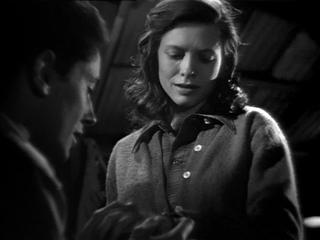
They Live By Night (1948)

The File On Thelma Jordan (1950): You always intend when you have to…

The File On Thelma Jordan (1950)

A married DA falls for a woman with a past

Thelma Jordan, the last film noir by Robert Siodmak is under-rated, and not because of Siodmak, whose lacklustre direction disappoints, but for the intelligent script and a bravura performance from Barbara Stanwyck, who plays Thelma, the woman with a past. I have deliberately not described her as a femme-fatale, as her character is multi-layered. She is trapped by her past but genuinely loves the DA who falls for her.

Noir determinism propels the story, which to a degree is melodramatic and contrived, but the pyschological elements and literate study of the dynamics of marriage and immaturity give the film more depth than most melodramas.

“Id’ like to say I didn’t intend to kill her, but when you have a gun, you always intend when you have to…”

The File On Thelma Jordan (1950)

Film Noir: Getting Started

As introductions to film noir, you can’t go past these two books, which are immensely readable and entertaining:

The Rough Guide to Film Noir (2007)
A great introduction that covers the genre from early
German expressionism to the latest neo-noirs, and highlights the movies to look out for.

Film Noir by Alain Silver (2004)
A general overview of film noir covering its most important themes with many rare stills. Among the films covered are: Double Indemnity, Kiss Me Deadly, Gun Crazy, Criss Cross, Detour, In A Lonely Place, T-Men, Out of the Past, The Reckless Moment, and Touch of Evil.

Scarlet Street (1946): Unrelenting Noir

Scarlet Street (1946)

The banal and squalid machinations of a floozey and her pimp, and a lonely older man’s infatuation lead to inevitable destruction

Scarlet Street, a classic film noir from Fritz Lang, shattered the closed romantic realism of Hollywood. It is unremitting in its pessimism. A dark mood and pervading doom are devastating in their intensity.

On the surface the streetwalker Kitty (Joan Benett) is the femme-fatale to Edward G. Robinson’s chump, Chris, with her manipulative and abusive no-good boyfriend as her ally. But Kitty is not an active protagonist. She is an empty-headed girl who thinks she is in love with her pimp, Johnny (Dan Duryea), and who is pushed all the way by his cheap stratagems to milk Chris for money.

Like the Swede in Criss Cross, Chris is not so much dealt a raw deal by fate but by his own naivety and irrational need to believe that Kitty loves him.

Scarlet Street (1946)

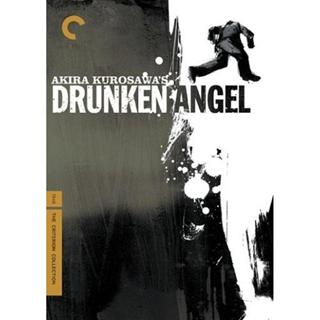
New Criterion DVD: Drunken Angel (aka Yoidore tenshi – Japan 1948)

Drunken Angel (Japan - 1948)

Drunken Angel is the first Kurosawa film starring Toshiro Mifune, and has a strong noir mood.

From the New York Times review of the new Criterion release 27 November:

The liner notes for this Criterion Collection release identify Drunken Angel as a film noir, and visually the movie often suggests the dark, dangerously askew world that Hollywood directors like Anthony Mann and Robert Siodmak were developing during the same period in their urban thrillers. But thematically “Drunken Angel” hails back to an earlier genre, the tenement dramas of the 1920s and ’30s… with their principled heroes and calls for social reform. For every virtuoso sequence – like the Mifune character’s climactic knife fight with his former gang boss, which ends with the two squirming in a pool of white paint – there is a bluntly didactic scene in which the doctor rails against feudal traditions and demands better hygiene.

Shimura and Mifune went on to play symbolic father-and-son-type pairs in several Kurosawa films, including the dazzling and more truly noir-flavored Stray Dog of 1949; their pairing seems to represent the fundamental division in Kurosawa’s work between high-minded sentiment and down-and-dirty action. (Criterion Collection, $39.95, not rated.)

Are Femme-Fatales Crazy?

Double Indemnity (1944)

Now that I have your attention.

I have just been googling with Google Scholar, and have been amazed at the wealth of film noir material this Beta service unearths. There are book extracts, complete books, and journal articles on many and varied aspects of the genre.

This brings me to the heading for this post. A very interesting article I uncovered comes from the Journal of Criminal Justice and Popular Culture: Personality Disorder And The Film Noir Femme Fatale by Scott Snyder of the University of Georgia:

Motion pictures can influence the development of both normal and disordered personality. The femme fatale of the film noir movies of the 1940s and 1950s is representative of several related personality disorders characterized by histrionics, self-absorption, psychopathy, and unpredictability. This report will examine how various societal factors occurring during World War II and its aftermath influenced the portrayal of these disordered females and how these depictions, in turn, reflected and influenced American culture at the time. Specific reference to issues of criminology, economics, gender, as well as feminist viewpoints on this phenomenon will be explored.

New Edition: Somewhere in the Night – Film Noir & the American City

Somewhere in the Night - Film Noir & the American City

Intellectually stimulating, thoroughly researched, and excellently written. Christopher writes with the mind of a scholar and the heart of a poet . Publishers Weekly

As Christopher observes . . . film noir is more than just a style – it’s a way of looking at the world, ‘a dark mirror reflecting the dark underside of American urban life’. – Michiko Kakutani, New York Times

Author Nicholas Christopher from this new and expanded edition of Somewhere in the Night: Film Noir and the American City:

I had seen film noirs before, with only the vaguest notion of what that term really signified (something dark and sinister?), and was attracted by their unique visual style, gritty, textured rendering of urban life, sharply drawn characters, and psychological complexity.

Starting with the classic Out of the Past, Christopher explores over 300 films noir by identifying the genre’s central motif: “The city as labyrinth is key to entering the psychological and aesthetic framework of the film noir.”.

More Film Noir Essays On-Line

The Big Combo

Some more interesting articles on Film Noir:

Film Noir’s Knights of the Road by John Belton

What Is This Thing Called Noir? by Alain Silver and Linda Brookover

10 Shades of Noir – Film Noir: An Introduction

Beyond the Golden Age: Film Noir Since the ’50s by C. Jerry Kutner

Dames in the Driver’s Seat: Rereading Film Noir by Deane R Coolidge

Orson Welles’s The Trial: Film noir and the Kafkaesque by Jefftrey Adams

Naremore and Noir: More than night by Lev Peter

Film Noir by Chris Routledge

Creatures of Darkness: Raymond Chandler, Detective Fiction, and Film Noir M S Peters

The Themes of Film Noir

Out Of The Past (1947)

These thumbnail interpretations from the book Film Noir by Alain Silver and James Ursini, are compelling renditions of the two essential themes of film noir:

The Haunted Past… In the noir world both past and present are inextricably bound… One cannot escape one’s past… And only in confronting it can the noir protagonist hope for some kind of redemption, even if it is at the end of a gun.

The Fatalistic Nightmare. The noir world revolves around causality. Events are linked… and lead inevitably to a heavily foreshadowed conclusion. It is a deterministic universe in which psychology… and even the structures of society… can ultimately override whatever good intentions and high hopes the main characters may have.

(p. 15)

Film Noir Essays On-Line

Brute Force The Maltese Falcon

These on-line essays are well-written and serious studies of the film noir genre:

No Place for a Woman: The Family in Film Noir by John Blaser

Film Noir’s Progressive Portrayal of Women by John Blaser

Film Noir & the Hard-Boiled Detective Hero by John Blaser

The Outer Limits of Film Noir by John Blaser

Nietzsche and the Meaning of Noir by Mark Conard

Dark Art by Chris Fujiwara

An Introduction to Neo-Noir by Lee Horsley

The Urban Landscape of Marxist Noir by Alan Wald

European Film Noir by K H Brown

Film Noir: Fear In The City by Bruce Hodsdon

Film Noir and the German-Hollywood Connection by Hyde Flippo

Film Noir as Deferred Action by Steffen Hantke

Rerunning Film Noir by Richard Schickel

Shades Among Shadows: The Murder Mystery, Film Noir, and Poetry by David Lehman

Lost in the Dark: The Elusive Film Noir by Patrick Ellis

The Cinematic Flaneur:
Manifestations of modernity in the female protagonist of 1940s film noir

by Dr Petra Désirée Nolan

Film Noir: You sure you don’t see what you hear? by Raffaele Caputo