Film Noir Digest: Dassin Retrospective

Jules Dassin: 1911-2008

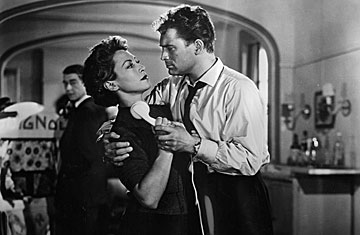
Rififi (1955)
Rififi (1955)

The New York Film Forum from March 27 to April 12 will host a Jules Dassin retrospective over 12 days.  March 31 mark the anniversary of Dassin’s passing. All of Dassin’s major features will be screened, including:

  • Brute Force (1947)
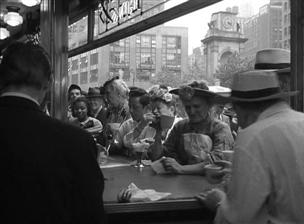
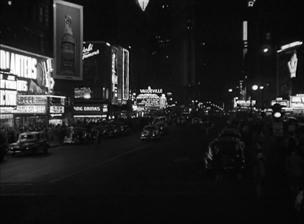
  • The Naked City (1948)
  • Thieves’ Highway (1949)
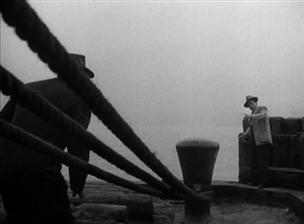
  • Night And the City (1950)
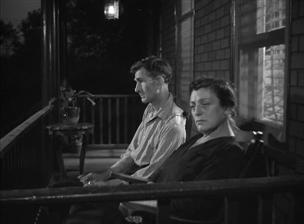
  • Rififi (1955)

Full program

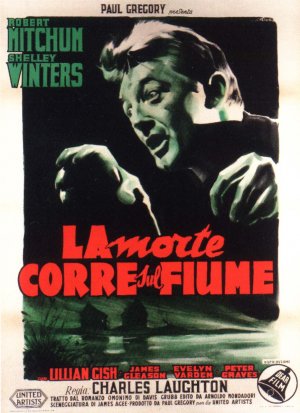
The Night of the Hunter (1955): Not Noir

The Night of The Hunter (1955)

In the only film directed by Charles Laughton, The Night of the Hunter, we have an example of the danger of applying a template approach to establishing a picture as a film noir. Expressionist lighting and criminality – tick. But these elements alone do not a noir make. The Night of the Hunter is a gothic tale of good versus evil: there is no ambivalence nor an inversion of traditional values. Good triumphs over evil and the story ends.

This is not to say Night of the Hunter is not a great film- it assuredly is.  A tale about a psychotic and murderous Southern preacher terrorising two children who know the whereabouts of a loot of stolen money is not without flaws, but great nonetheless. The compelling screenplay, first class acting, atmospheric cinematography, and an enthralling stylised mise-en-scene from a first-time director make it great.

The editing is not fluid however, and the narrative flow suffers. Whether this is due to cuts made after completion of the preview version is uncertain. In a new book on the making of the movie, author Jeffrey Coachman says Laughton re-interpreted James Agee’s script, which itself was based on the first novel of Davis Grubb. The original Agee script surfaced in 2003, and out-takes still exist and have been viewed by Couchman. Also certain studio scenes clash jarringly with on-location shots.  Scenes in a small town near the end of the film are so obviously set-bound, that the drama takes on a theatrical tone which weakens the ‘reality’ of the story. The ending steers perilously close to sentimentality, but is saved by the luminous acting of Lillian Gish.

Other weaknesses relate to a certain moral relativism. The opening scene that establishes the story arc is not as strong as it should be – a weak performance by Peter Graves as the father on-the-run with the loot is redeemed only by the young actors playing his children. The father is caught and hanged, after sharing his cell with the evil preacher played superbly by Robert Mitchum, who learns that the loot has been hidden but not where. In the cell, disturbingly, the father justifies his crime, and presumably the killing of two people during the robbery, by saying he did it so his kids would not suffer during the hard times of the depression. After the hanging, the hangman is shown going home to his wife and young children and his remorse is clearly established. Yet at the end he is shown gleefully anticipating the hanging of another man – the preacher. An elderly married couple who are friends of Grave’s widow and portrayed as the salt of the earth in their generosity and concern for the woman alone struggling to raise her two children, at the end of the movie are transformed into unhinged rabble-rousers screaming for revenge and leading a lynch mob.

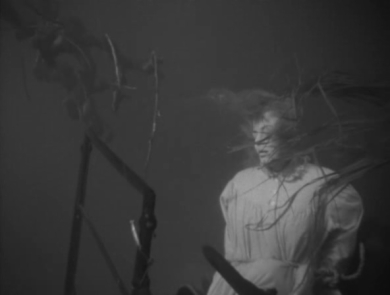
These weaknesses aside, there are stunningly elegiac scenes as the story unfolds. The most compelling is of the murdered widow still sitting upright in a car submerged in a river.

The Night of The Hunter (1955)

Dark Passage (1947): Not so dark

Dark Passage (1947)


I start viewing each Humphrey Bogart picture with a heightened anticipation, so strong is the Bogart persona in any movie.  Alas, Dark Passage is one of the few  Bogart pictures that disappoints.  Bogart goes through the motions of an escaped con on the run trying to clear himself of a murder charge, and Lauren Bacall look great, but for a thriller the whole affair is flat.

Based on a story by David Goodis, the screenplay relies on too many implausible coincidences.  The pedestrian direction of Delmer Daves (The Red House) constrains the  camera of cinematographer Sid Hickox (To Have and Have Not, The Big Sleep, Possessed, White Heat), and the Franz Waxman score is sadly undistinguished.  You don’t see Bogart’s face  for the first half of the movie, with the camera taking a point of view angle – it didn’t work in Lady in The Lake (1947) and it doesn’t work here.  The ending is lame, and the climax is ho-hum even though a dame falls out of the window of an apartment building!

Dark Passage (1947)

Deep focus outdoor scenes on the streets of San Francisco sustain visual interest, and the hilly topography results in some great angled shots.  Snappy lines of dialog enliven some static scenes, and there are interesting bit-roles that to a limited extent mitigate the film’s overarching weaknesses.  Agnes Moorehead is entertaining as a closet psychopath, but her camp characterisation is out-of-place in an otherwise earnest scenario.   A veteran bit-player with an  expressively craggy visage, Houseley Stevenson, is great as an eccentric  bootleg plastic surgeon.  Tom D’Andrea as a helpful cab driver,  Clifton Young as a small-time hood turned blackmailer, and  Tory Mallison as Bogart’s only friend, contribute immensely in roles that are pivotal to the story.  To give Daves, who adapted Goodis’ novel, due credit, the taxi cab scene is great – with Bogart’s “old” face in shadow in the back seat working so much better than the POV gimmick.

As for Dark Passage being a film noir, I suppose at a stretch you could say that there is an underlying theme of entrapment, but there are no noir atmospherics or motifs.

Shock (1946): The Killer Shrink from Frisco!

Shock (1946)

Shock is a perverse b-thriller noir from 20th Century Fox. So traumatised is a young married woman after surreptitiously witnessing a murder that she lapses into catatonia. The shrink charged with her care in the sanatorium is the killer. An enticingly preposterous story with a super-suave performance by a clean-shaven Vincent Price as the shrink, and a smouldering turn by a 30-something Lynn Bari as his girl-friend and erstwhile femme-fatale.  Atmospherically shot by Joseph MacDonald (The Dark Corner, Call Northside 777, Panic in the Streets, Niagara) with fluid direction by Alfred L. Werker (He Walked by Night).

The highlight is when a psychotic patient escapes from his room in the sanatorium on a stormy night and causes havoc. It is a brilliantly executed sequence with a bravado performance by a veteran uncredited bit-player from the silent era, John Davidson.

Shock (1946) Shock (1946)

A camp delight.

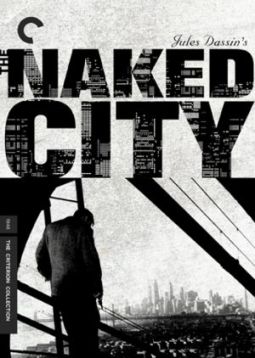
The Naked City (1948): “There are 8 million stories… “

The Naked City 1948

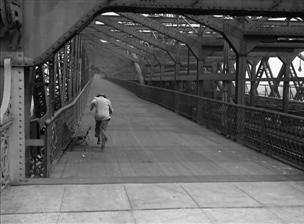
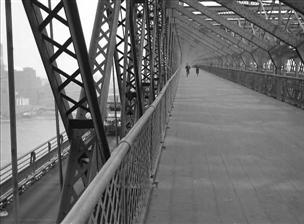
Jules Dassin’s third major feature, The Naked City, is legendary for its cine-verite portrayal of the city of New York: on the streets and in deep focus, with a stunning climax on the Williamsburg bridge.  Deservedly, in 1949 William H. Daniels received an Academy Award for Best Black-and-White Cinematography and Paul Weatherwax  an Oscar for Best Film Editing.  Miklós Rózsa and Frank Skinner contribute a solid musical score.   A voice-over narration by producer, Mark Hellinger, who died before the movie’s release, follows the story of a murder investigation by NY homicide cops.

The Naked City 1948

The Naked City 1948

The story is well-paced with the who-dun-it and why tension elegantly elaborated. While the cast is solid and the dialog has a sardonic edge, the picture is essentially a police procedural of little irony or depth, and with a ‘magazine expose’ feel . Once we are into the story, Hellinger’s voice-over becomes tedious, and by the climax downright annoying, as he starts addressing a hood on the run. Thematically, there is little to distinguish The Naked City as a film noir. We have to wait for Thieves Highway the following year to begin to appreciate Dassin’s greatness as a noir director.

The Naked City 1948

thenakedcity76-_sm

It is the city of New York and its people that hold our attention, and the several bit-portrayals of people going about their lives are truly engaging. The final scene where a street-sweeper in profile scoops up yesterday’s papers from the gutter and moves on into the New York night gives an arresting hard-bitten closure to the story behind the murder and to the film itself.

The Naked City 1948

The Naked City 1948

The B Connection: Lewton, Renoir and Truffaut

Desperate

In a book I am currently reading, The Early Film Criticism of François Truffaut by Wheeler Dixon (Indiana University 1993), there is an interesting section that deals with the obvious influence on Truffaut of Hollywood b-movies, particularly film noir.

According to Dixon, Truffaut and even his mentor, Jean Renoir, preferred b-features over a-productions. In a 1954 interview, Renoir was quite emphatic:

I’ll say a few words about Val Lewton, because he was an extremely interesting person; unfortunately he died, it’s already been a few years. He was one of the first, maybe the first, who had the idea to make films that weren’t expensive, with ‘B’ picture budgets, but with certain ambitions, with quality screenplays, telling more refined stories than usual. Don’t go thinking that I despise “B” pictures; in general I like them better than big, pretentious psychological films they’re much more fun. When I happen to go to the movies in America, I go see “B” pictures. First of all, they are an expression of the great technical quality of Hollywood. Because, to make a good western in a week, the way they do at Monogram, starting Monday and finishing Saturday, believe me, that requires extraordinary technical ability; and detective stories are done with the same speed. I also think that “B” pictures are often better than important films because they are made so fast that the filmmaker obviously has total freedom; they don’t have time to watch over him.

So all you b-movie fans you are in hallowed company!

[Cross-posted at Another Cinema Blog]

Nora Prentiss (1947): Turbo-charged Noir Melodrama

Nora Prentiss (1947)

“You had something on him
What was it?

Doctor Talbot was a respected member of the community
He lived in the same house on the same street
Year after year
Every one admired him, looked up to him
But then something happened, he did something
Something that gave you a hold over him
What was it? What was he hiding? What did he do?

According to the Motion Picture Herald, of the 298 top-grossing films for 1945-56, only nine were noirs (Spicer, Film Noir, 2002 ,p41). One of those movies was Nora Prentiss.  As a Warner Bros a-feature it ran for 111 minutes and though largely studio-bound, featured top-draw production values.

Though slow in the beginning, Nora Prentiss, once the noir scenario is established, develops into a dark melodrama of tortured loyalties and thwarted passions.  Steady direction from Vincent Sherman (The Damned Don’t Cry, The Unfaithful, The Garment Jungle) with the fluid camera of James Wong Howe,  and a brilliant pulsating score from Franz Waxman, deliver classy Hollywood melodrama.  The lovely Ann Sheridan as always is truly engaging as Nora, and the rather stolid Kent Smith despite his limitations delivers a solid performance as the noir protagonist.

Nora Prentiss (1947)

A doctor, Richard Talbot,  living the “father-knows-best” dream in a San Francisco suburb is catapulted into the dark chasm of noir angst, when he falls for cabaret singer Nora.  The film opens with a twist on the classic noir flashback narrative.  A guy who we only see in profile has been arrested for the murder of  the doctor and refuses to talk even to his lawyer. We move from the suspect in his holding cell to a delightful Spring morning in a Frisco bungalow  where a comfortable upper middle-class family sits down to breakfast.

Dr Talbot is settled in a successful career and lives a scheduled orderly passionless existence.  One evening a young woman is knocked over by a car as the doctor is leaving his surgery for the evening – he goes to her aid – enter a sassy uninhibited Nora.  Richard is free the for weekend, with his wife and kids away – you get the picture.  The affair blossoms into love, but Richard hasn’t the resolve to leave his wife. One evening a very ill patient arrives at the surgery after-hours. The camera and lighting have gone to noir: an irrevocable decision born of desperation unleashes a maelstrom of dark deeds, deceit, and tragedy. Fate is truly majestic in retribution with a twist that seals the good doctor’s doom.  As bleak an ending as any noir before or since.

Nora Prentiss (1947)

What’s a dame like you doing in a movie like this?

It was not for want of viewing, that I have  not reviewed a movie here for 10 days.  At least two movies which while not recognised as noirs, promised significant noir elements, but in the watching were both problematic and revealing.

They Made Me A Criminal 1939

I am always a sucker for John Garfield.  One of his early features from 1939 was a boxing melodrama for Warner Bros, They Made Me a Criminal, directed by, yes, Busby Berkeley.  A young boxing champ played by Garfield who likes booze and broads, is framed by his manager for the death of a reporter.

They Made Me A Criminal 1939

The first 20 minutes are deliciously taut and noirish. The movie opens with the last rounds of a fight in front of a wild crowd. The action shifts to the dressing room after Garfield’s knockout win, where his volatile character is revealed. Cut to his apartment where he is boozing and cavorting with a young and very nubile Ann Sheridan. One thing leads to another, a man is dead, and Garfield is on the run from a murder rap. His manager has beat it in Garfield’s car with Sheridan, and the boxer’s wallet and watch. But they don’t get far – after being chased by the cops they crash into a tree with the girl’s screams extinguished by a fireball as the car explodes. Then Garfield, after being gypped by his shyster lawyer, is on the skids and riding freight trains. We are now in hokum territory with Garfield ultimately redeeming himself and home free.

Lucky Nick Cain

Next up, an aging George Raft and a sexy Colleen Gray in a 1950 British Romulus production, Lucky Nick Cain (aka I’ll Get You for This), a boys-own thriller shot on location in Southern Italy, co-starring Enzo Staiola  (who played the young son in Bicycle Thieves) as a street-kid.  Raft plays an American gambler who is framed for the murder of a T-Man by hoods running a counterfeiting operation using a hotel-casino as a front. Gray looks great but isn’t asked to do much.  Stock-stuff you might say, and you would be right. But this movie has some distinguished noir elements.

Lucky Nick Cain

Lucky Nick Cain

The director Joseph M. Newman (711 Ocean Drive and Dangerous Crossing) and expatriate Czech cinematographer Otto Heller (They Made Me a Fugitive) turn a small Italian town into a noir locale of exquisite mystery, peril, and sinister shadows.

Lucky Nick Cain

Lucky Nick Cain

As if this was not enough, there are two out-of-left field scenes that are richly erotic and camp.  In the first scene, Raft confronts a sultry blonde femme-fatale boisterously over-played by bit-player Greta Gynt, and engages in some lurid gun-play.  Later in the picture, Colleen Gray has been arrested and is interrogated by a towering blonde female butch prison guard in a gothic women’s prison, while the guard is ragged by some b-girls in another cell. When Raft rescues the girl, the guard is placed in the same cell as the b-girls…

Lucky Nick Cain

Lucky Nick Cain

All-in-all, not quite the stuff of noir dreams, but not a bad double-feature.

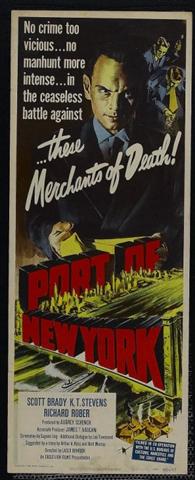
Port of New York (1949): Cut-out Cops

Port of New York (1949)

An 82-min programmer from Eagle-Lion, Port of New York, was one of the first verite-style drama-cum-newsreel movies about crime fighting, which followed the classic noirs of the 40s, almost as a reactionary backlash against ambivalence, and which could be labelled as anti-noirs.  Documentary footage blended with an authoritative voice-over and a screenplay where govt officers pursue felons: brutal violence, thinly drawn characters, criminality brought to justice, and no shading or complexity.

Port of New York is interesting because of its on the street locales and notable performances.  Perversely, the cops are played as cut-outs and forgettable, while the hoods inhabit their roles with a depth that belies the earnestness of the script.   A young Yul Brunner in his first screen role is accomplished as a cunning but elegant crime boss dealing in narcotics. He does his own dirty work and kills with psychotic empathy to a recurring classical score. Arthur Blake, an actor who ever only played bit parts in a handful of b-pictures, is great as a small-time hood who is using as well as dealing, and goes cold turkey while being held by the cops.

Competent direction from Laslo Benedek and above-average camera-work from noir veteran George Diskant.

A solid-b. Great poster!

Macao (1952): “You’re up early for a loser”

Macao (1952)

It was made under the supervision of six different men in charge… and instead of fingers in that pie, half a dozen clowns immersed various parts of their anatomy into it. ”
– Director Josef Von Sternberg in his autobiography Fun in a Chinese Laundry

What a pastiche! A boring stupid movie that has the fingerprints of RKO studio boss Howard Hughes all over it. Hughes didn’t like Von Sternberg’s first cut and had Nicholas Ray direct retakes and additional scenes.  Obviously neither man had any real interest in the project.  How anyone can include it in the noir canon has me beat.

The whole debacle is an excuse to get Mitchum and Russell on screen together, for some rather lame he loves me she loves me not antics in a preposterous mistaken identity cum gambling racket story set in of all places, Macao.  The two plodding chase scenes are about as thrilling as it gets.  Who’s to blame? Von Sternberg or Ray?  Let’s say both.

Though I think a tawdry tantrum scene with Russell exposing a full leg is most certainly a Von Sternberg touch.

Macao (1952)

Gloria Grahame does add a touch of class in a small role as a gangster’s mole, but even she begged her then divorcing husband Ray, to cut her out of the picture completely.

Try it only after too much cheap rye…