Blog Feed

Double Indemnity: The Unseen Ending

Double Indemnity (1944)

The final draft of the screenplay of Double Indemnity (1944) by Billy Wilder and Raymond Chandler in the Motion Picture Academy Library in Los Angeles – download from here – includes a final prison execution chamber scene and a line of dialog that was spoken by Walter Neff, just after he said “I love you.” to Barton Keyes. With sirens wailing in the background, Neff says: “At the end of that trolley line, just as I get off, you be there to say good bye. Will you, Keyes?” The story then shifts to the execution.

This sequence was filmed but cut (by the studio?) from the production release.

Double Indemnity (1944)

James Naremore in his 1998 book on film noir, More than Night: Film Noir in Its Contexts, offers this penetrating analysis and critique:

… the execution described in the longest version of the script greatly increases our sympathy for Walter, all the while raising questions about the criminality of the state. It also provides a tragic recognition scene for Keyes, who is shaken out of his moral complacency. This last point is especially important, because Keyes functions as a representative of the insurance company. Although he approaches his work with the intuitive flair of an artist and the intellectual intensity of a scientist, he remains a loyal agent of industrial rationality—a talented bureaucrat who, in effect, has helped to create the office building, the drive-in restaurant, the supermarket, and all the other landmarks of modern Los Angeles that the film relentlessly criticizes… One of the many virtues of Wilder’s original ending is that this complex, brilliantly acted character would have been made to confront his inner demon and to experience poetic justice. Keyes would have been brought face-to-face with the culminating instance of instrumental reason, the “end of the line” for industrial culture: the California gas chamber… For the original version of Double Indemnity, Paramount built an exact replica of the [San Quentin]  gas chamber, depicting it as a modern, sanitized apparatus for administering official death sentences. At considerable expense, Wilder photographed the step-by-step procedure of execution, emphasizing its coldly mechanical efficiency. There was no blood, no agonized screaming, and, for once in the movie, almost no dialogue. Much of the sequence was shot from Walter’s point of view, looking through glass windows at the spectators outside the chamber—an angle creating a subtle parallel between the chamber and the “dark room” of a movie theater. When the fatal pellets dropped, clouds of gas obscured the windows, and we could barely make out Keyes standing amid the witnesses, turning his head away. Soon afterward, a doctor entered the chamber to pronounce Walter dead. According to the script, the original film ended as follows:

… All the witnesses have now left except Keyes, who stares, shocked and tragic, beyond the door. The guard goes to him and touches his arm, indicating to him that he must leave. Keyes glances for the last time towards the gas chamber and slowly moves to go out. CORRIDOR OUTSIDE THE DEATH CHAMBER CAMERA SHOOTING IN THROUGH THE OPEN DOOR AT KEYES , who is just turning to leave. Keyes comes slowly out into the dark, narrow corridor. His hat is on his head now, his overcoat is pulled around him loosely. He walks like an old man. He takes eight or ten steps, then mechanically reaches a cigar out of his vest pocket and puts it in his mouth. His hands, in the now familiar gesture, begin to pat his pockets for matches. Suddenly he stops, with a look of horror on his face. He stands rigid, pressing hand against his heart. He takes the cigar out of his mouth and goes slowly on toward the door, CAMERA PANNING with him. When he has almost reached the door, the guard stationed there throws it wide, and a blaze of sunlight comes in from the open prison yard outside. Keyes slowly walks out into the sunshine, a forlorn and lonely man.

Until someone rescues this scene from the Paramount vaults, we will never know if it is superior to the current version, and even then there may be room for debate. One thing, however, is clear: Keyes’s lonely walk out of the prison would have thrown a shadow over everything that preceded it. It was not until Sunset Boulevard and Ace in the Hole that Wilder would produce such a savage critique of modernity. Although the released version of his famous thriller remains an iconoclastic satire that challenges the censors, it is a lighter entertainment than the original and a much easier product for Hollywood to market. (According to the Paramount press book, photographs of Barbara Stanwyck in her wig and tight sweater were circulated to American soldiers overseas, and Edward G. Robinson’s performance enabled the studio to obtain a tie-in from the Cigar Institute of America.) No matter how much we admire the film that was exhibited in 1944, the form of cinema that the French described as noir is probably better exemplified by another Double Indemnity, which we have yet to see.

The rare (Spanish?) poster featured at the top of this post features a rendering of Neff from the gas chamber scene. Note also the nightmarish imagery which has a definite surrealist quality, making this perhaps one of the most intriguing film noir posters ever. I am unsure of its origin or the artist. Perhaps a reader of filmsnoir.net can help in tracing its origin? The signature seems to be “Lopez Riem”?
Noir Novelists in Hollywood

Noir Novelists in Hollywood: An Overview
Free Seminar with Film Scholar James Naremore
Thursday, April 10, 2008 @ 6:00 p.m.
Chicago Public Library
400 S. State Street
312-747-1194

Scholar and film noir writer, James Naremore, professor emeritus of film studies at Indiana University-Bloomington, and author of More than Night: Film Noir in Its Contexts, explores how the work of authors such as Raymond Chandler, Dashiell Hammett and James Cain was adapted by Hollywood. This is a One Book, One Chicago event.

Charleton Heston Dead at 84

Touch Of Evil (1958)

Actor, Charleton Heston, died today. He starred alongside director Orson Welles in the last great noir of the classic cycle: Touch of Evil (1958).  Heston’s first role  was as a crooked gambler in the crime thriller cum noir Dark City (1950).

Night And the City (1950): A Near Perfect Noir

Night And the City 1950Night and the city.
The night is tonight, tomorrow night…
or any night.
The city is London.

This anonymous voice-over introduces Jules Dassin‘s Night and the City (1950), which has to be one of the great noirs: a near-perfect work.

Dassin crafted a mesmerising study of thwarted ambition and tawdry betrayal into a dark existential journey of the human soul, played out in the dives and night-clubs of post-war London fashioned as the quintessential noir city. This is not a b-movie, the production values are high, and Dassin has total command of his mise-en-scene.

But the achievement is not Dassin’s alone. There is also a literate script by Jo Eisinger, wonderful expressionist photography from Mutts Greenbaum, who cut his teeth in the German silent cinema, and deeply moving portrayals by the major players. Richard Widmark’s performance is frenetic and real, and the soft counterpoint of an achingly elegant turn by Gene Tierney as his girl, transubstantiate Harry’s demise into the stuff of tragedy. Each supporting role is vividly drawn by an excellent ensemble cast.

You know Harry Fabian is doomed from the start: a dreamer of wrong dreams and sympathetically amoral, he is no match for fate and the immoral traffickers of wrestlers and cheap champagne, who plot his destruction. He is a hustler yes, but not in the same league as the big guys, the “businessmen” whose greed has no bounds and whose actions are never tempered by remorse. Harry thinks he knows all the angles, but he is not ruthless enough for that.

Harry. Harry.
You could have
been anything.
Anything.
You had brains…
ambition.
You worked harder
than any 10 men.

But the wrong things.
Always the wrong things.

This slideshow requires JavaScript.

Towards a Definition of Neo-Noir

Blogger cineycrispetas has posted an excellent essay on neo-noir on his Géneros cinematográficos:

What defines then the noir spirit? Could it be the “cynical and the pessimistic tone […] the darker side of human condition, modern fables that highlight the dangers of alienation, the fragmentation of society, the breakdown of human interaction, the debasement of love, the beguiling power of wealth, the corruption of government, and mankind’s inherent propensity for inertia and impotence”… Is noir “spirit” allowed to evolve, mutate as the environment in which it exists changes? It is also entitled to refer and quote to the noir canon since contemporary audiences are not only conscious of the legacy of noir but also amenable to noir references in modern perspectives and environments?

Progressive Origins of Film Noir

Force Of Evil

Force of Evil (1948)

With the passing of Jules Dassin, it is worth noting that social criticism in early film noir is largely ignored by most contemporary noir pundits and populists.
James Naremore in his 1998 book on film noir, More than Night: Film Noir in Its Contexts, mounts a strong argument for the leftist origins of film noir (my emphasis):

…most of the 1940s noir directors — including Orson Welles, John Huston, Edward Dmytryk, Jules Dassin, Joseph Losey, Robert Rossen, Abraham Polonsky, and Nicholas Ray—were members of Hollywood’s committed left-wing community. Among the major crime writers who provided source material for dark thrillers, Dashiell Hammett, Graham Greene, and Eric Ambler were Marxists to one degree or another, and Raymond Chandler and James M. Cain were widely regarded as social realists. Among what Robert Sklar has described as the major “city boy” actors of the period, Bogart and John Garfield, who played veterans of the Lincoln Brigade in Casablanca and The Fallen Sparrow (1943), were icons respectively of liberalism and leftist radicalism. Meanwhile, the credits for noir screenplays usually included such names as Albert Maltz, Howard Kotch, Waldo Salt, and Dalton Trumbo, all of whom were eventually blacklisted, and these screenplays were often based on literature by such politically engaged figures as Kenneth Fearing, Vera Caspary, Daniel Fuchs, and Ira Wolfert.

There is good reason to conclude that the first decade of American film noir was largely the product of a socially committed fraction or artistic movement in Hollywood, composed of “Browderite” communists (after Earl Browder, head of the American Communist Party) and “Wallace” Democrats (after Henry Wallace, the radical vice president and potential successor to Franklin Delano Roosevelt). This movement is somewhat downplayed by Borde and Chaumeton, who emphasize the anarchic, antisocial qualities of noir and who initially argued that the form died off with the rise of neorealist policiers in the late 1940s. The Cahiers critics and subsequent American commentators tended to depoliticize noir even further, thereby obscuring the fact that many of the best thrillers of the 1940s and early 1950s were expressions of the Popular Front and the radical elements of the New Deal. A more accurate account would show that although the noir category viewed as a whole has no essential politics, it has formative roots in the left culture of the Roosevelt years—a culture that was repressed, marginalized, and virtually extinguished during the postwar decade, when noir took on increasingly cynical and even right-wing implications. During the 1950s, the congressional hunts for communists in Hollywood were themselves based on a kind of noir scenario and were crucially important to the history of American crime movies, affecting not only their politics and their doom-laden atmosphere, but also their reception by later generations. (pp 104-105)

Jules Dassin (1911-2008): Rebel With a Cause

Night And the City 1950
Richard Widmark in Night and The City (1950)

Jules Dassin, one of the great noir directors, died in Athens overnight.

Born in Middletown, Connecticut in 1911, Dassin’s ground-breaking noirs of the late 1940’s rank among the great films noir:

Brute Force (1947)
The Naked City (1948)
Thieves’ Highway (1949)

A committed leftist, Dassin was blacklisted by the HUAC and left the US before the final cut of Thieves Highway was made. In London he made in 1950 Night and the City, another classic noir starring Richard Widmark, in perhaps his best dramatic role.

In Europe, Dassins’ attempts to work as a director were vengefully thwarted by Hollywood mogules until 1955, when penniless and in despair he was offered Du rififi chez les hommes (1955) [“Rififi”], which he crafted into the greatest french noir of the 50’s. Dassin also played the Italian safe-cracker in the picture. The movie, which featured the legendary 32 minute heist scene filmed in almost total silence, desevedly won him the best director prize at the Cannes Film Festival, where he met his second wife, the Greek actress Melina Mercouri, who died in 1994.

An interesting Salo.com interview with the 89-yo Dassin in August 2000 by Michael Sragow offers some background on Dassin’s attitudes to his early noir work.

Check out my reviews of Thieves’ Highway, Rififi and Night And the City.

His major noir releases are available as Criterion DVDs, and these essays on the Criterion web-site are elegant dissertations on Dassins’ artistry:

Brute Force: Screws and Proles by Michael Atkinson Here we are in the dark territories again, the republic of bitternesses and bile known as noir, squaring our jaws against an amoral universe and roaming the rain-wet, lightless American City as if it were a circle of the inferno where backstabbers, goldbricks, and unfortunates march in closed patterns and puzzle >>>

The Naked City: New York Plays Itself by Luc Sante In 1945 Arthur Fellig, known as Weegee, a canny and gifted tabloid newspaper photographer, did something unprecedented: he assembled some of his best shots, of corpses and fires and arrests and crowds and spectacles, and made them into a book, published in hardcover—this at a time when photography books were still >>>

Night and the City: In the Labyrinth by Paul Arthur Within film noir’s unparalleled roster of resonant titles—Kiss of Death, Out of the Past, Where Danger Lives, to name three—none is more emblematic or iconographically cogent than Night and the City. Juxtaposing two of noir’s essential, virtually ontological qualities, the title of Jules Dassin’s underrated elegy for a self-annihilating hustler reminds >>>

Rififi: Love Made Invisible by Jamie Hook In 1955, Jules Dassin, an American director in exile in Paris, made this flat-out perfect piece of cinema. The film came as a redemption for Dassin: a one-time promising young director cranking out B-movies under an MGM contract (“They were awful. It was just plain unhappiness and embarrassment,” he later said >>>

Thieves Highway: Dangerous Fruit by Michael Sragow Like the movie’s rattletrap trucks lurching down the highway as they carry way-too-heavy loads, the characters in Jules Dassin’s brilliantly volatile Thieves’ Highway struggle under psychological and moral baggage until they can lay their burdens down. Working from a novel and script by A.I. Bezzerides, Dassin made this swift, fluid melodrama >>>

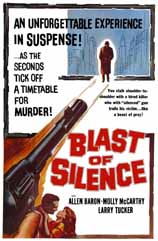
Blast Of Silence (1961): Hidden Noir

Blast Of Silence (1961): Hidden Noir

Criterion Confessions blog has an interesting review of a recent DVD release of Blast of Silence, a little known low-budget independent production from Allen Baron made in 1961:
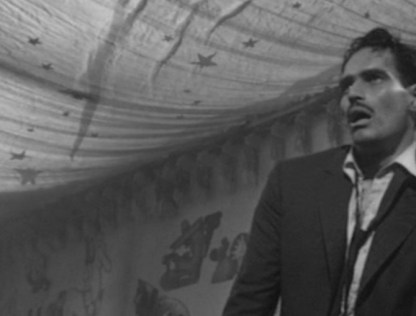
There are films with more polish than Blast of Silence, but that’s okay. In some ways, the unsanded corners of this film put the boot into old film noir and how the bad guys were prettied up. Inside Frank Bono’s head, we hear about hate and pain and the things a man can’t escape, film noir concepts that weren’t always given those blunt terms. Shot as it was, Allen Baron’s movie brings the struggle to life, illustrating the need to get ahead and to get the filthy jobs done. The fact that Baron and Merrill and the rest got theirs done, putting together a one-two punch of a film, is illustration enough of what that means.

Criterion Noir Essays

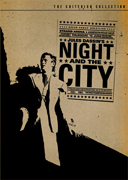
Night and the CityThis link will take you to a page listing the current catalog of Criterion Noir DVDs.

Of interest also is a link to an essay on each film in the catalog, including a lengthy article on Jules Dassins’ Night an the City (1950) by film essayist Paul Arthur, who passed away last week. Coincidentally, Night and the City stars Richard Widmark, who also died last week, and an article in this Weekend’s New York Times by Dave Kehr rates this as Widmark’s best picture.

The Dark Self: The Origins of Film Noir

Nighthawks: Edward Hopper

Lloydville of mardecortesbaja.com has responded to my post yesterday, Light in the Shadows: Noir and Redemption:

Hibbs writes: “In its assumption that a double” — that is a “dark self” — “lurks just beneath the surface of the most ordinary individuals, noir punctures naive, conventional assumptions about human behavior.” This I think is exactly right, and I can’t understand your position that the emergence of a film tradition with this underlying theme precisely in the wake of the global catastrophe of WWII and in the shadow of nuclear annihilation had nothing to do with those phenomena. To me, the connection is self-evident, and if it’s a cliche, it’s a cliche because it’s true.

While I believe the origins of film noir lie elsewhere, this is not to say that the experience of WWII did not influence or inform the themes and development of the noir cycle in the post-war period. But the shadow of nuclear annihilation was cast only by the US until the classic noir cycle was already mature, so I don’t see this as particularly relevant.

The origins of film noir and why it flowered where and when it did are complex, and we can’t be definitive, but it is fairly evident that noir emerged before the US entered the War, and had it’s origins principally in the new wave of emigre European directors and cinematographers, who fashioned a new kind of cinema from the gangster flick of the 30’s and the pre-War hard-boiled novels of Hammett, Chandler, Cain, and Woolrich. We can also clearly see the influence of German expressionism, the burgeoning knowledge of psychology and its motifs, and precursors in the French poetic realist films of the 30’s.

Noir was not only about the other, the “dark self”, but the alienation in the modern American city manifested in psychosis, criminality, and paranoia. It was also born of an existential despair which had more to do with the desperate loneliness of urban life in the aftermath of the Depression. Cornell Woolrich, for example, was a lonely and repressed individual, who spent his life in hotel rooms, and Edwards Hopper’s study of the long lonely night in Nighthawks was painted in 1942.

Film noir was a manifestation of the fear, despair and loneliness at the core of American life apparent well before the first shot was fired in WWII.

Philip Slater prefaced his study of American culture, The Pursuit of Loneliness (1970), with these words from Paul Simon:

‘Kathy, I’m lost,’ I said,
Though I knew she was sleeping.
‘I’m empty and aching and
I don’t know why.’
Counting the cars
On the New Jersey Turnpike.
They’ve all come
To look for America.