
The Leopard Man (1943): Dated and Over-rated

The Leopard Man (1943)

An escaped leopard is linked with the grisly murders of three young women in a small New Mexico town. (1943 RKO. Directed by Jacques Tourneur 96 mins)

Produced by Val Lewton
Based on the novel ‘Black Alibi’ by Cornell Woolrich
Film Editing by Mark Robson
Original Music by Roy Webb

A low-budget thriller from Val Lewton’s horror production unit at RKO based on a Cornell Woolrich novel, The Leopard Man, despite a strong film-making team and spooky noir lighting, looks dated and apart from the famous expressionist sequence, where a young latino girl is sent out into a dark night with a leopard on the loose, to buy corn-meal for her mother, is visually flat. But even the scenes with the terrified young girl are inferior to a similar sequence in Tourneur’s earlier and far superior Cat People (1942) from the same production unit.

The Leopard Man (1943)

The Leopard Man lacks tension and the drama is muddied by a soppy romantic angle, and any viewer who is half-awake will pick the culprit very early on.

Overall, The Leopard Man is disappointing and over-rated.

This is some background and an alternate take from Mayer and McDonnell, ‘Encylcopedia of Film Noir’:

RKO bought the rights to Woolrich’s next novel, Black Alibi (1942), for $5,175 and gave it to producer Val Lewton, who had just completed two memorable low-budget horror films, Cat People (1942) and I Walked with a Zombie (1943). Lewton, working with screenwriter Ardel Wray, proceeded to change the setting of Woolrich’s novel from Latin America to New Mexico. They also altered the story line and the title of Woolrich’s book was changed to The Leopard Man (1943). Woolrich’s five sequences involving different women who are stalked by a killer jaguar and, subsequently, a man, were changed to two deaths, with only the first one caused by a black leopard, instead of a jaguar. However, the first killing, a young girl sent by her mother into the night to buy bread for the family, remains one of the most frightening moments in the cinema as Tourneur blends silence, natural sounds, and stylized lighting with images that capture the terror of the young girl as she moves through the darkness toward her house, only to discover that her mother has locked the door. Her death is presented mainly by the use of sound and lighting.

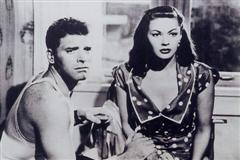
The Leopard Man (1943)

Lloyd Fonvielle: Film Noir Revisited

Criss-Cross

Lloyd Fonvielle on his mardecortesbaja.com blog has posted a concise and penetrating survey of film noir and how it informed the cinema of the 1960’s Film Noir Revisited:

Film noir had a beginning in the global dislocations and moral derangement of WWII, and an end in the open social and political critiques of the Sixties.  There had never been anything quite like film noir before WWII, and there has never been anything quite like it since the Sixties.  It was, and remains, a distinct tradition.

Richard Corliss on the World of Cornell Woolrich

The Bride Wore Black (1968)
La Mariée était en noir (1968 The Bride Wore Black)

Woolrich not only dislodged the detective from his traditional pedestal — as the solver of the puzzle, the good guy who nabs the bad guy, the knight on the mean streets, the arbiter of ethics, the reader’s surrogate whose very presence is a guarantee of narrative clarity and the restoration of order in the chaotic world of crime — but challenged the very notions of hero and quest. Now the hero could be the villain, or the dupe; the quest itself could prove to be deranged, as the moral moorings of standard detective fiction fall away. That dark view was reflected in the humid nightscapes of film noir cinematography, just as Woolrich’s tilt of perspective was mirrored in the movies’ oblique camera angles and paranoid worldview.

Back in December 2003 Richard Corliss published a two-part article on the life and works of Cornell Woolrich on TimeCNN, which is a fascinating introduction to the life and fiction of this seminal noir writer:

Noir Lighting and Analepsis: The Motley View

Double Indemnity (1944)

The Motley View blog has two very erudite and concise articles on chiaroscuro lighting and analepsis in film noir referencing Billy Wilder’s Double Indemnity (1944):

Jean Gabin Retrospective

La bête humaine (1938)

Thanks to the mysterious Dark City Dame for a heads up on these screenings.

The American Cinematheque will this weekend (Sept 6-7) at The Egyptian Theatre, 6712 Hollywood Boulevard in Hollywood, screen four films starring French screen legend, Jean Gabin, under the banner Jean Gabin: The World’s Coolest Movie Star:

The Sicilian Clan (Le Clan Des Siciliens), 1969, 20th Century Fox, 118 Min
Moontide¸ 1942, 20th Century Fox, 94 Min
House On The Waterfront (Port Du Désir), 1955, 94 Min. Dir. Edmund T. Gréville
Grisbi (Touchez Pas Au Grisbi), 1954, Rialto Pictures, 88 Min. Dir. Jacques Becker

The full schedule and trailers are available here.

Apropos Jean Gabin – my favorite French tough guy – he starred in most of the poetic-realist French movies of the 30s, which were really the pre-cursors of Hollywood noir.  As Geoff Mayer and Brian McDonnell say in their book, Encyclopedia of Film Noir (Greenwood Press 2007): “in these movies an ironical poetry was found in the everyday: hence the term poetic realism. The iconography of the cycle included the shiny cobblestones of nighttime Parisian streets (the faubourgs), the shadowy interiors of neon-lit nightclubs, and the moody, haunted, doom-laden faces of actors such as Jean Gabin. As well as inspiring Hollywood film-makers, who viewed them admiringly, some of these French films were actually remade as American noirs, for example, Le Chienne (1931) was remade as Scarlet Street (1945), La bête humaine (1938) as Human Desire (1954), Pépé Le Moko (1937) as Algiers (1938), Le Jour se lève as The Long Night (1947), and Le Corbeau (1943) as The Thirteenth Letter (1951).”

I saw La bête humaine a few years back and it is everything we would expect in a film noir of the 40s with a really downbeat ending.

Noir Novelists and Screenwriters

The Big Sleep

With the valuable assistance of Fanglei from China, who provided the names of screenwriters, I have revised my earlier post of noir novelists to produce a new post which includes screenwriters.  Again, I welcome revisions.

The listing has been transferred to a permanent page: Film Noir Writers Listing

The Tortured Psyche of Cornell Woolrich

Cornell Woolrich

The most prolific noir novelist during the classic film noir cycle was Cornell Woolrich. From Convicted (1938) to No Man of Her Own (1950) 15 of his stories were adapted for the screen. Woolrich’s tales were darkly paranoid and played out in a brutally malign universe filled with existential dread and entrapment.

His nihilism was deeply personal. A repressed loner he died a lonely death in 1968 at the age of 65. After his death, a telling literary fragment was found in his personal papers:

I was only trying to cheat death… I was only trying to surmount for a while the darkness that all my life I surely knew was going to come rolling in on me one day and obliterate me. I was only trying to stay alive a little brief while longer, after I was already gone. To stay in the light, to be with the living, a little while past my time.

The Bride Wore Black

Woolrich’s writing was not in the hard-boiled tradition, but intensely descriptive and, you could say, richly cinematic:

We went down a new alley… ribbons of light spoked across this one, glimmering through the interstices of an unfurled bamboo blind stretched across an entryway. The bars of light made cicatrices across us. He reached in at the side and slated up one edge of the pliable blind, made a little tent-shaped gap. For a second I stood alone, livid weals striping me from head to foot.

– From Woolrich’s 1944 novel The Black Path of Fear, which was made into the film The Chase in 1946.

These are the major noirs based on Woolrich’s novels and short stories:

Street of Chance (1942) – based on the novel titled The Black Curtain
The Mark of the Whistler (1944) – based on the short story Dormant Account
The Leopard Man (1943) – based on the novel Black Alibi
Phantom Lady (1944)
Deadline at Dawn (1946)
Black Angel (1946)
The Chase (1946) – based on the novel The Black Path of Fear
Fall Guy (1947) – based on the short story C-Jag
Fear in the Night (1947) – based on the short story And So to Death (Nightmare)
The Guilty (1947) – based on the short story He Looked Like Murder
I Wouldn’t Be in Your Shoes (1948)
Night Has a Thousand Eyes (1948)
The Window (1949) – based on the short story The Boy Cried Murder
Convicted (1950) – based on the novel Face Work
No Man of Her Own (1950) – based on the novel I Married a Dead Man
Nightmare (1956) – based on the short story And So to Death (Nightmare)
The Bride Wore Black (France 1968)

Reference:
Geoff Mayer and Brian McDonnell, Encyclopedia of Film Noir (Greenwood Press 2007)

Noir Novelists

Elsewhere I recently became embroiled in a discussion where a reviewer of a film noir who had not the read the novel was admonished for not crediting the significant contribution of the writer of the original novel.

This has spurred me to put together a list of the major “noir” novelists whose works underpinned the genesis and flowering of film noir in the 1940s and 1950s.

The list is not exhaustive and features works that were adapted for the screen in notable films noir.

A.I. Bezzerides 1908-2007
They Drive by Night (1940) – screenplay of his novel Long Haul
Desert Fury (1947) – co-wrote screenplay of Ramona Stewart novel Desert Town
Thieves’ Highway (1949) – screenplay of his novel Thieves Market
On Dangerous Ground (1952) – screenplay of the novel “Mad with Much Heart” by Gerald Butler
Kiss Me Deadly (1955) – screenplay of Mickey Spillane novel

W. R. Burnett (1899–1982)
Little Caesar (1931)
High Sierra (1941)
Nobody Lives Forever (1946)
The Asphalt Jungle (1950)

James M. Cain (1892–1977)
Double Indemnity (1944)
Mildred Pierce (1945)
The Postman Always Rings Twice (1946)

Raymond Chandler (1888–1959)
Time to Kill (1942) – based on the novel The High Window
Double Indemnity  (1944) – co-scripted screenplay based on the James M. Cain novel
The Big Sleep (1946)
The Blue Dahlia (1946) – original  screenplay
Farewell, My Lovely (aka Murder, My Sweet) (1944)
The Brasher Doubloon (1947)  – based on the novel The High Window
Lady in The Lake (1947)
Strangers on a Train (1951)  – original  screenplay
Playback (1949) – un-produced screenplay
Playback  (1959) – novelisation of un-produced screenplay
The Long Goodbye (1973)

Steve Fisher (1912–1980)
I Wake Up Screaming (1941)
Johnny Angel (1945) –  original  screenplay
Lady in the Lake (1947) –  original  screenplay
Roadblock (1951) –  original  screenplay
City That Never Sleeps (1953) – original  screenplay
36 Hours (1953) –  original  screenplay

David Goodis (1917–1967)
Dark Passage (1946)
The Unfaithful (1947) –  original  screenplay
Nightfall (1957)
The Burglar (1953)
Shoot the Piano Player (1960) – based on the novel Down There

Dashiell Hammett (1894–1961)
The Glass Key (1935)
The Maltese Falcon (1941)
The Glass Key (1942)

Jonathan Latimer (1906–1983)
The Glass Key (1942) –  original  screenplay
Nocturne (1946)
They Won’t Believe Me  (1947)
The Big Clock (1948) – screenplay based on the Kenneth Fearing novel
Night Has a Thousand Eyes (1948) – screenplay based on the Cornell Woolrich novel
The Unholy Wife (1957)

Horace McCoy (1897–1955)
Kiss Tomorrow Goodbye (1950)
They Shoot Horses, Don’t They? (1969)

William P. McGivern (1918-1982)
The Big Heat (1953) – based on Saturday Evening Post serial
Shield for Murder (1954)
Rogue Cop (1954)
Odds Against Tomorrow (1959)

Cornell Woolrich (1903–1968)
Street of Chance (1942) – based on the novel titled The Black Curtain
The Mark of the Whistler (1944) – based on the short story Dormant Account
The Leopard Man (1943) – based on the novel Black Alibi
Phantom Lady (1944)
Deadline at Dawn (1946)
Black Angel (1946)
The Chase (1946) – based on the novel The Black Path of Fear
Fall Guy (1947)  – based on the short story C-Jag
Fear in the Night (1947) –  based on the short story And So to Death (Nightmare)
The Guilty (1947) –  based on the short story He Looked Like Murder
I Wouldn’t Be in Your Shoes (1948)
Night Has a Thousand Eyes (1948)
The Window (1949) – based on the short story The Boy Cried Murder
Convicted (1950) – based on the novel Face Work
No Man of Her Own (1950) – based on the novel I Married a Dead Man
Nightmare (1956) –  based on the short story And So to Death (Nightmare)

The Bride Wore Black (France 1968)

James M. Cain on the Origins of Film Noir

The Postman Always Rings Twice

James M. Cain, who wrote the novels, Double Indemnity, The Postman Always Rings Twice, and Mildred Pierce, said in 1946 that the changes seen in Hollywood movies like Double Indemnity (1944):

“ [have] …nothing to do with the war [or any] … of that bunk… it’s just that producers have got hep to the fact that plenty of real crime takes place every day and that makes it a good movie. The public is fed up with the old-fashioned melodramatic type of hokum. You know, the whodunit at which the audience after the second reel starts shouting, “We know the murderer. It’s the butler. It’s the butler. It’s the butler.”

From Alain Silver and James Ursini (ed), Film Noir Reader 2,  pp 12-13

Raymond Chandler: God and The Lost Screenplay

Playback Script

During 1948-49 Raymond Chandler completed a Philip Marlowe screenplay titled Playback for Universal Pictures, but for financial and other reasons the movie was never produced. After starting a novelisation in 1953, he put the draft aside until 1957 when at the age of 70 in a final Scotch-fueled effort he completed the novel. It was Chandler’s last completed work of fiction. Chandler suffered from depression in his final years and attempted suicide in 1955. He died in March 1959 from natural causes.

In Playback the book, Chandler makes his only cameo appearance in a Marlowe story, as an old hotel lobby-sitter who gives PI Marlowe some information.  In the persona of  Henry Clarendon IV, who like Chandler in his later years used a walking cane and wore white gloves to hide a skin ailment, he says to Marlowe:

“ …you may not question a man’s religious beliefs however idiotic they may be. Of course I have no right to assume that I shall go to heaven. Sounds rather dull, as a matter of fact. On the other hand how can I imagine a hell in which a baby that died before baptism occupies the same degraded position as a hired killer or a Nazi death-camp commandant or a member of the Politburo? How strange it is that man’s finest aspirations, dirty little animal that he is, his finest actions also, his great and unselfish heroism, his constant daily courage in a harsh world—how strange that these things should be so much finer than his fate on this earth. That has to be somehow made reasonable. Don’t tell me that honor is merely a chemical reaction or that a man who deliberately gives his life for another is merely following a behavior pattern. Is God happy with the poisoned cat dying alone in convulsions behind the billboard? Is God happy that life is cruel and that only the fittest survive? The fittest for what? Oh no, far from it. If God were omnipotent and omniscient in any literal sense, he wouldn’t have bothered to make the universe at all. There is no success where there is no possibility of failure, no art without the resistance of the medium. Is it blasphemy to suggest that God has his bad days when nothing goes right, and that God’s days are very, very long?”

References:

1.    The script for Playback is available here
2.    Gene D. Phillips, Creatures of Darkness: Raymond Chandler, Detective Fiction, and Film Noir (University Press of Kentucky, 2003) pp. 217-221