The 7th Victim (1943): Review by Film Sufi

The 7th Victim (1943)

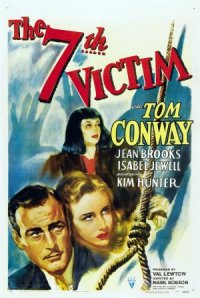
The Film Sufi blog has posted an interesting review of the Val Lewton horror flick, The Seventh Victim (1943) directed by Mark Robson: “one of a string of hypnotic films noir he brought to the screen, coming right after “The Cat People”, “I Walked With a Zombie”, and “The Leopard Man”. What makes this film interesting is the wide gulf separating its virtues and its flaws”.

Kiss of Death (1947): More Than Udo

Kiss of Death (1947)

A reformed hood, who turns state evidence to get parole to care for his kids after his wife’s suicide, is a marked man (Fox 1947 Directed by Henry Hathaway 98 mins)

Kiss of Death is usually remembered for the debut performance of Richard Widmark as the giggling psychotic hit-man Tommy Udo and his brutal murder of a hood’s wheelchair-bound mother. But it is a strong performance by Victor Mature as the squealer, Nick Bianco, out to save his family, that holds the film together. An unaffected Coleen Gray is engaging as the love interest Nettie.  Brian Donlevy gives his usual straight-up delivery as the Assistant DA who offers Bianco a get out of jail free card.

The action is tautly directed and is set mostly on the actual streets of New York, where the innocent streets of suburbia in the afternoon are a counterpoint to the dark sordid streets of the city at night. The only weakness is a redundant and banal voice-over commentary on the action by Nettie, which is also at odds with the noir theme that redemption costs. The climatic resolution is nicely nuanced and well-paced, as is the claustrophobic tension of the perps sweating out a slow elevator ride down from the 27th floor of an office building after a jewellery heist. The family scenes of Bianco with his daughters and Nettie are beautifully played and deeply moving, without resort to sentimentality.

Kiss of Death (1947)

The Breen Office and Noir

Laura (1944)

In the 1940’s the Breen Office rejected initial scripts (amongst many other films) for The Maltese Falcon (1941), Laura (1944), and Murder, My Sweet (aka Farewell, My Lovely 1944):

The Maltese Falcon… required the… following revisions: Joel Cairo should not be characterized as a ‘pansy type’; the ‘suggestion of illicit sex between Spade and Brigid’ should be eliminated; there should be less drinking; there should be no physical contact between Iva and Spade ‘other than that of decent sympathy’; Gutman should say ‘By Gad!’ less often; and ‘Spade’s speech about District Attorneys should be rewritten to get away from characterizing [them] as men who will do anything to further their careers.’ A similar pattern of objections can be seen in the Breen Office reports on other celebrated films noirs. A… review of Laura insisted that Waldo Lydecker must be portrayed as a ‘wit and debonair man-about-town’ and that ‘there can never be any suggestion that [he] and Laura have been more than friends’; meanwhile, scenes of police brutality had to be downplayed, along with the drinking at Laura’s apartment… [A] report on Farewell, My Lovely informed the producers that ‘there must, of course, be nothing of the ‘pansy’ characterization about Marriott’; by the same token, Mr. Grayle could not ‘escape punishment’ by committing suicide, and the scenes of pistol-whipping, drinking, and illicit sex would have to be reduced or treated indirectly.

– James Naremore, More Than Night – Film Noir In Its Contexts (UCLA Press 1998)

New Bright Lights article on Force Of Evil (1948)

Force of Evil

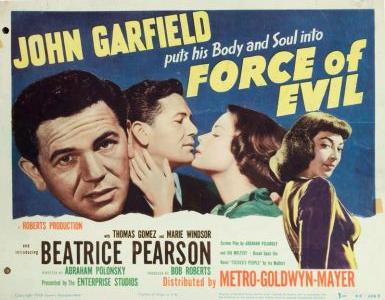
Imogen Sara Smith has written in the August issue of the Bright Lights film journal a review of Abraham Polonsky’s Force of Evil (1948).  The article is a good introduction to the movie without giving too much away – an endemic weakness for many reviewers of films noir and writers on film noir.

While rightly focusing on Garfield’s characterisation as the hoodlum lawyer and the relationship with his brother played by Thomas Gomez, Smith gives too little credit to Polonsky’s  solid screenplay and his impressive directorial debut.

The Harder They Fall (1956): For a few lousy bucks

The Harder They Fall (1956)

In his last role, Humphrey Bogart, as an aging down-on-his-luck sportswriter, is drafted into fronting for a mob-controlled boxer. ( Dir. Mark Robson 109 mins)

After a stunning opening which tracks a series of cars heading to a New York boxing studio, The Harder They Fall, lapses into a visually mediocre boxing movie.  Strong performances from a haggard Bogart, who died not long after completing the picture,  and Rod Steiger as the mobster, keep the interest up, but overall the picture is flat and unmoving.

Bogart’s redemption comes too late and reluctantly, and seems shallow after the avoidable death of a punch-drunk boxer in which he is complicit.

What is interesting is the inclusion of fight fans in the denunciation of the “sport”. Bogart tells the boxer Toro when trying to persuade him to throw his championship fight to avoid getting hurt:

What do you care what a bunch of bloodthirsty, screaming people think of you?  Did you ever get a look at their faces? They pay a few lousy bucks hoping to see a man get killed. To hell with them! Think of yourself. Get your money and get out of this rotten business.

Another cynical touch is the scene where the mob “accountant” insists on itemising the “deductibles” from the million dollar take on the fight leaving the hapless boxer with $49.07 after “overheads”.

Factual Note: The interview on skid-row of real-life ex-boxer, Joe Greb, was not scripted or rehearsed.

The Harder They Fall (1956)

Woman on the Run (1950): Intelligent B Thriller

Woman on the Run (1950)

The wife of a man who goes into hiding after witnessing a gangland killing, tries to track him down before the killer does (Fidelity Pictures 1950 Directed by Norman Foster 77 mins)

A great b-thriller from Foster, who had a (disputed) role in the making of Orson Welles’ Journey Into Fear (1943)  and directed Kiss the Blood Off My Hands (1948).  The  picture moves apace on the streets, tenements, dives, and wharfs of San Fransisco, with a novel climax at a beach-side amusement park.  A nice twist half-way through the movie ramps up the tension to the finale on and around a roller-coaster. Anne Sheridan is great in a role that moves from an indifferent wife in a failing marriage through a street-wise dame with a razor wit to the hysterical woman back in love desperately trying to save her husband’s life. The supporting b-cast performs well by playing stock characters with some considerable vitality and depth.

The movie’s noir credentials come not only from low-key lighting and sharply angled night shots, but from an intelligent screenplay that explores the ennui of a disintegrating marriage and its revival after the protagonists learn more about each other from other people than they can have imagined.   The savage murder of an innocent young cabaret dancer that gets in the way of the killer desperately trying to hide his identity, is off-screen,  but poignantly handled to add a tragic undertone to the story.

A truly engaging film.

The Dark Cinema of David Goodis Series

Nightfall (1957)

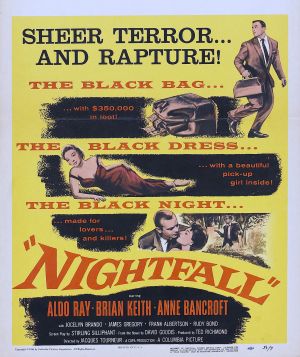
Streets of No Return: The Dark Cinema of David Goodis will run from August 1 – 23 at the Pacific Film Archive. Kelly Vance in a feature in today’s East Bay Express, previews the program and gives a short biography of Goodis.

The films to be shown:

And Hope to Die
The Burglar
The Burglars
Dark Passage
Descent into Hell
Nightfall
The Professional Man x Two
Shoot the Piano Player

The Unfaithful

There is a full program at the Archive’s web site.

Touch of Evil: 50th Anniversary Edition DVD

Touch of Evil (1958)

A special 50th Anniversay 2-DVD set of Orson Welles’ film noir, Touch of Evil (1958), to  be released by Universal on October 7, will include in three versions of the movie, which most noir pundits agree marks the end of the classic film noir cycle:  theatrical, preview and restored based on Welles’ original vision, and a copy of the  58-page memo Welles  wrote to the studio before the film’s release asking for his original-cut re to  be restored, after it had been butchered by studio hacks. The request fell on deaf ears.

More info from Welles.Net.

Body and Soul (1947): “Everybody dies”

Body and Soul (1947)

“A knockout on all levels. In what’s probably the greatest performance of his career, John Garfield portrays Charlie Davis, a Jewish prizefighter who quickly rises to the top of the heap, only to fall hard and fast. Robert Rossen‘s direction is superb, and the marvelous photography of James Wong Howe and the Oscar-winning editing by Robert Parrish set a whole new standard for fight pictures.”

TV Guide

“With its mean streets and gritty performances, its ringside corruption and low-life integrity, Body and Soul looks like a formula ’40s boxing movie: the story of a (Jewish) East Side kid who makes good in the ring, forsakes his love for a nightclub floozie, and comes up against the Mob and his own conscience when he has to take a dive. But the single word which dominates the script is ‘money’, and it soon emerges that this is a socialist morality on Capital and the Little Man – not surprising, given the collaboration of Rossen, Polonsky (script) and Garfield, all of whom tangled with the HUAC anti-Communist hearings (Polonsky was blacklisted as a result). A curious mixture: European intelligence in an American frame, social criticism disguised as noir anxiety (the whole film is cast as one long pre-fight flashback).”

– Time Out

“It is Canada Lee, however, who brings to focus the horrible pathos of the cruelly exploited prizefighter. As a Negro ex-champ who is meanly shoved aside, until one night he finally goes berserk and dies slugging in a deserted ring, he shows through great dignity and reticence the full measure of his inarticulate scorn for the greed of shrewder men who have enslaved him, sapped his strength and then tossed him out to die. The inclusion of this portrait is one of the finer things about this film.”

– Bosley Crowther, The New York Times, November 10, 1947

Body and Soul is one of the great movies of the 40’s.  The powerful screenplay by Abraham Polonsky is brought to the screen with an authority and beauty that is still breathtaking. From the editing to the photography and direction, the film is a work of art.  Throughout the picture, from the opening scene of the empty boxing ring and the fluid use of flashback and dreaming to the sensational fight climax, there is an assured elegance and, most profoundly, a freedom of expression that is rarely matched.  (The film was made by Garfield’s independent Enterprise Pictures.  Sadly, after one more great noir film, Force of Evil (1948), where the numbers racket came under the spotlight, and starring John Garfield with  the screenplay and direction by Polonksy, the company folded.)

The essential quality of Body and Soul is integrity: a masterwork by craftsmen committed not only to their craft but to film as social critique.  On one level the picture is a brilliant melodrama and exposé of the fight game, and on another level a savage indictment of money capitalism where the individual has only commodity value, and the artisan and worker is owned body and soul by the capitalist. The boss and the laborer, even the crooked fight promoter and the boxer, are in antagonistic relations of production dictated by the market. When Charlie Davis in an heroic act of rebellion, in finally refusing to throw his last fight, breaks the chains of greed that bound him to a venal, shallow and alienated existence, his action is a subversive challenge not only to the crooked capitalist but to the false imperative that dictates he should act only in his material self-interest. By rejecting this false consciousness he not only exposes himself to retribution but to penury.  In the final words in the movie, spoken by Garfield to the promoter, he throws down the revolutionary gauntlet in an ironic play on the words “everybody dies” used by the promoter in an earlier scene when he writes off the life of the black boxer Ben:

Charlie: Get yourself a new boy. I retire.
Roberts: What makes you think you can get away with this?
Davis: What are you gonna do? Kill me? Everybody dies.

The final sad irony is the destruction of the careers of Polonsky and Garfield, and Canada Lee, who plays the black boxer Ben, by the HUAC which-hunt only a few years later.  Garfield died prematurely in 1952 at the age of 39 as the HUAC blacklist finally took its toll on his ailing health.


Body and Soul (1947)

Fear in the Night (1947): Wake in fright

Fear In the Night (1947)

A timid young bank teller wakes from a murderous nightmare to find it’s true. (Pine-Thomas Productions 1949, Directed by Maxwell Shane 72 mins).

Fear in the Night, is a very good b-thriller-cum-noir, based on a Cornell Woolrich story, Nightmare, adapted for the screen by the director, Maxwell Shane, and shot by cinematographer Jack Greenhalgh. The movie was remade less successfully in 1956 as Nightmare by the same director and production company.

The direction is tight and the action never lags over 72 minutes, with inventive camera work by Greenhalgh that creates exactly the dark signature mood of the Woolrich story. The nightmare scenes are powerful and the use of voice-over narration flashback adds to the mystery.  The performance of noir regular Paul Kelly as a cop with a conflict of interest is on target, and the troubled protagonist is well-played by De Forest Kelley, with good support from Ann Doran as his sister, and Kay Scott as his girl-friend.

I found the performance of bit-player Scott in her first role as Betty Winter, particularly engaging: her portrayal is so unaffected that the whole bizarre story seems real and grounded in the familiar. Her incomprehension at her boyfriend’s paranoia and strange behavior, and the dark mood established by the deft camera work and direction, establish exactly the nightmare Woolrich world of existential dread.

A strong climax with a doomed car-chase at night nicely ends the action. Definitely a B+.

Fear In the Night (1947)