Double Feature: Young Man with a Horn and A Lady Without Passport

Young Man With a Horn (1950)

I like to think here at FilmsNoir.Net, readers are made aware of movies that are under the radar and do not fit established categories, genres or movie lists. Many such films were made by major studios on modest budgets and while not likely to make best-of listings or have major genre standing, they are pictures that are good entertainment made with craft and discipline, and sometimes with special elements that reward the discerning viewer.

Two such films were made in 1950 and, while having noir aspects, are largely entertainment features made memorable by facets that have been largely ignored by film reviewers and other writers on film.

Young Man with a Horn from Warner Bros. was directed by Michael Curtiz, and Joseph H.Lewis directed A Lady Without Passport which was produced by MGM.

Each of these films is special in its own way.

Young Man With a Horn (1950)

Young Man with a Horn is loosely based on the biography of jazz trumpeter Bix Beiderdecke: the story of how a lonely kid in L.A. learns the trumpet from a black musician, who becomes his close friend and mentor. His shift to New York in pursuit of a career is the stuff of melodrama; young guy makes good, marries the wrong woman and abandons his friends, and after tragedy finds a kind of redemption. There is great jazz played by Hoagey Charmichael and Harry James, nice songs from a young Doris Day, solid acting from Kirk Douglas in the lead, Lauren Bacall as the wife, Junco Hernandez as the black trumpeter, and Charmichael as Douglas’ piano-playing buddy. Competent direction by Curtiz and inspired cinematography from DP Ted McCord also add value. Of particular interest is Baccall’s acid performance as the neurotic wife.

But the real strength of the film is in the script by Carl Foreman (who during filming of his script for High Noon in 1951 appeared at HUAC and was later blacklisted by Hollywood studio bosses).  Redemption for the young man with the horn comes from a realisation that a great artist’s obsession with his craft is not the only requirement for artistic fulfilment – it cannot come from a sterile wedding of player and instrument but ultimately from a deeper maturity which comes from embracing human relationships and commitment – a responsibility to and for others.

The tragic aspect of the story lends a true pathos to the melodrama, and the prominence given to the black father-figure in a film of this era is a revelation. Here we have a powerful expression of the personal and the social filmed with empathy and commitment.

A Lady Without a Passport (1950)

A Lady Without Passport is ostensibly a police procedural, one of the many that began to emerge in the early 1950’s as the noir cycle began to explore other directions, after the success of on-the-street exposés such as Jules Dassin’s The Naked City. Director Joseph H. Lewis made his seminal noir, Gun Crazy, in 1950, and as the noir cycle began to decline, he directed perhaps the best 50s noir, The Big Combo, in 1955. These two classic films noir established Lewis’ reputation as an innovative and iconoclastic film maker.  In A Lady Without Passport he has a more prosaic script, but together with his DP Paul Vogel and a romantic score from David Raksin, he brings to the project a wonderful transforming elegance to a fairly routine story. Also unusually for Lewis, in this movie, violence is handled with restraint, but not without originality.

A U.S immigration agent played by John Hodiak is sent to Cuba to investigate the murder in New York of an illegal alien, and uncovers a people-smuggling racket run by a suave villain played by George Macready. The agent falls for a Viennese refugee played with understated angst by 35-yo Hedy Lamarr, who was then entering the decline of her career. There is romance, humour, intrigue and sensuality – the stuff of a minor Casablanca, but filmed with a casual elegance that enthralls as well as entertains. The charm of pre-revolutionary Havana is rendered with a calm detachment and the sympathetic portrayal of Latin life is boisterous yet respectful.

Much has been written of the bank robbery scene in Gun Crazy shot from within the getaway car, but equally arresting is a long take for the opening scene of A Lady Without Passport from inside a taxi. While less tense the shot is more fluid when compared with the Gun Crazy take.  Indeed, Lewis in A Lady Without Passport displays the élan of Max Ophuls, with his camera often on the move, and zooming,  turning and panning,  as well as placed at unusual angles. In one scene an exotic cabaret dancer is filmed by placing the camera at a low angle near the floor so that the viewer is in the position of voyeur, looking up at the dancer’s legs and hips as she dances.  A particularly stunning scene towards the end shows the crash of a plane and a violent killing as seen from the cockpit of a government plane that was in pursuit, with a running commentary radioed to base by the pilot. This technique gives a strong documentary feel to the whole scene and a sense of stricken helplessness.  The dénouement in a foggy swamp is very reminiscent of Gun Crazy, and what it lacks in tension is made up in the artistry of the photography.

The picture’s final scene has the government agent make a radical re-statement that is sufficiently subversive to underline the human element of the story free of any romantic allusions.

Two fine Hollywood movies.
David Goodis…To A Pulp

David Goodis

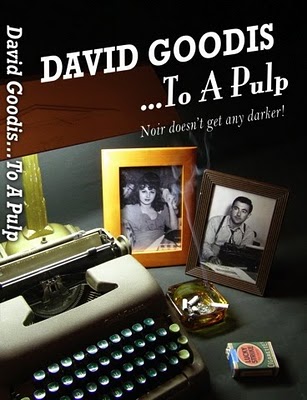
David Goodis… To A Pulp, a film biography of noir writer David Goodis, premieres this Friday, March 5, in Philadelphia. For film-maker Larry Withers making the movie was a peak into the once-hidden life of his mother, Elaine Astor, who had previously been married to Goodis.  Read all about it at Mike Lipkin’s Noir Journal.

Dead Peasants…

Capitalism - A Love Affair

Some Dead Peasant Policy Holders. From Capitalism: A Love Story (2009)

In the United States many large corporations take out secret ‘dead peasant’ or ‘dead janitor’ life insurance over the lives of rank-and-file workers for a tax-free payout on the death of an employee. Insurers have sold millions of these policies to companies such as Dow Chemical and others.  Michael Moore in his documentary film, Capitalism: A Love Story, recounts the story of one young middle-manager who died of cancer, and whose employer received a payout exceeding US$1.5 million. His widow learned of this when the payout letter was mailed to her by mistake.

In Moore’s film no-one was aware of the origin of the term ‘dead peasant’.  As I was watching the film, Nikolai Gogol’s 1842 novel, Dead Souls, came immedately to mind.  In Gogol’s novel, a savage social satire of pre-revolutionary Russia, the protagonist, Chichikov, an aspiring bourgeois con-artist, has hatched a get-rich scheme.  His plan is to ingratiate himself  with landowners and buy dead serfs, dead souls.

At the time the Russian government taxed landowners based on how many serfs they ‘owned’, as determined by the most recent census. As census were infrequent, landowners often had to pay taxes on dead serfs.

Once Chichikov had accumulated enough dead souls, his plan was to make massive borrowings against these phantom assets.

Sound familiar?  How about if we substitute sub-prime mortgages for dead serfs?

Similarly, at times of war, there is no shortage of criminals and the unscrupulous who will seek to line their own pockets through corruption and profiteering.

Two films noir I have reviewed here at FilmsNoir.Net use war racketeering as plot elements. In April last year there was Allotment Wives (1945), the story of a woman who uses her social status and ill-gotten wealth to front a bigamy racket where women marry multiple GIs during WW2 to skim the allotment support paid by the Defense Dept to spouses of men on active duty. Last week I looked at Ride the Pink Horse (1947), where a disillusioned war vet wants to blackmail a war racketeer using a check made out to a crooked govt. official signed by the hood.

In Ride the Pink Horse, the hood when cornered at the end tries to talk his way clear by appealing to the vet’s bitter resentments.  This spiel resonates just as strongly today and the argument has power because it is sadly still true: [the short clip of a few minutes has been removed by YouTube after NBC Universal claimed a breach of copyright].

Ride the Pink Horse (1947): A heart full of soul

Ride the Pink Horse (1946)

“Freedom’s just another word for nothing left to lose… “

Universal International Pictures
Director: Robert Montgomery
Cinematography: Russell Metty
Cast:
Robert Montgomery as Lucky Gagin
Thomas Gomez (AAN) as Pancho
Wanda Hendrix as Pila
Andrea King as Marjorie Lundeen
Fred Clark as Frank Hugo
Art Smith as Bill Retz
Screenplay: Ben Hecht, Charles Lederer, and Joan Harrison
Based on the novel Ride the Pink Horse by Dorothy B. Hughes (New York, 1946)
Music: Frank Skinner

A bitter disillusioned WW2 vet, Lucky Gagin, arrives in a New Mexico town aiming to blackmail a high-stakes racketeer, and with the help of two locals and a federal agent, he finds more than he bargained for. From the wistfully up-beat Latino rhythm that accompanies the opening credits over a desert vista, you know this movie will take you places beyond noir. This is a film imbued with a deep humanity so rare and moving that you don’t want it to end – the final scene of departure is wrenchingly personal – ‘so long? ah is a sad word, but you make me happy if is not too long’.

The great script from Ben Hecht, elegant direction by star Robert Montgomery, and accomplished photography from DP Russell Metty, are suffused with an aching regret for the loss of a better simpler world, tempered with an idealism and optimistic faith in the integrity and wisdom of ordinary people .  The cast is very strong with impressive turns by all the major players. An 18-yo Wanda Hendrix is beguiling as a young peasant girl on her first visit to a big town, who attaches herself to Gagin, and Gomez is superb as Pancho, the poor merry-go-round operator who befriends Gagin.

They don’t make movies like this any more. As John Fawell says in his book , THE HIDDEN ART OF HOLLYWOOD: In Defense of the Studio Era Film (2008):  “Hollywood aimed at idealism, it’s true, but its idealism is subsumed under its larger aesthetic of understatement. The best Hollywood directors thought of idealism as they did of sex and violence, all potent ingredients that needed to be doled out carefully. And they had the sense that idealism, to be effective, had to give room to a certain degree of pessimism.” (p 111).

Cinematic Cities: New York blues in the night

Blues in the Night (1941)

Blues in the Night (1941) … a very young Elia Kazan as a dizzy jazz clarinetist
Director  Anatole Litvak  |  DP  Ernest Haller

Film Noir and the Portrait

Laura (1944)
Laura (1944)

I recently started reading a ‘heavy’ tome by feminist academic Susan Felleman, Art in the Cinematic Imagination (University of Texas Press, 2006), and found her discussion of the portrait as a central motif  in certain films noir worth sharing.

The portraits, too inert and non narrative to realistically inspire such identification within a realist scenario, threaten the viewer with awareness of the magic of the mimetic and narrative devices employed by the film itself to engage him or her. This is very much a danger in a number of movies in which the portrait assumes a more explicit role and is incorporated into narratives whose realism is strained by, if not abandoned to, psychological or supernatural treatment of mortal desire. In Otto Preminger’s Laura and Fritz Lang’s The Woman in the Window, both from 1944, the male protagonists fall in love with portraits of beautiful women. In Laura, it is ambiguous, at first, when Detective McPherson (Dana Andrews) falls asleep beneath the portrait of Laura (Gene Tierney)—his desire for which has been established—and then awakens to the ‘‘real’’ Laura, presumed dead, whether or not he is dreaming. This ambiguity is a function, as [scholar] Reynold Humphries has indicated, of the uncanny: ‘‘The irruption of Laura the woman into the privileged space of Laura the portrait is not just a question of a return from the dead but rather of a return of the repressed.’’   Humphries aptly relates this to the even more explicit scenario of The Woman in the Window, in which the entire narrative, stemming from Professor Wanley’s fascination with the portrait, is revealed—only finally—as a dream: a dream in which mortal terror and death are conceived as the inevitable outcome of his desire.

Film noir’s peculiar amalgam of sexual angst,morbidity, and the portrait may well find its apogee in another Fritz Lang film, Scarlet Street (1945), in the painfully ironic scene in which the defeated and dispossessed portraitist (Edward G.Robinson) witnesses the sale of what might be called his ‘‘self-portrait as femme fatale,’’ that is, the portrait Chris painted of Kitty ( Joan Bennett) that was exhibited as her self-portrait. The cadaverous image of the woman who stole his meager self-respect, along with the authorship of the painting, and whom he murdered in a fit of sexual jealousy, is borne, funereally, out of the gallery and past the painter, as he shuffles past in a schizophrenic oblivion. The pathological possibilities of mimesis and its subject-object confusions reach so fevered a pitch in Scarlet Street that it’s hard to imagine a sicker scenario…” (pp 17-18).

On reading this passage, the thought came to me, and I don’t claim that I am the first to have had this ‘revelation’,  that in Laura, Detective McPherson doesn’t actually wake-up to be greeted by the living Laura but dreams what he subconsciously desires – that Laura is not dead but alive.   To this ambiguity challenged by necromancy, add Felleman’s bizarre description of  “[his ]self-portrait as femme fatale”!

Love or something like it…

The Big Combo (1955)

Down city streets at night looking for love, or something like it. A squalid chance for momentary bliss.

Love or something like it.

Under the lurid glow of neon planets, in a firmament of gasolean fumes and hard luck.  The pavement meets my empty gaze and tiny stars of mica shine in an inverted gray sky. My shoes shuffle and drag me on to nowhere. This is my universe.  All the shadows are mine.  Not strangers nor intimate friends, but sordid extensions of my damned to hell soul.

The soft laughter of a woman somewhere off in another universe a stab to the heart.  Whispers and intimacy I ache for and never have.  For others.  Not for me the easy familiarity of a life worth living.  Somewhere not alone, not broken, not sad beyond sadness.

My shoes sill shuffle dragging me nowhere.

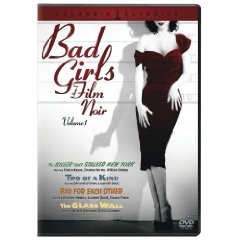
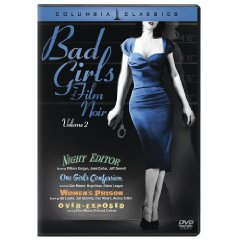
New on DVD: Bad Girls of Film Noir

Bad Girls Vol 1Bad Girls Vol 2

Sony has released a new twin DVD-set of 8 b-girl movies from the Columbia vaults titled Bad Girls of Film Noir.  Mostly pot-boilers, but Night Editor is a must-have cult noir.

Volume 1

Evelyne Keys
The Killer That Stalked New York (1950) directed by Earl McEnvoy

Lizabeth Scott
Two of A Kind (1951) directed by Henry Levin
Bad for Each Other (1953) directed by Irvin Rapper

Gloria Grahame
The Glass Wall (1953) directed by Maxwell Shane

Volume 2

Cleo Moore
Night Editor (1946) directed by Henry Levin
One Girl’s Confession (1953) directed by Hugo Haas
Over-Exposed (1956) directed by Lewis Seiler

Ida Lupino/Cleo Moore/JanSterling/Audrey Totter
Women’s Prison (1956) directed by Lewis Seiler

Cornell Woolrich: The shadows come from within

Night Has a Thousand Eyes Book Cover

I was left alone there a long time. I could see, all right, and know the things about me. My car was there at the curb, glistening in the dark, with a thin ripple of wet orange paint running down its hood in one place where the light from the doorway struck out at it. A ripple that never moved, and yet was warped and liquid as running ripples are. I even shifted once, from where she had left me standing, and moved over to it, and stood up close beside it, my hands pressing down tight upon the top of the door, as if I were unsteady and needed something to cling to in order to remain upright. My head inclined, as if peering intently at the upholstery of the seat backs.

Yes, the car was real, it was there. My hands could feel it, my eyes could see it, I had but to touch a button to make light shoot out of it, light that no shadows could withstand; but yet the shadows had the best of it, it was powerless to rive this pall that blanketed the eyes that looked at it, the mind that considered it. It could not take me out of the shade, it was I who had brought it into the shade with me; its powers of contrast were lost, it became one with the other Gothic shadows about me. For the shadows came from within, and so anything they fell upon was shadowed. Just as if you front your eyes with a piece of smoked glass, the most sparkling sunlight will become somber.

Each unto himself has his own world that he looks out upon, and though someone else were to stand on the very selfsame inch of ground your feet were placed upon, guided by chalk marks, he would not see the same things you did. There would have been two different views there, not just one. Or is there any world at all, I wondered, out there before us as we look upon it; may it not be inside, behind the eyes, and out front nothing, just a blank infinite? But madness lurked along that trail, and I quickly turned aside.

– Cornell Woolrich, Night Has a Thousand Eyes (1945)

Summary Reviews: The Amazing Mr X meets Phantom Lady

Phantom Lady

Phantom Lady (1944)
Loyal secretary Ella Raines desperately tries to save her innocent boss from  the gallows. Woody Bredell’s moody noir photography and an orgasmic jazz jam session add jive to Siodmak’s otherwise lack-luster direction. Franchot Tone is convincing as a closet psychopath. Elisha Cook Jr’s turn as a sleazy jazz drummer is anarchic, but Raines’ impersonation of  a gum-chewing floozy is just embarrassing.  Based on a Cornell Woolrich novel.

Sweet Smell of Success

Sweet Smell of Success (1957)
Manipulative NY celebrity columnist enlists sleazy publicist to destroy his younger sister’s suitor. As bracing as vinegar and cold as ice. Ambition stripped of all pretense.  Great chemistry between Burt Lancaster as the sinister chat columnist and Tony Curtis as the ruthless publicist.  DP James Wong Howe’s sharpest picture:  the streets of Manhattan have never looked so real.

The Amazing Mr X

The Amazing Mr. X (1948)
A crooked clairvoyant manipulates a widow who believes her dead husband is back. A brilliant gothic satire with humor, poetry, and panache.  John Alton’s expressionist lensing, Bernard Vorhaus’ fluid direction, and an ace Alex Laszlo score deliver top-flight entertainment.

Railroaded

Railroaded (1947)
John Ireland is great as a savage hood who frames an innocent guy for murder.  Anthony Mann’s poverty-row pulp-b is very noir, cut with acid, and photographed in the deafening blaze of gun-fire. Very entertaining.

Raw Deal

Raw Deal (1948)
A tragic love triangle very reminiscent of Marcel Carne’s Port of Shadows has to be one of  the great noirs.   A sublime film from director Anthony Mann and  DP John Alton, with a knockout cast in a strong story stunningly rendered as expressionist art.  The portrayals by Dennis O’Keefe, Claire Trevor, Marsha Hunt, and John Ireland are career bests.  Poetic voice-overs by Claire Trevor are  beautifully enhanced by Paul Sawtell’s eerie scoring.

Obsession

Obsession (1948 UK)
A macabre and sardonic melodrama. Psychopath shrink plans perfect murder. Taut direction from Edward Dmytryk with a Nino Rota score! Gruesome and disturbing.

Private Hell 36

Private Hell 36 (1954)
A flat crooked cop flic from Don Siegel. Ida Lupino, who co-wrote the screenplay, and Steve Cochran make it interesting.

Pursued

Pursued (1947)
Noir western from Raoul Walsh. Robert Mitchum is trapped by a dark dimly discerned past. Solid but inferior to the moody western Blood on The Moon (1948), also starring Mitchum.  Story is far-fetched and the actions of the protagonists seem  un-convincing.

Strange Illusion

Strange Illusion (1945)
A truly bizarre Hamlet remake. Edgar Ulmer turns a PRC-b into a camp expressionist noir of foul villains with a knockout finale. Jimmy Lydon, remember Henry Aldrich, plays Hamlet to Warren Williams’ Claudius, who is a bit of a lecher and is not past feeling-up teenage girls in swimming pools!

The Long Night

The Long Night (1947)
A  war vet is under siege in a tenement after killing a romantic rival. An RKO Henry Fonda vehicle from Anatole Litvak plays as melodrama with a strong supporting cast.  Barbara Bel Geddes is interesting as the love interest, but Vincent Price as the rival is too rococo and out-of-place. Me, I’m stuck on the luscious Ann Dvorak, a straight-up dame who falls for Fonda. John Wexley’s script over-reaches on the social criticism angle.