Possessed (1947): Melodramatic Soap

Possessed (1947)

A repressed woman is pushed into the abyss of schizophrenia by unrequited love
(1947 Warner Bros. Directed by Curtis Bernhardt 108 mins)

A tour-de-force performance from an aging Joan Crawford impresses, but the gestalt of this movie rarely strays beyond melodrama – more a soap-opera on steroids than film noir.

The use of flash-back and dark moody lighting make it look noirish, but the deranged protagonist is not responsible for the consequences of her delusions, and there is no redemption, only the hope of recovery.

Visually the opening scenes on the streets of LA and in the corridors of a hospital are stunning, but this virtuosity is not sustained, and the only visual interest in the rest of the film is the brutal and visceral murder at the end.

Possessed (1947)

Film Noir Women: Does she really love him?

But does she really love him? That’s always the question about these heroines-obsessive to the hero, central to the movie. De Carlo’s Anna [Criss-Cross], for example, is willing enough to betray her racketeer husband for love of Lancaster, but not willing to stay with him once the husband catches up with them. Not when she can take the money and run…  It’s one of the noir heroine’s most invariable features that she is motivated by greed: she is poor and wants to be rich, or else she is rich and wants to be richer. She may inspire romantic dreams, but she doesn’t have them herself. Not like he does, anyway. That’s one of the advantages she has over him.

– James Harvey, Movie Love in the Fifties

NPR has posted under its You Must Read This feature, an interesting excerpt from Harvey’s book on the femme-fatale from  the early 40’s to the late 50’s, with nicely drawn portraits of the femmes-fatale from The Maltese Falcon, Double Indemnity, The Killers, Criss-Cross, The Woman in the Window, Scarlet Street, Pushover, Pitfall, Gun Crazy, The File on Thelma Jordan, The Locket, and Where Danger Lives.

Dark City (1998) The Director’s Cut: Zapped by the biochemist

Dark City (1998)

The Director’s cut of Dark City (1998) has been released on DVD this week.  A sci-fi noir from director Alex Proyas, it explores the nature of consciousness and memory in a classic stylised noir city, which is the closest a contemporay color movie has ever come to evoking the look of a 40’s film noir.

Dark City (1998)

It is a visually stunning and enigmatic dream-scape where true identity doesn’t exist, but is the construct of a biochemist in the employ of dark soul-less aliens, who inhabit cadavers, collectively employed in attempting to stave off extinction by reconstructing physical reality and manipulating the brain’s chemistry.  The noir motif of an amnesiac protagonist on the run after he is implicated in the serial killing of b-girls is the arc on which the story is woven.  It is an amalgam of Al Hartley’s Amateur (1994), which preceded it, and The Matrix (1999), of the following year: a brave new world with a ghost in the machine…

References:
Brave New World – Aldous Huxley
The Ghost in the Machine – Arthur Koestler

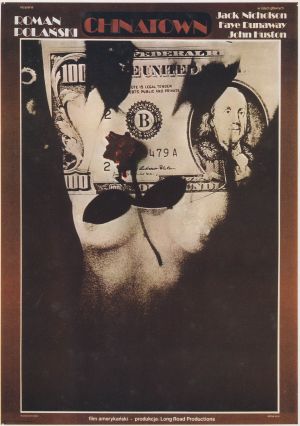
Chinatown (1974): Review by Pick-Up Flix

Chinatown (1974)

Michael Clawson has posted to his blog, Pick-Up Flix, a review of Roman Polanski’s Chinatown (1974) with an original take on Chinatown as metaphor: the title refers to a place where law and order (i.e. death) are circumvented by the tragedy and corruption of life. Roman Polanski wasn’t creating just a mystery; he was bowing to the greatness in which mystery thrived — film noir”.

The Breen Office and Noir

Laura (1944)

In the 1940’s the Breen Office rejected initial scripts (amongst many other films) for The Maltese Falcon (1941), Laura (1944), and Murder, My Sweet (aka Farewell, My Lovely 1944):

The Maltese Falcon… required the… following revisions: Joel Cairo should not be characterized as a ‘pansy type’; the ‘suggestion of illicit sex between Spade and Brigid’ should be eliminated; there should be less drinking; there should be no physical contact between Iva and Spade ‘other than that of decent sympathy’; Gutman should say ‘By Gad!’ less often; and ‘Spade’s speech about District Attorneys should be rewritten to get away from characterizing [them] as men who will do anything to further their careers.’ A similar pattern of objections can be seen in the Breen Office reports on other celebrated films noirs. A… review of Laura insisted that Waldo Lydecker must be portrayed as a ‘wit and debonair man-about-town’ and that ‘there can never be any suggestion that [he] and Laura have been more than friends’; meanwhile, scenes of police brutality had to be downplayed, along with the drinking at Laura’s apartment… [A] report on Farewell, My Lovely informed the producers that ‘there must, of course, be nothing of the ‘pansy’ characterization about Marriott’; by the same token, Mr. Grayle could not ‘escape punishment’ by committing suicide, and the scenes of pistol-whipping, drinking, and illicit sex would have to be reduced or treated indirectly.

– James Naremore, More Than Night – Film Noir In Its Contexts (UCLA Press 1998)

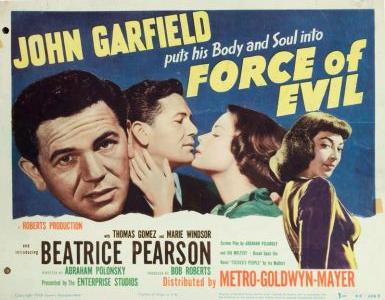
New Bright Lights article on Force Of Evil (1948)

Force of Evil

Imogen Sara Smith has written in the August issue of the Bright Lights film journal a review of Abraham Polonsky’s Force of Evil (1948).  The article is a good introduction to the movie without giving too much away – an endemic weakness for many reviewers of films noir and writers on film noir.

While rightly focusing on Garfield’s characterisation as the hoodlum lawyer and the relationship with his brother played by Thomas Gomez, Smith gives too little credit to Polonsky’s  solid screenplay and his impressive directorial debut.

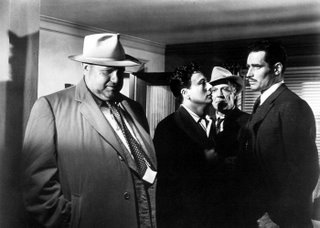
Touch of Evil: 50th Anniversary Edition DVD

Touch of Evil (1958)

A special 50th Anniversay 2-DVD set of Orson Welles’ film noir, Touch of Evil (1958), to  be released by Universal on October 7, will include in three versions of the movie, which most noir pundits agree marks the end of the classic film noir cycle:  theatrical, preview and restored based on Welles’ original vision, and a copy of the  58-page memo Welles  wrote to the studio before the film’s release asking for his original-cut re to  be restored, after it had been butchered by studio hacks. The request fell on deaf ears.

More info from Welles.Net.

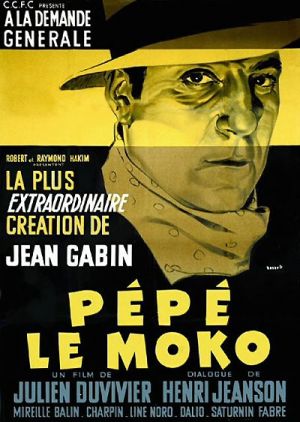
Full Program for French Crime Wave Series Now Out

Pépé Le Moko (1937)Pépé Le Moko (1937)

Further to my post of July 11, the full program for the The French Crime Wave: Film Noir & Thrillers 1937-2000 series is now available on the New York Film Forum Web Site. The Series has been dedicated to the memory of Jules Dassin, who died this year.

Over four weeks from August 8 to September 4 the NY Film Forum Movie House, 209 West Houston Street, New York NY 10014, will screen 38 French films noir and thrillers:

Band Of Outsiders
Bob Le Flambeur
Borsalino
Breathless
Casque D’or
Le Cercle Rouge
La Cérémonie
Classe Tous Risques
The Clockmaker
Coup De Torchon
Diabolique
Le Doulos
Elevator To The Gallows
Eyes Without A Face
Un Flic
Garde À Vue
Goupi Mains Rouges
A Man Escaped
Mississippi Mermaid
Murderous Maids
Pépé Le Moko
Pickpocket
Pierrot Le Fou
La Piscine
Police Python 357
Purple Noon
Quai Des Orfèvres
Rififi
Riptide
Série Noire
Shoot The Piano Player
The Sicilian Clan
The Thief Of Paris
Les Tontons Flingueurs
Touchez Pas Au Grisbi
La Vérité
The Wages Of Fear
We Are All Murderers

The Dark Knight (2008): Still a comic

The Dark Knight (2008)The Dark Knight is worth seeing for Heath Ledger’s bravura study in psychopathology, but as a movie it rarely strays from the confines of its comic-book origins.

Many are waxing lyrical on the “dark vision” and the portrayal of a flawed Batman, and this is true, but to say that the picture “is a straight-up gritty, dirty, soul-rending film noir crime drama” *, is pure hyperbole.  In the film noir universe, there are no super-heros.

As a film it has also major flaws: confused editing with dis-jointed dialog, and an obsession with the minutiae of violence.

* Review by Movie Blawger at SportingNews.com.

Gun Crazy (1950): Not so Bonnie and Clyde

Gun Crazy (1950)Violent femme and husband with a gun fetish decide to emulate Bonnie & Clyde (Orig title: Deadly is the Female, King Bros Productions 1950, Directed by Joseph H. Lewis, 86 mins)

I greatly admire Lewis’s film noir The Big Combo (1955), but Gun Crazy is a lesser work.  I am not sure it is even a film noir.

While there is a potent mix of sex and violence, layered with psycho-sexual motifs and fetishes, the narrative lacks tension and some scenes are very slow. Peggy Cummins is strong as the psychopathic urban gun-slinger, Laurie, but there is no depth or history to this woman who kills on reflex and with no remorse. The rest of the cast is ok only, and it is the director’s signature obsession with violence as a sexual psychosis that drives the story.  Gun Crazy is really a robbers-on-the run movie with noir pretensions, and these are only really evident in the climactic early morning shoot-out at the end in a fog-laden creek.  Bart, Cummins’ partner in crime, achieves some sort of redemption by shooting Laurie dead before she can kill two of his un-armed child-hood friends, one a deputy sheriff, who approach them  pleading that they give themselves up, after which he is killed in a hail of police bullets.  There is a tragic irony here: the man who is not a killer kills his reason for being.

The much-acclaimed long take inside the get-away car before, during, and after a bank robbery, is innovative for the period, but the action is flat until after the heist and they are pursued by the cops.  Low and high camera angles are used by Lewis to express mood and suggest sexual undercurrents, but if they operate on the audience, do so only unconsciously. While much has also been made of the ‘amour fou’ of the two protagonists, it is more an instinctual sexual attraction that is sustained on Laurie’s part by the sexual gratification that she achieves in their life crime.

Interesting historically and although it transcends its b origins, Gun Crazy is not a great movie. It’s cult status has more to do with the perversity of the theme and the performance of Cummins, than its merits as a filmic work.


Gun Crazy (1950)