New Edition of The Film Noir Encyclopedia Slated for April 2010

The Encyclopedia of Film Noir 2010

A long overdue fourth edition of  Film Noir: An Encyclopaedic Reference to the American Style co-edited by Alain Silver, Elizabeth Ward, James Ursini, and Robert Porfirio (3rd Edition 1992) is slated for April 2010 and can be pre-ordered for US$26.40 from Amazon. This classic reference has been completely revised, expanded, redesigned, and retitled The Film Noir Encyclopedia.

I have found the third edition an invaluable reference on American film noir and neo-noir, though the authors’ insistence that film noir is a purely US phenomenon leaves some large gaps.  Alain Silver’s reviews are superior to those of the other editors and can be wonderfully enlightening. I hope two common weaknesses in the previous editions, significant errors in plot outlines and pedestrian and over-blown reviews by some co-editors, will be remedied in the new edition.

The Noir City: A Cosmic B-Movie

noir city

My shadow’s the only one that walks beside me
My shallow heart’s the only thing that’s beating
Sometimes I wish someone out there will find me
‘Til then I walk alone…

Green Day – Boulevard Of Broken Dreams

The origins of this post lie in a book I found in a used bookstore a few months back: The Cinematic City edited by David B Clarke (Routledge 1997). This is an academic book with a collection of essays on the “relationship between city and cinema”, which contains some fascinating essays on the noir city. The central thesis is that the modern metropolis is so large and diverse, that inhabitants’ experience of  the modern city is alienated.  This experience of modernity has shaped the cinema’s portrayal of the city as a place, and the cinematic city is a place as real as the physical entity it represents.

Having never been to the US, I realised that through my love of film noir, I ‘know’ the cities as Los Angeles, Chicago, New York, and San Francisco as a virtual stranger, and that even for those living in these cities, they experience their city as strangers:

Whereas the social and physical spaces of pre-modem society formed an intimately related, lived totality, modernity brought about their colonization by a thoroughly abstract space, which ensured their fragmentation and disjuncture. A world that was once perceived ‘as a living whole’, so to speak, could no longer be experienced as whole or complete… The ambivalence of the stranger thus represented the ambivalence of the modem world. Time and space were no longer stable, solid and foundational. Hence, the experience of modernity equated… [with ] the world as experienced by the stranger, and the experience of a world populated by strangers — a world in which a universal strangehood was coming to predominate . It was within such a world that the virtual presence of the cinema was to find its place (Clarke page 4)…  In the arena of the noir city, protagonists must confront both the strangeness of others and the strange otherness within – as film noir’s scenarios of disorientation and dislocation challenge their ability to chart an identity (F Krutnik page 89).

NOIR CITY DC: The 2009 Film Noir Festival

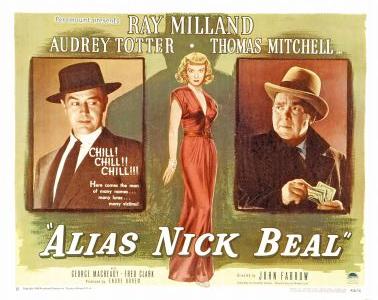
Alias Nick Beal (1949)

The Film Noir Fndation is presenting the NOIR CITY DC: The 2009 Film Noir Festival  over October 24 – November 4.

The program features new 35mm prints of these classic noirs:

  • SLIGHTLY SCARLET (1956)
  • ACE IN THE HOLE (1951)
  • GUN CRAZY (1950)
  • WICKED AS THEY COME (UK, 1956)
  • ALIAS NICK BEAL (1949)
  • THE BIG COMBO (1955)
  • SHAKEDOWN (1950)
  • BEYOND A REASONABLE DOUBT (1956)
  • OUT OF THE PAST (1947)
  • THE KILLERS (1946)
  • HOLLOW TRIUMPH (1948)

Full details here.

The Maltese Falcon: The beginning of noir

The Maltese Falcon (1941)

John Huston’s 1941 screenplay was the first serious attempt to bring the hard-boiled nature of Hammett’s fiction to the screen. The 1931 version may have more closely followed the story of the novel, but it did not carry the hard-boiled spirit of Spade to the screen, and the 1936 version, Satan Met a Lay, with Bette Davis played the story as broad comedy.

David Spicer wrote in his book Film Noir (2002) that Huston’s film “was much closer than previous versions to the cynical tone of Hammett’s hard-boiled novel, retaining as much of Hammett’s dialogue as possible”.  William Luhr, in his book on the 1941 version says that: “Spade does not happily juggle a plethora of women but is bitterly involved with only two… For him, sexuality is not carefree but dangerous and guilt-ridden. The mystery and the evil world it reveals dominate the mood of the movie, and this sinister atmosphere does not entirely disappear at the end. Such an atmosphere presages film noir.”

The Spade of Hammett’s novel is deeply cynical, and at the end of the novel, but not in Huston’s film, he is ready to resume his affair with Archer’s wife. Mayer and McDonnell in The Encyclopedia of Film Noir (2007), say this about the final scenes in Huston’s screenplay: “Huston replaces Hammett’s cynicism with a more romantic gesture from Spade as he tells Brigid, ‘Maybe I do [love you]‘. While Ricardo Cortez’s Spade in 1931 is more or less resigned to handing Wonderly over to the police, Huston extends this sequence by accentuating the psychological disturbance within the detective. His torment is palpable, especially when he shouts into her face that ‘I won’t [fall for you] because all of me wants to, regardless of the consequences’. While this is not an existential moment, as some claim, it does represent a significant moment in the development of film noir. Unlike the novel, where survival is all that matters to the detective, Spade’s torment in the 1941 film nearly destroys him.”

Blues in the Night (1941): Noir Counterpoint

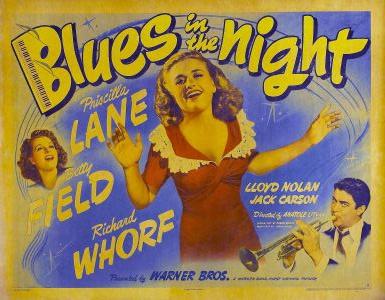
Blues in the Night (1941)

Blues in the Night (Warner Bros 1941) is a fascinating musical noir melodrama about a budding white jazz band scripted by Robert Rossen, directed by Anatole Litvak, and atmospherically lensed by Ernest Haller, with a b-cast, including a very young Elia Kazan, as a dizzy jazz clarinetist. These impeccable leftist credentials are reflected in the plot and the resolution which talk to personal integrity and the values of solidarity and loyalty. Amazingly for the period an establishing scene in a police lock-up respectfully credits the music’s black roots. Tied up in all this is a noir arc with a hood played by Lloyd Nolan and a killer performance by Betty Field (an actress who sadly went nowhere) as a cheap femme-fatale.  The socially aware feel-good ending is tempered by the noir-like denouement for the hoods and the femme-noir.

This movie is a serious contender as a seminal film noir,  remembering The Maltese Falcon was made in the same year, Stranger On the Third Floor only a year earlier in 1940, and Double Indemnity a full three years later in 1944.

Sexual Imagery in Film Noir: Tread Softly Stranger (1958)

Dian Dors - Tread Softly Stranger (1958)

Tread Softly Stranger (1958) is a top-class British noir set in a steel town in the North of England, starring Diana Dors, as a sultry femme-noir.  Two brothers are desperate for money after one has been stealing from his employer, a steel mill, to finance his infatuation with Dors.  She suggests a heist to cover the fraud and it of course goes badly wrong.  The second brother also falls for the woman, and this scene where physical violence becomes sexual attraction is deftly handled by director Gordon Parry with potent imagery that flows with the narrative as the scene shifts to the next day at the steel works…

The First Rule of Film Noir: “A Dame With a Past and a Hero With No Future”

Out of the Past

Check out this recent primer from BBC4:  The Rules of Film Noir.  Odd that it makes no mention of British Noir. I was also disappointed that little attribution was given to the film-makers with most of the attention on the stars.  The talking heads also spoke in generalities.  The best sequence is where a British cinematographer takes you through a series of tracking shots from The Sweet Smell of Success with Burt Lancaster and Tony Curtis in conversation as they walk-stop-walk on a Manhattan street. Pure artistry. But zero credit to the brilliant work of DP James Wong Howe!

Allotment Wives (1945): The main squeeze is a dame!

Allotment Wives (1945)

A title that conjures up sordid images doesn’t disappoint.  A b-programmer from Monogram co-produced by and starring the sublime Kay Fancis as a crime-boss in one of her last roles, Allotment Wives is really a late gangster flick.   The organisers of the San Francisco’s Roxie Theatre coming noir series,  I WAKE UP DREAMING: The Haunted World of the B Film Noir,  have stretched the envelope by including this feature. Though others no doubt will pull out the tired arguments: the emasculating femme-noir threatening male dominance during the War, and the eroticisation of violence.

Allotment Wives (1945)
“Nice shooting…”

The story of a woman who uses her social status and ill-gotten wealth to front a bigamy racket where dames marry multiple GIs during WW2 to skim the allotment support paid by the Defense Dept to spouses of men on active duty, is predictable but well-made with a snappy script. Noir regular Paul Kelly as an army investigator is disappointingly wooden and his performance is underwhelming at best. Otto Kruger is fine as the lady boss’ right-hand man.  The climax is brutal with Francis plugging a dame without qualm or remorse, but justice triumphs in the end.  Francis’ flamboyant hats and her hair-do add a juicy camp quality to the goings-on.

Nightfall (1957): Final curtain call for classic noir

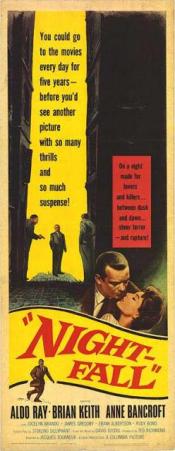
Nightfall (1957)

Jacques Tourneur’s Nightfall signals the coming end of the classic noir cycle, followed only by Murder By Contract and Touch of Evil in 1958, and Odds Against Tomorrow in 1959.

Despite Tourneur’s directorial elan, excellent noir photography from Burnett Guffey, and a script based on a David Goodis novel, the movie clearly attests to the decline of the film noir cycle. The story of the innocent man entrapped by fate and on the run from both the cops and hoods has been played out many times before, and Tourneur does not manage to invest the scenario with any real tension. Even at 78 minutes the screenplay takes too long to reach its rather pat resolution.

Nightfall (1957)

Aldo Ray and Ann Bancroft in the leads are well cast, and the development of their relationship from a pick-up at a bar in LA and its flowering in the snow-drifts of Wyoming, is handled with economy and flair. The dialog is intelligent and the inter-play between two mis-matched hoods and their prey is strikingly good. The violence whether threatened or real is particularly noir.  The two merciless hoods threaten to snap the legs of the protagonist on the boom of an oil rig, and the pitiless gunning down of a victim is still shocking to a jaded noir sensibility. But a climactic fight in the snow against an out-of-control snow plough is bereft of any true suspense, and even the final gruesome aftermath lacks real impact.

A Lighter Shade of Noir: Matinee Double-Bill

A Woman's Secret (1949) Hollywood Story (1951)

A Woman’s Secret (1949) and Hollywood story (1951), two flicks that carry a film noir classification on IMDB which I watched in the past week, I found  to be hardly noir at all.

A Woman's Secret (1949)

A Woman’s Secret, an RKO-feature, has great credentials. The movie is directed by Nicholas Ray from a screenplay from Herman J. Mankiewicz, with photography from George Diskant, and starring Maureen O’Hara, Melvyn Douglas, and Gloria Grahame.  It starts off noir with a shooting off-screen, and the use of flashback in the narrative, but plays out as sophisticated melodrama with a biting wit, and some really funny slapstick when the wife of the investigating cop does her own snooping with a handbag carrying fingerprint powder and a giant magnifying glass. The story of the conflict between a naive young singer (Grahame) and her controlling mentor (O’Hara), has shades of All About Eve but this motif is not taken too seriously.  The two female leads are charming, with Grahame displaying an engaging gift for comedy.  Melvyn Douglas is as debonair as you would expect and takes the role of narrator and referee.  Great fun.

Hollywood Story (1951)

Hollywood Story is a programmer from Universal that has a 50s television feel.  Richard Conte is a producer in LA that wants to make a movie about the murder of a big silent movie director 20 odd years before, and his delving into the past has violent consequences.  A  strictly b-effort that plays well as a whodunit with noir atmospherics, and some really funny lines.