New Book on Maverick Film-Maker Samuel Fuller

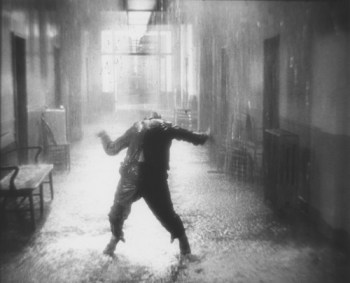
Shock Corridor 1963
Shock Corridor (1963)

Professor of film studies Wesleyan University, Lisa Dombrowski has just published The Films of Samuel Fuller: If You Die, I’ll Kill You!.

In a press release Dombrowski said of Fuller:

His films are inherently fascinating. They’re designed to reach out and grab you. They’re provocative; they want you to respond emotionally and intellectually and sometimes even physically in an instinctual manner, as if someone has punched you in the face. He accomplished his goals in different ways. In the content, he discussed controversial issues of the time, race, gender, violence, critiques of America. Also, through their narrative structure, they emphasize conflict and contradictions, with dramatic tonal shifts that are jarring.

A book-signing and discussion of Fuller by Dombrowski will be held Thursday 24 April 2008 at 7:30 p.m. at the Goldsmith Family Cinema, 301 Washington Terrace, on the campus of Wesleyan University in Middletown, Connecticut. The signing will be held in conjunction with a screening of the 1955 Fuller thriller House of Bamboo.

Reviews of Samuel Fuller noirs on filmsnoir.net:

Pickup On South Street (1953)
The Crimson Kimono (1959): Little Tokyo Rift
The Naked Kiss (1964): Pulp Noir

Review of Fritz Lang’s M

M 1931

US novelist David Schleicher, has posted a very worthy review of Fritz Lang’s M (1931) on his blog.

Murder, My Sweet (1944): A face like a Sunday school picnic

Murder My Sweet (1944)It was a nice little front yard.
Cozy, okay for the average family…
only you’d need a compass
to go to the mailbox.

The house was all right, too,
but it wasn’t as big as Buckingham Palace.

I had to wait
while she sold me to the old folks.
It was like waiting to buy a crypt
in a mausoleum.

Watching Murder, My Sweet (aka Farewell My Lovely – 1944) , is the most fun you will ever have with a film noir. Raymond Chandler’s hard-boiled prose crackles in this screen adaption by John Paxton, with moody noir direction by Edward Dmytryk.

Inhabiting a plot about a rich dame’s stolen jade necklace almost as convoluted as The Big Sleep (1946), the cast is superb. Dick Powell has a comic edge that brings a lightness to the shenanigans, and is a superb foil to the camp turn by Claire Trevor as the putative femme-fatale. Anne Shirley is as cute a 40’s starlet as ever graced the screen. The bad guys are bigger than life and truly entertaining, and rub each other out without ceremony or prevarication. It looks like a film noir, but the bad guys and gals are truly bad, and the good guy and gal are incorruptible.

Look out for the innovative “purple haze” sequence, after PI Marlowe is drugged by a crooked quack.

Murder My Sweet (1944)

The Bridge and the City Motif in Film Noir

The bridge motif has powerful symbolism in film noir. These poignant shots from the final fatal scenes of three films noir attest to this:

Night And the City 1950
Night and the City (1950)

Force Of Evil 1948
Force of Evil (1948)

roadblock4.jpg
Roadblock (1951)

[piclens-lite-link]

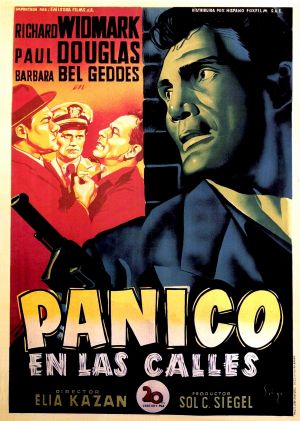
Panic In the Streets (1950): Neo-Realist Noir

Panic In The Streets (1950)


Local authorities track down violent hoods infected with a virulent infection.

Panic In the Streets (1950) is an interesting documentary-style noir set on the docks of New Orleans: a fast-paced on-the-streets thriller with little time or inclination for deep characterisation. The movie picked up the Venice International prize in 1950, and an Oscar for Best Writing in 1951. Tautly directed by Kazan and with strong street cred: the climax on a ship’s mooring rope is elegantly metaphoric.

Richard Widmark is cast against (then) type as the local health official pushing the cops to track down the killers of an illegal alien who has infected the hoods with pneumonic plague. Paul Douglas is well-cast as the reluctant cop who heads the police task force. Jack Palance and Zero Mostel are strong as the hoods, with a certain tension between them: Palance is focused and brutal, while Mostel is nervous and obsequious. Cinematographer, Joe MacDonald, who did similar work in The Dark Corner (1946), has filmed the night scenes with moody noir atmospherics.
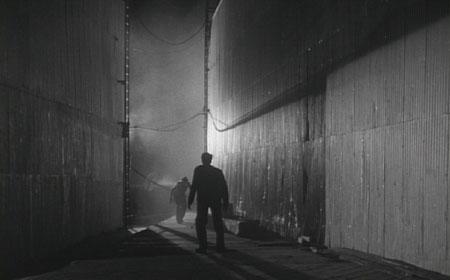
Panic In The Streets (1950)

Given Kazan’s tendency for emotional distance and the cinema-verite approach, there is a strong social dimension to the picture. The working people in the docks milieu distrust the cops and are uncooperative, and the cops and local bureaucrats are reluctant partners. The mood is of dysfunction and the trajectory is that it is only the doggedness of Widmark and Douglas that saves the day.

All this points to Kazan’s complexity and contradictions. While those on the edge of criminal society are fairly portrayed, there is the feeling that they are stubborn and boorish, and need to be bullied by authority. At the same time, public institutions are seen at logger-heads and can only function effectively if commandeered by strong personalities.

Conventionally, Widmark and Douglas develop a grudging respect for each other and by the end of the story are friends. Strangely, this relationship for me is the core of the film, and comes not only from what happens on the screen, but also from a backward almost nostalgic perspective. Both these actors invest their roles with an essential integrity: they are not perfect, struggle financially, and their personal lives have their share of bewilderment and angst, but they are thoroughly decent men doing tough jobs, for lousy pay, and little social recognition or thanks. These guys inhabit a lost black and white world of simpler times when normal lives seemed to have greater decency. Perhaps also this perception is colored for me by Paul Douglas, a wonderful actor who always came across as a totally solid guy that you would love to have as your friend.
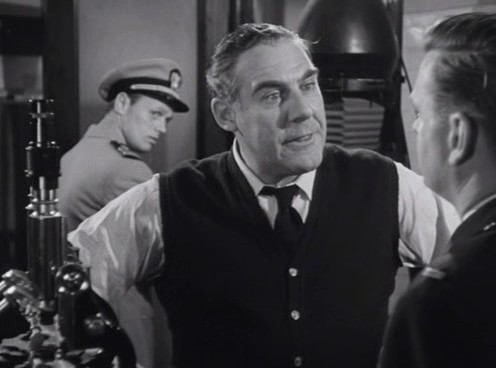

Panic In The Streets (1950)

Noir Novelists in Hollywood

Noir Novelists in Hollywood: An Overview
Free Seminar with Film Scholar James Naremore
Thursday, April 10, 2008 @ 6:00 p.m.
Chicago Public Library
400 S. State Street
312-747-1194

Scholar and film noir writer, James Naremore, professor emeritus of film studies at Indiana University-Bloomington, and author of More than Night: Film Noir in Its Contexts, explores how the work of authors such as Raymond Chandler, Dashiell Hammett and James Cain was adapted by Hollywood. This is a One Book, One Chicago event.

Charleton Heston Dead at 84

Touch Of Evil (1958)

Actor, Charleton Heston, died today. He starred alongside director Orson Welles in the last great noir of the classic cycle: Touch of Evil (1958).  Heston’s first role  was as a crooked gambler in the crime thriller cum noir Dark City (1950).

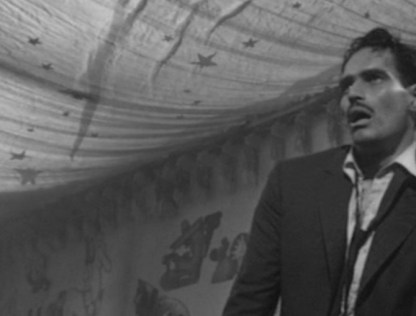
Night And the City (1950): A Near Perfect Noir

Night And the City 1950Night and the city.
The night is tonight, tomorrow night…
or any night.
The city is London.

This anonymous voice-over introduces Jules Dassin‘s Night and the City (1950), which has to be one of the great noirs: a near-perfect work.

Dassin crafted a mesmerising study of thwarted ambition and tawdry betrayal into a dark existential journey of the human soul, played out in the dives and night-clubs of post-war London fashioned as the quintessential noir city. This is not a b-movie, the production values are high, and Dassin has total command of his mise-en-scene.

But the achievement is not Dassin’s alone. There is also a literate script by Jo Eisinger, wonderful expressionist photography from Mutts Greenbaum, who cut his teeth in the German silent cinema, and deeply moving portrayals by the major players. Richard Widmark’s performance is frenetic and real, and the soft counterpoint of an achingly elegant turn by Gene Tierney as his girl, transubstantiate Harry’s demise into the stuff of tragedy. Each supporting role is vividly drawn by an excellent ensemble cast.

You know Harry Fabian is doomed from the start: a dreamer of wrong dreams and sympathetically amoral, he is no match for fate and the immoral traffickers of wrestlers and cheap champagne, who plot his destruction. He is a hustler yes, but not in the same league as the big guys, the “businessmen” whose greed has no bounds and whose actions are never tempered by remorse. Harry thinks he knows all the angles, but he is not ruthless enough for that.

Harry. Harry.
You could have
been anything.
Anything.
You had brains…
ambition.
You worked harder
than any 10 men.

But the wrong things.
Always the wrong things.

This slideshow requires JavaScript.

Towards a Definition of Neo-Noir

Blogger cineycrispetas has posted an excellent essay on neo-noir on his Géneros cinematográficos:

What defines then the noir spirit? Could it be the “cynical and the pessimistic tone […] the darker side of human condition, modern fables that highlight the dangers of alienation, the fragmentation of society, the breakdown of human interaction, the debasement of love, the beguiling power of wealth, the corruption of government, and mankind’s inherent propensity for inertia and impotence”… Is noir “spirit” allowed to evolve, mutate as the environment in which it exists changes? It is also entitled to refer and quote to the noir canon since contemporary audiences are not only conscious of the legacy of noir but also amenable to noir references in modern perspectives and environments?

Progressive Origins of Film Noir

Force Of Evil

Force of Evil (1948)

With the passing of Jules Dassin, it is worth noting that social criticism in early film noir is largely ignored by most contemporary noir pundits and populists.
James Naremore in his 1998 book on film noir, More than Night: Film Noir in Its Contexts, mounts a strong argument for the leftist origins of film noir (my emphasis):

…most of the 1940s noir directors — including Orson Welles, John Huston, Edward Dmytryk, Jules Dassin, Joseph Losey, Robert Rossen, Abraham Polonsky, and Nicholas Ray—were members of Hollywood’s committed left-wing community. Among the major crime writers who provided source material for dark thrillers, Dashiell Hammett, Graham Greene, and Eric Ambler were Marxists to one degree or another, and Raymond Chandler and James M. Cain were widely regarded as social realists. Among what Robert Sklar has described as the major “city boy” actors of the period, Bogart and John Garfield, who played veterans of the Lincoln Brigade in Casablanca and The Fallen Sparrow (1943), were icons respectively of liberalism and leftist radicalism. Meanwhile, the credits for noir screenplays usually included such names as Albert Maltz, Howard Kotch, Waldo Salt, and Dalton Trumbo, all of whom were eventually blacklisted, and these screenplays were often based on literature by such politically engaged figures as Kenneth Fearing, Vera Caspary, Daniel Fuchs, and Ira Wolfert.

There is good reason to conclude that the first decade of American film noir was largely the product of a socially committed fraction or artistic movement in Hollywood, composed of “Browderite” communists (after Earl Browder, head of the American Communist Party) and “Wallace” Democrats (after Henry Wallace, the radical vice president and potential successor to Franklin Delano Roosevelt). This movement is somewhat downplayed by Borde and Chaumeton, who emphasize the anarchic, antisocial qualities of noir and who initially argued that the form died off with the rise of neorealist policiers in the late 1940s. The Cahiers critics and subsequent American commentators tended to depoliticize noir even further, thereby obscuring the fact that many of the best thrillers of the 1940s and early 1950s were expressions of the Popular Front and the radical elements of the New Deal. A more accurate account would show that although the noir category viewed as a whole has no essential politics, it has formative roots in the left culture of the Roosevelt years—a culture that was repressed, marginalized, and virtually extinguished during the postwar decade, when noir took on increasingly cynical and even right-wing implications. During the 1950s, the congressional hunts for communists in Hollywood were themselves based on a kind of noir scenario and were crucially important to the history of American crime movies, affecting not only their politics and their doom-laden atmosphere, but also their reception by later generations. (pp 104-105)