
Fritz Lang’s Human Desire, made after The Big Heat (1953), brings together the two stars from that film, Glenn Ford and Gloria Grahame, in a relentlessly sordid noir melodrama of lust, infidelity, murder, and deceit played out on a wide screen.
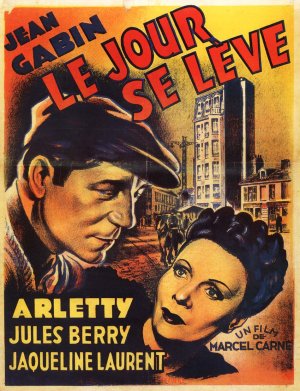
The screenplay by Alfred Hayes, who worked on Lang’s Clash By Night (1952), is based on Emil Zola’s novel La Bête Humaine, which was first adapted for the screen by Jean Renoir in 1938 in one of the major films of the French poetic realism cycle, and starred Jean Gabin and Simone Simon. The poetic realism cycle of the late 1930s in France is considered by some film scholars a precursor to American film noir, and the eroticism of the Renoir film makes the strongest case for such a connection. That said, I see that little is to be gained by comparing Lang’s picture with Renoir’s. Each film is grounded in a different social milieu, and Lang’s effort is more deterministic as befits a late cycle American noir.

For the first five minutes of the picture Lang introduces his story using shots of a locomotive-powered inter-urban passenger train barrelling through a flat landscape and one last tunnel before it reaches the ordered tangle of converging and diverging tracks at its destination. From the first frame the evocative musical score of Daniele Amfitheatrof establishes both an echo of the train’s rumbling progress and a dark counterpoint that portends the dark drama that will follow in the diesel’s wake. Lang brilliantly uses the train’s inexorable passage and the determinism of the rails that brook no turning back or detour: fate is laid out in hard steel, and the switches and way-lays are beyond the driver’s control – all he can do is slow or speed his progress along an ineluctable pre-ordained trajectory – and even then he has a schedule to stick to.
Jeff Warren (Glenn Ford), a returning Korean war vet is shown as the driver in fast cuts to the cabin of the speeding locomotive. This montage of scenes establishes a parallel metaphor. Jeff as the train driver is essentially passive and has no control over the train’s path, and in his life he is also happy to go with the flow, not to think too much about where his headed or why.
When he hits town his stated ambition is to keep a steady job, go fishing, and take in a movie. A decent young girl who has been waiting for him declares herself as the ‘right woman’ to share this life, but he is passive and makes no serious effort to deepen the relationship. Trouble starts when he meets the wrong woman on a train, soon after a murder has been committed in an adjoining carriage. Enter the erotic Gloria Grahame, sexually available and looking for a drink, but she settles for a cigarette and a languorous kiss between strangers. She is married to an insanely jealous older man, whom she does not love. But can she love any man? She is damaged goods and desperately needs help to escape not only the confines of her marriage but destroy the terrible secret hold her husband has over her. Situation dire. Is she a femme-fatale, or a woman so used and abused by men from a young age that she is forced to use her sexuality as a weapon just to survive? She lies but she doesn’t lie, she tells the truth but not the whole truth, and not all at once.

Grahame’s performance is powerfully convincing and Broderick Crawford is solid as the husband, but Ford lets the team down badly – rarely is his lack of depth so visible and so damaging. The strength of the climax requires more than Ford is capable of and the drama is dissipated to the extent that he needs to show terror, contempt, or real anger.
Even with this significant weakness, Lang and his cameraman, Burnett Guffey, are unrelenting in their unblinking gaze on the dark underside of modern American life. Lang does not flinch from showing the ugliness and malevolence in a world brightly lit and without visible shadows: a man has been murdered behind a closed train compartment door – cut to a close-up of another man’s hand holding a bloodied knife wiping the blood off by rubbing the blade on his suit.







 FilmsNoir.Net - all about film noir