W R Burnett: Master of noir imagery

The Asphalt Jungle

From W.R. Burnett’s novel  The Asphalt Jungle (1949).  Notice how often the adjective ‘black’ is used.

Dix made no comment and sat looking off across the wide black river,
which moved sluggishly southward between its steep cement
embankments toward its faraway union with the Mississippi.
There was no moon, but the sky was cloudless and a handful of bright
stars, diamond points of bluish light, glittered coldly over the tall
buildings on the far shore. The houses along the embankment were
almost all dark, but here and there a window showed light and cast
golden zigzag reflections onto the shiny black pavement of the river. A
slow, damp wind was blowing, carrying a smell of deep water.
Late as it was, traffic was fairly heavy on the big, three-lane bridge.
Suddenly a siren wail rose from the darkness of the far shore, and in a
moment a prowl car passed them, going back at high speed toward
the hilly slums of the Camden Square district.

_____________________

A dark, blustery night had settled down like a cowl over the huge,
sprawling Midwestern city by the river. A mist-like rain blew between
the tall buildings at intervals, wetting the streets and pavements and
turning them into black, fun-house mirrors that reflected in grotesque
distortions the street lights and neon signs.

The big downtown bridges arched off across the wide, black river into
the void, the far shore blotted out by the misty rain; and gusts of wind,
carrying stray newspapers, blew up the almost deserted boulevards,
whistling faintly along the building fronts and moaning at the
intersections. Empty surface cars, and buses with misted windows,
trundled slowly through the downtown section. Except for taxis and
prowl cars, there was no traffic.

River Boulevard, wide as a plaza and with its parkways and arched,
orange street lights stretching off into the misty horizon in diminishing
perspective, was as deserted as if a plague had swept the streets
clean. The traffic lights changed with automatic precision, but there
were no cars to heed or disobey them. Far down the boulevard, in the
supper-club section of the city, elaborately glittering neon signs
flashed off and on to emptiness. The night city, like a wound-up toy,
went about its business with mechanical efficiency, regardless of man.

_____________________

Dix sat up with a start and looked about him as if he’d never seen this
place before—never heard of it even. He had an uneasy feeling that he had
been lifted up in the night by unknown hands and carried to
this place of exile, this alien city with its canyons of masonry and its
unpredictable and ugly ways—far from home, far from sense and
meaning, far from any resting place.

_____________________

They were living very close to the river now, and all night long they
could hear the tugs moaning as they slid downstream pulling the
big coal barges; and sometimes, when it was exceptionally quiet,
they could hear the waves, stirred by the passage of the heavyladen
barges, washing and slapping against the old wharves at the
foot of Front Street. Through their one window they could see the
Lackawanna Street Bridge arching off toward the tall buildings of
the downtown area across the river. In the daytime the bridge was
huge, gray, and misty-looking; at night it was nothing but a long,
brilliant garland of yellow lights, duplicated upside down in the
black water.

_____________________

They cleared the suburb at last, and huge factories and warehouses
began to loom along their route. A light mist started to fall, making little
pinkish haloes about the street lights. For a while they skirted a
railroad embankment, and a freight train passed them going toward
town, and they heard the lonely, off-key ringing of the crossing-bells.
At last they pulled clear of the giant warehouses, the factories, the big
viaducts arching up out of the mists to nowhere, and came out into a
wide, flat, sparsely settled area, with a few poor, frame houses
grouped along cracked and weed-bordered sidewalks.

The mist turned to a drizzle, and the wet asphalt shone like black
glass, palely reflecting the widely separated street lights. A cold
wind began to blow, and Riemenschneider huddled down into his
big overcoat.
Chandler on Cain: “Proust in greasy overalls”

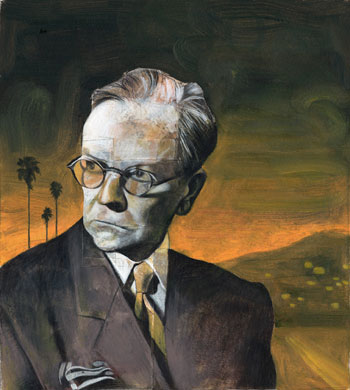
Raymond Chandler
“RAYMOND CHANDLER ” LOS ANGELES TIMES

Raymond Chandler wrote his publisher Alfred Knopf in February 1943:

I hope the day will come when I don’t have to ride around on Hammett and James Cain, like an organ grinder’s monkey. Hammett is all right. I give him everything. There were a lot of things he could not do, but what he did he did superbly. But James Cain—faugh! Everything he touches smells like a billygoat. He is every kind of writer I detest, a faux naif, a Proust in greasy overalls, a dirty little boy with a piece of chalk and a board fence and nobody looking. Such people are the offal of literature, not because they write about dirty things but because they do it in a dirty way.

– Frank MacShane, The Life of Raymond Chandler, 1978, p101)

On the Avenue

Laura (1944)

Those dames on the Avenue.  Wrapped and decorated exotic empresses. Ice-cold blondes and raven-haired goddesses loping from privileged canopies to long black limousines purring at the road-side. Glimpses of the dream. Full breasts dark hidden valleys of lush abandon. Ivory skin and golden tans. Long languid legs. Heaven between their thighs and a come-on swank to their hips. Curves sublime sheathed in gossamer. Perfumed gardens of blissful delight. Soft caresses and sweet moans. Eyes deep as emeralds and as hard.

Sweet Clover

The Killers

The headlight-beams of his car kept slashing up the road ahead of them like ploughshares, seeming to cast aside its topsoil of darkness, reveal its borax-like white fill, and spill that out all over the roadway.  Then behind them the livid furrows would heal again into immediate darkness.

It seemed hours they’d been driving like this, in silence yet acutely aware of one another. Trees went by, dimly lit up from below, along their trunks, by the passing reflection of their headlight-wash, into a sort of ghostly incandescence.  Then at times there weren’t any trees, they fell back, and a plushy black evenness took their place—fields or meadows, she supposed—that smelled sweeter. Clover. It was beautiful country around here; too beautiful for anyone to be in such a hell of suffering in the midst of it.

Roads branched off at times, too, but they never took them. They kept to this wide, straight one they were on.

– Cornell Woolrich, I Married A Dead Man (1948)


L.A. Night of the Broken Dream

Kiss Me Deadly (1955)

And I see you now, you woman of that night – I see you in the sanctity of some dirty harbor bedroom flop-joint, with the mist outside, and you lying with legs loose and cold from the fog’s lethal kisses, and hair smelling of blood, sweet as blood, your frayed and ripped hose hanging from a rickety chair beneath the cold yellow light of a single, spotted bulb, the odor of dust and wet leather spinning about, your tattered blue shoes tumbled sadly at the bedside, your face lined with the tiring misery of Woolworth defloration and exhausting poverty, your lips slutty, yet soft blue lips of beauty calling me to come come come to that miserable room and feast myself upon the decaying rapture of your form, that I might give you a twisting beauty for misery and a twisting beauty for cheapness, my beauty for yours, the light becoming blackness as we scream, our miserable love and farewell to the tortuous flickering of a gray dawn that refused to really begin and would never really have an ending.

John Fante – The Road to Los Angeles (1933)

A Colt is My Passport (Koruto wa ore no pasupoto – Japan 1967)

A Colt is My Passport (1967)

A Colt is My Passport, a wide-screen b&w movie from the prolific Hikkatsu studio, is a hip acid noir with a 60s patina and a surreal spaghetti-western score.  A twist on a classic noir  motif has a hit-man as existential hero, committed to an austere private code that elevates him above the yakuza hoods that want him dead after a mob hit goes wrong.

Director Takashi Nomura fills the screen with elegantly composed flowing senarios that pan and follow the action, giving movement to even establishing placement shots.  The mis-en-scene is austere yet perversely satirical.  While the planning and the mechanics of preparing for the hit are slowly paced and meticulous, the bland assured peregrinations of the hit man and his young apprentice, who are both dressed like loyal company men, and in one scene are seated in an office behind a desk,  have an unnerving quotidian ambience.  These guys are cold and distant, almost effigies.

However, the mood changes when the staging of the hit backfires and the two are on the run.  They hole up in a sea-side hotel and are aided by a young waitress attracted to the older man, whose bravery and protective loyalty to his young buddy take on a mythic dimension.  Here a mood of fatalism takes hold, and the inevitable final denoument  is telegraphed by their  entrapment in a closet-like room.  After a final desperate bid to shake-off the mobsters, the classic western theme of redemption emerges, with the hero returning to face his pursuers after parlaying his fate for the escape of his buddy, who learns of the pact too late.  The girl is left forlorn and bitter. The finale is a cinematic tour-de-force staged with mannered precision but hinging on a chaotic precipice of climactic violence and retributive justice.

You start by seeing the protagonist as a cousin of Melville’s  inscrutable Samouri but by the end of the film he has been transformed into an avenging angel.  Uber cool.

Your Ghost: “let him shoot me down”

Meshes of the Afternoon (1943)

Your Ghost (1994) – Kristin Hersh

If I walk down this hallway, tonight,
It’s too quiet,
So I Pad through the dark
and call you on the phone
Push your old numbers
and let your house ring
til I wake your ghost.
Let him walk down your hallway
it’s not this quiet
slide down your receiver
sprint across the wire
follow my number
slide into my hand.

It’s the blaze across my nightgown
it’s the phone’s ring.

I think last night
you were driving circles around me.

I can’t drink this coffee
til I put you in my closet
let him shoot me down
let him call me off
I take it from his whisper
you’re not that tough.

Re-Focusing Film Noir

The Big Sleep

After some recent reading on film noir, I am re-focusing my approach to film noir, and this re-appraisal will influence my coming film noir reviews.

If we go back to the hard-boiled detective novels of Dashiell Hammett and Raymond Chandler, we find protagonists who are essentially outsiders with personas concerned not with redemption but with maintaining a stasis that is outside the mainstream in an existential sense.  Sam Spade and Philip Marlowe are not concerned with money or status, conventional relationships, or necessarily following the letter of the law.  These guys are loners. Independent men above banal striving and ambition, but loyal to a code that not only guides but defines them.  While the PI works at the perimeter of convention, his realm goes beyond the dark sordid recesses of criminality to the rotten core of polite society.  Death-in-life is their métier, and integrity their salvation.  But this integrity and independence casts them adrift. They are of society but not anchored in it. Their alienation is knowing and desperate:  capitulation is existential death.  These guys are subversives as film noir is subversive:  a losing battle against chaos. Nietzche was wrong: superman is a ‘loser’. The loser is outside society, his alienation is a positive reverse-psychosis, he maintains his sanity in a crazy urban nightmare only by his detachment, yet he despairs of it.  Ambivalence and entrapment the cost.

What’s Happening in 2010

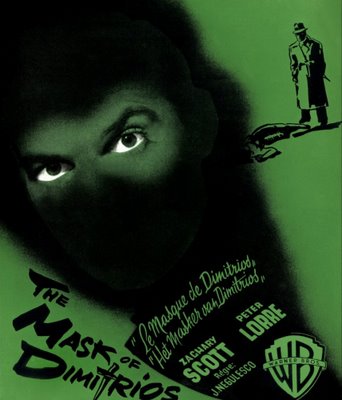
The Mask of Dimitrios

I will be reviewing a big backlog of noirs this year, and widening my focus to include reviews of noir fiction and books of commentary.  Reviews will generally be shorter than in the past, with an emphasis on a particular feature of interest.

Movies slated for review include:

A Colt is My Passport (1967 Japan)
The Amazing Mr. X (1948)
Asphalt (1929 Germany)
La Chienne (1931 France)
Harikomi (aka Stakeout 1958 Japan)
The Las Vegas Story (1952)
Leave her to Heaven (1946)
The Long Night (1947)
The Mask Of Dimitrios (1944)
Obsession (1948 UK)
Obsession (1949)
Odd Man Out(1947 UK)
Of Missing Persons (1956 Argentina)
Out of the Past (1947)
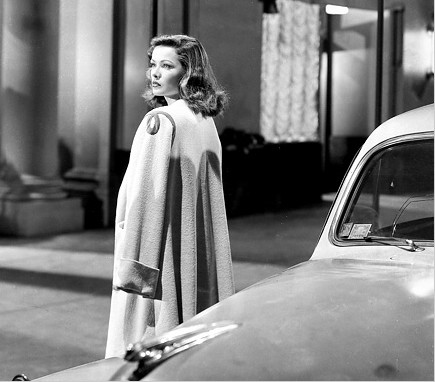
Phantom Lady (1944)
The Phenix City Story (1955)
Private Hell 36 (1954)
Pursued (1947)
Railroaded (1947)
Raw Deal (1948)
Scandal Sheet (1952)
The Second Woman (1950)
The Sleeping City (1950)
The Sound of Fury (1950)
Strange Illusion (1945)
The Strange Love Martha Ivers (1946)
Sweet Smell of Success (1957)
Tread Softly Stranger (1958 UK)
The Unfaithful(1947)
The Unsuspected (1947)
The Web (1947)
The Well (1951)
The Woman On the Beach (1947)
Where the Sidewalk Ends (1950)
World For Ransom (1954)

L.A. 1939: Ask the dust

MaxYavno-Underneath-Third-Avenue-El-1938
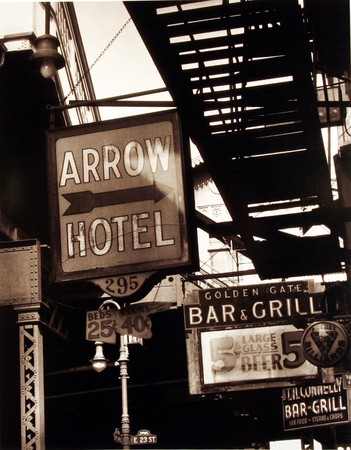
Max Yavno (Los Angeles: Underneath Third Avenue El –  1938)

I am currently reading a very interesting book, Unless the Threat of Death Is Behind Them: Hard-Boiled Fiction and Film Noir (2006 The Johns Hopkins University Press) by John T. Irwin, which studies five novels and the films based on them – The Maltese Falcon, The Big Sleep, Double Indemnity, High Sierra, and Night Has a Thousand Eyes.  Irwin’s thesis seems to be that noir is concerned with death metaphysically as life-in-being and death also in an existential sense bred of social alienation.  The following excerpts for me express the kind of prose Irwin is concerned with, and are passages from my own reading that have particularly struck me as being relevant.

“I went up to my room, up the dusty stairs of Bunker Hill, past the soot-covered frame buildings along that dark street, sand and oil and grease choking the futile palm trees standing like dying prisoners, chained to a little plot of ground with black pavement hiding their feet. Dust and old buildings and old people sitting at windows, old people tottering out of doors, old people moving painfully along the dark street. The old folk from Indiana and Iowa and Illinois, from Boston and Kansas City and Des Moines, they sold their homes and their stores, and they came here by train and by automobile to the land of sunshine, to die in the sun, with just enough money to live until the sun killed them, tore themselves out by the roots in their last days, deserted the smug prosperity of Kansas City and Chicago and Peoria to find a place in the sun. And when they got here they found that other and greater thieves had already taken possession, that even the sun belonged to the others; Smith and Jones and Parker, druggist, banker, baker, dust of Chicago and Cincinnati and Cleveland on their shoes, doomed to die in the sun, a few dollars in the bank, enough to subscribe to the Los Angeles Times, enough to keep alive the illusion that this was paradise, that their little papier-mache homes were castles. The uprooted ones, the empty sad folks, the old and the young folks, the folks from back home. These were my countrymen, these were the new Californians. With their bright polo shirts and sunglasses, they were in paradise, they belonged. But down on Main Street, down on Towne and San Pedro, and for a mile on lower Fifth Street were the tens of thousands of others; they couldn’t afford sunglasses or a four-bit polo shirt and they hid in the alleys by day and slunk off to flop houses by night. A cop won’t pick you up for vagrancy in Los Angeles if you wear a fancy polo shirt and a pair of sunglasses. But if there is dust on your shoes and that sweater you wear is thick like the sweaters they wear in the snow countries, he’ll grab you. So get yourselves a polo shirt boys, and a pair of sunglasses, and white shoes, if you can. Be collegiate. It’ll get you anyway. After a while, after big doses of the Times and the Examiner, you too will whoop it up for the sunny south. You’ll eat hamburgers year after year and live in dusty, vermin-infested apartments and hotels, but every morning you’ll see the mighty sun, the eternal blue of the sky, and the streets will be full of sleek women you never will possess, and the hot semi-tropical nights will reek of romance, you’ll never have, but you’ll still be in paradise, boys, in the land of sunshine.”

– John Fante, Ask the Dust (1939)

“No feelings at all was exactly right. I was as hollow and empty as the spaces between the stars. . . . Out there in the night of a thousand crimes people were dying, being maimed, cut by flying glass, crushed against steering wheels or under heavy tires. People were being beaten, robbed, strangled, raped, and murdered. People were hungry, sick; bored, desperate with loneliness or remorse or fear, angry, cruel, feverish, shaken by sobs. A city no worse than others, a city rich and vigorous and full of pride, a city lost and beaten and full of emptiness. It all depends on where you sit and what your own private score is. I didn’t have one. I didn’t care.”

– Raymond Chandler, The Big Sleep (1939)