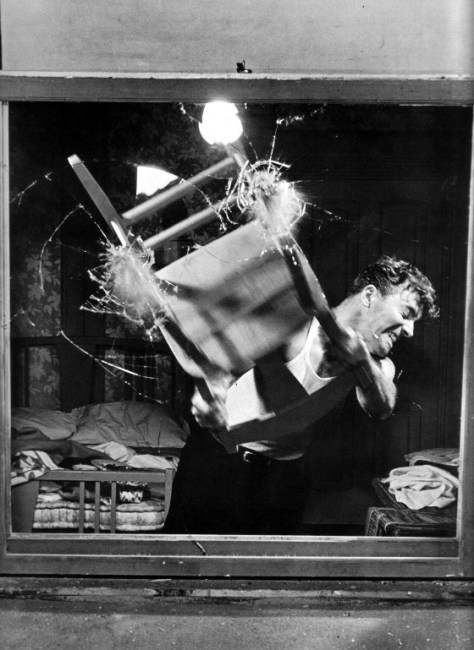
New Book on Maverick Film-Maker Samuel Fuller

Shock Corridor 1963
Shock Corridor (1963)

Professor of film studies Wesleyan University, Lisa Dombrowski has just published The Films of Samuel Fuller: If You Die, I’ll Kill You!.

In a press release Dombrowski said of Fuller:

His films are inherently fascinating. They’re designed to reach out and grab you. They’re provocative; they want you to respond emotionally and intellectually and sometimes even physically in an instinctual manner, as if someone has punched you in the face. He accomplished his goals in different ways. In the content, he discussed controversial issues of the time, race, gender, violence, critiques of America. Also, through their narrative structure, they emphasize conflict and contradictions, with dramatic tonal shifts that are jarring.

A book-signing and discussion of Fuller by Dombrowski will be held Thursday 24 April 2008 at 7:30 p.m. at the Goldsmith Family Cinema, 301 Washington Terrace, on the campus of Wesleyan University in Middletown, Connecticut. The signing will be held in conjunction with a screening of the 1955 Fuller thriller House of Bamboo.

Reviews of Samuel Fuller noirs on filmsnoir.net:

Pickup On South Street (1953)
The Crimson Kimono (1959): Little Tokyo Rift
The Naked Kiss (1964): Pulp Noir

Double Indemnity: The Unseen Ending

Double Indemnity (1944)

The final draft of the screenplay of Double Indemnity (1944) by Billy Wilder and Raymond Chandler in the Motion Picture Academy Library in Los Angeles – download from here – includes a final prison execution chamber scene and a line of dialog that was spoken by Walter Neff, just after he said “I love you.” to Barton Keyes. With sirens wailing in the background, Neff says: “At the end of that trolley line, just as I get off, you be there to say good bye. Will you, Keyes?” The story then shifts to the execution.

This sequence was filmed but cut (by the studio?) from the production release.

Double Indemnity (1944)

James Naremore in his 1998 book on film noir, More than Night: Film Noir in Its Contexts, offers this penetrating analysis and critique:

… the execution described in the longest version of the script greatly increases our sympathy for Walter, all the while raising questions about the criminality of the state. It also provides a tragic recognition scene for Keyes, who is shaken out of his moral complacency. This last point is especially important, because Keyes functions as a representative of the insurance company. Although he approaches his work with the intuitive flair of an artist and the intellectual intensity of a scientist, he remains a loyal agent of industrial rationality—a talented bureaucrat who, in effect, has helped to create the office building, the drive-in restaurant, the supermarket, and all the other landmarks of modern Los Angeles that the film relentlessly criticizes… One of the many virtues of Wilder’s original ending is that this complex, brilliantly acted character would have been made to confront his inner demon and to experience poetic justice. Keyes would have been brought face-to-face with the culminating instance of instrumental reason, the “end of the line” for industrial culture: the California gas chamber… For the original version of Double Indemnity, Paramount built an exact replica of the [San Quentin]  gas chamber, depicting it as a modern, sanitized apparatus for administering official death sentences. At considerable expense, Wilder photographed the step-by-step procedure of execution, emphasizing its coldly mechanical efficiency. There was no blood, no agonized screaming, and, for once in the movie, almost no dialogue. Much of the sequence was shot from Walter’s point of view, looking through glass windows at the spectators outside the chamber—an angle creating a subtle parallel between the chamber and the “dark room” of a movie theater. When the fatal pellets dropped, clouds of gas obscured the windows, and we could barely make out Keyes standing amid the witnesses, turning his head away. Soon afterward, a doctor entered the chamber to pronounce Walter dead. According to the script, the original film ended as follows:

… All the witnesses have now left except Keyes, who stares, shocked and tragic, beyond the door. The guard goes to him and touches his arm, indicating to him that he must leave. Keyes glances for the last time towards the gas chamber and slowly moves to go out. CORRIDOR OUTSIDE THE DEATH CHAMBER CAMERA SHOOTING IN THROUGH THE OPEN DOOR AT KEYES , who is just turning to leave. Keyes comes slowly out into the dark, narrow corridor. His hat is on his head now, his overcoat is pulled around him loosely. He walks like an old man. He takes eight or ten steps, then mechanically reaches a cigar out of his vest pocket and puts it in his mouth. His hands, in the now familiar gesture, begin to pat his pockets for matches. Suddenly he stops, with a look of horror on his face. He stands rigid, pressing hand against his heart. He takes the cigar out of his mouth and goes slowly on toward the door, CAMERA PANNING with him. When he has almost reached the door, the guard stationed there throws it wide, and a blaze of sunlight comes in from the open prison yard outside. Keyes slowly walks out into the sunshine, a forlorn and lonely man.

Until someone rescues this scene from the Paramount vaults, we will never know if it is superior to the current version, and even then there may be room for debate. One thing, however, is clear: Keyes’s lonely walk out of the prison would have thrown a shadow over everything that preceded it. It was not until Sunset Boulevard and Ace in the Hole that Wilder would produce such a savage critique of modernity. Although the released version of his famous thriller remains an iconoclastic satire that challenges the censors, it is a lighter entertainment than the original and a much easier product for Hollywood to market. (According to the Paramount press book, photographs of Barbara Stanwyck in her wig and tight sweater were circulated to American soldiers overseas, and Edward G. Robinson’s performance enabled the studio to obtain a tie-in from the Cigar Institute of America.) No matter how much we admire the film that was exhibited in 1944, the form of cinema that the French described as noir is probably better exemplified by another Double Indemnity, which we have yet to see.

The rare (Spanish?) poster featured at the top of this post features a rendering of Neff from the gas chamber scene. Note also the nightmarish imagery which has a definite surrealist quality, making this perhaps one of the most intriguing film noir posters ever. I am unsure of its origin or the artist. Perhaps a reader of filmsnoir.net can help in tracing its origin? The signature seems to be “Lopez Riem”?

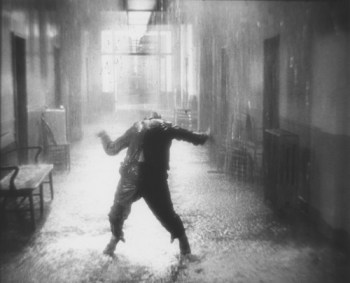
Night And the City (1950): A Near Perfect Noir

Night And the City 1950Night and the city.
The night is tonight, tomorrow night…
or any night.
The city is London.

This anonymous voice-over introduces Jules Dassin‘s Night and the City (1950), which has to be one of the great noirs: a near-perfect work.

Dassin crafted a mesmerising study of thwarted ambition and tawdry betrayal into a dark existential journey of the human soul, played out in the dives and night-clubs of post-war London fashioned as the quintessential noir city. This is not a b-movie, the production values are high, and Dassin has total command of his mise-en-scene.

But the achievement is not Dassin’s alone. There is also a literate script by Jo Eisinger, wonderful expressionist photography from Mutts Greenbaum, who cut his teeth in the German silent cinema, and deeply moving portrayals by the major players. Richard Widmark’s performance is frenetic and real, and the soft counterpoint of an achingly elegant turn by Gene Tierney as his girl, transubstantiate Harry’s demise into the stuff of tragedy. Each supporting role is vividly drawn by an excellent ensemble cast.

You know Harry Fabian is doomed from the start: a dreamer of wrong dreams and sympathetically amoral, he is no match for fate and the immoral traffickers of wrestlers and cheap champagne, who plot his destruction. He is a hustler yes, but not in the same league as the big guys, the “businessmen” whose greed has no bounds and whose actions are never tempered by remorse. Harry thinks he knows all the angles, but he is not ruthless enough for that.

Harry. Harry.
You could have
been anything.
Anything.
You had brains…
ambition.
You worked harder
than any 10 men.

But the wrong things.
Always the wrong things.

This slideshow requires JavaScript.

Rififi (France 1955): America’s Loss France’s Gain

Rififi (France 1955)

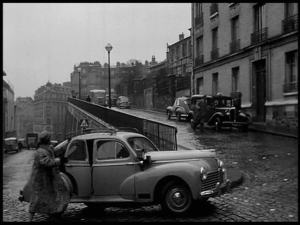
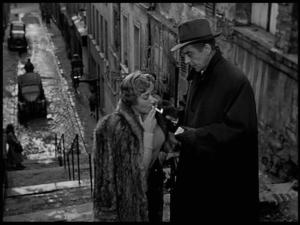
Rififi has to be the greatest French film noir of the 50’s. The taught direction of Jules Dassin, working in France after his blacklisting by the HUAC, has Paris in deep focus in this classic heist gone wrong picture. An excellent cast and sexy night-club interlude culminating in the terrific final scenes of a car desperately careening through the streets of Paris, make an absorbing and sobering thriller. The whole action is underpinned by an evocative and hip jazz score.

The best line in the movie is given to a peripheral character, the wife of one of the hoods, whose young son is kidnapped by a rival gang, and in her anger and angst calmly confronts him with these words:

There are kids… millions of kids who have grown up poor. Like you.
How did it happen… What was the difference between you and them that you became a hood, a tough guy, and not them?
Know what I think Jo, they’re the tough guys, not you.

Rififi (France 1955)

Rififi (France 1955)

The Big Combo (1955): Quintessential Noir

The Big Combo (1955)

Obsessed cop hunts down a psychotic crime boss

You think this is a mink… you think these are the skins of little wild animals sewn together for your pleasure – you’re mistaken… these are the skins of human beings… people, who have been beaten, sold, robbed, doped, murdered by Mr Brown.

I live in a maze… a strange blind backward maze, and all the little twisting paths lead back to Mr Brown.

The Big Combo is the greatest film noir of the 50’s: put simply a masterpiece of the genre. Directed by maverick “B” director Joseph H. Lewis and filmed by master cinematographer John Alton from a tight screenplay from Philip Yordan, this movie is totally engrossing and visually stunning. Each scene is a study in composition and expressionist lighting. The cast is exceptionally strong and each player delivers a nuanced performance. The hip 50s score of David Raksin introduced over the opening credits is both surreal and portentous.

There are no femme-fatales but three women who are pivotal to a tragic story of sex, obsession, psychosis, and perverted love.

While not wishing to downplay Jean Wallace, who is arresting as the female lead, for me Rita, the stripper and erstwhile girlfriend of the obsessed cop, holds the central interest. Played beautifully by Helene Stanton, a B actress in her first role (followed by some other minor roles until she disappeared into obscurity in 1957), Rita is the most fascinating and real person in the story: any more about the role will risk spoilers.

The Big Combo (1955)

Her scenes linger long in the memory, and when the film is over you realise how much integrity she has. That Helene Stanton could bring such depth to a supporting role is testimony to her strength as an actress and director Lewis’ ability to foster strong performances from raw talent.

If you only ever see one film noir, this is it.

The Big Combo

They Live by Night (1948): Great but is it noir?

They Live By Night (1948)

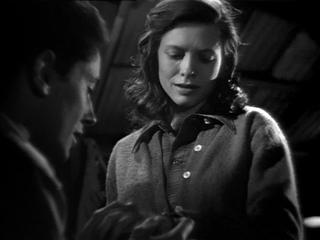
This first feature from Nicholas Ray is a great film in every sense: tight and inventive direction, a sensitive script from Charles Schnee adapted from Edward Anderson’s novel “Thieves Like Us”, moody noir lighting and photography by George E. Diskant, and terrific performances from the two young leads: Cathy O’Donnell and Farley Granger.

From Steven H. Schueur’s book Movies On TV: “… possibly the most romantic crime film ever made. Granger and O’Donnell beguilingly portray an awkward young couple who are forced into becoming ‘lovers on the run’ … Their sympathetic relationship is depicted with sensitivity and touching detail, and the performances are remarkably intense…”

They Live By Night is a tragedy of Shakespearean dimensions and  transcends film noir. The genre is more crime melodrama with noir elements. We know the relationship is doomed to fail in violent tragedy, not because this is a film noir, but as an audience we have seen the crime movies that Hollywood churned out in the 30’s and early 40’s.

The two young protagonists have no way out as they do not have the maturity to make the decisions they are forced to make, and this is telegraphed by Ray at the film’s opening as sub-titles over a scene of the two lovers in the throes of gentle passion: ” … this boy and this girl were never properly introduced to the world we live in … “.

A masterpiece of 40s Hollywood cinema.

They Live By Night (1948)

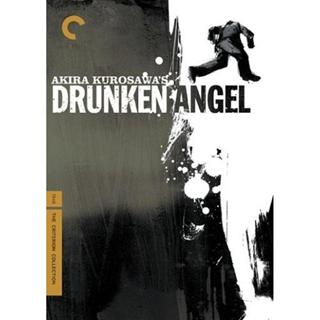
New Criterion DVD: Drunken Angel (aka Yoidore tenshi – Japan 1948)

Drunken Angel (Japan - 1948)

Drunken Angel is the first Kurosawa film starring Toshiro Mifune, and has a strong noir mood.

From the New York Times review of the new Criterion release 27 November:

The liner notes for this Criterion Collection release identify Drunken Angel as a film noir, and visually the movie often suggests the dark, dangerously askew world that Hollywood directors like Anthony Mann and Robert Siodmak were developing during the same period in their urban thrillers. But thematically “Drunken Angel” hails back to an earlier genre, the tenement dramas of the 1920s and ’30s… with their principled heroes and calls for social reform. For every virtuoso sequence – like the Mifune character’s climactic knife fight with his former gang boss, which ends with the two squirming in a pool of white paint – there is a bluntly didactic scene in which the doctor rails against feudal traditions and demands better hygiene.

Shimura and Mifune went on to play symbolic father-and-son-type pairs in several Kurosawa films, including the dazzling and more truly noir-flavored Stray Dog of 1949; their pairing seems to represent the fundamental division in Kurosawa’s work between high-minded sentiment and down-and-dirty action. (Criterion Collection, $39.95, not rated.)

The Crimson Kimono (1959): Little Tokyo Rift

The Crimson Kimono (1959)

An unusual film from pulp noir director, Samuel Fuller, set in LA’s Little Tokyo. The search for the killer of a stripper brutally gunned down in late-night traffic on the streets of LA is the pretext for a deft study of race, love, jealousy, and friendship. Fuller’s signature expressionist lighting, jumpy takes, and jarring jazz score keep the viewer off-balance.

Fuller’s screenplay takes us from inner-city sleaze to a Shinto temple and back. There are intriguing conversations on art and painting, love and music, race and prejudice, loyalty and friendship, that not only propel the narrative but also give the major characters amazing depth and complexity for such a short film (82 mins). The thriller aspect is not neglected with an exciting surprise ending.

The Crimson Kimono (1959)

I am struck by Fuller’s humanity. Little Tokyo is not a just an exotic locale, it is place of genuine interest that is explored with intelligence and respect. There is a quiet hiatus in a Shinto temple where a peripheral character, a Japanese-American man, attends a memorial service for his son, a US soldier killed in action.

The Crimson Kimono (1959)

A strong performance by then new-comer, James Shigeta, as an LA cop, is complemented by solid support from Glenn Corbett as his police partner and ex-Army buddy. Victoria Shaw and Anna Lee shine as the female leads Chris and Mac, intelligent women of contrasting ying and yang persuasions: Chris the demure innocent abroad and love interest, and Mac as the hard-drinking painter and proto-feminist with a heart of gold. Fuller truly loved and respected women, taking the noir genre beyond the narrow misogyny of the femme-fatale stereotype.

Enjoy it on a wide-screen.

The Crimson Kimono (1959)

The Naked Kiss (1964): Pulp Noir

The Naked Kiss (1964): Pulp Noir

discomfited staggering between camp, noir, and grotesque melodrama, might be more a result of studio tampering than Fuller’s misdirection. It is also difficult to discern just what sort of censorship the studios achieved, for whatever they did was austerely permeated by social taboos the likes of abortion, prostitution, child molestation, and murder.

IMBD Comment from jeanpesce

Samuel Fuller, writer, director, and producer of The Naked Kiss, apparently disclaimed this film after alleged re-editing ordered by studio bosses before its release.

I found the film largely emotionally distant, but the story of a prostitute who tries to remake her life in the face of social prejudice and male misogyny is perversely involving. A noir sensibility pervades, but it is not really a film noir as the anti-hero is a woman who is punished for being good: though her violent actions may be justified in a closed sense, they are not necessarily the only reasonable responses.

The best scene is when the text of a newspaper headline is flashed across the screen: it is a veritable punch to the stomach.

Fuller was a pulp director who tried to understand women and support their empowerment, unlike directors like Quentin Tarantino, who seek to debase the feminine.

Something different.

Anthony Hopkins: Influenced by Film Noir

Anthony Hopkins in an interview with Cinema Blend about his new film, Slipstream, which he not only wrote and directed, but in which he also stars and wrote the music, says of his influences:

Our existence is beyond our explanation… I believe that everything is illusory, because we can’t grasp anything… The films that I really like were the film noir movies […] Those film noir things just got to me as a kid. A film that’s non-linear, Burt Lancaster in The Killers

thekiillers01.jpg