Philip Marlowe: not so hard-boiled…

philip marlowe

From Raymond Chandler’s novel, Farewell, My lovely (1940):

It got darker.  I thought; and thought in my mind moved with a kind of sluggish stealthiness, as if it was being watched by bitter and sadisitic eyes. I thought of dead eyes looking at a moonless sky, with black blood at the corners of the mouths beneath them…

It got darker. The glare of the red neon sign spread farther and farther across the ceiling. I sat up on the bed and put my feet on the floor and rubbed the back of my neck.

I got up on my feet and went over to the bowl in the corner and threw cold water on my face. After a little while I felt a little better, but very little. I needed a drink, I needed a lot of life insurance, I needed a vacation, I needed a home in the country. What I had was a coat, a hat and a gun. I put them on and went out of the room…

‘I’m scared,’ I said suddenly. ‘I’m scared stiff… I’m afraid of death and despair,’ I said. ‘Of dark water and drowned men’s faces and skulls with empty eyesockets.  I’m afraid of dying, of being nothing…’

The Hitch-Hiker (1953): Desert Noir

The Hitch-Hiker (1953)Two ordinary Joes driving to Mexico on a fishing trip are waylaid by a serial killer on the run (RKO 71 mins). Directed by actress Ida Lupino and based on a true story adapted by maverick writer Daniel Mainwaring. Cinematography by veteran noir cameraman Nicholas Musuraca.

Usually billed nowadays as the only film noir directed by a woman, this b-noir starts out well but fails to develop sufficient tension and a flat ending disappoints.  Lupino’s direction is adequate, but the strong opening noir-lit scenes of urban hijack and murder would be largely the work of Musuraca. Even Musuraca seems to lose it in the open spaces of the Mexican desert where most of the subsequent action is played out.

The Hitch-Hiker (1953)

Star-billing is given to Edmond O’Brien and Frank Lovejoy as the hostages, but they are constrained by their largely passive roles, and it is b-noir regular, William Talman, in a memorable portrayal as the psychotic killer, who holds the picture together.  The desperado’s savage menace and barely contained hysteria is entirely convincing, and it is this that saves the movie from obscurity.

The Big Steal (1949): “Oh Mexico”

The Big Steal (1949)

Comedy melodrama. Army officer (Robert Mitchum) is framed for a robbery and sets off after the culprit in a wild car chase across Mexico with a swell girl (Jane Greer). A hoot! Directed by Don Seigel and written by Gerald Drayson Adams and Geoffrey Homes from a story by Richard Wormser.

Last year in an insightful post on Mexico and Film Noir on his mardecortesbaja.com blog, Lloydville said: “Greer and Mitchum in Out Of the Past have their romantic idyll in Mexico but can’t bring the magic of it back with them to the States.  This fits in with the notion of Mexico as a lost or unattainable paradise.  But sometimes the idea of Mexico went to filmmakers’ heads – they got giddy with the possibilities of it.  Films that started out noir would, once they crossed south of border, turn into larks, light-hearted and feckless. Re-teamed in The Big Steal, Greer and Mitchum venture into Mexico to try to extricate themselves from typical noir predicaments involving betrayal and unjust accusation, but the dark clouds vanish almost immediately – they find love and high-spirited adventure instead of noir’s dark, impenetrable maze, and all ends well.  Film noir expert Elizabeth Ward amusingly suggests that The Big Steal ought to be labelled fiesta noir…”

The Big Steal is a fun ride with a nice twist at the end that leaves you wanting more. Mitchum and Greer are magic together.  There are really funny running gags with Greer delivering great lines with wit and charm: any guy with blood in his veins will fall for her in this picture.

The Big Steal (1949)

The supporting cast is strong, with a great turn by the veteran Mexican-born  actor Ramon Novarro as a wiley Mexican police inspector, who has some magic lines. The scene where Greer fabricates an elopement story for the soft-hearted foreman of a road-gang is high farce infused with a true empathy and affection for the romance of Mexico and her people. This affection permeates the whole film with a sense of true liberation.  The bouncy Mexican musical soundtrack echoes this mood of fun and adventure.

Two of my favorite songs reflect this love of Mexico: Elvis singing Mexico (Tepper,Bennett) in his 1963 movie Fun In Acapulco, and James Taylor’s Mexico. Elvis sings Mexico with such joy that for as long as the song lasts his voice takes you there:

Mexico, Mexico
They’ve got muchas, mucha-chas, amigos
…Latin features, never saw such adorable creatures
…Love to dig, ooh…the nights here

We live it up and love it up amigo
Life begins when you’re in Mexico

You never order, water
When you order south of the border
…In to kiss a lovely senorita
You do the samba, la bamba
…I’ll go where you go
Life begins when you’re in Mexico

Mexico, Mexico
They’ve got muchas mucha-chas, amigos
…never saw such adorable creatures

We’ll live it up and love it up amigo
Life begins…when you’re in…MEXICO…

James Taylor’s Mexico is more plaintive and shares a longing for some mythical place:

Way down here you need a reason to move
Feel a fool running your stateside games
Lose your load, leave your mind behind, Baby James

Oh, Mexico
It sounds so simple I just got to go
The sun’s so hot I forgot to go home
Guess I’ll have to go now

Americano got the sleepy eye
But his body’s still shaking like a live wire
Sleepy Senorita with the eyes on fire

Oh, Mexico
It sounds so sweet with the sun sinking low
Moon’s so bright like to light up the night
Make everything all right

Baby’s hungry and the money’s all gone
The folks back home don’t want to talk on the phone
She gets a long letter, sends back a postcard; times are hard

Oh, down in Mexico
I never really been so I don’t really know
Oh, Mexico
I guess I’ll have to go

Oh, Mexico
I never really been but I’d sure like to go
Oh, Mexico
I guess I’ll have to go now

This love for Mexico is expressed more deeply and poetically in Jack Kerouac’s On the Road:

I was alone in my eternity at the wheel, and the road ran straight as an arrow. Not like driving across Carolina, or Texas, or Arizona, or Illinois; but like driving across the world and into the places where we would finally learn ourselves among the Fellaheen Indians of the world, the essential strain of the basic primitive, wailing humanity that stretches in a belt around the equatorial belly of the world from Malaya…to Morocco to the selfsame deserts and jungles of Mexico.

Oh Mexico…

Key Largo (1948): Almost Noir


Key Largo (1948)

Returning WW2 vet fights gangsters on the Florida keys

The director of Key Largo, John Huston, co-wrote the screenplay with Richard Brooks, from a play by Maxwell Anderson.  The stage origins of the film are evident, but this strengthens the atmosphere of claustrophobia as the action is played out inside a seaside guest-house boarded-up against a hurricane.

The cast is particularly strong with Humphrey Bogart as the war vet, Edward G. Robinson as the over-the-hill gangster Johnny Rocco staging a comeback, with Claire Trevor as his alcoholic mole and Thomas Gomez as Rocco’s No.2, and Lauren Bacall as a young war widow with the legendary Lionel Barrymore as her father-in-law. Trevor deservedly won a best-supporting-actress Oscar for her role.

For some the returning war vet theme gives the movie a film noir quality – even though the action takes place in a non-noir locale and there is no cross-over between the good guys and the bad guys. I feel the picture is essentially a good-triumphs-over-evil tale laced with a swan-song for the gangster flick and leavened with post-war existentialist angst.

Bogart’s vet, Frank McLoud, shares the angst  of post-war Europe, where many returning to the peace with expectations of a better world that would justify the suffering and destruction, are confronted with the reality that nothing has changed. Disillusioned and bitter, the moral absolutism that underpinned their sacrifice dissolves into a weary relativism where one less Johnny Rocco is not worth dying for.

The climax and resolution of the story complete with a non-noir ending, also give little support to the view that Key Largo is a film noir. As the final scene hits the screen, it is the strength of family and the selfless pursuit of established values that destroy evil, with the existential anti-hero morphing into a hero of the classic mold. As McLoud says: “When your head says one thing and your whole life says another, your head always loses.”

Key Largo 1948

The Naked City: Weegee’s NY Noir Nightscape

Weegee

This weekend’s New York Times New York Explorer feature, Crime Was Weegee’s Oyster, spotlights the life, times, and photography of 30s and 40s freelance crime and street photographer, Arthur Fellig, better known as “Weegee”, and one of the city’s most famous photographers:

Weegee’s peak period… was a whirl of perpetual motion running from the mid-1930s into the postwar years. Ceaselessly prowling the streets during the graveyard shift, he took thousands of photographs that defined Manhattan as a film noir nightscape of hoodlums and gangsters, Bowery bums and slumming swells, tenement dwellers and victims of domestic brawls, fires and car crashes. He gave it its enduring nickname, the Naked City.

The on-line article features a slide-show of Weegee’s photographs and a video exploration of the New York locales where the photos were taken.

Update 20 June 2008: Today the NY Times published a Weegee Primer with a source list books, movies, NY locales, and a link to the INTERNATIONAL CENTER OF PHOTOGRAPHY‘s Weegee Web site, which features other photos and audio clips.

The Woman in the Window (1944): Over-rated

The Woman in the Window (1944)“The shopworn and superfluous ending has all the impact of a stale peppermint upon a man who has ordered a steak dinner.”
– Motion Picture Herald on the film’s release

Even without the cop-out ending, I find it hard to see Fritz Lang’s The Woman in The Window as other than a minor film noir. Although Freudian symbolism abounds and the noir theme of lives destroyed by chance events and small decisions is deftly handled, the movie is slow and ponderous – like the middle-aged law professor protagonist. Definitely one of Lang’s lesser works. Lang’s similarly-themed Scarlet Street (1945), made a year later with the same leads, is much stronger.

To give it credit the picture was popular with audiences and made money, but producer and screenwriter, Nunnally Johnson, was less than impressed, and it was received coolly by the critics.

In an interview in 1975, Lang justified the ending in these words:

This movie was not about evil… it was about psychology, the subconscious desires, and what better expression of those than in a dream, where the libido is released and emotions are exxagerated… [an] audience wouldn’t think a movie worthwhile in which a man kills two [sic] people and himself just because he had made a mistake by going home with a girl…

The irony of the second part of the quote will not be lost on film noir aficionados.

The Woman in the Window (1944)

Mildred Pierce (1945): “alligators have the right idea… they eat their young”

Mildred Pierce (1945)

“this etched-in-acid film chronicles the flaws in the American dream…”
– Steven H. Scheuer

“Constant, lambent, virulent attention to money and its effects, and more authentic suggestion of sex than one hopes to see in American films.”
– James Agee

Mildred Pierce (1945)

One of the great Hollywood melodramas with an Oscar-winning performance from the luminous Joan Crawford as Mildred. Better than the James M. Cain novel on which it is based, Mildred Pierce under the assured direction of Michael Curtiz, and with stunning film noir photography by cinematographer Ernest Haller, is top-class entertainment.

The story of family tragedy played out against the pursuit of the California dream of wealth and ease through hard-work and ambition destroyed by wastrel conceit and shameless greed, is as strong an indictment of the moral corrosiveness of wealth and privilege as Hollywood has achieved. But it is also a story of profound humanity and the worth of simple decency and personal integrity. Mildred makes tragic mistakes and misplaces her trust and love, but she is always true to herself, and in even in her darkest hour towers above the morass of greed and selfishness that would suck her down.

These frames from the movie illustrate the visual dynamite that explodes on the screen in the film’s most dramatic moments:

This slideshow requires JavaScript.

Fury (1936): On The Threshold of Noir

Fury 1936Director Fritz Lang’s first American film is a sharp terrifying study of mob hysteria as a town tries to lynch an innocent [kidnap] suspect. [Spencer] Tracy survives however, and returns to take revenge.
– Steve H. Scheuer – Movies on TV

After 70 years, Fury, which was co-written by Lang, remains a powerful and still relevant social criticism that telegraphs the recurring theme in Lang’s later Hollywood noirs: the fate of the individual when social institutions fail and injustice destroys innocent lives.

The film’s title is particularly apt with the first half concerned with mob fury, and the second half with the fury of the erstwhile victim seeking revenge. Strong performances from Tracy and Sylvia Sidney hold the narrative together even though their actual screen time is limited. The focus is on how hysteria grips a small town and allows mob rule to destroy social cohesion, and in the aftermath how the operation of the laws that protect freedom are thwarted by community loyalties trying to shield the law-breakers from justice. The irony is profound and convincingly played out in a court-room in the trial of the ringleaders. Lang spares no-one from the forensic gaze of the camera. A camera within a camera is used to indict the defendants when a projector is set-up in the court-room, and newsreel footage of the affray is shown. The newsreel footage is silent, and plays like a silent movie with riotous acts and facial expressions exaggerated for dramatic effect. A modern audience may find this technique dated, but it would have certainly had a strong impact on contemporary movie-goers only a few years after the end of the silent era.

Lang cut his teeth in German silent cinema, and silent movie techniques are also used in the movie’s action. Dramatic sustained close-ups of characters with extremely emotional expressions, and montage in two scenes: in the opening sequence a cut to an ominous roaring steam train disturbs the evening stroll of the two lovers, and later a clucking hen-house cut is a sardonic chorus to the burgeoning female rumor mill that is the build-up to the riot.

While Alain Silver and Elizabeth Ward include Fury, in their book, Film Noir: An Encyclopedic Reference to the American Style, I see the movie as pre-cursor only – not a fully-fledged film noir. The resolution at the end of the film is classic Hollywood, with the lovers re-united and justice morally if not legally served, but the Tracy character remains profoundly marked by his experience and not fully repentant of his attempt at vengeance. This is the territory that film noir would begin to explore a few years later.

Fury 1936

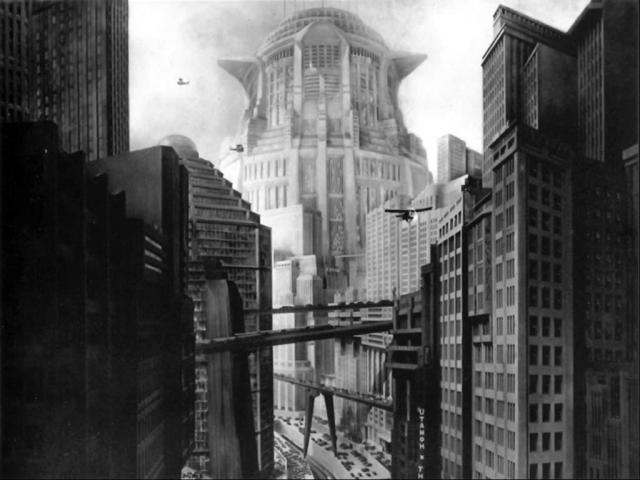
Metropolis Now: Dystopia and Sci-fi Noir

Metropolis (1927) Tower Of Babel

Metropolis (1927) Tower Of Babel

New York Times film critic, A.O. Scott has written a great article in this weekend’s NYT magazine: The Way We Live Now: Metropolis Now, in which he discusses the cinematic prophecies concerning the city as urban space in science fiction and the influence of film noir on the genre:

Architects and planners are by professional inclination both practical-minded and utopian. Their job is to solve problems, to ground their projects in collective hopes for a grander, cleaner, more rational organization of human space. The long-term results of their efforts, however, are typically ambiguous, yielding new problems on top of solutions. For much of the past century, the job of imagining the worst possible outcomes of their good intentions — of assessing the radically dystopian implications of urban progress — has fallen to film directors and production designers. They invent the city of the future not as a model but as a cautionary tale; and their future is the only future we know firsthand…

Scott goes on to discuss Fritz Lang’s Metropolis (1927), the science fiction noir Alphaville (Jean-Luc Godard 1965), and the more recent Blade Runner, Minority Report, and Code 46.

The Devil Thumbs A Ride (1947): A Dark Little Gem

devilthumbsrideThe Devil Thumbs A Ride (1947) made as a B-filler by RKO is a tight thriller that takes only 63 minutes from the first gun-shot to the last. Tough guy actor Lawrence Tierney plays Steve Morgan, a cold-blooded killer on the run.

The leaky plot and B-grade supporting cast add a camp quality to the mix, and there are plenty of high-jinks with crackling dialog and absurd twists that keep you mesmerised: a highlight is when Morgan is on his knees cleaning a spot off a rug after a house has been trashed, and asks for cleaning fluid…

Why a film noir? There is a profoundly tragic element in the needless brutal death of a young female drifter who also thumbs a ride in a morbid turn of fate. The role is nicely played by a Betty Lawford, in her only major role.

Watch it as it was intended – as the first movie in a double-feature.