Le quai des brumes (Port of Shadows – France 1938): Poetic Realism

portofshadows

The fog of angst seeps from the faces of two doomed lovers in the dank gloom of Le Havre. Jean is on the run and Nelly is trapped in a psychic prison as real as the physical constraints on her existence. Happiness is something that may exist but neither knows it.

They meet by chance one night in a broken-down bar on the waterfront amongst the detritus of an ephemeral humanity. Panama’s is a haven for the down-and-out named for the hat of the publican, an old shaman with a rusted soul as deep as the canal he visited in his youth. Father confessor of a convent for lost souls. He keeps his counsel, asks no questions, and strums his guitar.

And everywhere the fog and the harbor with rusting hulks at anchor ever-waiting transport for deliverance. The two lovers stroll as tentative friends with a hope as forlorn as it is sublime, when a bright clarity intrudes, a hood with a malice as sharp as his clothes and his shave, and as evil as his cowardice.

A night of bliss follows. Jean and Nelly find love at a sea-side carnival and that elusive union we all seek – in a rented room. They keep missing pernicious Fate a drunken vagabond. The glory of a new dawn is soon shattered. They each leave alone. Fate occupies the sheets of last night’s passion, and they are lost.

“Kiss me. We don’t have much time.”

The Black Cat (1934): Erotic nightmare

The Black Cat (1934)

Edgar G. Ulmer’s trash-noir Detour (1945) has a cult following. The film relates a fatalistic story of a guy so dumb he blames fate for the consequences of his own foolishness. Anne Savage, as the street-wise dame who incredulously falls for the sap, is memorable.

Earlier in 1934 Ulmer directed The Black Cat starring Boris Karloff and Bela Lugosi. Loosely based on a short story by Edgar Allan Poe, the movie is a camp masterpiece.  Set in the wonderfully gothic modernist house of a sinister architect, it is a mad expressionist tale of abduction, revenge, sexual obsession, camp horror, and unbridled eroticism.  Sex is the primary motif and there is a sense of unreality with the action moving with the strange fractured incoherence of a dream. In a sense Ulmer prefigures the oneiric and sexual motifs of the classic noir period. A must-see.

This trailer I have created focuses on the pervasive eroticism… see the shapely legs of the comely heroine get the Von Sternberg treatment!
The clip has been blocked by NBC Universal on copyright grounds.

Electric nightmares in dark empty warehouses…

electricnightmare

Electric nightmares in dark empty warehouses. Dank with the ocean’s chill and the blood of vengeance.

The rotting planks of a pier are suddenly shaken by a heavy thud and then by pounding footfalls. A running figure traverses the dull cone of light from a fog lamp affixed high on a post where the deck meets the shoreline.

The bent outline of a fugitive runs along a wharf in the macabre shadow of a looming gray hulk a brooding inert sentinel under an empty sky. A car door slams. The glimmering ebony saloon roars away, tires sliding atop the wet asphalt, and the headlights raucously stabbing the squalid shadows grown onto the mercantile mausoleums that hover at the perimeter.

Too late the sirens’ screeching cacophony cleaves the silence the careening car has left behind. More car doors slam. The harsh fevered intersecting headlights of the squad cars survey the scene revealing nothing.

The last train at the end of the line…

The last train at the end of the line...

Empty streets of stolen angst. The silent steel sentinels are specters of a hidden horror. A crippling step at a time. Your breathing is labored and the red flood is existence ebbing away. Stumbling and crashing back to the fountainhead. You knew this is where it started and ends. Alone. A dying creature of the long night of the sleeping city. You desperately try to hold it back but you can’t stem the tide of fate. Falling hard on the wet tar in the sordid yellow light of the streetlight’s waning, your head shatters into a thousand fragments of racing memories. A blissful high showers your prone body, a shimmering bundle of rags. Your mouth fills with sweet black honey, and you finally find a sort of peace, the gutter a soft pillow for staring at the stars. A sheltering sky of black oblivion falls gently towards you.

The midnight special thunders in. The pavement an echoing platform at the end of the line. All the way. No stops. Leaving in one minute. “All aboard”. No-one is left behind. All seats are reserved. Who made that reservation? And when? Was it God in his infinite indifference at year zero? Or was it your mother in boundless love calling you back to the womb as you were leaving it. Do something! Make it real. Make it happen like it never did before. Just once. Too late. One final useless effort to go back, then you give it up. Sirens scream. The wails of the condemned a dark chorus do futile battle with the rumble and hiss of the locomotive as it draws the carriages away in a dirty cloud of steam.

Caged (1950): “the plot of our life sweats in the dark like a face”

Caged (1950)

… the plot of our life sweats in the dark like a face
the mystery of childbirth, of childhood itself
grave visitations
what is it that calls to us?
why must we pray screaming?
why must not death be redefined?
we shut our eyes we stretch out our arms
and whirl on a pane of glass
an afixiation a fix on anything the line of life the limb of a tree
the hands of he and the promise that she is blessed among women…”

Patti Smith – Dancing Barefoot (1979)

Caged (1950) is a gritty hard-hitting social problem picture from Warner Bros. A young woman is jailed after she is an unwitting accomplice in a gas-station robbery with her husband, who is killed during the heist.  The sheltered girl on admittance to a women’s prison discovers she is pregnant, but her condition does not protect her from the humiliation and brutalisation of prison life. Melodramatic but with a strong social conscience that targets corrupt authorities, the movie is downbeat and pessimistic.  Eleanor Parker in the lead is powerfully convincing, and is supported by a strong female cast, including Agnes Moorehead as a compassionate and crusading  superintendent, and Hope Emerson as a corrupt and sadistic block matron.  Though set-bound the regimentation and claustrophobia of incarceration is given a strong expressionist treatment by director John Cromwell and DP Carl Guthrie.  A moody evocative score from Max Steiner adds emotional depth.

The Maltese Falcon: The beginning of noir

The Maltese Falcon (1941)

John Huston’s 1941 screenplay was the first serious attempt to bring the hard-boiled nature of Hammett’s fiction to the screen. The 1931 version may have more closely followed the story of the novel, but it did not carry the hard-boiled spirit of Spade to the screen, and the 1936 version, Satan Met a Lay, with Bette Davis played the story as broad comedy.

David Spicer wrote in his book Film Noir (2002) that Huston’s film “was much closer than previous versions to the cynical tone of Hammett’s hard-boiled novel, retaining as much of Hammett’s dialogue as possible”.  William Luhr, in his book on the 1941 version says that: “Spade does not happily juggle a plethora of women but is bitterly involved with only two… For him, sexuality is not carefree but dangerous and guilt-ridden. The mystery and the evil world it reveals dominate the mood of the movie, and this sinister atmosphere does not entirely disappear at the end. Such an atmosphere presages film noir.”

The Spade of Hammett’s novel is deeply cynical, and at the end of the novel, but not in Huston’s film, he is ready to resume his affair with Archer’s wife. Mayer and McDonnell in The Encyclopedia of Film Noir (2007), say this about the final scenes in Huston’s screenplay: “Huston replaces Hammett’s cynicism with a more romantic gesture from Spade as he tells Brigid, ‘Maybe I do [love you]‘. While Ricardo Cortez’s Spade in 1931 is more or less resigned to handing Wonderly over to the police, Huston extends this sequence by accentuating the psychological disturbance within the detective. His torment is palpable, especially when he shouts into her face that ‘I won’t [fall for you] because all of me wants to, regardless of the consequences’. While this is not an existential moment, as some claim, it does represent a significant moment in the development of film noir. Unlike the novel, where survival is all that matters to the detective, Spade’s torment in the 1941 film nearly destroys him.”

Summary Noir Reviews: when Pushover comes to Whirlpool

Tomorrow Is Another Day

Tomorrow Is Another Day (1951) A rare Warner-b. Felix Feist ( The Man Who Cheated Himself and The Devil Thumbs a Ride) helms a redemption noir with true pathos. The redemption is played out in a farm-worker’s camp with shades of The Grapes of Wrath. The two leads, Ruth Roman and Steve Cochran, are great and deliver with real grit and integrity.

The Glass Key (1942) A very flat adaptation of Hammett’s novel starring Alan Ladd and Veronica Lake. But William Bendix is a knockout as a queer sadistic hood in the darkest scene, which succeeds because it is faithful to the novel. The scene opens in a basement dive with a soulful black singer Lillian Randolph (uncredited) on a piano performing a bluesy number, and climaxes in a seedy private room with a drunken Bendix strangling his hoodlum boss, while Ladd looks on holding a “roscoe”.

Pushover (1954) is a wide-screen noir as hip as an LA martini, where an LA cop redefines Double Indemnity, with bravura direction by unknown stringer Richard Quine. Fred MacMurray and Kim Novak in her first role are awesome! Darkly forlorn like an empty city street at the witching hour.

Lured (1947) is an entertaining camp thriller set in London. Douglas Sirk (!) directs a virtual cavalcade of talent, George Sanders as a good guy, a luscious Lucille Ball as the serio-comic heroine, Cedric Hardwicke as the bad guy who writes Baudelaire-like poetry, Charles Coburn as a wily police inspector, with an over-the-top cameo from Boris Karloff as an off-the-wall washed-up fashion designer!

Fallen Angel (1945) is as tight and elegant noir as you would want. Otto Preminger steers a solid cast through an ethical labyrinth: Dana Andrews in perhaps his best role as a grifter on the skids, Linda Darnell is a femme-savant whose sexual chemistry sends the male protagonists’ libidos haywire, Broderick Crawford is a deadly cop, and Alice Faye is the salvation angel.

LA Confidential (1997) is a visually stunning thriller: great direction, production design, score, camera-work, and editing. Strong performances all-round. But it has no real soul and lacks a true noir sensibility. The screenplay is hopelessly contrived, and the ending is pat. Mickey Spillane on steroids.

The Blue Gardenia (1953) is a minor Fritz Lang melodrama which has some noir elements. Anne Baxter shines as a young woman who thinks she has killed a guy, but Lang was not really interested, and Richard Conte as a cynical reporter delivers yet another weak performance. The saccharine ending disappoints. Nick Musucura’s contribution as DP is sadly undistiguished, though some moody scenes impress.

You Only Live Once (1937) also from Fritz Lang is a fascinating movie. Henry Fonda and the luminous Sylvia Sidney as star-crossed lovers become desperadoes on the run, and the stunning ending presages Gun Crazy’s fog-bound denouement by a full decade. As a relentless fatalistic melodrama moodily shot by virtuoso DP Leon Shamroy, it is a real contender as the first poetic realist film – beating the French by a full year. Consider this, Carne’s Port of Shadows was released in 1938, and Pépé le Moko debuted in France on 28 January 1937, while You Only Live Once opened in the US only a day later on 29 January 1937! The amour fou of Lang’s feature I think bumps the less romantic Pepe Le Moko.

Witness to Murder (1954) directed by Roy Rowland and lensed by John Alton is a minor but involving thriller with a noir angle. Barbara Stanwyck as the witness and a deliciously sinister George Sanders as the murderer hold it all together. Alton’s contribution is subdued, but the opening scenes around an LA apartment building on a breezy summer night are nicely atmospheric.

Laura (1944) is elegant noir melodrama. Gene Tierney is an exquisite iridescent angel and Dana Andrews a stolid cop who nails the killer after falling for a dead dame. Clifton Webb as the homme-fatale is his annoying best.

Citizen Kane (1941) Its sheer audacity always amazes. Though the scenario is beginning to feel dated with the episodic nature of the narrative less than satisfying.

Kiss the Blood Off My Hands (1948) is an atmospheric noir set in London directed by Norman Foster and lensed by Russell Metty with a great Miklos Rózsa score. Burt Lancaster and Joan Fontaine shine as two loners. The trauma of the returning WW2 vet is given an original treatment and Foster’s direction is polished. Norman Foster started out in the 30’s directing Charlie Chan and Mr Moto features, and does not have a high profile. He got directing credit for the Welles’ scripted Journey Into Fear (1943) starring Joseph Cotton, but the cognoscenti claim that Welles is the real helmsman. Foster also directed the sharp b-noir Woman on the Run (1950), and he deserves high praise for Kiss the Blood Off My Hands, which ranks with the best of Siodmak and Tourneur.

Black Angel (1946) is a visually elegant psycho-noir from a Cornell Woolrich story. Dan Duryea and June Vincent investigating the murder of a female blackmailer are impressive, with good support from a suave Peter Lorre as a ‘good’ bad guy. An hypnotic dream climax is the highlight – with kudos to director Roy Neill (his last movie) and DP Paul Ivano.

Whirlpool (1949) is directed by Otto Preminger, and stars Gene Tierney, Richard Conte, and José Ferrer in another psycho-noir. Lensed by Arthur Miller with a wonderfully dramatic score from David Raksin. Preminger turns a preposterous frame-up by hypnosis premise into a polished melodrama. Tierney is vivacious but does little more than the role of a dupe demands. Conte is incredibly wooden and a real disappointment, while Ferrer steals the picture as a suave homme-fatale, who has real wit and cunning. Broderick Crawford is good as a skeptical scruffy cop. Preminger uses mise-en-scene deftly to expose the truth below the surface. In an early scene, we have Tierney in close-up while Ferrer delivers lines of seductive poison, and as he approaches Tierney with his promises of sincerity his shadow fall across her face…

The Killer That Stalked New York (1950)

The Killer That Stalked New York (1950)

The Killer That Stalked New York (1950) is a b-noir from a director who made only three movies in the early 50s, Earl McEvoy. The movie was lensed by Joe Biroc and stars the under-rated Evelyn Keyes, who passed away last year, and appeared to advantage in Joseph Losey’s The Prowler (1951) and Robert Rossen’s Johnny O’Clock (1947). Keyes plays an accomplice to a hood, who after a job in Cuba, returns to NYC with smallpox, in a dramatisation of the New York smallpox scare of 1946. Keyes is brilliant as ‘the killer’ and dominates the film, which in the light of the current swine flu scare, is a well-crafted docu-drama which deftly weaves the drama of the woman’s noir story and how a city of over 8 million people has to mobilise to deal with such a threat, with vignettes on how the illness is transmitted, and a continuing story arc of the fate of the killer’s first ‘victim’, a young working-class girl.

An interesting segue is how these old Hollywood b-pictures weaved wonderful vignettes and comic moments into the story. Two such scenes stand out in this movie. A milkman is infected and there is a scene in the sick man’s bedroom when the inoculation team visits. The poor guy’s persona is eloquently evoked by his wife’s harping but deeply loving commentary on her husband – before she realises the gravity of his illness. The other scene cuts to a Brooklyn street with kids playing on the road in front of a bar. The kids scramble as a police car pulls up. They gather on the footpath to check it out. As a burly detective steps out of the car, one kid pipes up and asks for the low-down “Hey Bub…”. The cop replies “Beat it kid.” The bar is closed so the cops after getting the form from the kids, drive off, and the kids jump back on the road shooting air tommy guns after the car.

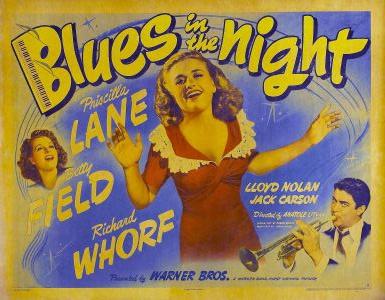
Blues in the Night (1941): Noir Counterpoint

Blues in the Night (1941)

Blues in the Night (Warner Bros 1941) is a fascinating musical noir melodrama about a budding white jazz band scripted by Robert Rossen, directed by Anatole Litvak, and atmospherically lensed by Ernest Haller, with a b-cast, including a very young Elia Kazan, as a dizzy jazz clarinetist. These impeccable leftist credentials are reflected in the plot and the resolution which talk to personal integrity and the values of solidarity and loyalty. Amazingly for the period an establishing scene in a police lock-up respectfully credits the music’s black roots. Tied up in all this is a noir arc with a hood played by Lloyd Nolan and a killer performance by Betty Field (an actress who sadly went nowhere) as a cheap femme-fatale.  The socially aware feel-good ending is tempered by the noir-like denouement for the hoods and the femme-noir.

This movie is a serious contender as a seminal film noir,  remembering The Maltese Falcon was made in the same year, Stranger On the Third Floor only a year earlier in 1940, and Double Indemnity a full three years later in 1944.

Sexual Imagery in Film Noir: Tread Softly Stranger (1958)

Dian Dors - Tread Softly Stranger (1958)

Tread Softly Stranger (1958) is a top-class British noir set in a steel town in the North of England, starring Diana Dors, as a sultry femme-noir.  Two brothers are desperate for money after one has been stealing from his employer, a steel mill, to finance his infatuation with Dors.  She suggests a heist to cover the fraud and it of course goes badly wrong.  The second brother also falls for the woman, and this scene where physical violence becomes sexual attraction is deftly handled by director Gordon Parry with potent imagery that flows with the narrative as the scene shifts to the next day at the steel works…