
I was left alone there a long time. I could see, all right, and know the things about me. My car was there at the curb, glistening in the dark, with a thin ripple of wet orange paint running down its hood in one place where the light from the doorway struck out at it. A ripple that never moved, and yet was warped and liquid as running ripples are. I even shifted once, from where she had left me standing, and moved over to it, and stood up close beside it, my hands pressing down tight upon the top of the door, as if I were unsteady and needed something to cling to in order to remain upright. My head inclined, as if peering intently at the upholstery of the seat backs.
Yes, the car was real, it was there. My hands could feel it, my eyes could see it, I had but to touch a button to make light shoot out of it, light that no shadows could withstand; but yet the shadows had the best of it, it was powerless to rive this pall that blanketed the eyes that looked at it, the mind that considered it. It could not take me out of the shade, it was I who had brought it into the shade with me; its powers of contrast were lost, it became one with the other Gothic shadows about me. For the shadows came from within, and so anything they fell upon was shadowed. Just as if you front your eyes with a piece of smoked glass, the most sparkling sunlight will become somber.
Each unto himself has his own world that he looks out upon, and though someone else were to stand on the very selfsame inch of ground your feet were placed upon, guided by chalk marks, he would not see the same things you did. There would have been two different views there, not just one. Or is there any world at all, I wondered, out there before us as we look upon it; may it not be inside, behind the eyes, and out front nothing, just a blank infinite? But madness lurked along that trail, and I quickly turned aside.
– Cornell Woolrich, Night Has a Thousand Eyes (1945)
Category: Articles

Summary Reviews: The Amazing Mr X meets Phantom Lady

Phantom Lady (1944)
Loyal secretary Ella Raines desperately tries to save her innocent boss from the gallows. Woody Bredell’s moody noir photography and an orgasmic jazz jam session add jive to Siodmak’s otherwise lack-luster direction. Franchot Tone is convincing as a closet psychopath. Elisha Cook Jr’s turn as a sleazy jazz drummer is anarchic, but Raines’ impersonation of a gum-chewing floozy is just embarrassing. Based on a Cornell Woolrich novel.

Sweet Smell of Success (1957)
Manipulative NY celebrity columnist enlists sleazy publicist to destroy his younger sister’s suitor. As bracing as vinegar and cold as ice. Ambition stripped of all pretense. Great chemistry between Burt Lancaster as the sinister chat columnist and Tony Curtis as the ruthless publicist. DP James Wong Howe’s sharpest picture: the streets of Manhattan have never looked so real.

The Amazing Mr. X (1948)
A crooked clairvoyant manipulates a widow who believes her dead husband is back. A brilliant gothic satire with humor, poetry, and panache. John Alton’s expressionist lensing, Bernard Vorhaus’ fluid direction, and an ace Alex Laszlo score deliver top-flight entertainment.

Railroaded (1947)
John Ireland is great as a savage hood who frames an innocent guy for murder. Anthony Mann’s poverty-row pulp-b is very noir, cut with acid, and photographed in the deafening blaze of gun-fire. Very entertaining.

Raw Deal (1948)
A tragic love triangle very reminiscent of Marcel Carne’s Port of Shadows has to be one of the great noirs. A sublime film from director Anthony Mann and DP John Alton, with a knockout cast in a strong story stunningly rendered as expressionist art. The portrayals by Dennis O’Keefe, Claire Trevor, Marsha Hunt, and John Ireland are career bests. Poetic voice-overs by Claire Trevor are beautifully enhanced by Paul Sawtell’s eerie scoring.

Obsession (1948 UK)
A macabre and sardonic melodrama. Psychopath shrink plans perfect murder. Taut direction from Edward Dmytryk with a Nino Rota score! Gruesome and disturbing.

Private Hell 36 (1954)
A flat crooked cop flic from Don Siegel. Ida Lupino, who co-wrote the screenplay, and Steve Cochran make it interesting.

Pursued (1947)
Noir western from Raoul Walsh. Robert Mitchum is trapped by a dark dimly discerned past. Solid but inferior to the moody western Blood on The Moon (1948), also starring Mitchum. Story is far-fetched and the actions of the protagonists seem un-convincing.

Strange Illusion (1945)
A truly bizarre Hamlet remake. Edgar Ulmer turns a PRC-b into a camp expressionist noir of foul villains with a knockout finale. Jimmy Lydon, remember Henry Aldrich, plays Hamlet to Warren Williams’ Claudius, who is a bit of a lecher and is not past feeling-up teenage girls in swimming pools!

The Long Night (1947)
A war vet is under siege in a tenement after killing a romantic rival. An RKO Henry Fonda vehicle from Anatole Litvak plays as melodrama with a strong supporting cast. Barbara Bel Geddes is interesting as the love interest, but Vincent Price as the rival is too rococo and out-of-place. Me, I’m stuck on the luscious Ann Dvorak, a straight-up dame who falls for Fonda. John Wexley’s script over-reaches on the social criticism angle.
W R Burnett: Master of noir imagery

From W.R. Burnett’s novel The Asphalt Jungle (1949). Notice how often the adjective ‘black’ is used.
Dix made no comment and sat looking off across the wide black river,
which moved sluggishly southward between its steep cement
embankments toward its faraway union with the Mississippi.
There was no moon, but the sky was cloudless and a handful of bright
stars, diamond points of bluish light, glittered coldly over the tall
buildings on the far shore. The houses along the embankment were
almost all dark, but here and there a window showed light and cast
golden zigzag reflections onto the shiny black pavement of the river. A
slow, damp wind was blowing, carrying a smell of deep water.
Late as it was, traffic was fairly heavy on the big, three-lane bridge.
Suddenly a siren wail rose from the darkness of the far shore, and in a
moment a prowl car passed them, going back at high speed toward
the hilly slums of the Camden Square district._____________________
A dark, blustery night had settled down like a cowl over the huge,
sprawling Midwestern city by the river. A mist-like rain blew between
the tall buildings at intervals, wetting the streets and pavements and
turning them into black, fun-house mirrors that reflected in grotesque
distortions the street lights and neon signs.The big downtown bridges arched off across the wide, black river into
the void, the far shore blotted out by the misty rain; and gusts of wind,
carrying stray newspapers, blew up the almost deserted boulevards,
whistling faintly along the building fronts and moaning at the
intersections. Empty surface cars, and buses with misted windows,
trundled slowly through the downtown section. Except for taxis and
prowl cars, there was no traffic.River Boulevard, wide as a plaza and with its parkways and arched,
orange street lights stretching off into the misty horizon in diminishing
perspective, was as deserted as if a plague had swept the streets
clean. The traffic lights changed with automatic precision, but there
were no cars to heed or disobey them. Far down the boulevard, in the
supper-club section of the city, elaborately glittering neon signs
flashed off and on to emptiness. The night city, like a wound-up toy,
went about its business with mechanical efficiency, regardless of man._____________________
Dix sat up with a start and looked about him as if he’d never seen this
place before—never heard of it even. He had an uneasy feeling that he had
been lifted up in the night by unknown hands and carried to
this place of exile, this alien city with its canyons of masonry and its
unpredictable and ugly ways—far from home, far from sense and
meaning, far from any resting place._____________________
They were living very close to the river now, and all night long they
could hear the tugs moaning as they slid downstream pulling the
big coal barges; and sometimes, when it was exceptionally quiet,
they could hear the waves, stirred by the passage of the heavyladen
barges, washing and slapping against the old wharves at the
foot of Front Street. Through their one window they could see the
Lackawanna Street Bridge arching off toward the tall buildings of
the downtown area across the river. In the daytime the bridge was
huge, gray, and misty-looking; at night it was nothing but a long,
brilliant garland of yellow lights, duplicated upside down in the
black water._____________________
They cleared the suburb at last, and huge factories and warehouses
began to loom along their route. A light mist started to fall, making little
pinkish haloes about the street lights. For a while they skirted a
railroad embankment, and a freight train passed them going toward
town, and they heard the lonely, off-key ringing of the crossing-bells.
At last they pulled clear of the giant warehouses, the factories, the big
viaducts arching up out of the mists to nowhere, and came out into a
wide, flat, sparsely settled area, with a few poor, frame houses
grouped along cracked and weed-bordered sidewalks.The mist turned to a drizzle, and the wet asphalt shone like black
glass, palely reflecting the widely separated street lights. A cold
wind began to blow, and Riemenschneider huddled down into his
big overcoat.
Chandler on Cain: “Proust in greasy overalls”

“RAYMOND CHANDLER ” LOS ANGELES TIMES
Raymond Chandler wrote his publisher Alfred Knopf in February 1943:
I hope the day will come when I don’t have to ride around on Hammett and James Cain, like an organ grinder’s monkey. Hammett is all right. I give him everything. There were a lot of things he could not do, but what he did he did superbly. But James Cain—faugh! Everything he touches smells like a billygoat. He is every kind of writer I detest, a faux naif, a Proust in greasy overalls, a dirty little boy with a piece of chalk and a board fence and nobody looking. Such people are the offal of literature, not because they write about dirty things but because they do it in a dirty way.
– Frank MacShane, The Life of Raymond Chandler, 1978, p101)
A Colt is My Passport (Koruto wa ore no pasupoto – Japan 1967)

A Colt is My Passport, a wide-screen b&w movie from the prolific Hikkatsu studio, is a hip acid noir with a 60s patina and a surreal spaghetti-western score. A twist on a classic noir motif has a hit-man as existential hero, committed to an austere private code that elevates him above the yakuza hoods that want him dead after a mob hit goes wrong.
Director Takashi Nomura fills the screen with elegantly composed flowing senarios that pan and follow the action, giving movement to even establishing placement shots. The mis-en-scene is austere yet perversely satirical. While the planning and the mechanics of preparing for the hit are slowly paced and meticulous, the bland assured peregrinations of the hit man and his young apprentice, who are both dressed like loyal company men, and in one scene are seated in an office behind a desk, have an unnerving quotidian ambience. These guys are cold and distant, almost effigies.
However, the mood changes when the staging of the hit backfires and the two are on the run. They hole up in a sea-side hotel and are aided by a young waitress attracted to the older man, whose bravery and protective loyalty to his young buddy take on a mythic dimension. Here a mood of fatalism takes hold, and the inevitable final denoument is telegraphed by their entrapment in a closet-like room. After a final desperate bid to shake-off the mobsters, the classic western theme of redemption emerges, with the hero returning to face his pursuers after parlaying his fate for the escape of his buddy, who learns of the pact too late. The girl is left forlorn and bitter. The finale is a cinematic tour-de-force staged with mannered precision but hinging on a chaotic precipice of climactic violence and retributive justice.
You start by seeing the protagonist as a cousin of Melville’s inscrutable Samouri but by the end of the film he has been transformed into an avenging angel. Uber cool.
Re-Focusing Film Noir

After some recent reading on film noir, I am re-focusing my approach to film noir, and this re-appraisal will influence my coming film noir reviews.
If we go back to the hard-boiled detective novels of Dashiell Hammett and Raymond Chandler, we find protagonists who are essentially outsiders with personas concerned not with redemption but with maintaining a stasis that is outside the mainstream in an existential sense. Sam Spade and Philip Marlowe are not concerned with money or status, conventional relationships, or necessarily following the letter of the law. These guys are loners. Independent men above banal striving and ambition, but loyal to a code that not only guides but defines them. While the PI works at the perimeter of convention, his realm goes beyond the dark sordid recesses of criminality to the rotten core of polite society. Death-in-life is their métier, and integrity their salvation. But this integrity and independence casts them adrift. They are of society but not anchored in it. Their alienation is knowing and desperate: capitulation is existential death. These guys are subversives as film noir is subversive: a losing battle against chaos. Nietzche was wrong: superman is a ‘loser’. The loser is outside society, his alienation is a positive reverse-psychosis, he maintains his sanity in a crazy urban nightmare only by his detachment, yet he despairs of it. Ambivalence and entrapment the cost.
L.A. 1939: Ask the dust
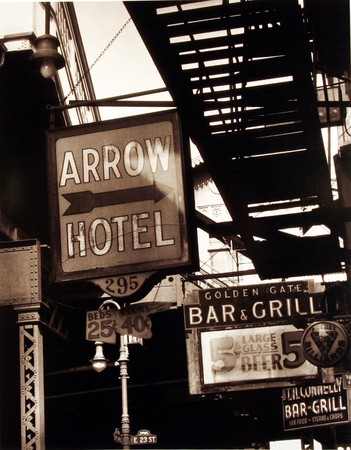
Max Yavno (Los Angeles: Underneath Third Avenue El – 1938)
I am currently reading a very interesting book, Unless the Threat of Death Is Behind Them: Hard-Boiled Fiction and Film Noir (2006 The Johns Hopkins University Press) by John T. Irwin, which studies five novels and the films based on them – The Maltese Falcon, The Big Sleep, Double Indemnity, High Sierra, and Night Has a Thousand Eyes. Irwin’s thesis seems to be that noir is concerned with death metaphysically as life-in-being and death also in an existential sense bred of social alienation. The following excerpts for me express the kind of prose Irwin is concerned with, and are passages from my own reading that have particularly struck me as being relevant.
“I went up to my room, up the dusty stairs of Bunker Hill, past the soot-covered frame buildings along that dark street, sand and oil and grease choking the futile palm trees standing like dying prisoners, chained to a little plot of ground with black pavement hiding their feet. Dust and old buildings and old people sitting at windows, old people tottering out of doors, old people moving painfully along the dark street. The old folk from Indiana and Iowa and Illinois, from Boston and Kansas City and Des Moines, they sold their homes and their stores, and they came here by train and by automobile to the land of sunshine, to die in the sun, with just enough money to live until the sun killed them, tore themselves out by the roots in their last days, deserted the smug prosperity of Kansas City and Chicago and Peoria to find a place in the sun. And when they got here they found that other and greater thieves had already taken possession, that even the sun belonged to the others; Smith and Jones and Parker, druggist, banker, baker, dust of Chicago and Cincinnati and Cleveland on their shoes, doomed to die in the sun, a few dollars in the bank, enough to subscribe to the Los Angeles Times, enough to keep alive the illusion that this was paradise, that their little papier-mache homes were castles. The uprooted ones, the empty sad folks, the old and the young folks, the folks from back home. These were my countrymen, these were the new Californians. With their bright polo shirts and sunglasses, they were in paradise, they belonged. But down on Main Street, down on Towne and San Pedro, and for a mile on lower Fifth Street were the tens of thousands of others; they couldn’t afford sunglasses or a four-bit polo shirt and they hid in the alleys by day and slunk off to flop houses by night. A cop won’t pick you up for vagrancy in Los Angeles if you wear a fancy polo shirt and a pair of sunglasses. But if there is dust on your shoes and that sweater you wear is thick like the sweaters they wear in the snow countries, he’ll grab you. So get yourselves a polo shirt boys, and a pair of sunglasses, and white shoes, if you can. Be collegiate. It’ll get you anyway. After a while, after big doses of the Times and the Examiner, you too will whoop it up for the sunny south. You’ll eat hamburgers year after year and live in dusty, vermin-infested apartments and hotels, but every morning you’ll see the mighty sun, the eternal blue of the sky, and the streets will be full of sleek women you never will possess, and the hot semi-tropical nights will reek of romance, you’ll never have, but you’ll still be in paradise, boys, in the land of sunshine.”
– John Fante, Ask the Dust (1939)
“No feelings at all was exactly right. I was as hollow and empty as the spaces between the stars. . . . Out there in the night of a thousand crimes people were dying, being maimed, cut by flying glass, crushed against steering wheels or under heavy tires. People were being beaten, robbed, strangled, raped, and murdered. People were hungry, sick; bored, desperate with loneliness or remorse or fear, angry, cruel, feverish, shaken by sobs. A city no worse than others, a city rich and vigorous and full of pride, a city lost and beaten and full of emptiness. It all depends on where you sit and what your own private score is. I didn’t have one. I didn’t care.”
– Raymond Chandler, The Big Sleep (1939)
Christmas Noir

In the opening sequence of Robert Aldrich’s Kiss Me Deadly (1955), on Mike Hammer’s car radio after picking up the panting Christina, the radio announcer introduces then plays the Nat King Cole recording, Rather Have the Blues:
The night is mighty chilly, and conversation seems pretty silly
I feel so mean and wrought, I’d rather have the blues than what I’ve got.
The room is dark and gloomy, you don’t know what you’re doing to me
The way it has got me caught, I’d rather have the blues than what I’ve got.
All night, I walk the city, watching the people go by.
I try to sing a little ditty, but all that comes out is a sigh.
The street looks very frightening, the rain begins and then comes lightning.
It seems love’s gone to pot, I’d rather have the blues than what I’ve got…
Summary Noir Reviews: Highway Crack-Up at Moontide

Apology for Murder (1945) Entertaining PRC rip-off of Double Indemnity. Hugh Beaumont plays the sap to Anne Savage’s femme-fatale. Savage dominates in a camp turn that has you wanting more.

Crack-Up (1946) A rollicking b-thriller. Pat O’Brien and Claire Trevor hunt down art forgery racket. Some noir overtones and moody photography with the clever use of flashback.

Endless Desire (Hateshinaki yokubo 1958 Japan) A darkly sardonic tale of greed punished by relentless fate. Bravura direction and cinematography, with a hip 50s jazz score. The movie opens with credits passing over a locomotive thundering along the rails – an opening very reminiscent of Fritz Lang’s Human Desire. A group of hoods and a wily femme-fatale tunnel for hidden loot with attendant double-crosses and a final triple-cross. A comic side-plot of a young couple’s courtship is nicely intertwined and the femme-fatale seduction of the callow youth is played for laughs. A brilliant climax in teeming rain at night in deserted city streets and the final denouement on an abandoned bridge thrill.

He Walked By Night (1948) A psychopathic killer is stalked by cops. An amazing chase climax in underground drains is the highlight. DP John Alton’s visual poetry offsets zero characterisation.

Highway 301 (1950) A taut crime-doesn’t pay b with Steve Cochran dominating as a savage hood. Cochran’s cold-blooded point-blank murder of a former girl friend is chilling, and his pursuit of the hapless wife of a dead gang-member is remorseless and unrelenting. The violent dispatch of these women is down-right disturbing. Memorable drawn-out tour-de-force climax on dark city streets.

I Walk Alone (1948) A great noir sleeper from director Byron Haskin. Crooked nightclub-impresario Kirk Douglas has framed boot-legging partner Burt Lancaster, who went down for a 14 year stretch. Lancaster returns looking for his cut, and falls for chanteuse Lizabeth Scott, the two-timing Douglas’ girl on-the-side. Wendell Corey is the fall guy. Lancaster oozes integrity, Scott decency, and Douglas villainy. Corey the crooked accountant is more resonant as the primal noir protagonist.

I Was a Communist for the FBI (1951) Slick reds-under-the-bed homage to HUAC. FBI plant Frank Lovejoy saves pinko dame in great noir rail-yard shoot-out.

Moontide (1944) Savvy pairing of Jean Gabin and Ida Lupino in a moody noir melodrama by the sea aching with love, humor, fog, and angst. A nice reversal of noir motifs: a guy with a past, a dame with no future, and an homme-fatale. Gabin in his first Hollywood picture oozes Gallic charm. Lupino you have to fall in love with. Cameron Mitchell is great as the low- life homme-fatale, with Claude Rains out-of-place as an enigmatic intellectual-cum-nightwatchman. Camp elements like Mitchell flicking Raines’ naked butt with a towel in a communal shower (behind a low wall of course); Gabin a $2 a day fish bait-seller dressed for his aboard-barge wedding in the most elegant suit this side of Paris; and Raines advising Lupino on her wedding night on the erotic obligations of a wife. Wonderful expressionist revenge climax on a dark pier at night. Archie Mayo directed with cinematography from Charles Clarke and Lucien Ballard (uncredited). Originally a Fritz Lang vehicle he was replaced by Mayo two weeks into shooting. How much the finished film owes to Lang is an intriguing mystery.

My Name Is Julia Ross (1945) Gothic noir is Joseph H. Lewis’ first notable film. Nina Foch is convincing as abducted young woman whose sanity is under assault. Richly atmospheric but marred by hurried ending after 60 minutes.
The Bribe (1949): Too late the fireworks

“Price and Laughton make a formidable pair of heavies in this otherwise feeble thriller shot on a cheaply rigged-up corner of the MGM backlot. Taylor isn’t up to moral dilemma as a US government agent sent to crack illicit aircraft engine trading in the Caribbean, yet tempted by a lucrative cash offer and the irresistible charm of café chanteuse Gardner.”
– Time Out Film Guide
You would think a movie boasting the talent invested here by MGM just couldn’t miss. But it does. The Bribe which flopped at the box-office never gets off the ground until the end with some pyrotechnical wizardry. We have an a-list production team in Director Robert Z. Leonard and DP Joseph Ruttenberg, supplied with a ripping story, a good script, an exotic latin locale, and a score from Miklós Rózsa. Robert Taylor is a jaded chain-smoking war vet turned undercover-cop, Ava Gardner the angelic wife of a lush moonlights as a sultry cabaret singer, Charles Laughton is a scruffy low-life with bad feet, and Vincent Price is the suave villain.
It starts off noir with Taylor’s cop sweating out a tropical storm in his hotel-room with a dame on his mind – you know because there is his voice-over. He can’t trust the woman but wants her bad. To keep her he has to go over to the other side, and a bribe offered by Laughton as Price’s voluble emissary is an added incentive to go over. We then segue into a long flashback to establish what he is doing in a hotel on an island off the coast of South America. Taylor is wooden and a drag on the story which moves too slowly and with little tension. Gardner is eminently watchable and convincing. Her single cabaret outfit is sensuous and quite revealing, but she is no Gilda. Laughton and Price give their roles a sardonic edge, with Laughton nicely hamming it up as a sloven conniver. When the flashback is over towards the end we hit noir territory again.
What saves the film from obscurity is the literally explosive climax, an imaginatively choreographed and technically daring shootout at night. This tour-de-force noir denouement is a blast!
 FilmsNoir.Net - all about film noir