Blog Feed

Ace In The Hole (1952): The Media Circus

Ace In The Hole (1951)

“A brilliant arrangement of cause and effect…
unique as a mirror of the morbid psychology of
crowds… revolting but incontrovertibly true.”
– New York Times

“Terrific drama. Grim tale of a big city reporter
who capitalizes on a disaster to ride himself back
to the big time. Unrelenting in its cynicism.”
– Steve H. Scheuer, Movies on TV and Video.

Ace in the Hole (aka The Big Carnival) is a savage critique not only of a corrupted but also corrupting modern mass media. Perhaps Billy Wilder’s best film, this subversive morality tale was not a box office success when first released. As Wilder said of the audience response at the time: “Americans expected a cocktail and felt I was giving them a shot of vinegar instead.”.

Kirk Douglas as the self-seeking journalist, Chuck Tatum, dominates the screen and develops by the climax as one of Wilder’s more complex characterisations. There are noir elements in the movie, but classifying it as a noir unfairly limits its scope and the depth of social criticism. Only the poor trapped man, his inconsolable parents, and the owner of the small town newspaper, have any true decency. Everyone else, is either corrupt or corruptible, if not downright stupid or plain evil – the trapped man’s floozy of a wife included, and Tatum’s naive young photographer is easily seduced by the reporter’s phoney charisma. The corrupt sheriff who actively conspires with Tatum, even after he is told the poor trapped man is doomed, wants to use this turn of events to his political advantage.

The power of this film resonates today, when countries go to war on manufactured evidence and manipulative spin. Innocent lives are as expendable today as they always have been in the cause of political ambition and warped ideological agendas: a world where the spin doctor rules.

This is a must see movie.

Double Indemnity (1944): Proto-Noir

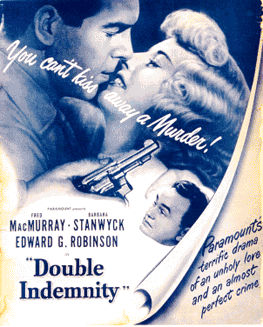
Double Indemnity (1944)

“One of the highest summits of film noir…
without a single trace of pity or love.”
Charles Ingham, 1971

Double Indemnity, Billy Wilder’s classic proto-noir from the pot-boiler novella by James M. Cain, is a great melodrama with snappy dialog and a tight script from Wilder and Raymond Chandler. All the elements of the archetypal film noir are distilled into a gothic LA tale of greed, sex, and betrayal. The casting of the inscrutable Fred MacMurray as the anti-hero, a seductive and transparently vile Barbara Stanwyck as the femme-fatale, and Edward G. Robinson as the garrulous claims manager is inspired.

I have lost count of how many times I have watched this movie, and it has been over 30 years since I first saw it on TV as teenager, but with each viewing I come away with something new. It attests to Wilder’s skill as a film-maker that the dramatic tension is sustained until the last frame even though the whole story is told in flashback – we know Walter Neff is a goner from the go. The opening fluid shots of the wounded Neff’s car careening down the dark LA streets with Miklos Rosza’s musical counterpoint, wonderfully establish the dark dramatic mood before any character is seen on the screen.

Double Indemnity (1944)Double Indemnity (1944)

Double Indemnity (1944)Double Indemnity (1944)

But there are some nagging weaknesses. The only rounded character is Robinson’s claims manager, Barton Keys. Walter Neff and Phyllis Dietrichson are flat protagonists and our interest is sustained mostly by their early banter and poisoned repartee in the brutal climax. Neff says he loves Phyllis, but I all I see is a murderous conspiracy based on greed and lust. He has no real remorse and elects to clean up the unravelling of the crime by plugging Phyllis – despite her last minute conversion. Half-way through, the picture is nearly lost by the over-long and ludicrous scene in the office of Barton Keys’ boss, who is played so badly that the otherwise deft attempt at comic relief falls completely flat – I was reminded of Zeppo Marx…

That said, Double Indemnity is great entertainment and a recommended introduction to the film noir genre.

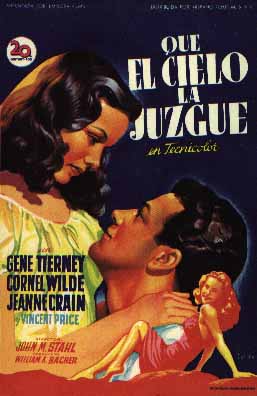
Leave Her to Heaven Screening

Leave Her to Heaven (1945)

The sixth annual Rewind/Fast Forward Film and Video Festival, held at the Miami-Dade Public Library will Friday screen a restored print of Leave Her To Heaven (1945) with Gene Tierney.

From a preview by Scott Cunningham in the Miami New Times:

…the festival is showing a range of cinematic realism, beginning with a restored print of the 1945 film noir classic Leave Her to Heaven, starring a 24-year-old Gene Tierney. Delightfully fake, this potboiler, washed in Technicolor and painted backgrounds, tells the melodramatic tale of Ellen Berent (Tierney), a rich woman driven to madness by her possessive love for her novelist husband Richard (Cornel Wilde). The realism in this case comes from the intersection of Tierney’s character with her own life. The actress suffered from bipolar disorder and was lobotomized a few years after the filming of the movie. Who’s to say if she was overacting, or acting at all?”

Lloydville on Schizo-Noir

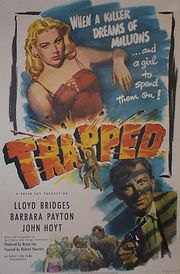
Crime Wave (1954)Trapped (1948)

Lloydville of mardecortesbaja.com has posted a good review of these two noirs: Trapped (1949) and Crime Wave (1954)

Drunken Angel (Japan – 1948)

Drunken Angel (Japan - 1948)

Filmsquich.com has posted an interesting review of the Akira Kurosawa noir Drunken Angel (1948) aka Yoidore Tenshi. Kurosawa’s other noir feature is the excellent High and Low (1963) aka Tengoku To Jigoku.  Both movies star the uber cool Toshiro Mifune.

Filmquish has also reviewed another early Kurosawa drama as noir: Stray Dog (1949) also starring Mifune.
Full list Filmsquish noir reviews:

13 Tzameti (2006)
Ace In The Hole (1951)
Angel Face (1952)
Angel Heart (1987)
Big Sleep, The (1946)
Blade Runner (1982)
Drunken Angel (1948)
Element Of Crime, The (1984)
L.A. Confidential (1997)
M (1931)
Man Who Knew Too Much, The (1934)
Man With the Golden Arm, The (1955)
Notorious (1946)
Reckless Moment, The (1949)
Rififi (1955)
Se7en (1995)
Shadow Of A Doubt (1943)
Sin City (2005)
Stage Fright (1951)
Strangers On A Train (1951)
Stray Dog (1949)
The Maltese Falcon (1941)
Third Man, The (1949)
Wrong Man, The (1956)

Detour (1945): Serious Not

Detour (1945): Serious Not

I caught up with Detour (1945) today, and must say I think director, Edgar G. Ulmer, is taking us for a a ride. The whole affair is hard to take seriously. The story of a guy so dumb he blames fate for the consequences of his own foolishness. Though fun to watch is Ann Savage, asVera, the street-wise dame, who incredulously falls for the sap. A camp oddity, but hardly serious noir.

I am very ambivalent about Detour. I can see the craft and that it is unlike any other Hollywood film of the period, but the story is so sappy that it irks. The story is based on the pulp novel by Martin M. Goldsmith, and the plot is essentially lifted straight from the book, which is pretty naif and while having a certain charm epitomises cheap pulp.

vera Vera: No Detours

Ann Savage’s portrayal of Vera is memorable . She is no femme-fatale, she is a dame on the skids and desperate for any scheme to get here out of the hole she is in, and by the way she is dying, and knows it. She is not from hell. She is tough but she is also a woman. She does not ‘make’ Haskell but scrapes the skin off his hands with her fingernails when he gets fresh. She is vulnerable and needs love as much as the next dame. Look at when we see her on the highway hitching for a ride, and then in the scene in the hotel room just before she dies. The woman is tainted yes, but she has an integrity that shines through the cheap bravado.  My poem for Vera is here Vera: No Detours.

Another issue. To understand Hollywood noir you have to understand b-movies. I love to quote Jean Renoir on this. In the book, The Early Film Criticism of François Truffaut by Wheeler Dixon (Indiana University 1993), there is an interesting section that deals with the obvious influence on Truffaut of Hollywood b-movies, particularly film noir. According to Dixon, Truffaut and even his mentor, Jean Renoir, preferred b-features over a-productions.

In a 1954 interview, Renoir was quite emphatic:

“I’ll say a few words about Val Lewton, because he was an extremely interesting person; unfortunately he died, it’s already been a few years. He was one of the first, maybe the first, who had the idea to make films that weren’t expensive, with ‘B’ picture budgets, but with certain ambitions, with quality screenplays, telling more refined stories than usual. Don’t go thinking that I despise “B” pictures; in general I like them better than big, pretentious psychological films they’re much more fun. When I happen to go to the movies in America, I go see “B” pictures. First of all, they are an expression of the great technical quality of Hollywood. Because, to make a good western in a week, the way they do at Monogram, starting Monday and finishing Saturday, believe me, that requires extraordinary technical ability; and detective stories are done with the same speed. I also think that “B” pictures are often better than important films because they are made so fast that the filmmaker obviously has total freedom; they don’t have time to watch over him.”

This is where the skill and artistry of Ulmer’s Detour are to be found.

Noir: Inside The Frame

Out Of The Past (1947)

Leonard Quart in an article, Noir in New York, on the recent New York City Noir festival for the Berkshire Eagle, has made an interesting observation, which is also my take on film noir (my emphasis):

Both these films [Taxi Driver and Klute], despite utilizing some of noir’s imagery and stylistics, explore their central characters in greater depth and depict a city much more particular and less formulaic in its rancid corruption and violence than traditional film noir. Emphasizing the psychological and aesthetic, neither film ever makes grand political and social statements. And despite the tendency of some critics to write about the genre itself as a mirror of the bleakness of life in a postwar urban America burdened by the oppressive weight of a Depression, WW II, and the Cold War, the fact was that American cities were generally prosperous and safe in those postwar years. In the words of “Taxi Driver” scriptwriter, Paul Schrader, film noir was “more a creation, rather than a reflection.” … Obviously, some noir films could be wonderful, and others dreadful. But they were films that always should be understood on their own terms, rather than mined for portentous subtexts. At their best they were well-wrought, atmospheric, suggestive entertainments.

To my mind, films noir are first and foremost entertainment, and any film must be first understood simply from what is on the screen.

This line from Siodmak’s Out of the Past (1947) says it best: “All I can see is the frame … I’m going inside to look at the picture”.

Melville’s Film Noir

Le Doulos (1962)

San Francisco’s Bay Area Reporter has published a good article, Double-crossed in the City of Lights, on French noir director Herman Melville, centered around his film Le Doulos (1962), playing August 17-23 at the Castro.

Pickup On South Street (1953)

Pickup On South Street (1953)

I am ambivalent about Pickup On South Street. Somehow the gestalt is off: the whole is not greater than the sum of the parts.

A weak story is propped up by Sam Fuller’s spirited direction and strong performances from the two female leads. Thelma Ritta received a deserved Academy Award Nomination for her role as the bag lady with soul. Jean Peters is great as the gutsy B-girl, and Richard Widmark makes the sparks fly in his scenes with Peters. The repartee in Fuller’s script is great and adds to the enjoyment. But I was left flat by the pat resolution and feel-good ending.

While Pickup On South Street is not readily identifiable as a noir as it does not follow the genre’s conventions, there is a noir sensibility. Flawed characters are portrayed sympathetically and redeemed by their essential humanity. As Fuller said in a 70s interview, he is not really concerned with the wider “reds under the bed” plot, but with how the drama of the lives affected plays out.

Pickup On South Street (1953)

But the flaws in the film are there and limit its impact. The strongest scene in the film should have been when the bag-lady, Moe, confronted late at night in her apartment by the commie stooge, goes into a relatively long monologue on her fate. An excellent performance by Thelma Ritta is undermined by an unconvincing delay, as the stooge waits for her to finish her story (which he is patently not interested in) before plugging her.

Recommended but over-rated.

Thieves’ Highway (1949)

Thieves’ Highway (1949)

From director, Jules Dassin, whose earlier films included the noirs, Brute Force (1947) and The Naked City (1948), Thieves’ Highway about the struggles of truckers trying to make a buck hauling fruit to the San Francisco produce markets, is great melodrama with a strong social conscience. It tells a story strongly rooted in the southern European migrant experience.

The screenplay was adapted by Albert Isaac Bezzerides from his novel Thieves’ Market (1949). Bezzeridis’ noir credits include Desert Fury (1947), Kiss Me Deadly (1955), On Dangerous Ground (1952), and They Drive by Night (1948). Dassin was blacklisted by the HUAC and left the US before the final cut was made, and word has it the studio axed his original “noir” ending and added a “happy-ending” re-take.

But even with a darker ending, I would not say it is a film noir. The protagonist, a straight-up guy, Nick Garcos, wants to avenge his Greek father’s maiming by a crooked wholesaler and risk his last dime on a freight trip that will give him the stake he needs to settle down with his hometown sweetheart – the perfect role for Richard Conte. The other femme is an Italian good-time girl, played beautifully by Italian actress, Valentina Cortese, who never really wants to hurt him, but is only drawn into the story by the conniving of the wholesaler, Mike Figlia, gleefully played by Lee J. Cobb.

What struck me is how well each of the main characters is drawn, and how the rush to get the load of apples to the market, propels the story, and the character development. The most potent scene is when Nick is pinned under his truck after the changing of a flat tyre goes wrong, just off the busy highway, where a never-ending stream of trucks rip through the night: the world is not going to stop for one poor guy stuck under his truck. Nick does survive after he is rescued by his erstwhile shady partner. This exemplifies a wonderful quality of the film: each character has a chance at redemption – only Figlia and his henchmen are too rotten achieve it.

Thieves’ Highway (1949)

Filmically it is also a great testimony to all who worked on its production. The atmosphere of the Frisco produce markets is rendered so convincingly, that it has a cinema verite quality.

Thieves’ Highway (1949)

I feel qualified to say this as this is one of the very rare times, I can directly relate to what is happening on the screen. I grew up in a small corner fruit store run by my immigrant parents in a working-class suburb of Sydney – a big harbour city with a produce market at it’s center. My father is Italian and my late mother was Greek. It was a struggle and we opened 7 days a week. During school vacation my father would wake me at 4am weekdays for the trip to the city markets, where I would haul the long barrow behind him, as he moved from stall to stall haggling to find produce at a price that he could sell and make a buck. This movie connected for me deeply.

Thieves’ Highway: a good story well told, and worth remembering.