Blog Feed

New Book on Edgar G. Ulmer

Edgar G Ulmer

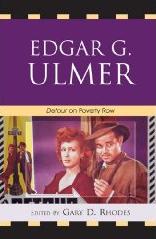
A new book on the work of Poverty-Row director, Edgar G. Ulmer, who made the cult b-noir, Detour (1945), was released in May.

The book, Edgar G. Ulmer: Detour on Poverty Row, was reviewed today by Michael H. Price in the Fort Worth Business Press:

[In] Edgar G. Ulmer: Detour on Poverty Row … Editor [Gary D.] Rhodes and a well-chosen crew of contributing writers consider Ulmer in light of not only his breakthrough film, 1934’s The Black Cat at big-time Universal Pictures, or such finery-on-a-budget exercises as Bluebeard (1944) and Detour (1945), but also Ulmer’s tangled path through such arenas as exploitation films (1933’s Damaged Lives), Yiddish-language pieces (1937’s Green Fields), well-financed symphonic soap opera (1947’s Carnegie Hall), and ostensible schlock for the drive-in theaters (1957’s Daughter of Dr. Jekyll)… A perceptive chapter from Christopher Justice wonders aloud whether the writer-director might be considered “the godfather of sexploitation,” in view of the “new aesthetic terrain and … core prototypes” that can be observed in such films as Damaged Lives and Girls in Chains (1943) and The Naked Venus (1958)… Tony Williams regards Ulmer as an advancer, rather than a follower, of the “psychobiography” approach that Orson Wells had defined with Citizen Kane in 1941 — on the evidence of an often-maligned, oftener-ignored Ulmer picture called Ruthless (1948). (Ruthless stars Zachary Scott as an industrialist who might make Welles’ Charles Foster Kane look like Rebecca of Sunnybrook Farm by comparison.)
New Criterion DVD: “The Furies”

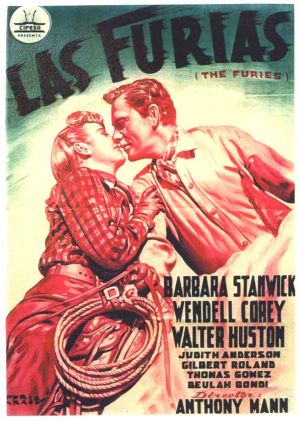
The Furies (1950)

Criterion today released on DVD one of the great noir westerns, The Furies (1950) directed by Anthony Mann.

From the LA Times review by Dennis Lim:

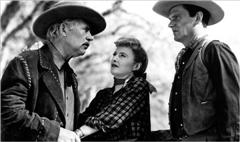
In truth, “The Furies,” frontier setting notwithstanding, barely counts as a western. There are elements of film noir in both the plot and the look; many key scenes unfold under cover of darkness (Victor Milner earned an Oscar nomination for his moody cinematography). Above all, though, it plays like a Freudian melodrama, dissecting the hysterical and ultra-competitive love-hate relationship between widowed patriarch T.C. Jeffords ( Walter Huston) and his headstrong daughter, Vance ( Barbara Stanwyck).

From the NY Times review by Dave Kehr:

Mann gives the action a metaphysical dimension that overwhelms easy psychoanalytic readings. As in his films noirs (Raw Deal, Desperate), he systematically composes his shots to create a sense of instability, using lines of perspective or boldly massed foregrounds to pull the images off balance. The titanic struggle between father and daughter has knocked the world off its axis.

The Furies (1950)

Links:
LA Times Review by Robert Lim
NY Times Review by Dave Kehr
Criterion: The Furies
The New Yorker Review by Richard Brody
The House Next Door Review by Dan Callaghan

Rare Screenings at Fifth Annual Albuquerque Film Noir Festival

Repeat Performance

This year’s 5th Annual Noir Film Festival, which started Friday today at the Guild Cinema in Nob Hill, Albuquerque (3405 Central Ave NE  255-1848), features some rarely screened titles that should have local film noir fans very excited:

JUNE 20 & 21 (FRIDAY & SATURDAY):

The Hidden Room

DOUBLE INDEMNITY (3:00, 7:00)
Dir. Billy Wilder – 1944 – 107m

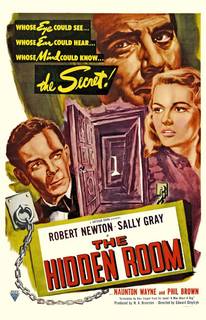
THE HIDDEN ROOM (a.k.a. OBSESSION) (5:10, 9:10)
Dir. Edward Dmytryk – 1949 – 96m – UK

JUNE 22 & 23 (SUNDAY & MONDAY):

REQUIEM FOR A HEAVYWEIGHT
The Original “Playhouse 90” Live Television Version (3:30, 7:00)
Dir. Ralph Nelson – 1956 – 90m

99 RIVER STREET (5:15, 8:45)
Dir. Phil Karlson – 1953 – 86m

JUNE 24 & 25 (TUESDAY & WEDNESDAY):

The Pretender

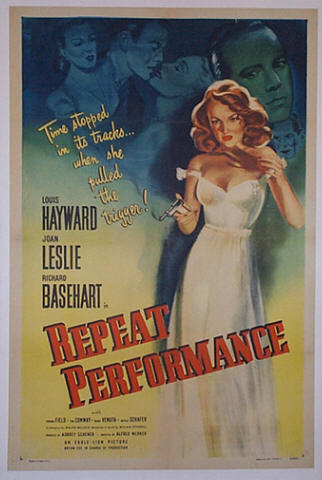
REPEAT PERFORMANCE (5:15, 8:30)
Dir. Alfred L. Werker – 1947 – 91m

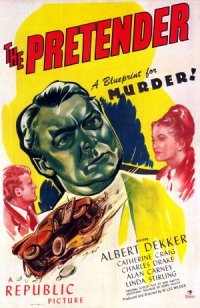
THE PRETENDER (7:00 ONLY)
Dir. W. Lee Wilder – 1947 – 69m

JUNE 26 & 27 (THURSDAY & FRIDAY):

TOMORROW IS ANOTHER DAY (3:10, 7:00)
Dir. Felix E. Feist – 1951 – 90m

KANSAS CITY CONFIDENTIAL (5:00, 8:45)
Dir. Phil Karlson – 1952 – 99m

JUNE 27 & 29 (SATURDAY & SUNDAY):

WIDMARK AND DASSIN
NIGHT AND THE CITY (2:30, 6:30)

ROAD HOUSE (4:30, 8:30)
Dir. Jean Negulesco – 1949 – 95m

JUNE 30 & JULY 1 (MONDAY & TUESDAY):

RARELY-SCREENED JOSEPH LOSEY
THE BIG NIGHT (5:30, 8:35)
Dir. Joseph Losey – 1951 – 75m

QUICKSAND (7:05 ONLY)
Dir. Irving Pichel – 1949 – 79m

JULY 2 & 3 (WEDNESDAY & THURSDAY):

CINEMATOGRAPHER JOHN ALTON IN TECHNICOLOR
SLIGHTLY SCARLET (5:00, 9:00)

JOSEPH LOSEY IN THE U.K.
THE CRIMINAL (7:00 ONLY)
Dir. Joseph Losey – 1960 – 97m – UK – Shown on digital video

JULY 4 & 5 (FRIDAY & SATURDAY):

CRY OF THE CITY (3:30, 7:05)
Dir. Robert Siodmak – 1948 – 95m

RARE SCREENING
CELL 2455, DEATH ROW (5:30, 9:05)
Dir. Fred F. Sears – 1955 – 77m


JULY 6 & 7 (SUNDAY & MONDAY):

RESTORED 35MM PRINT
THE BLACK BOOK (a.k.a. REIGN OF TERROR) (3:30, 7:00)
Dir. Anthony Mann – 1949 – 89m

STRANGE ON THE RANGE!
TERROR IN A TEXAS TOWN (5:20, 8:45)
Dir. Joseph H. Lewis – 1958 – 81m

JULY 8 & 9 (TUESDAY & WEDNESDAY):

No Way Out

THE CRIMSON KIMONO (5:20, 9:05)
Dir. Sam Fuller – 1959 – 81m

RICHARD WIDMARK
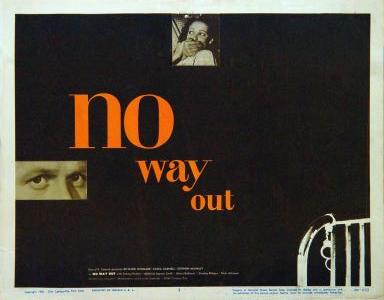
NO WAY OUT (7:00 ONLY)
Dir. Joseph L. Mankiewicz – 1950 – 106m

Full details here.

Key Largo (1948): Almost Noir


Key Largo (1948)

Returning WW2 vet fights gangsters on the Florida keys

The director of Key Largo, John Huston, co-wrote the screenplay with Richard Brooks, from a play by Maxwell Anderson.  The stage origins of the film are evident, but this strengthens the atmosphere of claustrophobia as the action is played out inside a seaside guest-house boarded-up against a hurricane.

The cast is particularly strong with Humphrey Bogart as the war vet, Edward G. Robinson as the over-the-hill gangster Johnny Rocco staging a comeback, with Claire Trevor as his alcoholic mole and Thomas Gomez as Rocco’s No.2, and Lauren Bacall as a young war widow with the legendary Lionel Barrymore as her father-in-law. Trevor deservedly won a best-supporting-actress Oscar for her role.

For some the returning war vet theme gives the movie a film noir quality – even though the action takes place in a non-noir locale and there is no cross-over between the good guys and the bad guys. I feel the picture is essentially a good-triumphs-over-evil tale laced with a swan-song for the gangster flick and leavened with post-war existentialist angst.

Bogart’s vet, Frank McLoud, shares the angst  of post-war Europe, where many returning to the peace with expectations of a better world that would justify the suffering and destruction, are confronted with the reality that nothing has changed. Disillusioned and bitter, the moral absolutism that underpinned their sacrifice dissolves into a weary relativism where one less Johnny Rocco is not worth dying for.

The climax and resolution of the story complete with a non-noir ending, also give little support to the view that Key Largo is a film noir. As the final scene hits the screen, it is the strength of family and the selfless pursuit of established values that destroy evil, with the existential anti-hero morphing into a hero of the classic mold. As McLoud says: “When your head says one thing and your whole life says another, your head always loses.”

Key Largo 1948

The Naked City: Weegee’s NY Noir Nightscape

Weegee

This weekend’s New York Times New York Explorer feature, Crime Was Weegee’s Oyster, spotlights the life, times, and photography of 30s and 40s freelance crime and street photographer, Arthur Fellig, better known as “Weegee”, and one of the city’s most famous photographers:

Weegee’s peak period… was a whirl of perpetual motion running from the mid-1930s into the postwar years. Ceaselessly prowling the streets during the graveyard shift, he took thousands of photographs that defined Manhattan as a film noir nightscape of hoodlums and gangsters, Bowery bums and slumming swells, tenement dwellers and victims of domestic brawls, fires and car crashes. He gave it its enduring nickname, the Naked City.

The on-line article features a slide-show of Weegee’s photographs and a video exploration of the New York locales where the photos were taken.

Update 20 June 2008: Today the NY Times published a Weegee Primer with a source list books, movies, NY locales, and a link to the INTERNATIONAL CENTER OF PHOTOGRAPHY‘s Weegee Web site, which features other photos and audio clips.

Woody Haut’s Blog: Noir Fiction and Film

I Wake Up Screaming

For those of you interested in the writers of noir fiction and the Hollywood screen-writers who penned the movies of the classic noir period, a visit to Woody Haut’s Blog is strongly recommended. Woody Haught is a journalist and the author of Pulp Culture: Hardboiled Fiction and the Cold War, Neon Noir: Contemporary American Crime Fiction, and Heartbreak and Vine: The Fate of Hardboiled Writers in Hollywood.

His essays are well-written and provide some fascinating insights. These sample posts should be of direct interest to readers of FilmsNoir.Net:

The Woman in the Window (1944): Over-rated

The Woman in the Window (1944)“The shopworn and superfluous ending has all the impact of a stale peppermint upon a man who has ordered a steak dinner.”
– Motion Picture Herald on the film’s release

Even without the cop-out ending, I find it hard to see Fritz Lang’s The Woman in The Window as other than a minor film noir. Although Freudian symbolism abounds and the noir theme of lives destroyed by chance events and small decisions is deftly handled, the movie is slow and ponderous – like the middle-aged law professor protagonist. Definitely one of Lang’s lesser works. Lang’s similarly-themed Scarlet Street (1945), made a year later with the same leads, is much stronger.

To give it credit the picture was popular with audiences and made money, but producer and screenwriter, Nunnally Johnson, was less than impressed, and it was received coolly by the critics.

In an interview in 1975, Lang justified the ending in these words:

This movie was not about evil… it was about psychology, the subconscious desires, and what better expression of those than in a dream, where the libido is released and emotions are exxagerated… [an] audience wouldn’t think a movie worthwhile in which a man kills two [sic] people and himself just because he had made a mistake by going home with a girl…

The irony of the second part of the quote will not be lost on film noir aficionados.

The Woman in the Window (1944)

Mildred Pierce (1945): “alligators have the right idea… they eat their young”

Mildred Pierce (1945)

“this etched-in-acid film chronicles the flaws in the American dream…”
– Steven H. Scheuer

“Constant, lambent, virulent attention to money and its effects, and more authentic suggestion of sex than one hopes to see in American films.”
– James Agee

Mildred Pierce (1945)

One of the great Hollywood melodramas with an Oscar-winning performance from the luminous Joan Crawford as Mildred. Better than the James M. Cain novel on which it is based, Mildred Pierce under the assured direction of Michael Curtiz, and with stunning film noir photography by cinematographer Ernest Haller, is top-class entertainment.

The story of family tragedy played out against the pursuit of the California dream of wealth and ease through hard-work and ambition destroyed by wastrel conceit and shameless greed, is as strong an indictment of the moral corrosiveness of wealth and privilege as Hollywood has achieved. But it is also a story of profound humanity and the worth of simple decency and personal integrity. Mildred makes tragic mistakes and misplaces her trust and love, but she is always true to herself, and in even in her darkest hour towers above the morass of greed and selfishness that would suck her down.

These frames from the movie illustrate the visual dynamite that explodes on the screen in the film’s most dramatic moments:

This slideshow requires JavaScript.

filmsnoir.net: AMC TV Site of the Week

AMCTV.COM

I was recently interviewed by Christine Fall of AMCTV.com about FilmsNoir.Net and her write-up of our discussion has today been posted under the AMC Site of the Week banner.

Check out the article for some background on me and why I started FilmsNoir.Net.

Fury (1936): On The Threshold of Noir

Fury 1936Director Fritz Lang’s first American film is a sharp terrifying study of mob hysteria as a town tries to lynch an innocent [kidnap] suspect. [Spencer] Tracy survives however, and returns to take revenge.
– Steve H. Scheuer – Movies on TV

After 70 years, Fury, which was co-written by Lang, remains a powerful and still relevant social criticism that telegraphs the recurring theme in Lang’s later Hollywood noirs: the fate of the individual when social institutions fail and injustice destroys innocent lives.

The film’s title is particularly apt with the first half concerned with mob fury, and the second half with the fury of the erstwhile victim seeking revenge. Strong performances from Tracy and Sylvia Sidney hold the narrative together even though their actual screen time is limited. The focus is on how hysteria grips a small town and allows mob rule to destroy social cohesion, and in the aftermath how the operation of the laws that protect freedom are thwarted by community loyalties trying to shield the law-breakers from justice. The irony is profound and convincingly played out in a court-room in the trial of the ringleaders. Lang spares no-one from the forensic gaze of the camera. A camera within a camera is used to indict the defendants when a projector is set-up in the court-room, and newsreel footage of the affray is shown. The newsreel footage is silent, and plays like a silent movie with riotous acts and facial expressions exaggerated for dramatic effect. A modern audience may find this technique dated, but it would have certainly had a strong impact on contemporary movie-goers only a few years after the end of the silent era.

Lang cut his teeth in German silent cinema, and silent movie techniques are also used in the movie’s action. Dramatic sustained close-ups of characters with extremely emotional expressions, and montage in two scenes: in the opening sequence a cut to an ominous roaring steam train disturbs the evening stroll of the two lovers, and later a clucking hen-house cut is a sardonic chorus to the burgeoning female rumor mill that is the build-up to the riot.

While Alain Silver and Elizabeth Ward include Fury, in their book, Film Noir: An Encyclopedic Reference to the American Style, I see the movie as pre-cursor only – not a fully-fledged film noir. The resolution at the end of the film is classic Hollywood, with the lovers re-united and justice morally if not legally served, but the Tracy character remains profoundly marked by his experience and not fully repentant of his attempt at vengeance. This is the territory that film noir would begin to explore a few years later.

Fury 1936