
From Raymond Chandler’s novel The Long Goodbye (1953):
There are blondes and blondes and it is almost a joke word nowadays. All blondes have their points except perhaps the metallic ones who are as blond as a Zulu under the bleach and as to disposition as soft as a sidewalk. There is the small cute blonde who cheeps and twitters, and the big statuesque blonde who straight-arms you with an ice-blue glare. There is a blonde who gives you the up-from-under look and smells lovely and shimmers and hangs on your arm and is always very very tired when you take her home. She makes that helpless gesture and has that god-damned headache and you would like to slug her except that you are glad you found out about the headache before you invested too much time and money and hope in her. Because the headache will always be there, a weapon that never wears out and is as deadly as the bravo’s rapier or Lucrezia’s poison vial.
There is the soft and willing and alcoholic blonde who doesn’t care what she wears as long as it is mink or where she goes as long as it is the Starlight Roof and there is plenty of dry champagne. There is the small perky blonde who is a little pal and wants to pay her own way and is full of sunshine and common sense and knows judo from the ground up and can toss a truck driver over her shoulder without missing more than one sentence out of the editorial in the Saturday Review. There is the pale, pale blonde with anemia of some non-fatal but incurable type. She is very languid and very shadowy and she speaks softly out of nowhere and you can’t lay a finger on her because in the first place you don’t want to and in the second place she is reading The Waste Land or Dante in the original or Kafka or Kierkegaard or studying Provencal. She adores music and when the New York Philharmonic is playing Hindemith she can tell you which one of the six bass viols came in a quarter of a beat too late. I hear Toscanini can also. That makes two of them.
And lastly there is the gorgeous show piece who will outlast three kingpin racketeers and then marry a couple of millionaires at a million a head and end up with a pale rose villa at Cap Antibes, an Alfa-Romeo town car complete with pilot and co-pilot, and a stable of shopworn aristocrats, all of whom she will treat with the affectionate absentmindedness of an elderly duke saying goodnight to his butler.
The dream across the way was none of these, not even of that kind of world. She was unclassifiable, as remote and clear as mountain water, as elusive as its color.
Blog Feed

Destination Murder (1950): The Alter-Ego and the Pianola
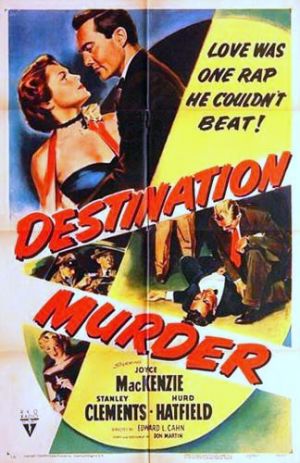 Young woman helps cops find her father’s killer
A poverty row b-thriller from a competent RKO production team. A scheming blonde, a suave villain, and an amateur female sleuth are packaged into 70 minutes of satisfying entertainment, with just a hint of sexual ambiguity and a novel twist with a reversal of roles between ego and alter-ego. Two smooth jazz interludes from Steve Gibson’s Redcaps in the Vogue night-club, and a great denoument scene at the end involving a pianola are highlights.
Director’s cut of Metropolis found
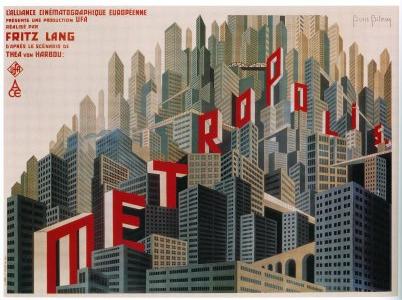
The long-lost original print of a Fritz Lang’s silent masterpiece, Metropolis (1927), has been found in Argentina.
The original 3½-hour film was believed lost after its US distributor, Paramount, cut it by 30 minutes after a poor reception from critics. But the German newspaper Die Zeit has reported that a copy of the original was sent to Argentina in 1928, where it has been gathering dust in the Buenos Aires Film Museum.
The lost footage, some of which is badly scratched, includes battle scenes and sections that flesh out a number of subplots and characters. Paula Felix-Didier, the curator of the museum, viewed the film only after a chance remark from a projectionist, who noted that it was longer than other versions. A film restorer who has seen the new footage said the film had its rhythm back. Source: The Telegraph – London
Samuel Fuller Restrospective in St. Louis
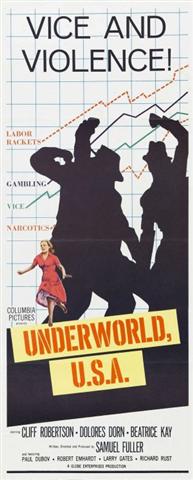 The Webster University Film Series will present a Samuel Fuller film each Thursday through July, starting tonight with his directorial debut, I Shot Jesse James (1949).
Coming up:
Pickup on South Street (1949) – July 10
Underworld, U.S.A (1961) – July 17
Shock Corridor (1963) – July 24
The Big Red One (1980) – July 31
San Quentin (1946): B-noir filler

Ex-con on parole tracks down escaped con who tried to kill him after a prison bust and a trail of violent robberies (RKO 70min)
San Quentin (1946), an early RKO factory job, not to be confused with the early Bogart movie of 1937, is a shoot-em-up with a message, complete with a real-life intro from an ex-Warden of Sing-Sing.
Tough guy actor, Lawrence Tierney, the bad-guy from The Devil Thumbs A Ride (1947), plays it straight as the defender of a prison reform program under threat, who falls under suspicion for the attempted murder of a cop after a violent prison escape. The direction is tight and the night scenes are nicely lit in noir fashion. A mean on-the-streets car chase and a gripping hand-to-hand climax tie the ribbon on this one.

This is the original NY Times review from 1947:
“As an attempted deviation from the normal prison melodrama, “San Quentin,” which made its appearance at the Gotham on Saturday, suffers the curse of a split personality. For the story line of this offering forks between seriously extolling self rehabilitation among convicts and straight cops-and-robbers adventure. And, rather early in its course, the yarn about an ex-prisoner and founder of San Quentin’s Inmates Welfare League, whose good work is nearly wrecked by an escaped killer, strays from its noble intentions to settle down to a traditional manhunt. From there on the going is normal, prosaic and only occasionally exciting.
Lawrence Tierney, whose screen portrait of Dillinger made that outlaw a paragon of hate, violence and bad temper, is the grim lad who seeks the killer, to vindicate the good names of the warden and the League. Mr. Tierney makes an indomitable, two-fisted, steely-eyed and tight-lipped tracker. But he is a sleuth—a man under parole at that—who shuns the aid of the law, a circumstance which is rather difficult to nationalize. As a man who has crashed out of countless cinema jails, Barton MacLane is thoroughly acceptable as the apparently reformed bank robber who escapes to sully the League’s escutcheon. As a climactic touch, the hand-to-hand showdown between MacLane and Tierney, makes quite an edifying donnybrook. Marian Carr and Joe Devlin as Tierney’s girl friend and sidekick, respectively; Harry Shannon and Tony Barrett handle some of the principal roles. And, though former Warden Lewis E. Lawes of Sing Sing sounds a note of approval in the prologue, “San Quentin” can hardly be listed as a documentary.”
Philip Marlowe: not so hard-boiled…

From Raymond Chandler’s novel, Farewell, My lovely (1940):
It got darker. I thought; and thought in my mind moved with a kind of sluggish stealthiness, as if it was being watched by bitter and sadisitic eyes. I thought of dead eyes looking at a moonless sky, with black blood at the corners of the mouths beneath them…
It got darker. The glare of the red neon sign spread farther and farther across the ceiling. I sat up on the bed and put my feet on the floor and rubbed the back of my neck.
I got up on my feet and went over to the bowl in the corner and threw cold water on my face. After a little while I felt a little better, but very little. I needed a drink, I needed a lot of life insurance, I needed a vacation, I needed a home in the country. What I had was a coat, a hat and a gun. I put them on and went out of the room…
‘I’m scared,’ I said suddenly. ‘I’m scared stiff… I’m afraid of death and despair,’ I said. ‘Of dark water and drowned men’s faces and skulls with empty eyesockets. I’m afraid of dying, of being nothing…’
Framed (1975) Released on DVD
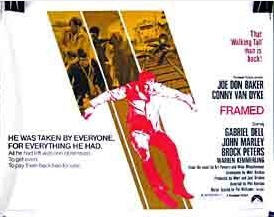
The last movie from a team of noir veterans, Framed (1975), has been released on DVD. Dave Kehr’s NY Times review is worth reproducing in full:
Released in 1975, “Framed” is among the last of the old-school films noirs. Three principal members of its creative team were part of the genre’s prime: the director Phil Karlson (“99 River Street,” 1953), the producer and screenwriter Mort Briskin (“Quicksand,” 1950), the cinematographer Jack A. Marta (who shot close to 200 B movies for Republic Pictures). The plot is practically a pocket guide to noir conventions. Joe Don Baker, a big man with a sad mouth, stars as Ron Lewis, a professional gambler who stumbles across a homicide involving some unknown, powerful people, who get him out of the way by sending him to prison on a trumped-up charge.
When, four years later, Lewis returns to the unnamed Southern metropolis he calls home, he finds that his adversaries have taken political control of the city and are moving in on the state. But Lewis, dehumanized by his experiences, isn’t deterred: with the help of a prison buddy, a syndicate hit man with a Sonny Bono haircut (Gabriel Dell, one of the original Dead End Kids back in the 1930s), he sets out to exact a terrible, bloody revenge.
“Somebody I don’t know took everything I had away from me,” he says, in a line from the Film Noir Hall of Fame, “and I’m going to make him pay. Double.”
Karlson and Briskin enjoyed a freak hit in 1973 with “Walking Tall” — essentially, a retooling of Karlson’s noir classic of 1955, “The Phenix City Story” — with Mr. Baker as a Southern sheriff fighting corruption. Their “Walking Tall” clout allowed them to make “Framed” without compromises, and this is a harsh, unlovely film, charged with unsettling anger and filled with a violence that was quite graphic for the time, and is still startling today.
Although “Framed” would prove to be the last film for both men, it is no nostalgic farewell. It’s a poison-pen letter filled with bitterness, paranoia and despair. When Lewis finally tracks down the individual responsible for his suffering, he finds — in another classic noir device — a man much like himself, with personal reasons for what he’s done. At the end of the journey lies its beginning, a film noir way of knowledge. (Legend Films, $14.95, R)
The Hitch-Hiker (1953): Desert Noir
 Two ordinary Joes driving to Mexico on a fishing trip are waylaid by a serial killer on the run (RKO 71 mins). Directed by actress Ida Lupino and based on a true story adapted by maverick writer Daniel Mainwaring. Cinematography by veteran noir cameraman Nicholas Musuraca.
Usually billed nowadays as the only film noir directed by a woman, this b-noir starts out well but fails to develop sufficient tension and a flat ending disappoints. Lupino’s direction is adequate, but the strong opening noir-lit scenes of urban hijack and murder would be largely the work of Musuraca. Even Musuraca seems to lose it in the open spaces of the Mexican desert where most of the subsequent action is played out.

Star-billing is given to Edmond O’Brien and Frank Lovejoy as the hostages, but they are constrained by their largely passive roles, and it is b-noir regular, William Talman, in a memorable portrayal as the psychotic killer, who holds the picture together. The desperado’s savage menace and barely contained hysteria is entirely convincing, and it is this that saves the movie from obscurity.
The Big Steal (1949): “Oh Mexico”

Comedy melodrama. Army officer (Robert Mitchum) is framed for a robbery and sets off after the culprit in a wild car chase across Mexico with a swell girl (Jane Greer). A hoot! Directed by Don Seigel and written by Gerald Drayson Adams and Geoffrey Homes from a story by Richard Wormser.
Last year in an insightful post on Mexico and Film Noir on his mardecortesbaja.com blog, Lloydville said: “Greer and Mitchum in Out Of the Past have their romantic idyll in Mexico but can’t bring the magic of it back with them to the States. This fits in with the notion of Mexico as a lost or unattainable paradise. But sometimes the idea of Mexico went to filmmakers’ heads – they got giddy with the possibilities of it. Films that started out noir would, once they crossed south of border, turn into larks, light-hearted and feckless. Re-teamed in The Big Steal, Greer and Mitchum venture into Mexico to try to extricate themselves from typical noir predicaments involving betrayal and unjust accusation, but the dark clouds vanish almost immediately – they find love and high-spirited adventure instead of noir’s dark, impenetrable maze, and all ends well. Film noir expert Elizabeth Ward amusingly suggests that The Big Steal ought to be labelled fiesta noir…”
The Big Steal is a fun ride with a nice twist at the end that leaves you wanting more. Mitchum and Greer are magic together. There are really funny running gags with Greer delivering great lines with wit and charm: any guy with blood in his veins will fall for her in this picture.

The supporting cast is strong, with a great turn by the veteran Mexican-born actor Ramon Novarro as a wiley Mexican police inspector, who has some magic lines. The scene where Greer fabricates an elopement story for the soft-hearted foreman of a road-gang is high farce infused with a true empathy and affection for the romance of Mexico and her people. This affection permeates the whole film with a sense of true liberation. The bouncy Mexican musical soundtrack echoes this mood of fun and adventure.
Two of my favorite songs reflect this love of Mexico: Elvis singing Mexico (Tepper,Bennett) in his 1963 movie Fun In Acapulco, and James Taylor’s Mexico. Elvis sings Mexico with such joy that for as long as the song lasts his voice takes you there:
Mexico, Mexico
They’ve got muchas, mucha-chas, amigos
…Latin features, never saw such adorable creatures
…Love to dig, ooh…the nights hereWe live it up and love it up amigo
Life begins when you’re in MexicoYou never order, water
When you order south of the border
…In to kiss a lovely senorita
You do the samba, la bamba
…I’ll go where you go
Life begins when you’re in MexicoMexico, Mexico
They’ve got muchas mucha-chas, amigos
…never saw such adorable creaturesWe’ll live it up and love it up amigo
Life begins…when you’re in…MEXICO…
James Taylor’s Mexico is more plaintive and shares a longing for some mythical place:
Way down here you need a reason to move
Feel a fool running your stateside games
Lose your load, leave your mind behind, Baby JamesOh, Mexico
It sounds so simple I just got to go
The sun’s so hot I forgot to go home
Guess I’ll have to go nowAmericano got the sleepy eye
But his body’s still shaking like a live wire
Sleepy Senorita with the eyes on fireOh, Mexico
It sounds so sweet with the sun sinking low
Moon’s so bright like to light up the night
Make everything all rightBaby’s hungry and the money’s all gone
The folks back home don’t want to talk on the phone
She gets a long letter, sends back a postcard; times are hardOh, down in Mexico
I never really been so I don’t really know
Oh, Mexico
I guess I’ll have to goOh, Mexico
I never really been but I’d sure like to go
Oh, Mexico
I guess I’ll have to go now
This love for Mexico is expressed more deeply and poetically in Jack Kerouac’s On the Road:
I was alone in my eternity at the wheel, and the road ran straight as an arrow. Not like driving across Carolina, or Texas, or Arizona, or Illinois; but like driving across the world and into the places where we would finally learn ourselves among the Fellaheen Indians of the world, the essential strain of the basic primitive, wailing humanity that stretches in a belt around the equatorial belly of the world from Malaya…to Morocco to the selfsame deserts and jungles of Mexico.
Oh Mexico…
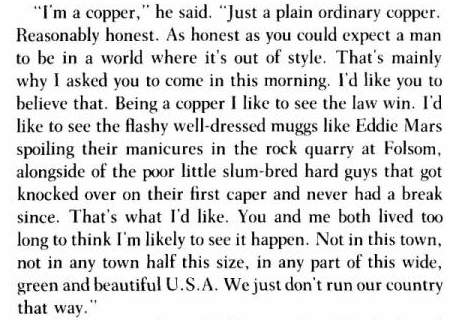
The Big Sleep: “flashy well-dressed mugs”
From Raymond Chandler’s novel, The Big Sleep (1939):
 FilmsNoir.Net - all about film noir