The Noir City: A Cosmic B-Movie

noir city

My shadow’s the only one that walks beside me
My shallow heart’s the only thing that’s beating
Sometimes I wish someone out there will find me
‘Til then I walk alone…

Green Day – Boulevard Of Broken Dreams

The origins of this post lie in a book I found in a used bookstore a few months back: The Cinematic City edited by David B Clarke (Routledge 1997). This is an academic book with a collection of essays on the “relationship between city and cinema”, which contains some fascinating essays on the noir city. The central thesis is that the modern metropolis is so large and diverse, that inhabitants’ experience of  the modern city is alienated.  This experience of modernity has shaped the cinema’s portrayal of the city as a place, and the cinematic city is a place as real as the physical entity it represents.

Having never been to the US, I realised that through my love of film noir, I ‘know’ the cities as Los Angeles, Chicago, New York, and San Francisco as a virtual stranger, and that even for those living in these cities, they experience their city as strangers:

Whereas the social and physical spaces of pre-modem society formed an intimately related, lived totality, modernity brought about their colonization by a thoroughly abstract space, which ensured their fragmentation and disjuncture. A world that was once perceived ‘as a living whole’, so to speak, could no longer be experienced as whole or complete… The ambivalence of the stranger thus represented the ambivalence of the modem world. Time and space were no longer stable, solid and foundational. Hence, the experience of modernity equated… [with ] the world as experienced by the stranger, and the experience of a world populated by strangers — a world in which a universal strangehood was coming to predominate . It was within such a world that the virtual presence of the cinema was to find its place (Clarke page 4)…  In the arena of the noir city, protagonists must confront both the strangeness of others and the strange otherness within – as film noir’s scenarios of disorientation and dislocation challenge their ability to chart an identity (F Krutnik page 89).

Almost bankers…

Bank Bounuses

“It was sheer unmitigated crime, a sort of selling bear on a huge scale in a sinking world. The aim of the gang was money, and they already had made scandalous profits. Partly their business was mere conscienceless profiteering well inside the bounds of the law, such as gambling in falling exchanges and using every kind of brazen and subtle trick to make their gamble a certainty . Partly it was common fraud of the largest size…  These fellows were wreckers on the grand scale, merchants of pessimism, giving society another kick downhill whenever it had a chance of finding its balance, and pocketing their profits.”

– John Buchan, The Three Hostages (Hodder & Stoughton, London 1924)  Graphic: ft.com.

The Black Cat (1934): Erotic nightmare

The Black Cat (1934)

Edgar G. Ulmer’s trash-noir Detour (1945) has a cult following. The film relates a fatalistic story of a guy so dumb he blames fate for the consequences of his own foolishness. Anne Savage, as the street-wise dame who incredulously falls for the sap, is memorable.

Earlier in 1934 Ulmer directed The Black Cat starring Boris Karloff and Bela Lugosi. Loosely based on a short story by Edgar Allan Poe, the movie is a camp masterpiece.  Set in the wonderfully gothic modernist house of a sinister architect, it is a mad expressionist tale of abduction, revenge, sexual obsession, camp horror, and unbridled eroticism.  Sex is the primary motif and there is a sense of unreality with the action moving with the strange fractured incoherence of a dream. In a sense Ulmer prefigures the oneiric and sexual motifs of the classic noir period. A must-see.

This trailer I have created focuses on the pervasive eroticism… see the shapely legs of the comely heroine get the Von Sternberg treatment!
The clip has been blocked by NBC Universal on copyright grounds.

Betty Draper found in Noir City

Betty Draper

Courtesy of GQ Magazine. Photo by Terry Richardson.
‘Slightly Scarlet’ enhancements by FilmsNoir.Net.

NOIR CITY DC: The 2009 Film Noir Festival

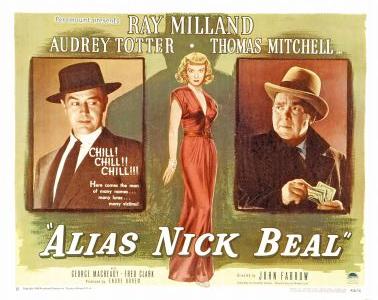
Alias Nick Beal (1949)

The Film Noir Fndation is presenting the NOIR CITY DC: The 2009 Film Noir Festival  over October 24 – November 4.

The program features new 35mm prints of these classic noirs:

  • SLIGHTLY SCARLET (1956)
  • ACE IN THE HOLE (1951)
  • GUN CRAZY (1950)
  • WICKED AS THEY COME (UK, 1956)
  • ALIAS NICK BEAL (1949)
  • THE BIG COMBO (1955)
  • SHAKEDOWN (1950)
  • BEYOND A REASONABLE DOUBT (1956)
  • OUT OF THE PAST (1947)
  • THE KILLERS (1946)
  • HOLLOW TRIUMPH (1948)

Full details here.

Electric nightmares in dark empty warehouses…

electricnightmare

Electric nightmares in dark empty warehouses. Dank with the ocean’s chill and the blood of vengeance.

The rotting planks of a pier are suddenly shaken by a heavy thud and then by pounding footfalls. A running figure traverses the dull cone of light from a fog lamp affixed high on a post where the deck meets the shoreline.

The bent outline of a fugitive runs along a wharf in the macabre shadow of a looming gray hulk a brooding inert sentinel under an empty sky. A car door slams. The glimmering ebony saloon roars away, tires sliding atop the wet asphalt, and the headlights raucously stabbing the squalid shadows grown onto the mercantile mausoleums that hover at the perimeter.

Too late the sirens’ screeching cacophony cleaves the silence the careening car has left behind. More car doors slam. The harsh fevered intersecting headlights of the squad cars survey the scene revealing nothing.

10 Never Before on DVD Noirs Released

Highway 301 (1950)

This month’s Warner Archive new releases include these never-on-dvd-before noirs.

  • BERLIN EXPRESS (1948)
  • KILLER MCCOY (1947)
  • I DIED A THOUSAND TIMES (1955)
  • THE TALL TARGET (1951)
  • PAY OR DIE (1960)
  • SUSPENSE (1946)
  • HIGHWAY 301 (1950)
  • LIGHTNING STRIKES TWICE (1951)
  • THE SEARCH (1948)
  • TERM OF TRIAL (1963)

The last train at the end of the line…

The last train at the end of the line...

Empty streets of stolen angst. The silent steel sentinels are specters of a hidden horror. A crippling step at a time. Your breathing is labored and the red flood is existence ebbing away. Stumbling and crashing back to the fountainhead. You knew this is where it started and ends. Alone. A dying creature of the long night of the sleeping city. You desperately try to hold it back but you can’t stem the tide of fate. Falling hard on the wet tar in the sordid yellow light of the streetlight’s waning, your head shatters into a thousand fragments of racing memories. A blissful high showers your prone body, a shimmering bundle of rags. Your mouth fills with sweet black honey, and you finally find a sort of peace, the gutter a soft pillow for staring at the stars. A sheltering sky of black oblivion falls gently towards you.

The midnight special thunders in. The pavement an echoing platform at the end of the line. All the way. No stops. Leaving in one minute. “All aboard”. No-one is left behind. All seats are reserved. Who made that reservation? And when? Was it God in his infinite indifference at year zero? Or was it your mother in boundless love calling you back to the womb as you were leaving it. Do something! Make it real. Make it happen like it never did before. Just once. Too late. One final useless effort to go back, then you give it up. Sirens scream. The wails of the condemned a dark chorus do futile battle with the rumble and hiss of the locomotive as it draws the carriages away in a dirty cloud of steam.

Caged (1950): “the plot of our life sweats in the dark like a face”

Caged (1950)

… the plot of our life sweats in the dark like a face
the mystery of childbirth, of childhood itself
grave visitations
what is it that calls to us?
why must we pray screaming?
why must not death be redefined?
we shut our eyes we stretch out our arms
and whirl on a pane of glass
an afixiation a fix on anything the line of life the limb of a tree
the hands of he and the promise that she is blessed among women…”

Patti Smith – Dancing Barefoot (1979)

Caged (1950) is a gritty hard-hitting social problem picture from Warner Bros. A young woman is jailed after she is an unwitting accomplice in a gas-station robbery with her husband, who is killed during the heist.  The sheltered girl on admittance to a women’s prison discovers she is pregnant, but her condition does not protect her from the humiliation and brutalisation of prison life. Melodramatic but with a strong social conscience that targets corrupt authorities, the movie is downbeat and pessimistic.  Eleanor Parker in the lead is powerfully convincing, and is supported by a strong female cast, including Agnes Moorehead as a compassionate and crusading  superintendent, and Hope Emerson as a corrupt and sadistic block matron.  Though set-bound the regimentation and claustrophobia of incarceration is given a strong expressionist treatment by director John Cromwell and DP Carl Guthrie.  A moody evocative score from Max Steiner adds emotional depth.

The Maltese Falcon: The beginning of noir

The Maltese Falcon (1941)

John Huston’s 1941 screenplay was the first serious attempt to bring the hard-boiled nature of Hammett’s fiction to the screen. The 1931 version may have more closely followed the story of the novel, but it did not carry the hard-boiled spirit of Spade to the screen, and the 1936 version, Satan Met a Lay, with Bette Davis played the story as broad comedy.

David Spicer wrote in his book Film Noir (2002) that Huston’s film “was much closer than previous versions to the cynical tone of Hammett’s hard-boiled novel, retaining as much of Hammett’s dialogue as possible”.  William Luhr, in his book on the 1941 version says that: “Spade does not happily juggle a plethora of women but is bitterly involved with only two… For him, sexuality is not carefree but dangerous and guilt-ridden. The mystery and the evil world it reveals dominate the mood of the movie, and this sinister atmosphere does not entirely disappear at the end. Such an atmosphere presages film noir.”

The Spade of Hammett’s novel is deeply cynical, and at the end of the novel, but not in Huston’s film, he is ready to resume his affair with Archer’s wife. Mayer and McDonnell in The Encyclopedia of Film Noir (2007), say this about the final scenes in Huston’s screenplay: “Huston replaces Hammett’s cynicism with a more romantic gesture from Spade as he tells Brigid, ‘Maybe I do [love you]‘. While Ricardo Cortez’s Spade in 1931 is more or less resigned to handing Wonderly over to the police, Huston extends this sequence by accentuating the psychological disturbance within the detective. His torment is palpable, especially when he shouts into her face that ‘I won’t [fall for you] because all of me wants to, regardless of the consequences’. While this is not an existential moment, as some claim, it does represent a significant moment in the development of film noir. Unlike the novel, where survival is all that matters to the detective, Spade’s torment in the 1941 film nearly destroys him.”