In Jean Delannoy’s sexy, funny, and uber dark adventure-melodrama, Macao, L’enfer Du Jeu (aka Gambling Hell 1939), starring a charming Erich von Stroheim as an arms dealer, the luminous Mireille Balin as a cabaret dancer, and the suave but sinister Sessue Hayakawa as a racketeer, the spin of the roulette wheel offers no escape nor redemption. Justice is swift and unromantic – only the innocent survive.
Don’t believe the dictates of les enfants terribles of the French New Wave or the pompous snobbery of contemporary ‘cineastes’, mainstream movies do have craft, enduring meaning, and true value. Viva la difference!
A fantastic hellish climax which sees the anti-heroes destroyed.
Ava Gardner - Publicity shot for The Killers (1946)Alida Valli starred in the noirs The Third Man (1949) and Walk Softly, Stranger (1950) Rita Hayworth - Publicity shot for Gilda (1946)
In your mind, in your mind
One foot on Jacob’s ladder
And one foot in the fire
And it all goes down in your mind
Living at the bottom of the stairs in your life
Never a smile knocking on your door
The air is blue and so are you
Prehistoric monsters on the floor
Last verse of your last song
And God don’t hear dead men
The end of the line is in your mind
And you’ll be staying in
In your mind, in your mind
Bone for bone and skin for skin
Eye for eye and tooth for tooth
Heart for heart and soul for soul
Somebody said what is true
Lock it up and close it down
The sound of morning like a dove
High beyond the rattle and roar
Look into the face of love
In your mind, in your mind
One foot on Jacob’s ladder
And one foot in the fire
And it all goes down in your mind
In your mind, in your mind
Sunday words are back again
And you’ll eat your fun of the middleman’s pie
But just a piece you understand
You’ll get the rest up in the sky
Praise and glory, wounded angel
Shuffling round the room
Eternity is down the hall
And you sit there bending spoons
In your mind, in your mind
Father, son and holy ghost
Sacrificial drops the pain
On a silver planet cross
Sanctification on a chain
They say redemption draws knives
Storms of silence from above
Stop your ears close your eyes
Try to find the face of love
In your mind, in your mind
One foot on Jacob’s ladder
And one foot in the fire
And it all goes down in your mind
________________________________________
Johnny Cash (1995) Song of Cash, Inc (ASCAP)
Part of the fun of having an interest in old movies is discovering an obscure title. Full Confession is so obscure that I could find only one frame and a lobby card on the Web, and no posters. It is not on DVD and while TCM has the movie in its catalog, it is not currently scheduled. I caught it on late night television over here.
While Full Confession is no lost gem, it deserves attention. Ostensibly a b-melodrama from the RKO factory, it is interesting for a number of reasons.
A compelling if contrived plot has a Catholic priest from an Irish parish connected in the fate of two men: a family man unjustly facing the chair for murder and the actual killer, who has been paroled from a stretch for robbery. The killer who had after a prison ‘accident’ confessed to the murder to the priest in a death-bed confession, survives after receiving a blood transfusion of the priest’s blood. The killer is not an evil man but tragically impulsive and this, together with his loving relationship with a modest and decent woman who is not aware of his guilt, evoke sympathy for his desire to ignore his conscience and make a new life. The dramatic tension of the priest being bound by the secrecy of the confessional and the imperative to save an innocent man drives the narrative once the killer is released.
A strong film crew and cast give the movie a certain patina. The director is John Farrow with cinematography by Roy Hunt, and original music by Roy Webb. An ensemble of veteran character actors complete the picture: Victor McLaglen plays the killer, Sally Eilers is the girl he loves, Joseph Calleia plays the priest, and Barry Fitzgerald the condemned man.
Farrow and Hunt while hobbled by some clunky expository sequences, which are largely the fault of the script, for the most part fashion impressive dramatically expressionistic scenes from, by necessity, darkly-lit studio sets, evoking the protagonist’s state of mind as he battles with his conscience and lashes out with desperate physical responses to his predicament. There are also well-constructed collages and voice-overs to portray his inner turmoil evocatively underscored by Roy Webb’s eerie orchestral accompaniment. Farrow uses the camera with panache and many scenes see the mise-en-scene explored with fluid elegant takes. Some scenes are overtly self-conscience, but are within the limitations imposed by the constraints of b film-making, and to be expected.
This expressionism and evident noir motifs I think fully qualify Full Confession as an early noir. We have the themes of fate dealing losing cards, physical entrapment and mental anguish, and redemption as a double-edged sword.
Essential if you are interested in the origins of the classic film noir cycle.
In this early Jean Renoir film with a magically delicious femme-noir and a brilliant car chase at night, were sewn the seeds of French poetic realism that flourished later in the 30s in the films of Marcel Carné and others.
La Nuit du Carrefour is a largely faithful adaption of Georges Simenon’s gloomy pulp policier ‘Maigret at the Crossroads’. Renoir in a television introduction to the movie in the early 60s said the screenplay is deliberately episodic and the rough-edges exaggerate the obscurity of the story to create an atmosphere of mystery. A review of the film in Time Out says the rough edges come from Renoir running out of cash before completion, while a story put about by Godard says that some footage is missing. It is a moot point though as the picture is great as is.
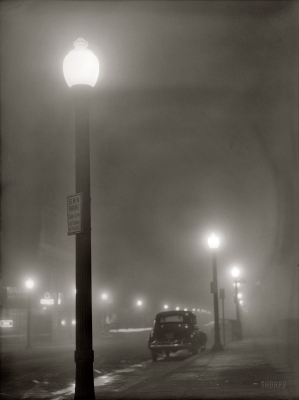
The cinematography of Georges Asselin and Marcel Lucien is dark and brooding, with foggy rural night scenes infiltrating even interior shots. An exhilarating car-chase at night filmed from the pursuing car in real-time uses only the car headlights, and is an exemplar of the creative fusion of director, camera, and editor. The editor is Renoir’s wife, Marguerite.
Is placement of the off-kilter ‘virginal’ portrait deliberate?
In the film, a city detective investigates a murder in a small rural burg, with suspicion surrounding the strange foreign tenants of a mysterious house: a bizarre ménage comprising a stoned b-girl and her reclusive ‘brother’, who as a foreigner with a weak alibi is the immediate suspect. The girl Else, played to delicious perfection by Danish actress, Winna Winifried, steals the picture. Renoir has aptly described Else as a ‘bizarre gamin’. You want Else to be in every scene – she is stunning and her turn is so lascivious. While in the book Else has more depth and is certainly less screwy, I think I prefer her screwy and sexy! Particularly memorable is the ambivalence of the relationship between Else and the detective, played by Renoir’s brother, Pierre, which is woven into the mis-en-scene with erotic abandon and casual elegance. My poetic homage to Else is here.
The story plays as a classic who-done-it, but by the end the veneer of the bucolic ville is stripped away to reveal a rotten reality where almost all residents, both workers and bourgeois, are complicit in a drug-trafficking racket, that segued into murder over the loot from a jewel heist. The irony is that the early suspect, Else’s brother, is innocent, while Else has been trapped by her past into a forced complicity that will see her released from jail early.
If you like your noir dark, sexy, mysterious and sharply witty, go for it!
Electric stars on main street
No moonlight
A desert wilderness of concrete and steel
Sphinx cars abandoned relics
of broken dreams
gravestones for lost souls
Siren for a delicious purgatory
a wanton butterfly she flutters wings that beckon
to a bed of lurid bliss
She mopes she languishes she swoons
she formulates a trajectory to the stars
from the milky way of her bosom to the glistening ivory of her ice cold thighs
A gambit for a gentle trap so you can fall into a warm moist grotto
and shut her doe eyes with kisses four
She does not leave you by a cold hill side
but caresses your tongue in her luscious mouth
her lips labia that clasp a deep penetration
and hold you transfixed
She leaves you a broken wreck
panting for more
You beg for
just a glimpse
An insolent glare has you shuddering
you want her to incinerate you with those eyes
incendiary transports to a cosmic nirvana
Her anger and petulant pout
a delirium
a narcotic –
you will expire for a fix
Until she graces her enfolding embrace over you
and sighs deep ecstatic sighs
Agony
Until she turns you to her
and you drown in a dark languid pool








 FilmsNoir.Net - all about film noir