Henry Hathaway’s 1945 film The House on 92nd Street for 20th Century Fox was the first of the doco-noirs that presaged the gritty realism of Jules Dassin’s The Naked City in 1948…
Henry Hathaway’s 1945 film The House on 92nd Street for 20th Century Fox was the first of the documentary-noirs that presaged the gritty realism of Jules Dassin’s The Naked City in 1948.
Although the story of the FBI’s breaking-up of a Nazi spy-ring isn’t strictly noir, it has all the elements of the police-procedural that ushered in a shift in the classic noir cycle from the early 1950s: documentary footage with a news-reel feel, stentorian narration, and a rousing musical score. All elements driven towards the portrayal of a great US institution “implacably” committed to the defense of American freedoms and the destruction of internal threats.
Based on a true case, the producer had full access to FBI surveillance footage and to FBI establishments and staff, and the opening scenes feature J. Edgar Hoover working at his desk. Wisely director Hathaway chose to shoot in actual New York City locales, and his DP Norbert Brodine delivered NY in compelling deep focus. Interesting also is the highlighting of then cutting-edge technology used in the pursuit of the spies: including a punch-card reading computer finding a finger-print match, and spectrography enlisted to identify the brand of lipstick found in a suspect’s ashtray. The whole affair balances real drama with a solemn purpose that has you engrossed.
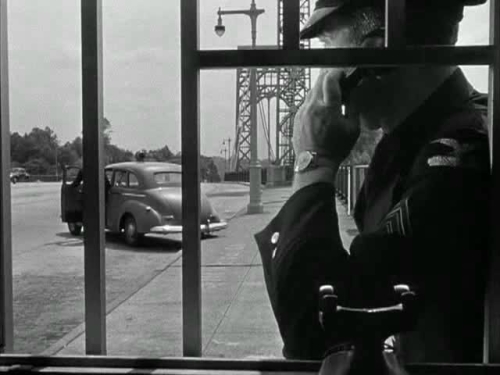
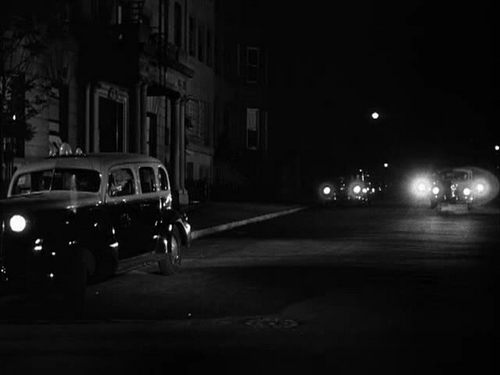
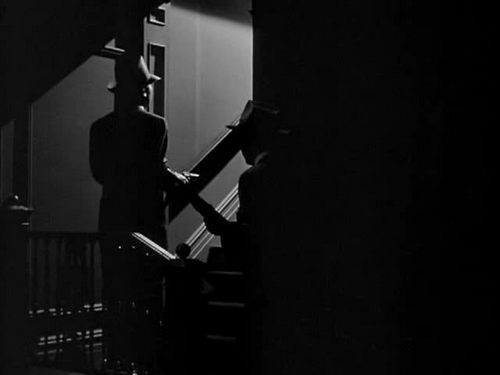
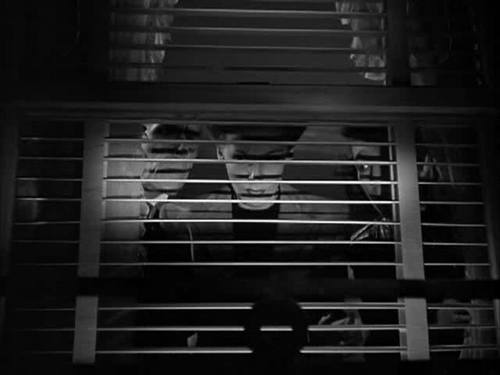
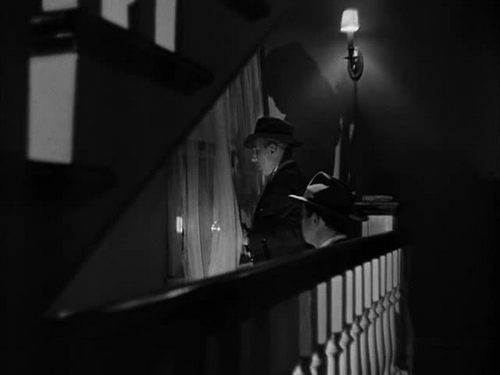
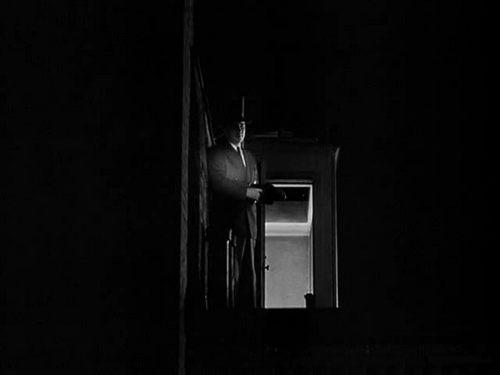
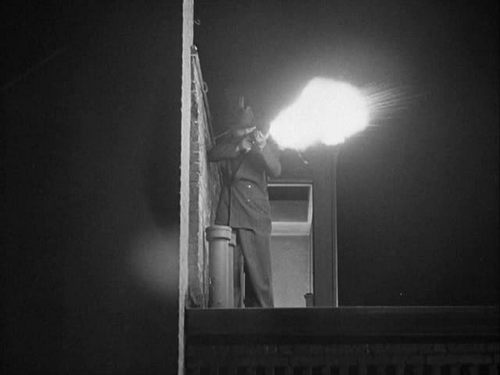
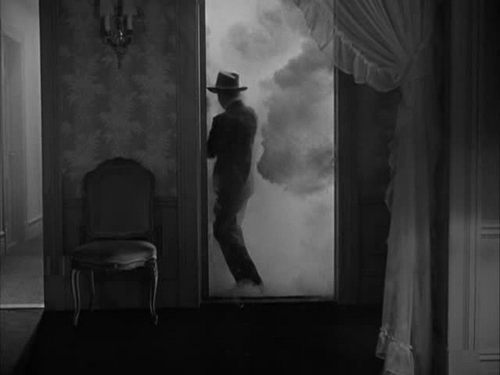
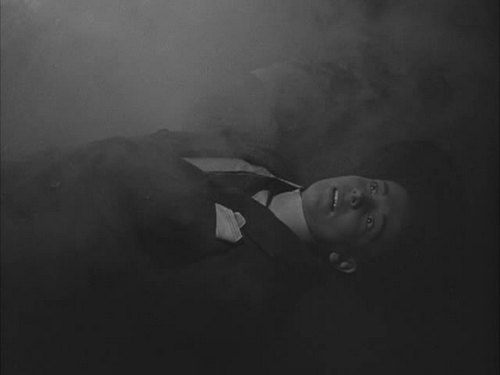
What I found particularly fascinating was the adroit expressionism of the tense finale, which is clearly evident in the following frames from the movie. You sometimes find art in the strangest places.
“I am going to destroy him. Take his brain apart and show him the pieces.”
“Psychoanalysis has furnished the detective film with many features of a noir psychology. To begin with, it has underlined the irrational character of criminal motivation: the gangster is a neurotic whose behavior can be fully understood only in utilitarian terms; aggressiveness, sadism, and masochism are self-serving; the interest in, or love of, money is often only a cover for libidinal fixation or infantile conflict. This, moreover, is the argument of the first explicitly psychoanalytic film, Blind Alley, adeptly directed by Charles Vidor: a gang boss hunted by the police hides out with his mistress and some of his men in a psychiatrist’s house in the country. A hideous nightmare (depicted in negative in the film) prevents him from relaxing. The doctor gains his confidence and manages, despite the usual resistances, to link the dream to a secret from his childhood. The gangster, freed from his complex, has no more need to kill and will be gunned down by a policeman. Under the title The Dark Past, Rudolph Mate directed a remake of the film in 1943.
Let’s think back to the dramatic motif of the ambivalence of feelings: in such an individual, sadism is openly twinned with masochism, sympathy masks hostility, etc. The importance of this trait in the definition of film noir has often been remarked. In the end, there’s a certain cynicism in the views of Freud that accords well with the moral decor of the series. Psychiatry no longer believes in traditionally defined good or evil. It knows that criminal behavior patterns often hide self-destructive reactions or guilt complexes, while moral conscience (the superego) is linked to the instincts it represses by means of an entire network of complicity.
Thus the ambience of this “depth psychology,” as the Germans put it, with its ambiguous or secret meanings, its infantile background, is transposed in the enigmatic situations of film noir, in imbroglios of intentions and of traps whose ultimate meaning remains remote and appears to recede indefinitely.”
– A Panorama of American Film Noir (1941-1953) by Raymond Borde & Etienne Chaumeton, pp 19-20
In 1955 when Borde and Chaumeton published their seminal survey of American film noir it is reasonable to assume they had not seen Boris Ingster’s The Stranger on the Third Floor (RKO 1940), considered by many as the first film noir of the classic cycle, but they had seen King Vidor’s Blind Alley (Columbia 1939). Indeed Blind Alley breaks the new ground otherwise credited to Ingster’s film: criminal behavior presented as psychosis and the use of expressionist dreams and flashback to find meaning in the past.
The “gang boss” in Bind Alley, a just-escaped con who kills without compunction or remorse, is played with convincing manic menace and infantile frenzy by veteran tough-guy Chester Morris. The scenario is played out in the lake-side home of a compassionate shrink, where Morris and his gang hold the occupants hostage while waiting for a boat across the lake. Think of Key Largo out-of The Petrified Forest. Ann Dvorak adds a strange level-headed yet lunatic loyalty as the killer’s moll. The shrink played with an unnerving pipe-smoking Walter Pidgeon-like affability by the ultimate nice-guy Ralph Bellamy, ups the ante, after a tragic killing at the house, when he resolves to psychoanalyse the hood: “I am going to destroy him. Take his brain apart and show him the pieces.”
The screenplay is quite adept in the time allowed – 59 minutes – in holding the tension with a thriller arc, while the shrink does his brain work. We even get a nice line-drawing explication of the unconscious, and an ironic opening scene with the shrink lecturing college students on the thin line between normality and psychosis. The dream and its motifs are intriguing and deftly drawn, with a sure trajectory to the final denouement, which has us feeling unomfortably ambivalent about the villain’s fate.
What is the connection with 13 East Street an undistinguished b-movie from across the Pond? Essentially the subversiveness of film noir. Where our moral compass is hijacked by scenarios and characterisations that bring a perverse pathos and empathy to bear on our feelings for the ‘bad guys’. In 13 East Street a London cop goes undercover to nab a heist-gang. While this movie is no Raw Deal and does not have any ambitions beyond similar police procedurals of the period, it does manage to have us rooting for the crooks.
The cop executes a fake jewel heist, is nabbed, imprisoned with a member of the gang. A friendship develops. Then they break-out and the cop is introduced to and joins the gang. The boss is a Yank and gives the erstwhile cop a fair shake in the face of hostility from another gang-member. The boss’s moll is hot and has melting eyes for the cop. They hatch a double-cross. A triple-cross really as the cop has his own agenda. The cop feels nothing for the girl, a charming cheeky gamin, who has your heart from the get-go, and is played by a b-stalwart of the period, Sandra Dorne, a rather classier forerunner to Diana Dors. By the end you have a certain contempt for the self-satisfied cop and sincerely hope that two-timing broad got away.



 FilmsNoir.Net - all about film noir