The French Crime Wave: Film Noir & Thrillers 1937-2000

Over four weeks from August 8 to September 4 the NY Film Forum Movie House, 209 West Houston Street, New York NY 10014, will screen 39 (!) French films noir and thrillers.

The full program has not yet been released, but the French Embassy’s French culture site has released early details:

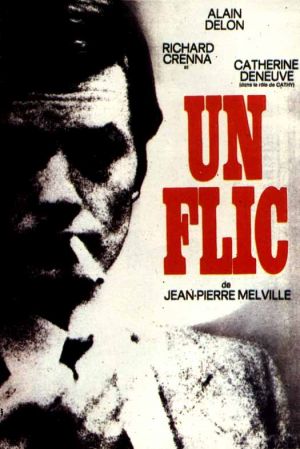
This festival of 39 prime examples opens with the late ex-pat Jules Dassin’s classic heist picture Rififi, which kick-started a whole new cycle of French Noir, and includes both classics and rarities by such masters of the genre as Jean-Pierre Melville (Bob le flambeur, Le Cercle rouge, Un flic), Jacques Becker (Touchez pas au grisbi), Henri-Georges Clouzot (Diabolique, Wages of Fear), Georges Franju (Eyes Without a Face), René Clément (Purple Noon), Louis Malle (Elevator to the Gallows), Claude Chabrol (La Cérémonie), and François Truffaut’s Mississippi Mermaid, The Bride Wore Black). Among the many stars showcased are the five great hommes durs (tough guys) of the genre — Jean Gabin, Lino Ventura, Yves Montand, Jean-Paul Belmondo, and Alain Delon — and such femmes fatales as Simone Signoret, Jeanne Moreau, Catherine Deneuve, and Brigitte Bardot. The festival concludes with a one-week run of Truffaut’s Shoot the Piano Player.

Noir Directors: Edward Dmytryk

Mirage (1965)Mirage (1965)

From an article, Film noir goes to war, in the TLS by Philip French:

Edward Dmytryk, Canadian son of Ukrainian immigrants, worked his way up in the cinema business from studio messenger boy to make Farewell My Lovely [aka Murder, My Sweet (1944)] . He followed this with two other crucial noir pictures, Cornered (1945), about war crimes and neo-Nazism, and Crossfire (1947), centring on returning veterans and post-war anti-Semitism. He was one of the Hollywood Ten, left-wing filmmakers jailed for refusing to cooperate with the House Un-American Activities Committee (HUAC). Unlike the others, he emerged from prison to reappear before HUAC, name former Communist associates and go back to work, making large-scale anti-Communist and conformist potboilers. But in 1965 he directed Mirage, an undervalued noir thriller, shot in black-and-white, turning on one of the genre’s favourite themes, amnesia, and indicting the military-industrial establishment which Dwight D. Eisenhower had warned against in one of his final speeches as President. It helped open the way for a new kind of political cinema that was to include such post-Watergate movies as The Parallax View and Three Days of the Condor.

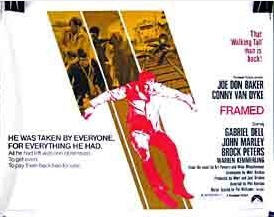
Framed (1975) Released on DVD

Framed (1975)

The last movie from a team of noir veterans, Framed (1975), has been released on DVD.  Dave Kehr’s NY Times review is worth reproducing in full:

Released in 1975, “Framed” is among the last of the old-school films noirs. Three principal members of its creative team were part of the genre’s prime: the director Phil Karlson (“99 River Street,” 1953), the producer and screenwriter Mort Briskin (“Quicksand,” 1950), the cinematographer Jack A. Marta (who shot close to 200 B movies for Republic Pictures). The plot is practically a pocket guide to noir conventions. Joe Don Baker, a big man with a sad mouth, stars as Ron Lewis, a professional gambler who stumbles across a homicide involving some unknown, powerful people, who get him out of the way by sending him to prison on a trumped-up charge.

When, four years later, Lewis returns to the unnamed Southern metropolis he calls home, he finds that his adversaries have taken political control of the city and are moving in on the state. But Lewis, dehumanized by his experiences, isn’t deterred: with the help of a prison buddy, a syndicate hit man with a Sonny Bono haircut (Gabriel Dell, one of the original Dead End Kids back in the 1930s), he sets out to exact a terrible, bloody revenge.

“Somebody I don’t know took everything I had away from me,” he says, in a line from the Film Noir Hall of Fame, “and I’m going to make him pay. Double.”

Karlson and Briskin enjoyed a freak hit in 1973 with “Walking Tall” — essentially, a retooling of Karlson’s noir classic of 1955, “The Phenix City Story” — with Mr. Baker as a Southern sheriff fighting corruption. Their “Walking Tall” clout allowed them to make “Framed” without compromises, and this is a harsh, unlovely film, charged with unsettling anger and filled with a violence that was quite graphic for the time, and is still startling today.

Although “Framed” would prove to be the last film for both men, it is no nostalgic farewell. It’s a poison-pen letter filled with bitterness, paranoia and despair. When Lewis finally tracks down the individual responsible for his suffering, he finds — in another classic noir device — a man much like himself, with personal reasons for what he’s done. At the end of the journey lies its beginning, a film noir way of knowledge. (Legend Films, $14.95, R)

The Hitch-Hiker (1953): Desert Noir

The Hitch-Hiker (1953)Two ordinary Joes driving to Mexico on a fishing trip are waylaid by a serial killer on the run (RKO 71 mins). Directed by actress Ida Lupino and based on a true story adapted by maverick writer Daniel Mainwaring. Cinematography by veteran noir cameraman Nicholas Musuraca.

Usually billed nowadays as the only film noir directed by a woman, this b-noir starts out well but fails to develop sufficient tension and a flat ending disappoints.  Lupino’s direction is adequate, but the strong opening noir-lit scenes of urban hijack and murder would be largely the work of Musuraca. Even Musuraca seems to lose it in the open spaces of the Mexican desert where most of the subsequent action is played out.

The Hitch-Hiker (1953)

Star-billing is given to Edmond O’Brien and Frank Lovejoy as the hostages, but they are constrained by their largely passive roles, and it is b-noir regular, William Talman, in a memorable portrayal as the psychotic killer, who holds the picture together.  The desperado’s savage menace and barely contained hysteria is entirely convincing, and it is this that saves the movie from obscurity.

The Big Steal (1949): “Oh Mexico”

The Big Steal (1949)

Comedy melodrama. Army officer (Robert Mitchum) is framed for a robbery and sets off after the culprit in a wild car chase across Mexico with a swell girl (Jane Greer). A hoot! Directed by Don Seigel and written by Gerald Drayson Adams and Geoffrey Homes from a story by Richard Wormser.

Last year in an insightful post on Mexico and Film Noir on his mardecortesbaja.com blog, Lloydville said: “Greer and Mitchum in Out Of the Past have their romantic idyll in Mexico but can’t bring the magic of it back with them to the States.  This fits in with the notion of Mexico as a lost or unattainable paradise.  But sometimes the idea of Mexico went to filmmakers’ heads – they got giddy with the possibilities of it.  Films that started out noir would, once they crossed south of border, turn into larks, light-hearted and feckless. Re-teamed in The Big Steal, Greer and Mitchum venture into Mexico to try to extricate themselves from typical noir predicaments involving betrayal and unjust accusation, but the dark clouds vanish almost immediately – they find love and high-spirited adventure instead of noir’s dark, impenetrable maze, and all ends well.  Film noir expert Elizabeth Ward amusingly suggests that The Big Steal ought to be labelled fiesta noir…”

The Big Steal is a fun ride with a nice twist at the end that leaves you wanting more. Mitchum and Greer are magic together.  There are really funny running gags with Greer delivering great lines with wit and charm: any guy with blood in his veins will fall for her in this picture.

The Big Steal (1949)

The supporting cast is strong, with a great turn by the veteran Mexican-born  actor Ramon Novarro as a wiley Mexican police inspector, who has some magic lines. The scene where Greer fabricates an elopement story for the soft-hearted foreman of a road-gang is high farce infused with a true empathy and affection for the romance of Mexico and her people. This affection permeates the whole film with a sense of true liberation.  The bouncy Mexican musical soundtrack echoes this mood of fun and adventure.

Two of my favorite songs reflect this love of Mexico: Elvis singing Mexico (Tepper,Bennett) in his 1963 movie Fun In Acapulco, and James Taylor’s Mexico. Elvis sings Mexico with such joy that for as long as the song lasts his voice takes you there:

Mexico, Mexico
They’ve got muchas, mucha-chas, amigos
…Latin features, never saw such adorable creatures
…Love to dig, ooh…the nights here

We live it up and love it up amigo
Life begins when you’re in Mexico

You never order, water
When you order south of the border
…In to kiss a lovely senorita
You do the samba, la bamba
…I’ll go where you go
Life begins when you’re in Mexico

Mexico, Mexico
They’ve got muchas mucha-chas, amigos
…never saw such adorable creatures

We’ll live it up and love it up amigo
Life begins…when you’re in…MEXICO…

James Taylor’s Mexico is more plaintive and shares a longing for some mythical place:

Way down here you need a reason to move
Feel a fool running your stateside games
Lose your load, leave your mind behind, Baby James

Oh, Mexico
It sounds so simple I just got to go
The sun’s so hot I forgot to go home
Guess I’ll have to go now

Americano got the sleepy eye
But his body’s still shaking like a live wire
Sleepy Senorita with the eyes on fire

Oh, Mexico
It sounds so sweet with the sun sinking low
Moon’s so bright like to light up the night
Make everything all right

Baby’s hungry and the money’s all gone
The folks back home don’t want to talk on the phone
She gets a long letter, sends back a postcard; times are hard

Oh, down in Mexico
I never really been so I don’t really know
Oh, Mexico
I guess I’ll have to go

Oh, Mexico
I never really been but I’d sure like to go
Oh, Mexico
I guess I’ll have to go now

This love for Mexico is expressed more deeply and poetically in Jack Kerouac’s On the Road:

I was alone in my eternity at the wheel, and the road ran straight as an arrow. Not like driving across Carolina, or Texas, or Arizona, or Illinois; but like driving across the world and into the places where we would finally learn ourselves among the Fellaheen Indians of the world, the essential strain of the basic primitive, wailing humanity that stretches in a belt around the equatorial belly of the world from Malaya…to Morocco to the selfsame deserts and jungles of Mexico.

Oh Mexico…

New Criterion DVD: “The Furies”

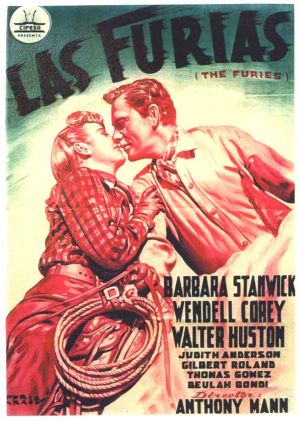
The Furies (1950)

Criterion today released on DVD one of the great noir westerns, The Furies (1950) directed by Anthony Mann.

From the LA Times review by Dennis Lim:

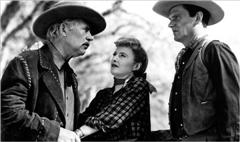
In truth, “The Furies,” frontier setting notwithstanding, barely counts as a western. There are elements of film noir in both the plot and the look; many key scenes unfold under cover of darkness (Victor Milner earned an Oscar nomination for his moody cinematography). Above all, though, it plays like a Freudian melodrama, dissecting the hysterical and ultra-competitive love-hate relationship between widowed patriarch T.C. Jeffords ( Walter Huston) and his headstrong daughter, Vance ( Barbara Stanwyck).

From the NY Times review by Dave Kehr:

Mann gives the action a metaphysical dimension that overwhelms easy psychoanalytic readings. As in his films noirs (Raw Deal, Desperate), he systematically composes his shots to create a sense of instability, using lines of perspective or boldly massed foregrounds to pull the images off balance. The titanic struggle between father and daughter has knocked the world off its axis.

The Furies (1950)

Links:
LA Times Review by Robert Lim
NY Times Review by Dave Kehr
Criterion: The Furies
The New Yorker Review by Richard Brody
The House Next Door Review by Dan Callaghan

Rare Screenings at Fifth Annual Albuquerque Film Noir Festival

Repeat Performance

This year’s 5th Annual Noir Film Festival, which started Friday today at the Guild Cinema in Nob Hill, Albuquerque (3405 Central Ave NE  255-1848), features some rarely screened titles that should have local film noir fans very excited:

JUNE 20 & 21 (FRIDAY & SATURDAY):

The Hidden Room

DOUBLE INDEMNITY (3:00, 7:00)
Dir. Billy Wilder – 1944 – 107m

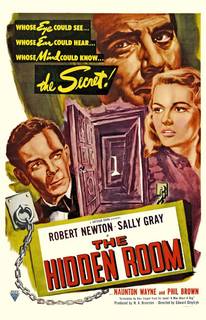
THE HIDDEN ROOM (a.k.a. OBSESSION) (5:10, 9:10)
Dir. Edward Dmytryk – 1949 – 96m – UK

JUNE 22 & 23 (SUNDAY & MONDAY):

REQUIEM FOR A HEAVYWEIGHT
The Original “Playhouse 90” Live Television Version (3:30, 7:00)
Dir. Ralph Nelson – 1956 – 90m

99 RIVER STREET (5:15, 8:45)
Dir. Phil Karlson – 1953 – 86m

JUNE 24 & 25 (TUESDAY & WEDNESDAY):

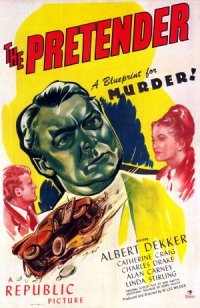
The Pretender

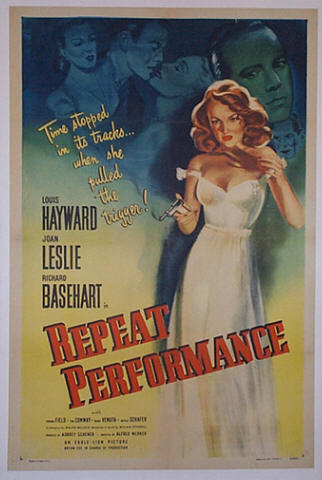
REPEAT PERFORMANCE (5:15, 8:30)
Dir. Alfred L. Werker – 1947 – 91m

THE PRETENDER (7:00 ONLY)
Dir. W. Lee Wilder – 1947 – 69m

JUNE 26 & 27 (THURSDAY & FRIDAY):

TOMORROW IS ANOTHER DAY (3:10, 7:00)
Dir. Felix E. Feist – 1951 – 90m

KANSAS CITY CONFIDENTIAL (5:00, 8:45)
Dir. Phil Karlson – 1952 – 99m

JUNE 27 & 29 (SATURDAY & SUNDAY):

WIDMARK AND DASSIN
NIGHT AND THE CITY (2:30, 6:30)

ROAD HOUSE (4:30, 8:30)
Dir. Jean Negulesco – 1949 – 95m

JUNE 30 & JULY 1 (MONDAY & TUESDAY):

RARELY-SCREENED JOSEPH LOSEY
THE BIG NIGHT (5:30, 8:35)
Dir. Joseph Losey – 1951 – 75m

QUICKSAND (7:05 ONLY)
Dir. Irving Pichel – 1949 – 79m

JULY 2 & 3 (WEDNESDAY & THURSDAY):

CINEMATOGRAPHER JOHN ALTON IN TECHNICOLOR
SLIGHTLY SCARLET (5:00, 9:00)

JOSEPH LOSEY IN THE U.K.
THE CRIMINAL (7:00 ONLY)
Dir. Joseph Losey – 1960 – 97m – UK – Shown on digital video

JULY 4 & 5 (FRIDAY & SATURDAY):

CRY OF THE CITY (3:30, 7:05)
Dir. Robert Siodmak – 1948 – 95m

RARE SCREENING
CELL 2455, DEATH ROW (5:30, 9:05)
Dir. Fred F. Sears – 1955 – 77m


JULY 6 & 7 (SUNDAY & MONDAY):

RESTORED 35MM PRINT
THE BLACK BOOK (a.k.a. REIGN OF TERROR) (3:30, 7:00)
Dir. Anthony Mann – 1949 – 89m

STRANGE ON THE RANGE!
TERROR IN A TEXAS TOWN (5:20, 8:45)
Dir. Joseph H. Lewis – 1958 – 81m

JULY 8 & 9 (TUESDAY & WEDNESDAY):

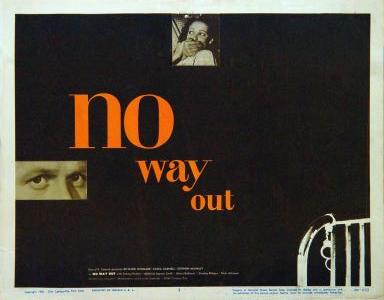
No Way Out

THE CRIMSON KIMONO (5:20, 9:05)
Dir. Sam Fuller – 1959 – 81m

RICHARD WIDMARK
NO WAY OUT (7:00 ONLY)
Dir. Joseph L. Mankiewicz – 1950 – 106m

Full details here.

Key Largo (1948): Almost Noir


Key Largo (1948)

Returning WW2 vet fights gangsters on the Florida keys

The director of Key Largo, John Huston, co-wrote the screenplay with Richard Brooks, from a play by Maxwell Anderson.  The stage origins of the film are evident, but this strengthens the atmosphere of claustrophobia as the action is played out inside a seaside guest-house boarded-up against a hurricane.

The cast is particularly strong with Humphrey Bogart as the war vet, Edward G. Robinson as the over-the-hill gangster Johnny Rocco staging a comeback, with Claire Trevor as his alcoholic mole and Thomas Gomez as Rocco’s No.2, and Lauren Bacall as a young war widow with the legendary Lionel Barrymore as her father-in-law. Trevor deservedly won a best-supporting-actress Oscar for her role.

For some the returning war vet theme gives the movie a film noir quality – even though the action takes place in a non-noir locale and there is no cross-over between the good guys and the bad guys. I feel the picture is essentially a good-triumphs-over-evil tale laced with a swan-song for the gangster flick and leavened with post-war existentialist angst.

Bogart’s vet, Frank McLoud, shares the angst  of post-war Europe, where many returning to the peace with expectations of a better world that would justify the suffering and destruction, are confronted with the reality that nothing has changed. Disillusioned and bitter, the moral absolutism that underpinned their sacrifice dissolves into a weary relativism where one less Johnny Rocco is not worth dying for.

The climax and resolution of the story complete with a non-noir ending, also give little support to the view that Key Largo is a film noir. As the final scene hits the screen, it is the strength of family and the selfless pursuit of established values that destroy evil, with the existential anti-hero morphing into a hero of the classic mold. As McLoud says: “When your head says one thing and your whole life says another, your head always loses.”

Key Largo 1948

The Naked City: Weegee’s NY Noir Nightscape

Weegee

This weekend’s New York Times New York Explorer feature, Crime Was Weegee’s Oyster, spotlights the life, times, and photography of 30s and 40s freelance crime and street photographer, Arthur Fellig, better known as “Weegee”, and one of the city’s most famous photographers:

Weegee’s peak period… was a whirl of perpetual motion running from the mid-1930s into the postwar years. Ceaselessly prowling the streets during the graveyard shift, he took thousands of photographs that defined Manhattan as a film noir nightscape of hoodlums and gangsters, Bowery bums and slumming swells, tenement dwellers and victims of domestic brawls, fires and car crashes. He gave it its enduring nickname, the Naked City.

The on-line article features a slide-show of Weegee’s photographs and a video exploration of the New York locales where the photos were taken.

Update 20 June 2008: Today the NY Times published a Weegee Primer with a source list books, movies, NY locales, and a link to the INTERNATIONAL CENTER OF PHOTOGRAPHY‘s Weegee Web site, which features other photos and audio clips.

Woody Haut’s Blog: Noir Fiction and Film

I Wake Up Screaming

For those of you interested in the writers of noir fiction and the Hollywood screen-writers who penned the movies of the classic noir period, a visit to Woody Haut’s Blog is strongly recommended. Woody Haught is a journalist and the author of Pulp Culture: Hardboiled Fiction and the Cold War, Neon Noir: Contemporary American Crime Fiction, and Heartbreak and Vine: The Fate of Hardboiled Writers in Hollywood.

His essays are well-written and provide some fascinating insights. These sample posts should be of direct interest to readers of FilmsNoir.Net: