1946: The numbers and the when and why of Film Noir

Kiss of Death (1946)
An ad for Kiss of Death in a 1946 issue of the Hollywood trade journal ‘The Film Daily’

Some film noir academics dispute the widely held view that the “expanding cycle of hard-boiled and cynical films” (as Bosley Crowther described them in the New York Times in his May 1946 review of The Blue Dahlia) produced in Hollywood in the immediate post-war period, necessarily reflected a darker pessimistic mood in American society in the shadow of WW2, as there was still plenty of Hollywood’s traditional romantic and escapist fare screening in the US at the time, and that the movies retroactively labelled as film noir were not big box office.

Mike Chopra-Grant in his 2006 book, ‘Hollywood Genres and Postwar America’, put this view as follows (my emphasis):

“when I began to look at the rental revenues earned by films in the American market in 1946 no single mood or tone could be identified that uniformly characterized all of the most popular films, although the dominance of musicals and comedies suggested a lighter and more exuberant mood than the emphasis on film noir in academic writing would suggest… Despite the inconsistency between the number of upbeat musicals and comedies among the most popular films of the early postwar period and the “mood” of that period suggested by much film noir scholarship, I do not entirely reject the suggestion that the “tough” movie represents one response to the disruptions and uncertainties of the wartime and postwar period. I do, however, take issue with the suggestion that this kind of film represented the typical response of Hollywood filmmakers, and with the implication that the “tough” movie captured the zeitgeist of American culture in the period after the Second World War: the evidence provided by the popular films suggests otherwise, and in the contradictory impressions of the period presented by the combination of the most popular films and the “tough” movies the very notion of zeitgeist is revealed to be highly problematic…  Although explaining these films in vague sociological terms, as a manifestation of historically existing social anxieties, produces an inadequate account of their place within the wider culture, examination of these “tough” movies in relation to the specific themes and discourses already discussed in relation to the popular films of the period does provide a way of understanding the position of film noir within its historical setting without the need to resort to common-sense truisms about the “mood” of the culture.”

On the other side and in the same year in her book ‘Blackout: World War II and the Origins of Film Noir’, Sheri Chinen Biesen argues that the dark expressionism of crime movies that started to appear during WW2 arose out of the economic constraints imposed on Hollywood by the war effort, such as the shortage of film stock and electricity rationing, dark lighting to hide cheap sets, and other deprivations, together with growing audience demand for “red meat” entertainment.

The other day I was idly ‘flipping’ through on-line archive copies of The Film Daily, a Hollywood trade journal of the period, and came across an interesting tabulation in the Friday May 23, 1947 issue: The Broadway Run Score Board comparing the weekly runs of new release movies in Broadway cinemas for the periods Jan-June 1946 and Jan-May 1947. The Scorecards are reproduced at the end of this article.  I have highlighted all the movies that are now identified as films noir. There are quite a number, and more than a few had exceptional runs. Some prestige noirs did very well. Clearly, there was something going on.

How we account for these numbers I leave to the experts, but I do have a view which I set out in my article What is Film Noir. Basically, while many see film noir originating in post-WW2 trauma, I believe the origins of film noir lie largely elsewhere. Film noir was a manifestation of the fear, despair and loneliness at the core of American life apparent well before the first shot was fired in WW2. This is not to say that the experience of WW2 did not influence or inform the themes and development of the noir cycle in the post-war period. The origins of film noir and why it flowered where and when it did are complex, and we can’t be definitive, but it is fairly evident that noir emerged before the US entered the War, and had it’s origins principally in the new wave of émigré European directors and cinematographers, who fashioned a new kind of cinema from the gangster flick of the 30’s and the pre-War hard-boiled novels of Dashiell Hammett, Raymond Chandler, James M. Cain, and Cornel Woolrich. We can also clearly see the influence of German expressionism, the burgeoning knowledge of psychology and its motifs, and precursors in the French poetic realist films of the 30’s. Noir was about the other, the “dark self” and the alienation in the modern American city manifested in psychosis, criminality, and paranoia. It was also born of an existential despair which had more to do with the desperate loneliness of urban life in the aftermath of the Depression.

The Score Boards – Double-click on the image to zoom:

The Film Daily Score Card - click to to zoom in
The Film Daily Score Board- click to to zoom in


Noirish: An exciting new noir blog on the block

Noirish

John Grant, the author of the just published ‘A Comprehensive Encyclopedia of Film Noir: The Essential Reference Guide’, which I reviewed recently, has started a blog titled Noirish as an annex to his book where he covers at greater length (spoiler alert) movies that are either too borderline or too recent to have made it into the book.

This is great news for film noir fans. There is a dearth of published authors blogging about film noir, and John already has blogged about a whole bunch of intriguing titles ranging from obscure Monogram b’s to foreign films, and more.

He is certainly prolific, and must have privileged access to a secret vault of seriously old celluloid.


Once a Thief (1965): Late noir à la européenne

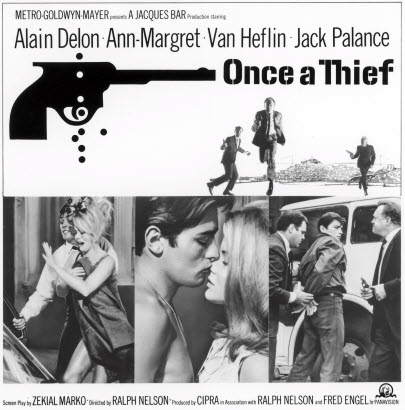
Once a Thief (1965)

Once A Thief from director Ralph Nelson (Requiem for a Heavyweight) and DP Robert Burks (Vertigo), and starring Alain Delon (Purple Noon, Le Samouraï) in his first Hollywood feature, is a derivative late noir with a hip Lalo Schifrin score and atmospheric on the streets of San Francisco visuals tinged with a European neo-realist aura.

Zekial Marko’s script has all the noir tropes but the picture never gets beyond the promise of the brilliant opening credits which feature Frisco freaks getting off at a jazz club.

Delon, as a young immigrant from Trieste with a wife and daughter, both played with considerable effect by Ann Margret as the wife and 6yo Tammy Locke as the child, is trying to go straight after doing time for a robbery and shooting a cop. After a frame-up his estranged older brother and mobster Jack Palance (Panic in the Streets, Sudden Fear, The Big Knife) turns up and wants him for one last big heist. It all moves predictably to a violent denouement on the Frisco waterfront. Delon strangely, when you consider his persona in Jean-Pierre Melville’s Le Samouraï, is less than effective, while Palance brings a certain realist cred to his portrayal of a hood who wants to keep things in the family. Margret delivers some justified histrionics at the climax while managing to steer clear of melodrama. An aging and visibly weary Van Heflin (Johnny Eager, The Strange Love of Martha Ivers, The Prowler ) as a cop tries hard but his heart is not in it. Particularly effective and chilling is John Davis Chandler as a violent psychopath in a signature henchman role.

The violence while stylised is brutal enough to evoke both shock and empathy. A lengthy heist sequence and a kidnapping borrow a lot from Jules Dassin’s Rififi and John Huston’s The Asphalt Jungle, both immeasurably superior films.

The Long Wait (1954): Tie Me Up And Kiss Me Deadly

The Long Wait (1954)

Anthony Quinn as an amnesiac who is wanted for murder? You got him in The Long Wait, and not one but four femmes noir. Three blondes and a brunette. All leggy and not backward in coming forward.
This violent and brutal flick has Mickey Spillane all over it. The second Spillane novel to be filmed in Hollywood – after I, The Jury (1953) – The Long Wait takes pulp fiction down to a new level. A preposterous plot with more holes than a pair of fishnet nylons itches a perversely compelling pastiche of noir tropes: amnesia, corruption in high places, crooked cops, frame-ups, violence, duplicitous dames, and sex. But no Mike Hammer. Our protagonist is strictly an amateur. But that doesn’t make him any less able to dizzy the dames nor prove his innocence – even if the key to the frame is patently absurd.

Quinn is a hunk and knows it. His kisses and clinches are not for the faint-hearted. He beds the first girl to show an interest. In fact, she picks him up. A frank come-on and cut to her apartment, where after a shower she is ready for the bout naked under her wrap. You get the picture.

Despite a strange incoherence and lackadaisical direction from Brit Victor Saville, the talented lensing of Franz Planer sustains visual interest, with suitably dark lighting and expressionist flourishes.

This brings us to the climax which melds sex and violent entrapment into an amazing expressionist sequence involving a spot-light and deft crane shots. Quinn is tied-up in a chair and a girl called Venus trussed on the floor is being goaded by the bad guy to crawl to Quinn for one last kiss. The resolution is neat and unexpected. One of those rare moments when you are left open-mouthed before the craft and audacity of what you have just seen. Totally weird.


Two New Books on Film Noir: Movie #3,500 and counting, or is enough enough?

cover35902-mediuma-companion-to-film-noir

They stopped making films noir 50 years ago, yet the books on film noir keep on coming.  The study of film noir is career-defining for many academics and noir pundits, and the selling of all those books and scholarly treatises must rake in the readies.

But sorry guys I am starting to get cynical about this plethora of prognostications and chatter about film noir.  Let me tell you why.  I will have to follow some currents and eddies but indulge me.

A new film noir encyclopedia has just been published, and I have been privileged to preview the galleys on-line. ‘A Comprehensive Encyclopedia of Film Noir: The Essential Reference Guide’ by prolific film author John Grant, is a 512 page behemoth that boasts capsule reviews of over 3,500 films. As you would guess the net has been cast far and wide to get this tally, with the publisher’s blurb telling me that the book covers “3,500 movie entries, including not only classic US film noirs from the 1940s through 1960s, but also modern manifestations like neonoirs and erotic thrillers. Films from every continent (except Antarctica)”.

I doubt even Eddie Muller has seen this many noirs, and my current list is only a bit more than 300.  So I will have to take Grant at his word.  Flipping through the book on my iPad, I see all the essential noirs are there, and Grant gets the stories right – something Silver & Ward in their pioneering effort, The Film Noir Encyclopedia, achieve only occasionally in their longer and rather overwrought entries. One thing Grant does do is avoid spoilers and this is definitely welcome.  His entries for the more important movies are longer, and provide some background and snippets on a movie’s aesthetics.  At US$50 it is a pricey but useful reference.

I just don’t believe there are that many noirs!  Let’s be honest. Most b-movies were b-movies: cheap and nasty. There are no doubt some forgotten gems still to be discovered, but not that many surely.  If you want a more manageable program of films that you can actually get hold of savour my list of essential films noir.

Hot on the heels of Grant’s book is a new academic treatise edited by UK academics Andrew Spicer and Helen Hanson, ‘A Companion to Film Noir’, presenting a new range of essays from the usual suspects from both sides of the Pond, and prefaced with an introduction by James Naremore. If you thought Grant’s book was beyond your budget, then this number is strictly for the birds at just below US$180 for the hardcover and US$160 for the Kindle e-book. No prizes for guessing that mere mortals don’t get a review copy. But the publisher Wiley has made the Introduction and a chapter titled ‘The Ambience of Film Noir’ available free on-line here.

A segue that may justify my increasing suspicion that we have an overload of books on film noir. In the introduction to Grant’s book he makes reference to the seminal film journal article in 1946 by French critic and existential intellectual Nino Frank, in which Frank coined the expression ‘film noir’. That year a backlog of Hollywood product hit Paris screens. (During the Nazi Occupation of France from 1941 to 1945 American films were banned).  Frank was struck by the darkness and ambience of a clutch of films that were radically different from Hollywood’s pre-war output. The films Frank wrote about were The Maltese Falcon (1941), Double Indemnity (1944), Laura (1944), Murder, My Sweet (1944), and The Lost Weekend (1945). Wanting to know more about Frank I started searching for references to his writing on film noir, and thanks to Google, I discovered a web site devoted to Nino Frank which hosts an excellent paper on just what was written and discussed in Paris in 1946. Frank’s original article appeared in the French film journal L’Ecran français on 28 August, 1946, and he wrote a follow-up article in another French film journal La Revue du Cinéma in November of that year.

The paper is comprehensive, providing a detailed history with citations. What struck me was that the intellectual ferment in Paris in 1946 produced a synthesis and comprehension of film noir that has hardly been added to since by the myriad books and journal articles that have appeared in the wake of Frank’s first distillation. I commend readers to the paper titled ‘Nino Frank and the Fascination of Noir’ available here, and best of all it is free.

Noir Poet: Marc Cohn

Strangers in a Car – Marc Cohn

There’s a stranger in a car
Driving down your street
Acts like he knows who you are
Slaps his hand on the empty seat and says
“Are you gonna get in
Or are you gonna stay out?”
Just a stranger in a car
Might be the one they told you about

Well you never were one for cautiousness
You open the door
He gives you a tender kiss
And you can’t even hear them no more
All the voices of choices
Now only one road remains
And strangers in a car
Two hearts
Two souls
Tonight
Two lanes

You don’t know where you’re goin’
You don’t know what you’re doin’
Hell it might be the highway to heaven
And it might be the road to ruin
But this is a song
For strangers in a car
Baby maybe that’s all
We really are
Strangers in a car
(Driving down your street)
Just strangers in a car
(Driving down your street)
Strangers in a car

Cinematic Cities: New York 1956

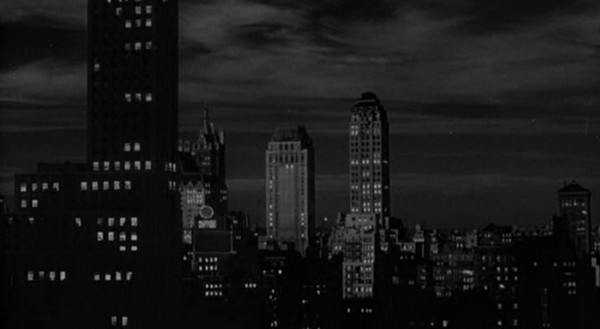
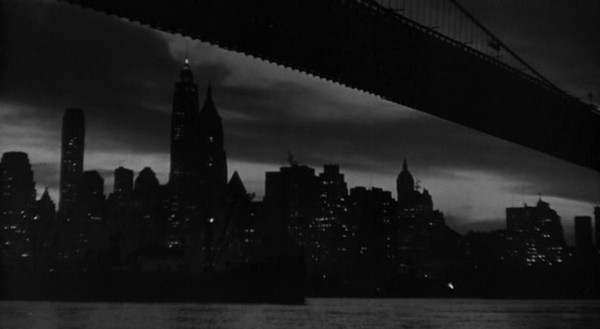
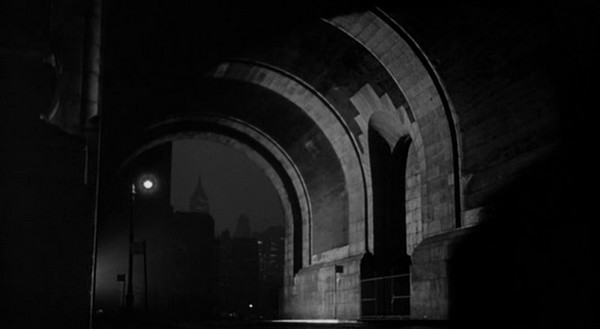
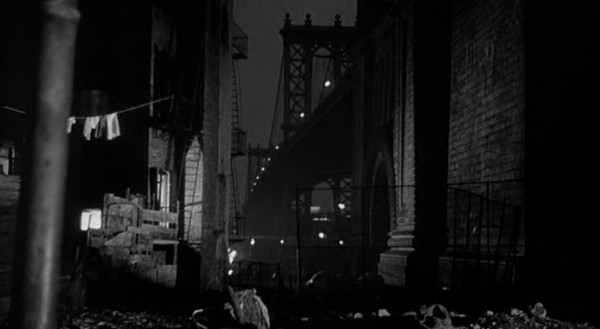
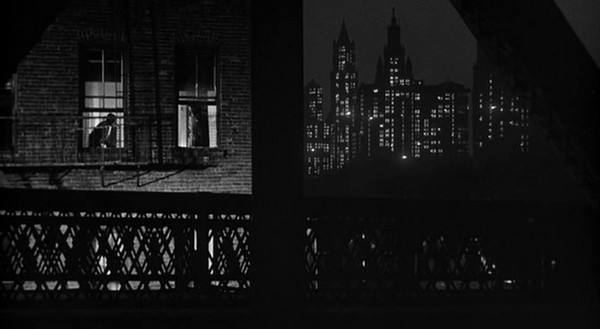
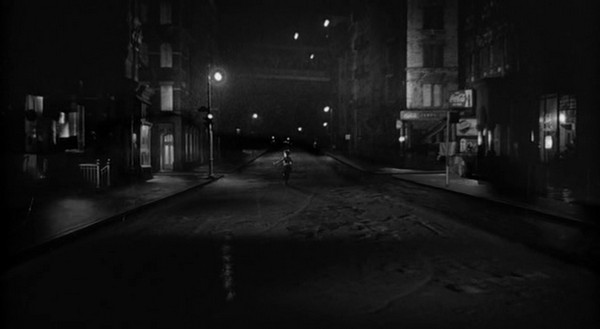
Somebody Up There Likes Me (1956): Direction –  Robert Wise |  Cinematography – Joseph Ruttenberg

Somebody Up There Likes Me (1956) sutlme (2) sutlme (3) sutlme (4) sutlme (5) sutlme (6)

Cinematic Cities: Harlem 1964

The Pawnbroker (1964)

The Pawnbroker (1964): Direction –  Sidney Lumet  |  Cinematography – Boris Kaufman

The Pawnbroker (1964)

The Pawnbroker (1964)

Some films  challenge you. Engage you. At the end the screen goes blank and you have to pull yourself back to who and where you are. You question all the facile assumptions you use to order your life and give it some meaning – reasons to get up each and every morning. Sidney Lumet’s The Pawnbroker is such a film.

Then you start reading what the “critics” have said.  Andrew Sarris called it “drivel” and Pauline Kael said it was “terrible”.  Film scholar David Bordwell in a feint valedictory for Lumet largely agrees with these pronouncements from – his term – “the critical intelligentsia”.  I give not two figs for this intelligentsia and their pretensions.

The Pawnbroker is a great film. An attempt to comprehend how a person can survive the unspeakable horror of the Holocaust and live. Pawnbroker Sol Nazerman exists. It is hard to say he does anything more. His living is to deny life has meaning beyond the sordid need to make money. He is not a brutal man just indifferent to others and consumed with his own pain. A pain bearable only to the extent that he denies it. The broken lives that confront his caged counter every day are simply triggers for stamping a pawn ticket and handing over a few dollars from the till. That these others suffer does not enter his comprehension.  He is not above fooling himself though. He launders money for a black racketeer with indifference – until he discovers that prostitution is one the rackets.

The Pawnbroker the film has large ambitions. It succeeds manifestly by drawing out the lives of small people. The people who go to a movie for relief, an escape from an existence that denies their worth, a world not interested in their suffering, and a fate standing ready to smack them down by whim alone. Not the kind of people who read the Village Voice.  A mother alone trying to bring up a boy who lives on the streets,  loves a girl, tries to build a decent life, goes wrong, then does right, only to pay the ultimate price alone amid squalor and indifference.  The man who feels no pain for a moment gets out beyond himself – but it is too late.

All the elements of this film deliver. The screenplay weaves the past and the present by juxtaposition, with what is not said, and is economic when words are needed. Each player  has a convincing sincerity. Rod Steiger’s portrayal of Nazerman is a tour-de-force and his nominations for an Oscar and other accolades are richly deserved.  The other players are as real – even if for a few short scenes.  The direction reviled by the “intelligentsia” as being heavy-handed and overwrought to my eyes is a revelation. Stillness is respected, movement followed not led, and the camera ready to be unanchored by what is happening on the screen. The score is savagely alliterative, so much so that you take it as your own heart-beat, arcing from aching to pounding. The editing is fluid and manages the shift from the past to the present almost seamlessly.  Apart from an opening scene in a suburban backyard indistinguishable from the other backyards around it, a scene which has a meaning of its own, the streets of a proletarian New York form a backdrop and a chorus to the intersecting lives that ebb and flow on their pavements, and sometimes collide. People looking out from tenement windows attuned to the spectacle of existence played out below. While they are desensitised to the trauma and tragedy that breaks out onto those streets, it happens not often enough to deny a spectacle yet is sufficiently familiar to hold their interest for only a short time.

All you need to let this film move you and pull the world from under you is compassion. Leave your self-importance in a jar by the door. Suffering is universal and suffered by each soul alone.

Guest In The House (1944): Sex in the strangest places

Guest in the House (1944)

Directed by John Brahm, Guest In The House, is about a psychopath who sets out to destroy a marriage.  A lesser film noir, but Anne Baxter is suitably creepy as a nut-job with a pathological and eventually fatal fear of birds. Ralph Bellamy a happily married man is in her sights.

What is interesting is firstly that Bellamy is essentially the same straight-up guy from His Girl Friday – a Howard Hawks’ film I loathe for raising calculation and wisecracks above honesty and decency – who is happily married to a charming woman, and secondly that Brahm makes it obvious they have a great sex life. In an early scene they are in their bedroom dancing and fooling around, and there is no doubt they would have happily consummated the frolick in bed, but for a piercing scream from the psycho down the hall. Decent guys don’t come last.  Breen was out to lunch or asleep when this pitch crossed his desk in the early 1940s.

An interesting curio.