The Sniper (1952): Off Target

The Sniper (1952)

A sharp-shooting psychopath who hates woman goes on a killing
spree in San Francisco and is pursued by the police.

Director Edward Dmytryk started work on The Sniper just after he finished serving a 12 month jail sentence for refusing to co-operate with the infamous HUAC. Upon his release Dmytryk recanted and squealed to the HUAC naming names. Producer Stanley Kramer then offered him this Columbia production. Ironically, the veteran right-wing actor and HUAC collaborator, Adolphe Menjou, was signed to play an un-sartorial cop sans moustache.  The NY-based Daily Worker was not impressed: “Movie director Edward Dmytryk, ex-member of the Hollywood Ten who turned informer for the FBI, is now palsy-walsy with his erstwhile foe – the rabid witch-hunter and haberdasher’s gentleman – Adolphe Menjou. Now Dmytryk and Menjou are together again – this time as friends. Menjou has a leading role in The Sniper, which Dmytryk, gone over to warmongering and restored to favor of the Big Money, is now directing for Stanley Kramer productions.”.

A solid b-production, The Sniper is a taut thriller, which does not quite come off as a film noir, although there are strong moments in this gritty story of a young loner battling a deep and violent pathological hatred of young woman. Shot on location on the streets of San Francisco, angle shots and off-kilter staging sustain the visual interest throughout, with those scenes in the seconds before the sniper shoots three of his victims being particularly suspenseful.

The Sniper (1952)

The acting is rather stolid and this weakens the drama. While the script attempts to explain the sniper’s pathology and sermonises on how the law should handle such offenders, there is little real depth to the portrayal. Filler scenes used to establish his immediate motivation are too obviously contrived, with the younger women he encounters socially being unnecessarily mean-spirited. But in a sequence in an amusement park, the pathology and the anger of the sniper are deftly explored without artifice and with chilling accuracy.

The police investigation has just too many convenient coincidences, and the meetings with the cops and the good burghers of ‘Frisco demanding action on the pursuit are too stagey by half. A fair b-thriller of considerable historical interest.

The Sniper (1952)

Underworld USA (1961): “We got a right to climb out of the sewer and live like other people”

Underworld USA (1961)

Samuel Fuller amazingly does not receive significant attention from most film writers, even though the substance of the passing tangential references to his oeuvre that are made, belie the lack of interest. Andrew Spicer says of Fuller in his book, Film Noir, when reviewing the course of noir post-Touch of Evil (and I dispute the b-film-maker appellation):

“…there was an ‘underground’ culture that retained film noir as a critical cultural form. This underground tradition included… b-film-maker Samuel Fuller with Underworld USA (1961), Shock Corridor (1963) and the Naked Kiss (1964) [that]… attacked the beneficence of American capitalism and the sanctity of the suburban family, keeping alive a habit of irony, scepticism, absurdity and dark existentialism.”

Mark Cousins refers to Fuller only once in his The Story of Film, and then only when introducing 1920s cinema:

The primitive film-making of the early 1910s with its simple shots, raw frontal acting and rapid action, un-moderated by the expectations of the middle classes, was disappearing. Like a humpback whale it went deep underwater. There would be rumours of sightings in 1950s America in melodramas such as Johnny Guitar (1953), and in the films of Samuel Fuller.

Fuller’s pulp melodramas are akin to guerrilla attacks on established certainties.  In Underworld USA, where the rackets are under the spotlight, we have a fast and furious battle where the alienated existential anti-hero Tolly Devlin, driven initially by revenge finds a kind of redemption in a squalid death in the same back alley where the genesis of his dark vengeance is rooted.  The women in his life find a new meaning and purpose in their lives: “We’ve got to finish the job for Tolly – or he died for nothing!”.  Fear is overcome by courage.  In  Fuller’s noirs, it is the influence of strong women that hold the ethical and moral center. Tolly finds what he never knew existed in the b-girl Cuddles – love and giving of one’s self without reservation or guile to another.  In each of the other Fuller noirs reviewed on FilmsNoir.Net, The Crimson Kimono (1959), The Naked Kiss (1964), and Pickup On South Street (1953), women hold the key to redemption.

The cast is superb, with Cliff Robertson’s performance as Tolly as nuanced as it could be, and Dolores Dorn as Cuddles steals the picture, with a simplicity and integrity that is matched by few more successful actresses.  The roller-coaster score by George Duning is a brilliant accompaniment seamlessly flowing from a dramatic crescendo underscoring the adrenalin-fuelled action on the screen to a plaintive but subdued  jazz motif that echoes the pathos that ensues.

Underworld USA (1961)

“The B List” in Paperback

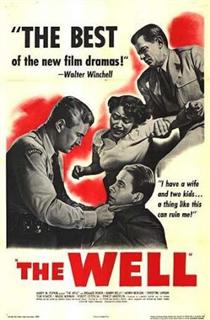
The Well (1951)

The B List: The low-budget beauties, genre-bending mavericks, and cult classics we love (Da Capo Press. $15.95. 288 pages), edited by David Sterritt and John Anderson, has been released as a paperback. The book is organised by genre – film noir, road movies, horror movies etc. Contributors include the Village Voice’s J. Hoberman, Newsweek magazine’s David Ansen, Salon’s Stephanie Zacharek, Roger Ebert and others.

The Noir section is fairly predictable, though The Well (1951) is a new one for me.  I see King Greole (1958) is included under a rock movies section, though it could also be seen as having noir elements, and for me is  Elvis Presley’s best movie (I am a closet Elvis fan).

You can check out the contents in full at Amazon.

Wierd Science…

The Red Menace (1948)

Tomorrow evening the University of Maryland will host a debate headlined The Un-Americaness of Film Noir. The background provided by the University is certainly interesting:

Jonathan Auerbach’s book in progress Dark Borders offers a political reading of American film noir as a Cold War genre centrally concerned with redefining citizenship. It begins with questions of affect and aesthetics–the strange tone of disenfranchisement or non-belonging that haunts so many of these mid-century crime movies. Freud’s notion of the unheimliche links the uncanny mood of these important films with fears that “Un-Americans” and un-American values might overtake or undermine the homeland. These anxieties surface during a series of wartime and post war emergency measures, beginning with the anti-sedition Smith Act (1940), the Mexican migrant worker Bracero Program (1942), the domestic internment of Americans of Japanese ancestry (1942), and the HUAC hearings in 1947 that sought to criminalize native-born communists (the CPUSA). This talk will be discussing one key scene in the anti-communist film The Red Scare (1949) in conjunction with a little-known but very striking movie (arguably the first film noir) Stranger on The Third Floor (1940), starring Peter Lorre, that imagines the rule of fascist law in the USA and that conceives of madness as a foreign country.

Wild stuff!  More info here.

Vertigo (1958): Red for Noir

Vertigo (1958)

“The old master, now a slave to television, has turned out another Hitchcock-and-bull story in which the mystery is not so much who done it as who cares.”
Time (16 June 1958)

“Brilliant but despicably cynical view of human obsession… The bleakness is perhaps a little hard to swallow, but there’s no denying that this is the director at the very peak of his powers, while Novak is a revelation. Slow but totally compelling.” – Time Out

I will win no friends with this review.

Vertigo is technically brilliant. Hitchcock has consummate command of his mise-en-scene and knows how to fill a wide screen, with San Francisco artfully rendered using a fresh and elegant palette. Bernard Herrmann’s score is brilliantly moody and asynchronous.

But the contrived and far-fetched plot, heavy-handed symbolism, and Hitchcock’s signature detachment-cum-contempt for his protagonists, make the whole affair rather bleak and alienating. The first half is so slow it undermines the mystery of the strange woman portrayed by Kim Novak. This shot of James Stewart after having followed her car around the same city block more than once, expresses my impatience precisely.

Vertigo (1958)

Hitchcock wallpapers the inside of a restaurant so garishly red in Stewart’s first encounter with the young woman he has been asked to tail, that it comes across as ham-fisted: danger danger alarm alarm sex sex. Then there is the atrocious portrait of a dead woman that inexplicably has pride of place in a public art gallery.

The cartoon nightmare sequence that is the immediate prelude to Stewart’s descent into catatonia feels imposed and artificial, as does the inexplicable flashing of a blue light over him as he slips into his disturbed dream.  We then move to a scene in an institution where his mental breakdown is confirmed, and then a fast-forward in a jump cut to a released and supposedly ‘recovered’ Stewart wandering the streets manically obsessed with the specter of a dead woman. Towards the end the proceedings start to fall apart. An unbelievably chance encounter on the streets of San Francisco between Stewart and a young sales assistant stretches credulity past a reasonable limit.

The movie has a gothic noir look and feel, so it is no surprise that some writers see Vertigo as a film noir. I suppose you could say that there is a femme-fatale and the themes of obsession, betrayal, and criminality support this view. Andrew Spicer in his book Film Noir (2002) sees Vertigo as “the most profound of noir’s exploration of psycho-sexual dislocation”. Personally, I think Joseph H. Lewis’s The Big Combo (1955) is a better picture where these motifs are rendered with more economy, elegance, wit, and empathy.

Bright Lights Shine on Film Noir

Bright Lights

Check out this page for links to all the articles on film noir published by the Bright Lights Film Journal, and these articles from their latest issue: a profile on noir regular Dana Andrews, and a review of Louis Malle’s 1958 noir  Elevator to the Gallows (Ascenseur pour le Chafaud).

Journey Into Fear (1943): Oriental Intrigue

Journey Into Fear (1943)

An hapless US munitions engineer visiting the Levant is the target of Gestapo spies
(1943 RKO. Directed by Norman Foster 79 mins restored version)
Unreleased preview version 91 mins

A Mercury Theater Production
Cinematography by Karl Struss
Screenplay by Joseph Cotten, Richard Collins, Ben Hecht and Orson Welles
Novel by Eric Ambler
Original Music by Roy Webb and Rex Dunn
Art Direction by Albert S. D’Agostino and Mark-Lee Kirk

Starring:
Joseph Cotten – Howard Graham
Dolores del Rio – Josette Martel
Orson Welles – Colonel Haki
Ruth Warrick – Mrs. Stephanie Graham

The official historical record has it that Orson Welles simply played a role in this movie, but original sources confirm that the film owes a lot to his creative genius. He had a part in writing the screenplay and in the direction. As Borde and Chaumeton say in their book A Panorama of Film Noir (1955):

“Journey into Fear, or ‘how fear makes people heroic’, bears the signature of Norman Foster, to be sure. But then Orson Welles collaborated on the scenario, and the exceptional breeziness and subtlety of his style emerge in the precision of the shooting script and the plastic beauty of the photography. Basing the film on a spy case that’s only a pretext and visibly turns into a hoax, Foster and Welles have rediscovered the chief laws of the noir genre: an oneiric plot; strange suspects; a silent killer in thick glasses, a genuine tub of lard buttoned up in a raincoat, who before each murder plays an old, scratched record on an antique phonograph; and the final bit of bravura, which takes place on the facade of the grand hotel of Batum. We may admire Orson Welles, with graying hair and mustache, in one of those minor, easy-going roles in which he excels: the Turkish Colonel Haki, head of the intelligence service and a womanizer.”

After mutilating The Magnificent Ambersons (1942) the year before, the studio bosses at RKO unsheathed their hatchets and hacked the completed Journey Into Fear from 91 minutes to 69 minutes for the US version and 71 minutes for the European release, and this was after various cuts from the screenplay required by the Breen office and The Legion of Decency. The 79 minute version currently available is a partial restoration, and the Welles.Net archive has a report of a further restoration. This report also provides some fascinating background on which scenes were cut.

The censors of the time, as from time immemorial, didn’t want audiences to have any fun, so as well cutting most political talk, they also had removed many scenes with ironic sexual references and any mention of religion. Still Journey Into Fear survives as a fascinating movie with moody atmospherics, exotic locales, sexy dames, weird villains, politics, wisdom, philosophy, and a wry humor.

A flawed gem, the picture is in a class of its own, and reminds me of John Huston’s glorious Beat The Devil (1953). Both movies have one guiding tenet: life is meant to be irreverent fun!

The beautiful opening shot before the credits that cranes up and peers into the window of a dingy hotel room at night and ends only after 80 seconds when the occupant leaves, and the magnificent climax on the outside ledges of another hotel at night during a rain-storm, are signature Welles. Welles has been quoted as saying that during filming, while the job of direction was given to Norman Foster, scenes were directed by “whoever was nearest the camera”. Bosley Crowther wrote in the NY Times on the film’s release: “that final duel in the beating rain on the ledge of a Batum hotel Mr. Foster [sic] has directed a melodramatic climax that is breathless and intense.”

Journey Into Fear (1943)

Those familiar with the early novels of Englishman, Eric Ambler, will know that the on-screen person of Joseph Cotton is a perfect fit for the typical Ambler hero: a timid middle-class everyman who becomes unwittingly embroiled in a nefarious and dangerous caper where he discovers guile and courage he never thought himself capable of, and after his adventure, is happy to return to the succour of a comfortable obscurity. Welles himself has a rollicking good-time hamming it up as a womanising Turkish intelligence officer. Dolores Del Rio is wonderful as a cabaret singer with sexy exotic charm, loyalty, and a calm worldly-wise aplomb: she is the perfect foil to the shy and unromantic Cotten.

The art direction for the early cabaret scene where Cotton is made to realise he is the target of a hit-man is beautifully evocative, and the whole sequence is immensely entertaining. When the action quickly moves to a tramp steamer, the sense of claustrophobia is deftly handled. To quote Crowther again: “The fright of the ordnance expert is constantly underscored by an uncanny use of light and distorted shadows in the ratty corridors of the ship; in a blacked-out cabin one senses the terror of the hidden expert as footsteps echo from the pitch-dark screen”.  Supporting roles that impinge on the protagonist have significant dialog and their characterisations are deeply drawn and well-acted. These characters also act as a philosophical chorus in scenes that while having a peripheral connection to the action, are anchored with elegant ruminations on god, war, love, death, politics, and marriage.

This is a connoisseur’s film: for those who rejoice in its eccentricities, wit, and romantic melodrama, while lamenting what has been lost to the barbarians.

Noir Westerns: A new take

Pursued (1947)

Michael Shepler, cultural coordinator for  PoliticalAffairs.net, has written an interesting article on noir westerns, Sagebrush Noir: The Western as ‘Social Problem’ Film. Schleper traces the origins of film noir from German expression through to the 50’s, and cites some Hollywood films of the 30s that are not usually referred to in discussions of film noir:

There were some pioneer American noirs such as Rowland Brown’s Beast of the City and Mamoulian’s City Streets and even a few embryonic westerns such as Wyler’s exceedingly grim version of the much filmed ‘Three Godfathers’ story, ‘Hell’s Heroes’ , shot in 1930.

He then goes on to review four western movies which he labels ‘Sagebrush Noirs’: Raoul Walsh’s Pursued (1947), Robert Wise’s Blood on the Moon (1948), and two early westerns by Anthony Mann,  The Furies (1950) and Devil’s Doorway (1950).  Other films noted by Shepler include Ramrod, Springfield Rifle, and Day of the Outlaw by Andre de Toth;  Jubal, 3:10 to Yuma, Cowboy and The Hanging Tree by Delmer Daves; Budd Boetticher’s Randolph Scott westerns  7 Men From Now (1957) and Comanche Station (1960);  Little Big Horn (1950) by Charles Marquis Warren; Sam Fuller’s I Shot Jesse James and Forty Guns; and two low budget Anthony Quinn films, The Man From Del Rio and The Ride Back which, were associated with Robert Aldrich’s ‘Associates and Robert Aldrich’ studio and produced during the same period as Kiss Me Deadly.

The full article is highly recommended.

White Heat (1949): Fission Noir

White Heat (1949)

Story of a psychotic hood with an Oedipus complex
(1949 Warner Bros. Directed by Raoul Walsh 114 mins)

Cinematography by Sid Hickox
Screenplay by Ivan Goff and Ben Roberts from a story by Virginia Kellogg
Original Music by Max Steiner
Art Direction by Edward Carrere

Starring:
James Cagney – Arthur ‘Cody’ Jarrett
Virginia Mayo – Verna Jarrett
Edmond O’Brien – Vic Pardo – alias for undecover cop Fallon
Margaret Wycherly – Ma Jarrett

Film Noir Filmographies:
Raoul Walsh: They Drive by Night (1940), High Sierra (1941)
Sid Hickox: To Have and Have Not (1944), The Big Sleep (1946), Possessed (1947),
Dark Passage (1947)
Virginia Kellogg: T-Men (1947) (story), Caged (1950) (screenplay)
Edward Carrere: Dial M for Murder (1954), I Died a Thousand Times (1955),
Sweet Smell of Success (1957)

White Heat (1949)

“White Heat = Scarface + Psycho” – Time Out

“The most gruesome aggregation of brutalities ever presented under the guise of entertainment” – Cue

“In the hurtling tabloid tradition of the gangster movies of the thirties, but its matter-of-fact violence is a new post-war style” – Time

“a wild and exciting picture of mayhem and madness” – Life

“an incendiary performance by James Cagney” – The Rough Guide to Film Noir

“Cagney is an epileptic and a borderline psychotic, and the cinema has rarely gone this for in a description of a true Oedipus” – A Panorama of American Film Noir (1955)

“Cagney… seems to incarnate the unstable explosive energies set loose by atomic fission” – Andrew Spicer in Film Noir

“A tragic grandeur… is achieved and culminates in Cody’s delirious and explosive self-immolation atop a metallic pyre” – Film Noir: An Encyclopaedic Reference

White Heat (1949)

From the daring and brutally violent train robbery that opens the film, this gangster flick has a relentless trajectory that ends only with the incendiary finale-de-resistance. Director, Raoul Walsh, and cinematographer, Sid Hickox, have produced one of the tautest and most electric thrillers ever to emanate from Hollywood, which together with the nuanced screenplay, has the spectator strapped into an emotional strait-jacket that is released only in the final explosive frames.

Jimmy Cagney as the criminal psychotic Cody Jarrett dominates the screen in a bravura performance that is as dynamic as it is intense. Edmond O’Brien as the undercover cop Fallon, is no match for Cagney, and appears flat and almost irrelevant. Cody’s razor-sharp intelligence, and unflinching decisiveness and brutality propel the action – Fallon and the other cops can only follow in his wake. Virginia Mayo is well-cast as Cody’s slatternly wife, and is as cheap and conniving as any gangster’s mole before or since. Only Ma Jarrett matches her in evil guile.

The film-making team conspires to hold you not only in awe of Cody but also to perversely empathize with him. Strange to say he is the only genuine character in the motley crew organised for the final disastrous heist. Even Fallon comes off looking lifeless and less than honorable. The mise-en-scene is calculated to subvert your moral compass. Cody is decisive and acts without hesitation or qualm, while Fallon’s actions are reactive and ponderous. When Fallon tries to sneak out of the gang’s hide-out on the eve of the heist to alert his superiors, he is way-laid and has to concoct a story about wanting to hook-up with his ‘wife’ for the night, as Cody talks intimately and almost poetically to him of his grief for his dead mother, and how he was just ‘talking’ to her when wandering in the brush outside.

In the final shoot-out Cody is pinned atop a gas storage silo at an LA refinery, while Fallon from a safe distance takes pot-shots at him with a sniper’s rifle. Cody won’t go down, and only when he wildly shoots his pistol into the silo is his fate finally sealed. Fallon looks far less heroic…

Sci-Fi Noir: New Book

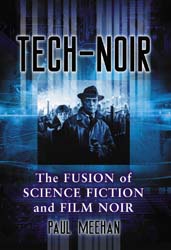
Tech-Noir

A new book Tech-Noir: The Fusion of Science Fiction and Film Noir by Paul Meehan has been published.

The publishers description:

This critical study traces the common origins of film noir and science fiction films, identifying the many instances in which the two have merged to form a distinctive subgenre known as Tech-Noir. From the German Expressionist cinema of the late 1920s to the present-day cyberpunk movement, the book examines more than 100 films in which the common noir elements of crime, mystery, surrealism, and human perversity intersect with the high technology of science fiction. The author also details the hybrid subgenre’s considerable influences on contemporary music, fashion, and culture.

The book has received a favorable review from film writer John Muir.