Christ in Concrete (1949): Simply a masterpiece

Christ in Concrete (1949)

The moving simplicity of the Pietro Di Donato novel, Christ in Concrete, has been brought to the screen with rare sincerity. It is two hours of genuine human drama, which makes no concession to convention.

– Variety (1949)

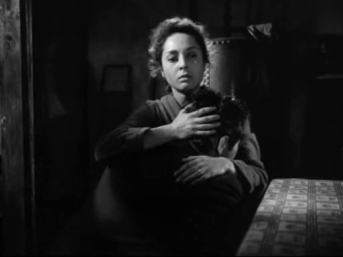
The camerawork by C. Pennington Richards is some of the best of the era, with the city streets, darkened hallways, and construction sites void of any softened corners guaranteed by Hollywood of the 1940s. With Dmytryk, Richards gave Christ in Concrete an astonishing look, which manages to straddle and suggest both film noir and Italian neo-realism. The deep focus crisp black-and-white photography evokes a handful of strong movies yet to be made, including On the Waterfront, Edge of the City, America, America, Sweet Smell of Success, Touch of Evil, and Pickup on South Street. Visually, Christ in Concrete looks like the most influential movie nobody ever saw… Christ in Concrete shares its rough-edged moral outrage with Visconti’s La Terra Trema but its gilded professionalism with Wilder’s Double Indemnity. It’s a knockout combination. Dmytryk found some kind of artistic voice in exile in England unlike any heard from him before or since.

– Matthew Kennedy, Bright Lights Film Journal (Nov 2003)

Based on the novel by Italo-American Pietro Di Donato, Christ in Concrete (aka Give Us This Day), a powerful leftist denunciation of capitalism from director Edward Dmytryk, had to be filmed in the UK, and was buried a few days after its US release by a reactionary backlash. Telling the story of Italian immigrant building workers and their families in Brooklyn during the Depression, the film is the closest an Anglo-American movie ever got to the aesthetic and socialist outlook of Italian neo-realism. Teeming tenements and residential streets are shot with a provocatively gritty realism and film noir atmospherics.
Christ in Concrete (1949)

The cast is superb with particularly powerful performances from the two leads, Sam Wanamaker and Lea Padovani, who embody the immigrant experience, which is so imbued with vitality and compassion that the film soars above any other similar work of the period. Enriched by a poetic script, the innovative cinematography of C.M. Pennington-Richards, outstanding art direction from Alex Vetchinsky, and a brilliantly evocative score by Benjamin Frankel, the movie is a revelation.

The opening scene in a deprived urban locale that follows a drunken man from the street and up the stairs of a dirty tenement building is a tour-de-force. An inspired mise-en-scene and a moving camera that follows the action from below Ozu-style, framed by the drama of the musical motifs, had me enthralled. This scene and the rest of the movie, except for panaromic shots of New York shown in the opening credits, were filmed in a studio lot in Denham, England!

Christ in Concrete (1949)

Film as art, Christ in Concrete is simply a masterpiece.
The Sound of Film Noir

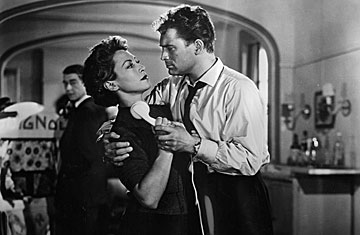
Phantom Lady (1944)

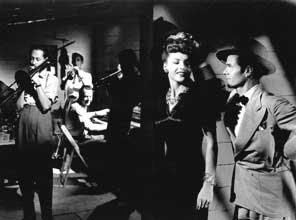
Robert Cumbow of the Parallax View blog has posted a very interesting article on film noir music scores discussing its origins, development,  and major composers from the early noirs to recent neo-noirs:

The sound of noir—plaintive sax solos, blue cocktail piano, the wail of a distant trumpet through dark, wet alleyways, hot Latin beats oozing like a neon glow from the half-shuttered windows of forbidden nightspots. You walk the sidewalks of big, lonely towns, with no destination in mind, following only the sounds, guided by them, wondering where they come from, what hurt souls cry out with such tones.

Mr Cumbow also highlights CD compilations of note.

The Garment Jungle (1957): Gia Scala’s Picture

The Garment Jungle (1957)

The Garment Jungle, a contemporary expose of New York garment employers’ use of racketeers to keep unions out, disappoints. Finished by director Vincent Sherman after Robert Aldrich (Kiss Me Deadly) left production towards the end of shooting, for a Columbia a-feature it is largely set-bound, and suffers for it.

The whole affair sags and ends with a weak resolution. Lee J. Cobb in the lead is sadly flat.  Robert Loggia as an Italo-American union organiser is strong and the performance of the tragic Gia Scala as his young wife dominates the picture.  She is palpably alive on the screen and thoroughly immersed in her role. The sequence where she is introduced is the film’s highlight. Shot at a union dancing-class on a steamy-night where the dance music is a dissonant counterpoint to the drama, she is by turns sensual, fiery, gentle, and despairing. Here and in the external shots on the streets of  NY, when they are used, the mise-en-scene and cinematography are truly inspired.  We can commend cameraman Joseph F. Biroc, but who directed these scenes? My bet was Aldrich.

The Garment Jungle (1957)

Silver and Ward list the movie in Film Noir: An Encyclopedic Reference, and to my mind ‘invent’ some film noir connections in the mise-en-scene and the lighting of some scenes. But For me The Garment Jungle is strictly melodrama.

The Woman on Pier 13 (1949): Better Wed than Red

The Woman on Pier 13 (1949)

A former member of the US Communist Party in a management
job on the San Francisco waterfront is blackmailed by the Party

It is with some irony that 60 years on it is the greed of bankers and not the ideology of  leftists that has brought global capitalism to the brink of collapse, so take the red-menace propaganda here with a good dose of salt and you have a top film noir.

The Woman on Pier 13 (original title I Married a Communist) was a pet project of RKO boss Howard Hughes and it is said by some was a litmus test to sniff out reds in the ranks.  His meddling delayed the movie’s release until 1951 after HUAC’s halycon days were past, and it bombed at the box office.

The screenplay, which despite criticism by most film critics as being far-fetched, to my viewing is quite solid, has the ‘commies’ work as a bunch of hoods. This conceit makes the script and the story compelling, with both melodramatic and thriller arcs.  RKO stringer Robert Stevenson (Walk Softly, Stranger) does a solid job of directing, with stunning noir visuals by veteran noir cameraman Nicholas Musuraca.

The Woman on Pier 13 (1949)

The cast is particularly strong.  Robert Ryan plays the former commie, and the lovely Laraine Day (The Locket) his wife.  Thomas Gomez is a ruthless commie boss, with Janis Carter (Night Editor, Framed, I Love Trouble) as an undercover commie femme-fatale who mixes politics and love, and William Talman (Armored Car Robbery, The Racket, The Hitch-Hiker, City That Never Sleeps, Big House USA ) is convincing as a carnie moonlighting as a commie hit-man – in his first role.

The Woman on Pier 13 (1949)

The story never flags, and eroticized and violent noir pyrotechnics make for an enthralling and wild roller-coaster ride.  When Ryan is first confronted by his Party blackmailer at a warehouse,  a Party member suspected of treason is trussed and thrown in the Bay to drown while Ryan watches. Later a protagonist is run down by a car in cold blood by hit-man Talman. That same night Gomez pushes a woman out of an apartment window, and the sister of the guy run-down by Talman tracks him down and poses as a wife who needs her husband out-of-the-way Double-Indemnity style.  The scenes between the two are erotic dynamite, and the perversity of  Talman as the wise-cracking hit-man on the make boasting about his latest job make Tommy Udo (Kiss of Death) look like a kindergarten teacher.

A solid downbeat ending after a spectacular shoot-out on the wharves satisfies and has a redemptive focus.

The Woman on Pier 13 (1949)

Two John Alton Films On New DVD Set

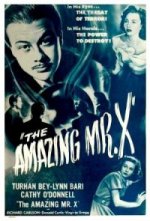
The Amazing Mr X (1948) Reign of Terror (1949)

The Classic Film Noir, Vol. 3 2-DVD Box set to be released by VCI Entertainment on March 31, features upgraded transfers of two John Alton lensed movies that have until now been available only as poor quality public domain copies. The films are Bernard Vorhaus’s Amazing Mr. X (1948), also known as The Spiritualist,  and  Anthony Mann’s Reign of Terror (1949), aka The Black Book.   NY Times movie critic Dave Kehr reviews these new releases here (half-way down the page).

Where Danger Lives (1950): It’s a long road…

Where Danger Lives (1950)

A compelling RKO noir melodrama from John Farrow (The Big Clock, Night Has a Thousand Eyes, Alias Nick Beal, His Kind of Woman), with great camera work from Nicholas Musuraca, and top-line art direction from Ralph Berger and  Albert S. D’Agostino.

Where Danger Lives (1950)

A naive young doctor falls for a stunningly beautiful but unstable young woman, and ends up the target at a shoot-out on the Mexican border after a frantic road trip to escape a murder rap. Robert Mitchum is the doctor and little-known b-actress Faith Domergue is the dame. Domergue steals the picture from Mitchum.  Her nuanced performance as a ravishingly sublime femme-fatale is enthralling and she dominates every scene. There are many close-ups of her manic eyes full of menacing allure.  If she is crazy, she is the sanest psychopath to inhabit a film noir. Her guile and determination are almost heroic.

Where Danger Lives (1950)

Low angle available-light interior shots exposing ceilings early on are deftly used to frame scenes of tension and violence.The noir motif of entrapment is strongly focused by close-framed shots, particularly on the road, where the fleeing protagonists are shown within the car or from outside the car in close-up, and rarely in open spaces.  The climactic finale on a neon-lit street in a border own at night is beautifully lit and the action superbly edited. If not for Domergue’s manic turn and Musuraca’s camera, Farrow’s less than taught direction would have doomed the picture to mediocrity. The establishing scenes drag, and the middle section with Mitchum and Domergue on the lam is slow, with two aimless interludes: when they have a car accident, and in a small town where they are forced to ‘wed’.  There is an unnecessary and soppy final scene that undermines the riveting penultimate scene where the camera stares up at Mitchum’s tortured face against an industrial wire fence as the cops surround the fugitives after the shoot-out.

A uneven film made memorable by Domergue’s portrayal and the stunning climax.

T-Men (1947): Electric Noir

T-Men (1947)

T-MEN 92 min Eagle Lion Films
Two US treasury agents go undercover in LA and Detroit to infiltrate a counterfeiting operation.

Director Anthony Mann
Cinematography John Alton
Screenplay John C. Higgins (Raw Deal, He Walked by Night, Border Incident, Railroaded, Shield for Murder)
Story Virginia Kellogg (Caged, White Heat)
Starring Dennis O’Keefe, Alfred Ryder, Charles McGraw, Wally Ford, Mary Meade, June Lockhart

“Each shot with it’s distortions of space and unpredictable, dissonant lighting, forces an awareness of the visual narrative so that the jingoism  of the Treasury Department may be ignored and a vision of the noir underworld may emerge.”
– Blake Lucas in Film Noir: An Encyclopedic Reference (1992)

“effortlessly transcends its semi-documentary brief (with blandly ‘official’ commentary) to land deep in noir territory, concerned less with the heroic exploits of its T-Men than with personality perversities involved in undercover work (the wrenching imperative to deny friends, wives, feelings, even to the point of standing by while a partner is cold-bloodedly executed). John Alton’s superlative camerawork counterpoints tensions and perspectives with almost geometrical precision.”
– T.M. in the Time Out Film Guide

Director Anthony Mann and cinematographer John Alton transform a police procedural screenplay into a dark visionary descent into a subterranean noir realm, where two undercover cops inhabit a flip-side life of criminality, brutality, and violence.  These men exist almost exclusively as ciphers whose lives have meaning only in the dark seething undertow of a sinister metropolis. So immersed are these men, that the dying words of one are cheap remonstrations of deceit, and the final vengeful shootout delivers a duel to the death.  Add to the mix, stand-out performances by Dennis O’Keefe as the T-man O’Brien, Wally Ford as a doomed hood who carries the richly redolent moniker of ‘the Schemer’, and Charles McGraw as the ruthless hit-man ‘Moxie’, and you have a top-flight thriller.

T-Men (1947)
T-Men (1947)

Every scene in this movie is a set-piece where the mis-en-scene, the lighting, and the camera’s fluid peregrinations in an electric fusion of a chiaroscuro aesthetic and technical mastery,  draw the viewer into a hyper-reality of grim tension, dark tenements, hellish steam baths, desolate streets, seedy nightclubs, drab wharves, rusting cargo steamers, sinister business offices, and the decadent palatial homes of mobsters.  This nether world is rotten to the core – each time a boss is uncovered yet another further up the social scale surfaces.

Only a touch of pathos is allowed when one of the T-Men and his wife have to deny their identities and feign being strangers, and even this scene telegraphs the cop’s fate as we leave the wife with the glint of a tear in her estranged eyes.

T-Men (1947)
T-Men (1947)

One of the classic noirs – not to be missed.

Film Noir Digest: Dassin Retrospective

Jules Dassin: 1911-2008

Rififi (1955)
Rififi (1955)

The New York Film Forum from March 27 to April 12 will host a Jules Dassin retrospective over 12 days.  March 31 mark the anniversary of Dassin’s passing. All of Dassin’s major features will be screened, including:

  • Brute Force (1947)
  • The Naked City (1948)
  • Thieves’ Highway (1949)
  • Night And the City (1950)
  • Rififi (1955)

Full program

The Night of the Hunter (1955): Not Noir

The Night of The Hunter (1955)

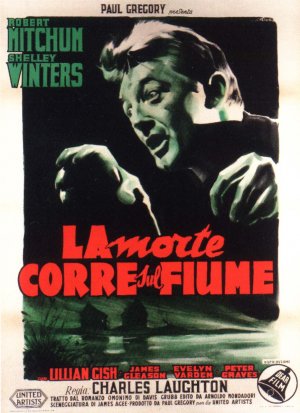
In the only film directed by Charles Laughton, The Night of the Hunter, we have an example of the danger of applying a template approach to establishing a picture as a film noir. Expressionist lighting and criminality – tick. But these elements alone do not a noir make. The Night of the Hunter is a gothic tale of good versus evil: there is no ambivalence nor an inversion of traditional values. Good triumphs over evil and the story ends.

This is not to say Night of the Hunter is not a great film- it assuredly is.  A tale about a psychotic and murderous Southern preacher terrorising two children who know the whereabouts of a loot of stolen money is not without flaws, but great nonetheless. The compelling screenplay, first class acting, atmospheric cinematography, and an enthralling stylised mise-en-scene from a first-time director make it great.

The editing is not fluid however, and the narrative flow suffers. Whether this is due to cuts made after completion of the preview version is uncertain. In a new book on the making of the movie, author Jeffrey Coachman says Laughton re-interpreted James Agee’s script, which itself was based on the first novel of Davis Grubb. The original Agee script surfaced in 2003, and out-takes still exist and have been viewed by Couchman. Also certain studio scenes clash jarringly with on-location shots.  Scenes in a small town near the end of the film are so obviously set-bound, that the drama takes on a theatrical tone which weakens the ‘reality’ of the story. The ending steers perilously close to sentimentality, but is saved by the luminous acting of Lillian Gish.

Other weaknesses relate to a certain moral relativism. The opening scene that establishes the story arc is not as strong as it should be – a weak performance by Peter Graves as the father on-the-run with the loot is redeemed only by the young actors playing his children. The father is caught and hanged, after sharing his cell with the evil preacher played superbly by Robert Mitchum, who learns that the loot has been hidden but not where. In the cell, disturbingly, the father justifies his crime, and presumably the killing of two people during the robbery, by saying he did it so his kids would not suffer during the hard times of the depression. After the hanging, the hangman is shown going home to his wife and young children and his remorse is clearly established. Yet at the end he is shown gleefully anticipating the hanging of another man – the preacher. An elderly married couple who are friends of Grave’s widow and portrayed as the salt of the earth in their generosity and concern for the woman alone struggling to raise her two children, at the end of the movie are transformed into unhinged rabble-rousers screaming for revenge and leading a lynch mob.

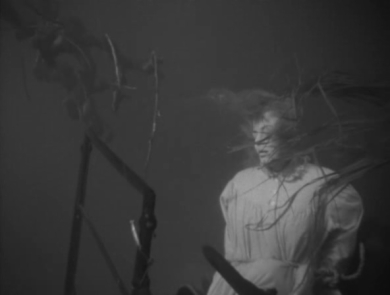
These weaknesses aside, there are stunningly elegiac scenes as the story unfolds. The most compelling is of the murdered widow still sitting upright in a car submerged in a river.

The Night of The Hunter (1955)

Dark Passage (1947): Not so dark

Dark Passage (1947)


I start viewing each Humphrey Bogart picture with a heightened anticipation, so strong is the Bogart persona in any movie.  Alas, Dark Passage is one of the few  Bogart pictures that disappoints.  Bogart goes through the motions of an escaped con on the run trying to clear himself of a murder charge, and Lauren Bacall look great, but for a thriller the whole affair is flat.

Based on a story by David Goodis, the screenplay relies on too many implausible coincidences.  The pedestrian direction of Delmer Daves (The Red House) constrains the  camera of cinematographer Sid Hickox (To Have and Have Not, The Big Sleep, Possessed, White Heat), and the Franz Waxman score is sadly undistinguished.  You don’t see Bogart’s face  for the first half of the movie, with the camera taking a point of view angle – it didn’t work in Lady in The Lake (1947) and it doesn’t work here.  The ending is lame, and the climax is ho-hum even though a dame falls out of the window of an apartment building!

Dark Passage (1947)

Deep focus outdoor scenes on the streets of San Francisco sustain visual interest, and the hilly topography results in some great angled shots.  Snappy lines of dialog enliven some static scenes, and there are interesting bit-roles that to a limited extent mitigate the film’s overarching weaknesses.  Agnes Moorehead is entertaining as a closet psychopath, but her camp characterisation is out-of-place in an otherwise earnest scenario.   A veteran bit-player with an  expressively craggy visage, Houseley Stevenson, is great as an eccentric  bootleg plastic surgeon.  Tom D’Andrea as a helpful cab driver,  Clifton Young as a small-time hood turned blackmailer, and  Tory Mallison as Bogart’s only friend, contribute immensely in roles that are pivotal to the story.  To give Daves, who adapted Goodis’ novel, due credit, the taxi cab scene is great – with Bogart’s “old” face in shadow in the back seat working so much better than the POV gimmick.

As for Dark Passage being a film noir, I suppose at a stretch you could say that there is an underlying theme of entrapment, but there are no noir atmospherics or motifs.