Noir Review Finds

Gun Crazy

Richard von Busack on MetroActive reviews Gun Crazy (1949):

Joseph H. Lewis’ berserk film noir classic ‘Gun Crazy’—the story of a sexy sharpshooter and a sensitive gun nut… we’ve seen some smooth, pale and impassive actresses, but none is as genuinely skull-faced as Peggy Cummins… Cummins’ Annie Laurie Starr has a down-turned mouth and the lockjaw of a woman smothering an English accent. She is pocket-size but a crack shot with the pistol, and her eyes have the gleaming calm of a rabid animal waiting to decide who to bite first…

The French Connection

Nicolas Rapold of the New York Sun on The French Connection (1971):

The French Connection hits the sweet spot of urban grit, perhaps by virtue of its early entry in the grimy ’70s sweepstakes. This New York is indeed broken-in, featuring a magnificently dilapidated warehouse, but it doesn’t wallow, stagger, and vomit like the squalid and bankrupt Gotham of Martin Scorsese’s 1976 milestone Taxi Driver. Nor does Popeye’s dispute with a federal agent attached to the case carry grimly satisfying anti-establishment overtones. Perhaps screenwriter Ernest Tidyman split the difference between his work on the glam attitude of “Shaft” (which made its debut the same year) and later in the deep-cover flick “Report to the Commissioner…
Killer’s Kiss (1955): Early Kubrick

Killer’s Kiss  -1955

Killers Kiss (1955), an early B noir from Stanley Kubrick has been reviewed by Cinepinion.

There is another review of Killer’s Kiss on the Noir Files, and other great articles on these films noir:

FILM NOIR
The Letter (1940)
Double Indemnity (1944)
Detour (1945)
The Lady From Shanghai (1948)
Niagara (1953)
Criss Cross (1949)
The Asphalt Jungle (1950)
The Bad & the Beautiful (1952)
The Big Heat (1953)
Pickup On South Street (1953)
Killer’s Kiss (1955)
The Killing (1957)
Touch of Evil (1957)

NEO-NOIR
Vertigo (1958)
The Killers (1964)
Seance on a Wet Afternoon (1964)
Un Flic (1972)
American Gigolo (1980)
Body Heat (1981)
Dance With A Stranger (1985)
House of Games (1987)
Bitter Moon (1992)
Noir, Now & Then (2001): feature book review

Act Of Violence (1948)

Act Of Violence (1948)

Film Forno has posted a lengthy review of Act Of Violence:

The issues in this film are so real it elevates the story from the genre to a lofty psychological plane. Once it starts I dare you to try and stop watching it! Noir was a B genre, they were made fast, a lot of the conventions of noir , the stylish shots were partly created to save time as for example when you have two characters talking to each other but both facing the camera, this saves the time of doing reverses, moving the camera, relighting, etc…

Lloydville on Schizo-Noir

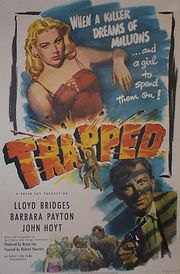
Crime Wave (1954)Trapped (1948)

Lloydville of mardecortesbaja.com has posted a good review of these two noirs: Trapped (1949) and Crime Wave (1954)

Noir: Inside The Frame

Out Of The Past (1947)

Leonard Quart in an article, Noir in New York, on the recent New York City Noir festival for the Berkshire Eagle, has made an interesting observation, which is also my take on film noir (my emphasis):

Both these films [Taxi Driver and Klute], despite utilizing some of noir’s imagery and stylistics, explore their central characters in greater depth and depict a city much more particular and less formulaic in its rancid corruption and violence than traditional film noir. Emphasizing the psychological and aesthetic, neither film ever makes grand political and social statements. And despite the tendency of some critics to write about the genre itself as a mirror of the bleakness of life in a postwar urban America burdened by the oppressive weight of a Depression, WW II, and the Cold War, the fact was that American cities were generally prosperous and safe in those postwar years. In the words of “Taxi Driver” scriptwriter, Paul Schrader, film noir was “more a creation, rather than a reflection.” … Obviously, some noir films could be wonderful, and others dreadful. But they were films that always should be understood on their own terms, rather than mined for portentous subtexts. At their best they were well-wrought, atmospheric, suggestive entertainments.

To my mind, films noir are first and foremost entertainment, and any film must be first understood simply from what is on the screen.

This line from Siodmak’s Out of the Past (1947) says it best: “All I can see is the frame … I’m going inside to look at the picture”.

Melville’s Film Noir

Le Doulos (1962)

San Francisco’s Bay Area Reporter has published a good article, Double-crossed in the City of Lights, on French noir director Herman Melville, centered around his film Le Doulos (1962), playing August 17-23 at the Castro.

They Live By Night (1948)

They Live By Night (1948)

Clydefro on his filmjournal.net blog has posted an interesting review of They Live By Night (1948) the first feature of director Nicholas Ray, in which Clydefro firmly establishes Ray’s auteur credentials.

While Clydefro’s exploration of They Live By Night is original and penetrating, I don’t quite agree with his take on the noir Outsider:

“Watching They Live by Night, I was reminded of the music of Bruce Springsteen and, specifically, the song “Atlantic City” off his Nebraska album. Both artists were able to locate the pulse of the outsider, someone not particularly special in any way but undeniably American in spirit and attitude. The idea of bettering one’s self and family, even if it means turning to crime or working outside the margins, is a recurring theme in both men’s work. Of course, Ray put his finger on this pursuit some twenty and thirty years before Springsteen.”

To me the persona of the outsider is more complex, and a universal (not parochial) archetype. The outsider is outside bourgeois society and does not share its aspirations, and in the noir genre this is manifested generally but not always in criminality. Ray and Springsteen both share this wider vision: consider Ray’s In A Lonely Place (1950) and Springsteen’s Streets Of Philadelphia.

They Live By Night is one of the 10 films noir released on July 31 by Warner Home Video in the Film Noir Classic Collection, Vol. 4 DVD box set.

Richard Schickel on Film Noir

Film Noir

TIME magazine film critic, Richard Schickel, has written an article on film noir for the Wilson Quartely, which has been published on-line: Rerunning Film Noir. Generally an excellent historical overview, with some interesting movies discussed, but in some aspects unsatisfying:

Noir, despite its Frenchified name, is a truly American form, as Alain Silver and Elizabeth Ward observe in Film Noir: An Encyclopedic Reference to the American Style (1979). Yes, many of its leading directors (Fritz Lang, Billy Wilder, Jacques Tourneur, André de Toth) were born in Europe and well versed in expressionism. But their ­source—­often directly, always at least ­indirectly—­was the American crime fiction of Dashiell Hammett, Raymond Chandler, James M. Cain, W. R. Burnett, and others. Almost all noir actors and many of the directors’ significant collaborators (cameramen, editors, etc.) were American born and certainly American ­trained.

This dismissal of the influence of the European directors is defensive, and does not help readers to understand the real influence of these expatriate directors. Schiekel seems to deride the autuer influence of artists like Wilder, Siodmak, Lang, Tourneur, and others. Existentialism is not even mentioned: the noir anti-hero is more of an outsider than an urban refugee. And of course the French recognised and named the genre, and provided an analytical framework.

Miklós Rózsa Centennial

On Aug. 17, the Academy of Motion Picture Arts and Sciences will kick off its Academy Centennial Salute to Miklós Rózsa at the Samuel Goldwyn Theater.
Rózsa scored a number of films noir:

Double Indemnity (1944)
Ministry of Fear (1944)
Lady on a Train (1945)
The Lost Weekend (1945)
The Strange Love of Martha Ivers (1946)
The Killers (1946)
The Red House (1947)
Brute Force (1947)
The Naked City (1948)
Kiss the Blood Off My Hands (1948)
The Bribe (1949)
Criss Cross (1949)
The Asphalt Jungle (1950)

My favorite is the Asphalt Jungle (1950). From the opening shots, Rózsa’s dramatic almost post-modern score establishes the feel of the picture, and remains in the memory forever. More from the LA Times.

In A Lonely Place (1950): The “Creative” Outsider

In A Lonely Place (1950)

Steve-O of Noir of The Week blog has posted a good article on In A Lonely Place, from Barry Gifford’s book, Out of the Past: Adventures in Film Noir. Don‘t read the article if you haven’t seen the film, as it contains spoilers.

I always go to my falling-apart paperback copy of Steve Scheuer’s Movies On TV and Video 1993-94 for a razor-sharp plot summary: Gripping story of a Hollywood writer who is under suspicion of murder and his strange romance with his female alibi.

This picture is an atypical noir, where the psyche of a “creative” outsider is explored. Its stars an aging Humphrey Bogart, and Gloria Grahame: both are great in these against-type roles. I prefer it to Sunset Blvd.

This is a movie in which the title has a real deep meaning. In a lonely place: those of you who have suffered from or been close to someone who has suffered major depression, will also find this story a painfully accurate portrayal of how a depressed person battles with his demons. Many creative artists are linked with depression or bipolar disorder, where anger is at a trigger point. Director Nicholas Ray, deftly explores the effects of frustration and anxiety on the creative psyche within the grid-lines of the noir genre.