Towards a Definition of Neo-Noir

Blogger cineycrispetas has posted an excellent essay on neo-noir on his Géneros cinematográficos:

What defines then the noir spirit? Could it be the “cynical and the pessimistic tone […] the darker side of human condition, modern fables that highlight the dangers of alienation, the fragmentation of society, the breakdown of human interaction, the debasement of love, the beguiling power of wealth, the corruption of government, and mankind’s inherent propensity for inertia and impotence”… Is noir “spirit” allowed to evolve, mutate as the environment in which it exists changes? It is also entitled to refer and quote to the noir canon since contemporary audiences are not only conscious of the legacy of noir but also amenable to noir references in modern perspectives and environments?

Jules Dassin (1911-2008): Rebel With a Cause

Night And the City 1950
Richard Widmark in Night and The City (1950)

Jules Dassin, one of the great noir directors, died in Athens overnight.

Born in Middletown, Connecticut in 1911, Dassin’s ground-breaking noirs of the late 1940’s rank among the great films noir:

Brute Force (1947)
The Naked City (1948)
Thieves’ Highway (1949)

A committed leftist, Dassin was blacklisted by the HUAC and left the US before the final cut of Thieves Highway was made. In London he made in 1950 Night and the City, another classic noir starring Richard Widmark, in perhaps his best dramatic role.

In Europe, Dassins’ attempts to work as a director were vengefully thwarted by Hollywood mogules until 1955, when penniless and in despair he was offered Du rififi chez les hommes (1955) [“Rififi”], which he crafted into the greatest french noir of the 50’s. Dassin also played the Italian safe-cracker in the picture. The movie, which featured the legendary 32 minute heist scene filmed in almost total silence, desevedly won him the best director prize at the Cannes Film Festival, where he met his second wife, the Greek actress Melina Mercouri, who died in 1994.

An interesting Salo.com interview with the 89-yo Dassin in August 2000 by Michael Sragow offers some background on Dassin’s attitudes to his early noir work.

Check out my reviews of Thieves’ Highway, Rififi and Night And the City.

His major noir releases are available as Criterion DVDs, and these essays on the Criterion web-site are elegant dissertations on Dassins’ artistry:

Brute Force: Screws and Proles by Michael Atkinson Here we are in the dark territories again, the republic of bitternesses and bile known as noir, squaring our jaws against an amoral universe and roaming the rain-wet, lightless American City as if it were a circle of the inferno where backstabbers, goldbricks, and unfortunates march in closed patterns and puzzle >>>

The Naked City: New York Plays Itself by Luc Sante In 1945 Arthur Fellig, known as Weegee, a canny and gifted tabloid newspaper photographer, did something unprecedented: he assembled some of his best shots, of corpses and fires and arrests and crowds and spectacles, and made them into a book, published in hardcover—this at a time when photography books were still >>>

Night and the City: In the Labyrinth by Paul Arthur Within film noir’s unparalleled roster of resonant titles—Kiss of Death, Out of the Past, Where Danger Lives, to name three—none is more emblematic or iconographically cogent than Night and the City. Juxtaposing two of noir’s essential, virtually ontological qualities, the title of Jules Dassin’s underrated elegy for a self-annihilating hustler reminds >>>

Rififi: Love Made Invisible by Jamie Hook In 1955, Jules Dassin, an American director in exile in Paris, made this flat-out perfect piece of cinema. The film came as a redemption for Dassin: a one-time promising young director cranking out B-movies under an MGM contract (“They were awful. It was just plain unhappiness and embarrassment,” he later said >>>

Thieves Highway: Dangerous Fruit by Michael Sragow Like the movie’s rattletrap trucks lurching down the highway as they carry way-too-heavy loads, the characters in Jules Dassin’s brilliantly volatile Thieves’ Highway struggle under psychological and moral baggage until they can lay their burdens down. Working from a novel and script by A.I. Bezzerides, Dassin made this swift, fluid melodrama >>>

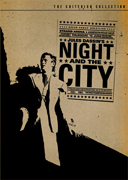
Criterion Noir Essays

Night and the CityThis link will take you to a page listing the current catalog of Criterion Noir DVDs.

Of interest also is a link to an essay on each film in the catalog, including a lengthy article on Jules Dassins’ Night an the City (1950) by film essayist Paul Arthur, who passed away last week. Coincidentally, Night and the City stars Richard Widmark, who also died last week, and an article in this Weekend’s New York Times by Dave Kehr rates this as Widmark’s best picture.

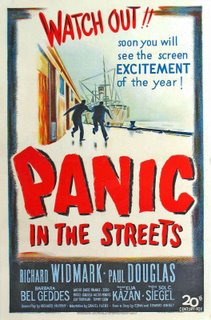
Panic In The Streets (1950) Free On-Line

Panic In The Streets (1950)

A public domain copy of this classic noir from Elia Kazan is available from the Internet Archive. The blurb on the site is worth quoting in full:

One night in the New Orleans slums, vicious hoodlum Blackie (Jack Palance) and his friends kill an illegal immigrant who won too much in a card game. Next morning, Dr. Clint Reed (Richard Widmark-this time not seen pushing little old ladies in wheelchairs down the stairs) of the Public Health Service confirms the dead man had pneumonic plague. To prevent a catastrophic epidemic, Clint must find and inoculate the killers and their associates, with the reluctant aid of police captain Tom Warren (Paul Douglas), despite official skepticism, and in total secrecy, lest panic empty the city. Can a doctor turn detective? He has 48 hours to try. Spellbinding

Sam Spade Radio Capers

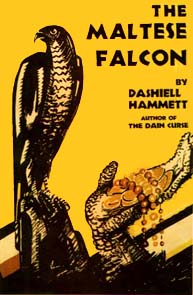
The Maltese Falcon - Book Cover

In the 40s and 50s, The Adventures of Sam Spade, was a popular US radio show based on stories written by Dashiell Hammett, featuring Howard Duff in the lead. But the story Blue Moon features the the chemistry of Bogie and Bacall!

The Free Information Society has five of the original broadcasts available for free download:

  • Blue Moon: with Humphrey Bogart and Lauren Bacall.
  • Missing Newshank Caper
  • Over My Dead Body Caper
  • Stopped Watch Caper
  • Terrified Turkey Caper

The Thrilling Detective site has more information on the shows on it’s excellent Sam Spade page.

The Glass Key: Mercury Radio Production (1939)

Orson Welles

Thanks to a pointer to the Mercury Theater on the Air site from Lloydville of mardecortesbaja.com.

Amongst many broadcasts from this famous Orson Welles radio-play project, is a 1939 radio adaptation of Dashiell Hammett’s novel, The Glass Key, which was adapted for the screen in 1935 and again in 1942.

You can download an MP3 of the original broadcast from the Mercury Theater on the Air site.

The Noir Anti-Hero

The Set-Up (1949)

Today I came across an article by one Tom Hart on the (alleged by some) neo-noir film Sin City in an obscure UK students portal.

Hart argues that this movie among other things bastardises the conventions of film noir insofar as there is no redeemed anti-hero. Strangely though he goes on to illustrate his point by referencing Bogart’s Rick in Casablanca.

What is interesting is Hart closes his piece with a nice take on the noir protagonist:

Noir anti-heroes can be amoral, cynics, corrupt, tormented by angst, ambiguous, absurd, but they are never, in the final event, without the courage to choose the absurd path in life. Sin City provides the basis for a great noir, but fails to deliver a redeemed anti-hero.

As Albert Camus observed:

‘In the midst of winter, I finally learned that there was in me an invincible summer.’

Film Noir and The Unconscious

The Killers

These on-line papers from the 2004 Conference of the Society for Critical Exchange make fascinating reading.

Shadowing Film Noir: Hollywood’s Political Unconscious

A Touch of Yellow in Film Noir
Sheng-mei Ma, Michigan State U.

‘Queer Eye’ for a ‘Straight Dick’: Contextualized Homosexuals in Film Noir
Scott F. Stoddart, Marymount Manhattan C

Face Plates: T-Men, Counterfeiting, and Noir Representation
Mark Osteen, Loyola C.

Are Femme-Fatales Crazy?

Double Indemnity (1944)

Now that I have your attention.

I have just been googling with Google Scholar, and have been amazed at the wealth of film noir material this Beta service unearths. There are book extracts, complete books, and journal articles on many and varied aspects of the genre.

This brings me to the heading for this post. A very interesting article I uncovered comes from the Journal of Criminal Justice and Popular Culture: Personality Disorder And The Film Noir Femme Fatale by Scott Snyder of the University of Georgia:

Motion pictures can influence the development of both normal and disordered personality. The femme fatale of the film noir movies of the 1940s and 1950s is representative of several related personality disorders characterized by histrionics, self-absorption, psychopathy, and unpredictability. This report will examine how various societal factors occurring during World War II and its aftermath influenced the portrayal of these disordered females and how these depictions, in turn, reflected and influenced American culture at the time. Specific reference to issues of criminology, economics, gender, as well as feminist viewpoints on this phenomenon will be explored.

The Left Hand Of Noir

Lloydville of mardecortesbaja.com has posted another interesting and provocative article on the origins of film noir: MORE ON FILM NOIR AND THE DEATH OF GOD:

…certain modern commentators want to see film noir as a phenomenon with essentially political implications – something that’s not hard to argue given the leftist leanings of many of the great masters of the noir tradition, a number of whom were eventually blacklisted. But seeing film noir as essentially political expression I think sells the phenomenon short… If film noir were simply a reflection of the politics of its leftward-leaning makers, it ought to be terribly dated today, after the demystification of Communism and Stalin, those ephemeral shibboleths for which the Hollywood radicals martyred themselves.

Lloydville’s post has prompted some musings of my own.

The concern with existential angst is what attracted me to films noir, and Lloydville’s recent posts have prompted me to look at certain films in new ways. More particularly, I have always dismissed Detour (1945) as an oddity that I didn’t take too seriously, mainly because the protagonist brought his fate upon himself by his own foolishness, and I saw the plot as too contrived. But now after reading Llloydville’s post I feel that perhaps, Al makes disastrous choices because he has lost a defining paradigm for life and his  immaturity. An indifferent universe may have played a stronger role in his downfall, than I previously thought.

I agree that there are elements of the socio-political in many noirs: Dassin, Lang, and Wilder come immediately to mind, but I disagree with some aspects of Lloydville’s analysis of leftism and film noir. Many of the great European film noir directors that landed in Hollywood, fled fascism, and I see no evidence that they had any Stalinist inclinations. We must be careful not to confuse leftism with authoritarian communism.

The leftist critique of the intellectual left of Europe was a response to existentialism and, as Lloydville says, the death of God. For others the response was an inclination to nihilism, and yes, Stalinism. We can see nihilism too in many noirs.

That said, I agree the political is only one element of many in the film noir genre, and placing exclusive emphasis on this element in a director’s oeuvre is invalid and limiting.

I also cannot agree with Lloydville’s view that “Hollywood radicals martyred themselves.”. They were destroyed for the most part because of past associations or beliefs that they in most cases no longer held, and principally for their innate decency and courage when they placed loyalty and morality ahead of self-interest. If they were martyrs, their sacrifice was for the highest ideals not “ephemeral shibboleths”.