New Noir Site: Film Noir Studies

filmnoirstudies.com

The authoritative University of California Berkeley hosted collection of essays by John J. Blaser, No Place for a Woman: The Family in Film Noir, has been re-launched with updated content as Film Noir Studies. While the focus is still on essays, new features include a film noir time-line, a comprehensive glossary, and an open invitation for the submission of new essays. Highly recommended.

Noir America: The Genius of Film Noir

crimsonkimono_tn

This article by Stanley Crouch on Slate.com is one of the best written and most entertaining surveys of film noir I have read: Noir America: Cynics, sluts, heists, and murder most foul. An extract follows:

Noir’s popularity was inevitable. How could American audiences resist the combative stance of an unimpressed hero whose ethos could be reduced to: “Is that so?” How could they fail to be lured by all of the actresses cast as Venus’ flytraps? Everything in film noir takes place at the bottom, in the sewers of sensibility. It holds that the force of the world is not only indifferent to, but obviously bigger than, the individual, which is why personal satisfaction, whether illegal or immoral, is the solution to the obligatory ride through an unavoidably brittle universe.

Offscreen Com: Noir Essays

Man With a Trumpet

The film site Offscreen.com has published an interesting collection of articles on film noir:

Gloria Grahame: Incendiary Blonde

New York-based film writer, Dan Callahan, has written a penetrating article on the films and life of film noir regular, Gloria Grahame, for the May edition of Bright Lights Film Journal, Fatal Instincts: The Dangerous Pout of Gloria Grahame.

Callahan concludes his article with stunning directness:

Gloria Grahame lived on the sidelines of her films because it was there that she could cause the most trouble; she might appear in any movie, young and sullen, aged and insistent, under a pound of make-up or plain-faced, fucking the pain away, putting out a cigarette in someone’s eye, giggling for no reason. She’s inescapable, a disruptive force, and when I hear her in my head, she seems to say, “C’mon, you know you want to . . .”

Noir filmography for Gloria Grahame:

Crossfire (1947)
In a Lonely Place (1950)
The Bad and the Beautiful (1952)
Macao (1952)
Sudden Fear (1952)
The Big Heat (1953)
Human Desire (1954)
Naked Alibi (1954)
Odds Against Tomorrow (1959)

Related FilmsNoir.Net posts:

The Big Heat (1953): Film Noir As Social Criticism
The Big Heat (1953) Revisited
Crossfire (1947)
In A Lonely Place (1950): The “Creative” Outsider
In A Lonely Place (1950): A Psychic Prison

The Long Goodbye (1973): Redefining Philip Marlowe

The Long Goodbye (1973)

The House of Mirth and Movies blog has posted an excellent review of Robert Altman’s The Long Goodbye (1973). An extract from The Long Goodbye: Recreating Noir:

The Long Goodbye maintains the thematic associations of noir, while altering the physical environment. The location remains much the same, as the conventional noir, as the film is set in Los Angeles, and the urban setting plays heavily into creating mood and atmosphere. The most apparent change is no doubt the shift from black and white to colour. The added choice to expose the undeveloped film negative to additional pure light in post production, until the colours were softened and the darks faded, further differentiate the look with the genre’s original stylistic trademark. Instead of the high contrast, low key lighting that characterizes film noir, the film is almost washed away. This technique works at creating a similar atmosphere as the traditional noir model despite being so different. Life and existence lack all vibrancy, and the uniform shade of grey that seems to pervade every scene emphasizes the moral ambiguity of all those who inhabit the city. There is little difference between black and white, so everyone is living in a perpetually grey and faded environment, living between the traditional models of good and evil instead of clearly on one side or the other…

This blog also has an interesting post on The Big Sleep (1946): Thinking about The Big Sleep and Howard Hawks.

The Noir City: Imagining Gotham

Hugh Ferriss: Gothic Noir in Gotham

The nonist blog has a fascinating article on (and including images from) the reprint of a 1929 book by Hugh Ferriss titled The Metropolis of Tomorrow: “Ferriss was the preeminent architectural draftsman of his time who through his moody chiaroscuro renderings of skyscrapers virtually inventing the image of Gotham…”

Ferriss’ gothic renderings of modern architecture have an uncanny affinity with the noir city of the classic film noir cycle.

The Fight Movie and Film Noir

The Set-Up 1949

The Set-Up (1949)

Film-maker David Mamet, in an interesting piece in today’s New York Times on his new film, Redbelt, about a movie fight director, has written eloquently on the fight movie and film noir:

Fight films are sad. There is nobility in effort, in discipline and, if not in suffering, in trying to live through suffering and endeavour to find its meaning… the fight film is a celebration of submission, which is to say, of loss. As such, it finds itself on the outskirts of my beloved genre of film noir. The punch-line of drama is “Isn’t life like that. …” But its elder brother, tragedy, is the struggle of good against evil, of man against the gods. In tragedy, good, and the gods, are proclaimed winners; in film noir, which is tragedy manqué, the gods still win, but good’s triumph gets an asterisk… The true story of any true fight must be sad. As Wellington said, “Nothing except a battle lost can be half so melancholy as a battle won.”

Mamet explores this thesis that “All fighters are sad” by analysing the scenes featuring real-life fighters playing fighters in Jules Dassin’s Night And the City (1950) and Stanley Kubrick’s The Killing (1956), and goes on to explore it more deeply in Kurosawa’s The Seven Samurai (1954).

Surprisingly, Mamet does not mention two other films noir: Robert Rossen’s Body and Soul (1947), or Robert Wise’s The Set-Up (1949). The wrestlers in Night and the City and The Killing are not central characters, while in Body And Soul and The Set-Up, a boxer is the central character, and the tragedies played-out in these two movies more strongly evoke the existential angst of the ‘fight’. Indeed, The Set-Up as a real-time evocation of one fight, brilliantly confronts Mamet’s theme of the melancholy duality of winning and losing. Robert Ryan, also once a real-life boxer, as the aging fighter, “Stoker” Thompson, refuses to throw the fight and by winning loses when the heavies, who paid his trainer for the fall, cripple him in a dark back-alley outside the stadium.

New Book on Maverick Film-Maker Samuel Fuller

Shock Corridor 1963
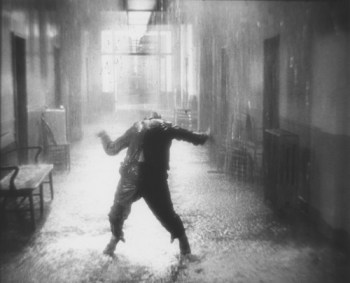
Shock Corridor (1963)

Professor of film studies Wesleyan University, Lisa Dombrowski has just published The Films of Samuel Fuller: If You Die, I’ll Kill You!.

In a press release Dombrowski said of Fuller:

His films are inherently fascinating. They’re designed to reach out and grab you. They’re provocative; they want you to respond emotionally and intellectually and sometimes even physically in an instinctual manner, as if someone has punched you in the face. He accomplished his goals in different ways. In the content, he discussed controversial issues of the time, race, gender, violence, critiques of America. Also, through their narrative structure, they emphasize conflict and contradictions, with dramatic tonal shifts that are jarring.

A book-signing and discussion of Fuller by Dombrowski will be held Thursday 24 April 2008 at 7:30 p.m. at the Goldsmith Family Cinema, 301 Washington Terrace, on the campus of Wesleyan University in Middletown, Connecticut. The signing will be held in conjunction with a screening of the 1955 Fuller thriller House of Bamboo.

Reviews of Samuel Fuller noirs on filmsnoir.net:

Pickup On South Street (1953)
The Crimson Kimono (1959): Little Tokyo Rift
The Naked Kiss (1964): Pulp Noir

Review of Fritz Lang’s M

M 1931

US novelist David Schleicher, has posted a very worthy review of Fritz Lang’s M (1931) on his blog.

Double Indemnity: The Unseen Ending

Double Indemnity (1944)

The final draft of the screenplay of Double Indemnity (1944) by Billy Wilder and Raymond Chandler in the Motion Picture Academy Library in Los Angeles – download from here – includes a final prison execution chamber scene and a line of dialog that was spoken by Walter Neff, just after he said “I love you.” to Barton Keyes. With sirens wailing in the background, Neff says: “At the end of that trolley line, just as I get off, you be there to say good bye. Will you, Keyes?” The story then shifts to the execution.

This sequence was filmed but cut (by the studio?) from the production release.

Double Indemnity (1944)

James Naremore in his 1998 book on film noir, More than Night: Film Noir in Its Contexts, offers this penetrating analysis and critique:

… the execution described in the longest version of the script greatly increases our sympathy for Walter, all the while raising questions about the criminality of the state. It also provides a tragic recognition scene for Keyes, who is shaken out of his moral complacency. This last point is especially important, because Keyes functions as a representative of the insurance company. Although he approaches his work with the intuitive flair of an artist and the intellectual intensity of a scientist, he remains a loyal agent of industrial rationality—a talented bureaucrat who, in effect, has helped to create the office building, the drive-in restaurant, the supermarket, and all the other landmarks of modern Los Angeles that the film relentlessly criticizes… One of the many virtues of Wilder’s original ending is that this complex, brilliantly acted character would have been made to confront his inner demon and to experience poetic justice. Keyes would have been brought face-to-face with the culminating instance of instrumental reason, the “end of the line” for industrial culture: the California gas chamber… For the original version of Double Indemnity, Paramount built an exact replica of the [San Quentin]  gas chamber, depicting it as a modern, sanitized apparatus for administering official death sentences. At considerable expense, Wilder photographed the step-by-step procedure of execution, emphasizing its coldly mechanical efficiency. There was no blood, no agonized screaming, and, for once in the movie, almost no dialogue. Much of the sequence was shot from Walter’s point of view, looking through glass windows at the spectators outside the chamber—an angle creating a subtle parallel between the chamber and the “dark room” of a movie theater. When the fatal pellets dropped, clouds of gas obscured the windows, and we could barely make out Keyes standing amid the witnesses, turning his head away. Soon afterward, a doctor entered the chamber to pronounce Walter dead. According to the script, the original film ended as follows:

… All the witnesses have now left except Keyes, who stares, shocked and tragic, beyond the door. The guard goes to him and touches his arm, indicating to him that he must leave. Keyes glances for the last time towards the gas chamber and slowly moves to go out. CORRIDOR OUTSIDE THE DEATH CHAMBER CAMERA SHOOTING IN THROUGH THE OPEN DOOR AT KEYES , who is just turning to leave. Keyes comes slowly out into the dark, narrow corridor. His hat is on his head now, his overcoat is pulled around him loosely. He walks like an old man. He takes eight or ten steps, then mechanically reaches a cigar out of his vest pocket and puts it in his mouth. His hands, in the now familiar gesture, begin to pat his pockets for matches. Suddenly he stops, with a look of horror on his face. He stands rigid, pressing hand against his heart. He takes the cigar out of his mouth and goes slowly on toward the door, CAMERA PANNING with him. When he has almost reached the door, the guard stationed there throws it wide, and a blaze of sunlight comes in from the open prison yard outside. Keyes slowly walks out into the sunshine, a forlorn and lonely man.

Until someone rescues this scene from the Paramount vaults, we will never know if it is superior to the current version, and even then there may be room for debate. One thing, however, is clear: Keyes’s lonely walk out of the prison would have thrown a shadow over everything that preceded it. It was not until Sunset Boulevard and Ace in the Hole that Wilder would produce such a savage critique of modernity. Although the released version of his famous thriller remains an iconoclastic satire that challenges the censors, it is a lighter entertainment than the original and a much easier product for Hollywood to market. (According to the Paramount press book, photographs of Barbara Stanwyck in her wig and tight sweater were circulated to American soldiers overseas, and Edward G. Robinson’s performance enabled the studio to obtain a tie-in from the Cigar Institute of America.) No matter how much we admire the film that was exhibited in 1944, the form of cinema that the French described as noir is probably better exemplified by another Double Indemnity, which we have yet to see.

The rare (Spanish?) poster featured at the top of this post features a rendering of Neff from the gas chamber scene. Note also the nightmarish imagery which has a definite surrealist quality, making this perhaps one of the most intriguing film noir posters ever. I am unsure of its origin or the artist. Perhaps a reader of filmsnoir.net can help in tracing its origin? The signature seems to be “Lopez Riem”?