The Set-Up (1949)

The Set-Up (1949)

The Set-Up from noir director, Robert Wise, is a sharp expose of the fight game packed into a lean 72 minutes. From RKO and filmed at night on a studio lot, this movie is brooding and intense, with Robert Ryan, as the aging boxer, “Stoker” Thompson, in perhaps his best role, with a great supporting cast. The boxing scenes are as real as they get: Ryan himself was a college boxing champ. The arena is brilliantly filmed with focused and repeated shots on selected spectators, which portray not only the excitement, but also the unadorned mob brutality, that reaches fever pitch as the fighters struggle to a climactic finish.

The film opens and ends with zoom shots of a street clock: starting at 9.05pm and ending at 10.17pm – yes – the actual length of the picture…

The Set-Up (1949) The Set-Up (1949)

There are other interesting visual commentaries on the action which mock the existential angst of the protagonists:

The Set-Up (1949) The Set-Up (1949)

The boxers’ dressing room, where Stoker’s essentially decent persona is established from his interactions with the other boxers, is beautifully evoked. Each person in that room is deeply and sympathetically drawn, and these scenes are enthralling. To the movie makers’ credit, remember this is 1949, there is a black boxer, who responds to Stoker’s friendliness, with a heart-felt wish of good luck, after winning his own fight.

The Set-Up (1949) The Set-Up (1949)

A simple story of gut-wrenching humanity. One of the great noirs.

The Set-Up has been packaged with four other films noir in the DVD set Film Noir Classic Collection Vol. 1. The other movies in the DVD set are the noir classics: The Asphalt Jungle, Gun Crazy, Murder My Sweet, and Out of the Past.

Roadblock (1951)

Roadblock (1951)

A competent b-noir from the RKO factory. While dated and rarely going beyond what its low budget allowed, Joan Dixon as the reforms-too-late femme-fatale leaves you wondering why her career as an actress went nowhere, and the more than competently shot doomed escape by car at the end is one of the best car chases from the period. The final scene is elegantly composed by stalwart noir photographer Nicholas Musuraca.

Roadblock (1951)Roadblock (1951) Roadblock (1951)
Roadblock (1951)

[piclens-lite-link]

Noir Review Finds

Gun Crazy

Richard von Busack on MetroActive reviews Gun Crazy (1949):

Joseph H. Lewis’ berserk film noir classic ‘Gun Crazy’—the story of a sexy sharpshooter and a sensitive gun nut… we’ve seen some smooth, pale and impassive actresses, but none is as genuinely skull-faced as Peggy Cummins… Cummins’ Annie Laurie Starr has a down-turned mouth and the lockjaw of a woman smothering an English accent. She is pocket-size but a crack shot with the pistol, and her eyes have the gleaming calm of a rabid animal waiting to decide who to bite first…

The French Connection

Nicolas Rapold of the New York Sun on The French Connection (1971):

The French Connection hits the sweet spot of urban grit, perhaps by virtue of its early entry in the grimy ’70s sweepstakes. This New York is indeed broken-in, featuring a magnificently dilapidated warehouse, but it doesn’t wallow, stagger, and vomit like the squalid and bankrupt Gotham of Martin Scorsese’s 1976 milestone Taxi Driver. Nor does Popeye’s dispute with a federal agent attached to the case carry grimly satisfying anti-establishment overtones. Perhaps screenwriter Ernest Tidyman split the difference between his work on the glam attitude of “Shaft” (which made its debut the same year) and later in the deep-cover flick “Report to the Commissioner…

The Narrow Margin (1952): B plus

The Narrow Margin (1952): B plus

A very enjoyable B thriller from a crew with strong film noir credentials. Director, Richard Fleischer, is ably supported by cameraman, George E. Diskant, and the movie features a strong cast of b-liners, with the tough Charles McGraw and the exciting Marie Windsor in the leads. A nice plot twist propels the tension to the end. From the dramatic opening credits of a train screeching through the night, The Narrow Margin, has you hooked.

One of the best on-a-train thrillers, this movie starts off in noir mood but develops into a smart thriller with few noir pretensions. The direction is sharp, the dialog snappy, and the cast top-notch. The early night scenes before the action switches to a train trip from Chicago to LA, are brilliantly filmed and edited, with stark lighting and shadows, and low angles.

The Narrow Margin (1952): B plus The Narrow Margin (1952): B plus

On the train, tension is heightened by judicious cuts to the steaming train running aggressively from right to left across the screen. There is a nice piece of montage worthy of Eisenstein half-way through the trip which gives a cut to the train even added tension: the action cuts from Marie Windsor frantically filing her nails to the churning wheels of the steam engine.

The Narrow Margin (1952): B plus the n

For me this film is all about Marie Windsor as the dame in trouble scrapping with her cop protector. She dominates every scene with her aura of sex, excitement, and nervous fear. Her great lines are delivered flawlessly with great rolling of her incendiary eyes and almost always with a cigarette in her mouth or hand. You don’t want this vixen to leave the screen.

The Narrow Margin (1952): B plusThe Narrow Margin (1952): B plus

She is brutally bumped off towards the end, and to my exasperation is never alluded to again. This cheapens the rest of the story for me, because she is the one character who is exposed to the most danger, and merits the greatest kudos. To be simply forgotten is almost misogynistic.

This weakness aside, the closing scenes are classic compositions which accentuate the escape from the claustrophobia of the train while remaining on the “straight and narrow”:

The Narrow Margin (1952): B plus The Narrow Margin (1952): B plus

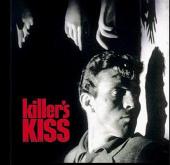
Killer’s Kiss (1955): Early Kubrick

Killer’s Kiss  -1955

Killers Kiss (1955), an early B noir from Stanley Kubrick has been reviewed by Cinepinion.

There is another review of Killer’s Kiss on the Noir Files, and other great articles on these films noir:

FILM NOIR
The Letter (1940)
Double Indemnity (1944)
Detour (1945)
The Lady From Shanghai (1948)
Niagara (1953)
Criss Cross (1949)
The Asphalt Jungle (1950)
The Bad & the Beautiful (1952)
The Big Heat (1953)
Pickup On South Street (1953)
Killer’s Kiss (1955)
The Killing (1957)
Touch of Evil (1957)

NEO-NOIR
Vertigo (1958)
The Killers (1964)
Seance on a Wet Afternoon (1964)
Un Flic (1972)
American Gigolo (1980)
Body Heat (1981)
Dance With A Stranger (1985)
House of Games (1987)
Bitter Moon (1992)
Noir, Now & Then (2001): feature book review

Boomerang (1947): Not Noir

Boomerang (1947)

Boomerang, an early movie from director, Elia Kazan, is famous for its then innovative quasi-documentary style. Based on a true story, it is a sharp and well-acted film where a small-town DA in a novel reversal of role determines the innocence of a troubled WW2 vet wrongly charged with murder. The movie feels dated but the story of integrity in the face of political corruption and police expediency remains strong.

How others have classified this picture as a noir has me stumped. Yes, the accused is a war veteran struggling to catch up in the “parade of life” after 5 years in the army, but this is peripheral and does not a film noir make.

Act Of Violence (1948)

Act Of Violence (1948)

Film Forno has posted a lengthy review of Act Of Violence:

The issues in this film are so real it elevates the story from the genre to a lofty psychological plane. Once it starts I dare you to try and stop watching it! Noir was a B genre, they were made fast, a lot of the conventions of noir , the stylish shots were partly created to save time as for example when you have two characters talking to each other but both facing the camera, this saves the time of doing reverses, moving the camera, relighting, etc…

Ace In The Hole (1952): The Media Circus

Ace In The Hole (1951)

“A brilliant arrangement of cause and effect…
unique as a mirror of the morbid psychology of
crowds… revolting but incontrovertibly true.”
– New York Times

“Terrific drama. Grim tale of a big city reporter
who capitalizes on a disaster to ride himself back
to the big time. Unrelenting in its cynicism.”
– Steve H. Scheuer, Movies on TV and Video.

Ace in the Hole (aka The Big Carnival) is a savage critique not only of a corrupted but also corrupting modern mass media. Perhaps Billy Wilder’s best film, this subversive morality tale was not a box office success when first released. As Wilder said of the audience response at the time: “Americans expected a cocktail and felt I was giving them a shot of vinegar instead.”.

Kirk Douglas as the self-seeking journalist, Chuck Tatum, dominates the screen and develops by the climax as one of Wilder’s more complex characterisations. There are noir elements in the movie, but classifying it as a noir unfairly limits its scope and the depth of social criticism. Only the poor trapped man, his inconsolable parents, and the owner of the small town newspaper, have any true decency. Everyone else, is either corrupt or corruptible, if not downright stupid or plain evil – the trapped man’s floozy of a wife included, and Tatum’s naive young photographer is easily seduced by the reporter’s phoney charisma. The corrupt sheriff who actively conspires with Tatum, even after he is told the poor trapped man is doomed, wants to use this turn of events to his political advantage.

The power of this film resonates today, when countries go to war on manufactured evidence and manipulative spin. Innocent lives are as expendable today as they always have been in the cause of political ambition and warped ideological agendas: a world where the spin doctor rules.

This is a must see movie.

Double Indemnity (1944): Proto-Noir

Double Indemnity (1944)

“One of the highest summits of film noir…
without a single trace of pity or love.”
Charles Ingham, 1971

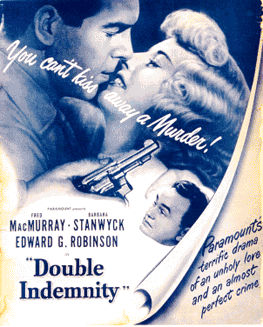
Double Indemnity, Billy Wilder’s classic proto-noir from the pot-boiler novella by James M. Cain, is a great melodrama with snappy dialog and a tight script from Wilder and Raymond Chandler. All the elements of the archetypal film noir are distilled into a gothic LA tale of greed, sex, and betrayal. The casting of the inscrutable Fred MacMurray as the anti-hero, a seductive and transparently vile Barbara Stanwyck as the femme-fatale, and Edward G. Robinson as the garrulous claims manager is inspired.

I have lost count of how many times I have watched this movie, and it has been over 30 years since I first saw it on TV as teenager, but with each viewing I come away with something new. It attests to Wilder’s skill as a film-maker that the dramatic tension is sustained until the last frame even though the whole story is told in flashback – we know Walter Neff is a goner from the go. The opening fluid shots of the wounded Neff’s car careening down the dark LA streets with Miklos Rosza’s musical counterpoint, wonderfully establish the dark dramatic mood before any character is seen on the screen.

Double Indemnity (1944)Double Indemnity (1944)

Double Indemnity (1944)Double Indemnity (1944)

But there are some nagging weaknesses. The only rounded character is Robinson’s claims manager, Barton Keys. Walter Neff and Phyllis Dietrichson are flat protagonists and our interest is sustained mostly by their early banter and poisoned repartee in the brutal climax. Neff says he loves Phyllis, but I all I see is a murderous conspiracy based on greed and lust. He has no real remorse and elects to clean up the unravelling of the crime by plugging Phyllis – despite her last minute conversion. Half-way through, the picture is nearly lost by the over-long and ludicrous scene in the office of Barton Keys’ boss, who is played so badly that the otherwise deft attempt at comic relief falls completely flat – I was reminded of Zeppo Marx…

That said, Double Indemnity is great entertainment and a recommended introduction to the film noir genre.

Leave Her to Heaven Screening

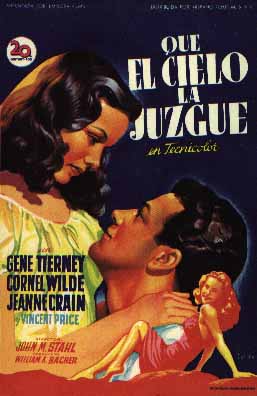
Leave Her to Heaven (1945)

The sixth annual Rewind/Fast Forward Film and Video Festival, held at the Miami-Dade Public Library will Friday screen a restored print of Leave Her To Heaven (1945) with Gene Tierney.

From a preview by Scott Cunningham in the Miami New Times:

…the festival is showing a range of cinematic realism, beginning with a restored print of the 1945 film noir classic Leave Her to Heaven, starring a 24-year-old Gene Tierney. Delightfully fake, this potboiler, washed in Technicolor and painted backgrounds, tells the melodramatic tale of Ellen Berent (Tierney), a rich woman driven to madness by her possessive love for her novelist husband Richard (Cornel Wilde). The realism in this case comes from the intersection of Tierney’s character with her own life. The actress suffered from bipolar disorder and was lobotomized a few years after the filming of the movie. Who’s to say if she was overacting, or acting at all?”