Desert Fury (1947): Technicolor Noir

Desert Fury (1947)

The young daughter of a lady casino operator falls for a racketeer
(1947 Paramount. Directed by Lewis Allen 96 mins)

Despite the use of lavish technicolor and high production values, Desert Fury only has any spark in the last 20 minutes culminating in a three-car car chase across the Nevada desert at dusk, which is made even more exciting by great musical scoring from Miklós Rózsa.

The big name stars are wasted and the screenplay from the otherwise dependable A. I. Bezzeridis and Rober Rossen lacks punch, and the dialog is sadly pretty sappy.  But the story did hold my interest to the end.

The debut performance of Wendell Corey as the possessive homme-noir to Lizabeth Scott and her racketeer boy-friend is impressive: his relationship with the racketeer played by John Hodiak has an undertone of sublimated homoerotic obsession, and it this that sustains the drama and is the trigger for the final denouement.

Jean Gabin Retrospective

La bête humaine (1938)

Thanks to the mysterious Dark City Dame for a heads up on these screenings.

The American Cinematheque will this weekend (Sept 6-7) at The Egyptian Theatre, 6712 Hollywood Boulevard in Hollywood, screen four films starring French screen legend, Jean Gabin, under the banner Jean Gabin: The World’s Coolest Movie Star:

The Sicilian Clan (Le Clan Des Siciliens), 1969, 20th Century Fox, 118 Min
Moontide¸ 1942, 20th Century Fox, 94 Min
House On The Waterfront (Port Du Désir), 1955, 94 Min. Dir. Edmund T. Gréville
Grisbi (Touchez Pas Au Grisbi), 1954, Rialto Pictures, 88 Min. Dir. Jacques Becker

The full schedule and trailers are available here.

Apropos Jean Gabin – my favorite French tough guy – he starred in most of the poetic-realist French movies of the 30s, which were really the pre-cursors of Hollywood noir.  As Geoff Mayer and Brian McDonnell say in their book, Encyclopedia of Film Noir (Greenwood Press 2007): “in these movies an ironical poetry was found in the everyday: hence the term poetic realism. The iconography of the cycle included the shiny cobblestones of nighttime Parisian streets (the faubourgs), the shadowy interiors of neon-lit nightclubs, and the moody, haunted, doom-laden faces of actors such as Jean Gabin. As well as inspiring Hollywood film-makers, who viewed them admiringly, some of these French films were actually remade as American noirs, for example, Le Chienne (1931) was remade as Scarlet Street (1945), La bête humaine (1938) as Human Desire (1954), Pépé Le Moko (1937) as Algiers (1938), Le Jour se lève as The Long Night (1947), and Le Corbeau (1943) as The Thirteenth Letter (1951).”

I saw La bête humaine a few years back and it is everything we would expect in a film noir of the 40s with a really downbeat ending.

Noir Novelists and Screenwriters

The Big Sleep

With the valuable assistance of Fanglei from China, who provided the names of screenwriters, I have revised my earlier post of noir novelists to produce a new post which includes screenwriters.  Again, I welcome revisions.

The listing has been transferred to a permanent page: Film Noir Writers Listing

The Good Die Young (UK 1954): British Noir

The Good Die Young (1954)

The Good Die Young (UK Remus Films 1954 Directed by Lewis Gilbert 100 minutes)

The Good Die Young  is an interesting British noir that employs the unusual homme-noir motif and the more common disillusioned war veteran theme in an original treatment.

“Four men with four guns” the voice-over narrator intones as four guys in a stolen car prepare for a heist on the dark streets of London, before a series of flashbacks traces how each of these four men, with no priors, find themselves in a stolen car, each with a gun in their hand. All four are WW2 vets in financial straits, with three in need of some quick cash and easy targets for the fourth, a wastrel toff cum homme-noir: a man so venal he is loathed and despised by his own father.

The Good Die Young (1954)

While an uneven film, the actual heist and denouement are very strong with deep focus location night-for-night shooting on dark sombre London streets, the London underground, a symbolic sequence in a grave-yard, and expressive tilted framings that break the linearity of the narrative.  The opening scene, which regrettably is obscured by the credits, coupled with a dramatic musical score, is evocative of US noirs of the period with the heist car speeding towards the camera on a rainy London night .

The Good Die Young (1954)

The strongest of the four stories are that of a washed-up boxer played beautifully by English actor Stanley Baker and that of the wastrel played with suave menace by a young Laurence Harvey.  The other two men are Americans whose stories are less convincing, and Gloria Grahame as the cheating starlet-wife of one of them is wasted in a tacky role.  The ‘seduction’ scene where the toff connives to get the others into the caper is marred by redundant and silent-era close-ups of Harvey’s exaggerated facial expressions and arch eye movements.

Interesting historically, and it is worth wading through the first 80 minutes to get to the final action-packed 20 minutes.

Noir Novelists

Elsewhere I recently became embroiled in a discussion where a reviewer of a film noir who had not the read the novel was admonished for not crediting the significant contribution of the writer of the original novel.

This has spurred me to put together a list of the major “noir” novelists whose works underpinned the genesis and flowering of film noir in the 1940s and 1950s.

The list is not exhaustive and features works that were adapted for the screen in notable films noir.

A.I. Bezzerides 1908-2007
They Drive by Night (1940) – screenplay of his novel Long Haul
Desert Fury (1947) – co-wrote screenplay of Ramona Stewart novel Desert Town
Thieves’ Highway (1949) – screenplay of his novel Thieves Market
On Dangerous Ground (1952) – screenplay of the novel “Mad with Much Heart” by Gerald Butler
Kiss Me Deadly (1955) – screenplay of Mickey Spillane novel

W. R. Burnett (1899–1982)
Little Caesar (1931)
High Sierra (1941)
Nobody Lives Forever (1946)
The Asphalt Jungle (1950)

James M. Cain (1892–1977)
Double Indemnity (1944)
Mildred Pierce (1945)
The Postman Always Rings Twice (1946)

Raymond Chandler (1888–1959)
Time to Kill (1942) – based on the novel The High Window
Double Indemnity  (1944) – co-scripted screenplay based on the James M. Cain novel
The Big Sleep (1946)
The Blue Dahlia (1946) – original  screenplay
Farewell, My Lovely (aka Murder, My Sweet) (1944)
The Brasher Doubloon (1947)  – based on the novel The High Window
Lady in The Lake (1947)
Strangers on a Train (1951)  – original  screenplay
Playback (1949) – un-produced screenplay
Playback  (1959) – novelisation of un-produced screenplay
The Long Goodbye (1973)

Steve Fisher (1912–1980)
I Wake Up Screaming (1941)
Johnny Angel (1945) –  original  screenplay
Lady in the Lake (1947) –  original  screenplay
Roadblock (1951) –  original  screenplay
City That Never Sleeps (1953) – original  screenplay
36 Hours (1953) –  original  screenplay

David Goodis (1917–1967)
Dark Passage (1946)
The Unfaithful (1947) –  original  screenplay
Nightfall (1957)
The Burglar (1953)
Shoot the Piano Player (1960) – based on the novel Down There

Dashiell Hammett (1894–1961)
The Glass Key (1935)
The Maltese Falcon (1941)
The Glass Key (1942)

Jonathan Latimer (1906–1983)
The Glass Key (1942) –  original  screenplay
Nocturne (1946)
They Won’t Believe Me  (1947)
The Big Clock (1948) – screenplay based on the Kenneth Fearing novel
Night Has a Thousand Eyes (1948) – screenplay based on the Cornell Woolrich novel
The Unholy Wife (1957)

Horace McCoy (1897–1955)
Kiss Tomorrow Goodbye (1950)
They Shoot Horses, Don’t They? (1969)

William P. McGivern (1918-1982)
The Big Heat (1953) – based on Saturday Evening Post serial
Shield for Murder (1954)
Rogue Cop (1954)
Odds Against Tomorrow (1959)

Cornell Woolrich (1903–1968)
Street of Chance (1942) – based on the novel titled The Black Curtain
The Mark of the Whistler (1944) – based on the short story Dormant Account
The Leopard Man (1943) – based on the novel Black Alibi
Phantom Lady (1944)
Deadline at Dawn (1946)
Black Angel (1946)
The Chase (1946) – based on the novel The Black Path of Fear
Fall Guy (1947)  – based on the short story C-Jag
Fear in the Night (1947) –  based on the short story And So to Death (Nightmare)
The Guilty (1947) –  based on the short story He Looked Like Murder
I Wouldn’t Be in Your Shoes (1948)
Night Has a Thousand Eyes (1948)
The Window (1949) – based on the short story The Boy Cried Murder
Convicted (1950) – based on the novel Face Work
No Man of Her Own (1950) – based on the novel I Married a Dead Man
Nightmare (1956) –  based on the short story And So to Death (Nightmare)

The Bride Wore Black (France 1968)

Possessed (1947): Melodramatic Soap

Possessed (1947)

A repressed woman is pushed into the abyss of schizophrenia by unrequited love
(1947 Warner Bros. Directed by Curtis Bernhardt 108 mins)

A tour-de-force performance from an aging Joan Crawford impresses, but the gestalt of this movie rarely strays beyond melodrama – more a soap-opera on steroids than film noir.

The use of flash-back and dark moody lighting make it look noirish, but the deranged protagonist is not responsible for the consequences of her delusions, and there is no redemption, only the hope of recovery.

Visually the opening scenes on the streets of LA and in the corridors of a hospital are stunning, but this virtuosity is not sustained, and the only visual interest in the rest of the film is the brutal and visceral murder at the end.

Possessed (1947)

Road House (1948): Noirish Melodrama

Road House (1948)

The love between a sultry cabaret singer and the manager of a road-house is thwarted by the jealous and vengeful owner (1948 20th Century Fox Directed by Jean Negulesco 95 mins)

A melodrama made memorable by a bravura performance from Ida Lapino as a cynical cabaret singer who finds love.  Her rendition of “One for My Baby” with a bluesy solo piano accompaniment is arresting, and her sensuality is palpable and provocative. She delivers her cynical lines  with a world-weary cigarette-smokey voice and her one-liner put-downs are delivered with perfect timing.  She is one hot dame, and the passions she arouses are very believable.

Road House (1948)

Richard Widmark is strong in only his third role as the schizoid road-house owner who covets Ida, but a stolid Cornel Wilde as Widmark’s manager and rival for the singer’s affection is a damper on the action.

The movie is set-bound and it shows, but veteran director Jean Negulesco composes interesting and fluid takes with almost-noir lighting.

Angel Face (1952): Gothic Noir

Angel Face (1952)

A young psychopath with an Electra complex tries to murder her step-mother
(1952 RKO Directed by Otto Preminger 91 mins)

Angel Face is a dark and occasionally chilling gothic melodrama with Jean Simmons effectively cast against type as an ‘enfant-terrible’, and Robert Mitchum as her hapless object of desire and manipulation.  While well-made and with high production values, the film moves too slowly and Mitchum’s trademark laconic persona is a further drag on the action.  The final denouement though half-expected is still a shocker.  But on balance, Preminger’s sardonic detachment, which usually finds favor with film critics, makes the film look and feel one-dimensional.

An interesting costuming twist telegraphs the repression of forbidden sexual desire on the day a fatal plot is executed: the protagonist contrary to her usually modestly feminine attire on this day sports a very tight sweater and a waist-hugging belt.

Angel Face (1952)

Dark City (1998) The Director’s Cut: Zapped by the biochemist

Dark City (1998)

The Director’s cut of Dark City (1998) has been released on DVD this week.  A sci-fi noir from director Alex Proyas, it explores the nature of consciousness and memory in a classic stylised noir city, which is the closest a contemporay color movie has ever come to evoking the look of a 40’s film noir.
Dark City (1998)

It is a visually stunning and enigmatic dream-scape where true identity doesn’t exist, but is the construct of a biochemist in the employ of dark soul-less aliens, who inhabit cadavers, collectively employed in attempting to stave off extinction by reconstructing physical reality and manipulating the brain’s chemistry.  The noir motif of an amnesiac protagonist on the run after he is implicated in the serial killing of b-girls is the arc on which the story is woven.  It is an amalgam of Al Hartley’s Amateur (1994), which preceded it, and The Matrix (1999), of the following year: a brave new world with a ghost in the machine…

References:
Brave New World – Aldous Huxley
The Ghost in the Machine – Arthur Koestler

Chinatown (1974): Review by Pick-Up Flix

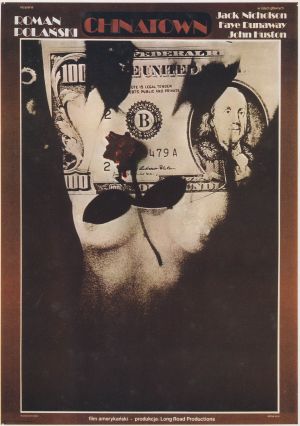
Chinatown (1974)

Michael Clawson has posted to his blog, Pick-Up Flix, a review of Roman Polanski’s Chinatown (1974) with an original take on Chinatown as metaphor: the title refers to a place where law and order (i.e. death) are circumvented by the tragedy and corruption of life. Roman Polanski wasn’t creating just a mystery; he was bowing to the greatness in which mystery thrived — film noir”.