The Dark Knight (2008): Still a comic

The Dark Knight (2008)The Dark Knight is worth seeing for Heath Ledger’s bravura study in psychopathology, but as a movie it rarely strays from the confines of its comic-book origins.

Many are waxing lyrical on the “dark vision” and the portrayal of a flawed Batman, and this is true, but to say that the picture “is a straight-up gritty, dirty, soul-rending film noir crime drama” *, is pure hyperbole.  In the film noir universe, there are no super-heros.

As a film it has also major flaws: confused editing with dis-jointed dialog, and an obsession with the minutiae of violence.

* Review by Movie Blawger at SportingNews.com.

The Clay Pigeon (1949): Snappy B Thriller

A WW2 ex-POW suffering from amnesia is accused of treason. (RKO 1949, Directed by Richard Fleischer 63 mins).

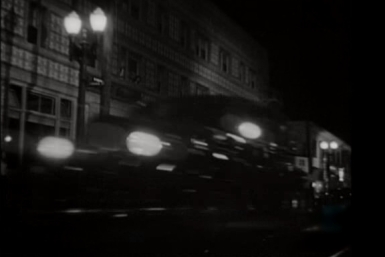
The Clay Pigeon is a tight b-thriller from Richard Fleischer, who also directed the b-noirs Bodyguard (1948), Trapped (1949), Armored Car Robbery (1950), and The Narrow Margin (1952). Set on the streets of LA’s Chinatown with a realistic chase sequence, and a nail-biting climax on a train at night, the movie is energetic and great entertainment. A Japanese villain adds to the exotic mix, with good performances all-round from a solid b-cast.

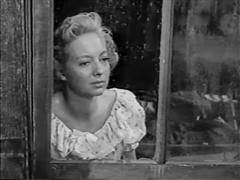
There is an interesting interlude in the apartment of a Chinese widow of a Sino-American war vet where the protagonist hides from his pursuers, which is deftly woven into the story and adds considerable depth. The widow is nicely played by Marya Marco, who had a short career as a bit-player in the 40s and 50s.

The Clay Pigeon (1949)


The Clay Pigeon (1949)

LA Woman: “so alone…”

LA Woman

…Drivin’ down your freeways
Midnight alleys roam
Cops in cars, the topless bars
Never saw a woman…
So alone, so alone
So alone, so alone
Motel money murder madness…
Lets change the mood from glad to sadness

LA Woman – The Doors (1971)

Marlowe on the moon and justice

From Raymond Chandler’s novel The High Window (1942):

The night was all around, soft and quiet. The white moonlight was cold and clear, like the justice we dream of but don’t find.

Evelyn Keyes Dead at 91

The Prowler (1951)Evelyn Keyes, who died on July 4, starred in a number of films noir: Johnny O’Clock (1947), The Killer That Stalked New York (1950), The Prowler (1951), and 99 River Street (1953).

The Prowler (1951)

Gun Crazy (1950): Not so Bonnie and Clyde

Gun Crazy (1950)Violent femme and husband with a gun fetish decide to emulate Bonnie & Clyde (Orig title: Deadly is the Female, King Bros Productions 1950, Directed by Joseph H. Lewis, 86 mins)

I greatly admire Lewis’s film noir The Big Combo (1955), but Gun Crazy is a lesser work.  I am not sure it is even a film noir.

While there is a potent mix of sex and violence, layered with psycho-sexual motifs and fetishes, the narrative lacks tension and some scenes are very slow. Peggy Cummins is strong as the psychopathic urban gun-slinger, Laurie, but there is no depth or history to this woman who kills on reflex and with no remorse. The rest of the cast is ok only, and it is the director’s signature obsession with violence as a sexual psychosis that drives the story.  Gun Crazy is really a robbers-on-the run movie with noir pretensions, and these are only really evident in the climactic early morning shoot-out at the end in a fog-laden creek.  Bart, Cummins’ partner in crime, achieves some sort of redemption by shooting Laurie dead before she can kill two of his un-armed child-hood friends, one a deputy sheriff, who approach them  pleading that they give themselves up, after which he is killed in a hail of police bullets.  There is a tragic irony here: the man who is not a killer kills his reason for being.

The much-acclaimed long take inside the get-away car before, during, and after a bank robbery, is innovative for the period, but the action is flat until after the heist and they are pursued by the cops.  Low and high camera angles are used by Lewis to express mood and suggest sexual undercurrents, but if they operate on the audience, do so only unconsciously. While much has also been made of the ‘amour fou’ of the two protagonists, it is more an instinctual sexual attraction that is sustained on Laurie’s part by the sexual gratification that she achieves in their life crime.

Interesting historically and although it transcends its b origins, Gun Crazy is not a great movie. It’s cult status has more to do with the perversity of the theme and the performance of Cummins, than its merits as a filmic work.


Gun Crazy (1950)

The French Crime Wave: Film Noir & Thrillers 1937-2000

Over four weeks from August 8 to September 4 the NY Film Forum Movie House, 209 West Houston Street, New York NY 10014, will screen 39 (!) French films noir and thrillers.

The full program has not yet been released, but the French Embassy’s French culture site has released early details:

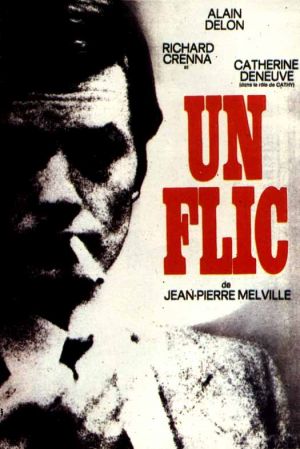
This festival of 39 prime examples opens with the late ex-pat Jules Dassin’s classic heist picture Rififi, which kick-started a whole new cycle of French Noir, and includes both classics and rarities by such masters of the genre as Jean-Pierre Melville (Bob le flambeur, Le Cercle rouge, Un flic), Jacques Becker (Touchez pas au grisbi), Henri-Georges Clouzot (Diabolique, Wages of Fear), Georges Franju (Eyes Without a Face), René Clément (Purple Noon), Louis Malle (Elevator to the Gallows), Claude Chabrol (La Cérémonie), and François Truffaut’s Mississippi Mermaid, The Bride Wore Black). Among the many stars showcased are the five great hommes durs (tough guys) of the genre — Jean Gabin, Lino Ventura, Yves Montand, Jean-Paul Belmondo, and Alain Delon — and such femmes fatales as Simone Signoret, Jeanne Moreau, Catherine Deneuve, and Brigitte Bardot. The festival concludes with a one-week run of Truffaut’s Shoot the Piano Player.

Noir Directors: Edward Dmytryk

Mirage (1965)Mirage (1965)

From an article, Film noir goes to war, in the TLS by Philip French:

Edward Dmytryk, Canadian son of Ukrainian immigrants, worked his way up in the cinema business from studio messenger boy to make Farewell My Lovely [aka Murder, My Sweet (1944)] . He followed this with two other crucial noir pictures, Cornered (1945), about war crimes and neo-Nazism, and Crossfire (1947), centring on returning veterans and post-war anti-Semitism. He was one of the Hollywood Ten, left-wing filmmakers jailed for refusing to cooperate with the House Un-American Activities Committee (HUAC). Unlike the others, he emerged from prison to reappear before HUAC, name former Communist associates and go back to work, making large-scale anti-Communist and conformist potboilers. But in 1965 he directed Mirage, an undervalued noir thriller, shot in black-and-white, turning on one of the genre’s favourite themes, amnesia, and indicting the military-industrial establishment which Dwight D. Eisenhower had warned against in one of his final speeches as President. It helped open the way for a new kind of political cinema that was to include such post-Watergate movies as The Parallax View and Three Days of the Condor.

Marlowe on Blondes

From Raymond Chandler’s novel The Long Goodbye (1953):

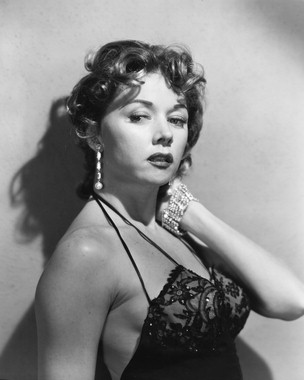
Gloria Grahame

There are blondes and blondes and it is almost a joke word nowadays. All blondes have their points except perhaps the metallic ones who are as blond as a Zulu under the bleach and as to disposition as soft as a sidewalk. There is the small cute blonde who cheeps and twitters, and the big statuesque blonde who straight-arms you with an ice-blue glare. There is a blonde who gives you the up-from-under look and smells lovely and shimmers and hangs on your arm and is always very very tired when you take her home. She makes that helpless gesture and has that god-damned headache and you would like to slug her except that you are glad you found out about the headache before you invested too much time and money and hope in her. Because the headache will always be there, a weapon that never wears out and is as deadly as the bravo’s rapier or Lucrezia’s poison vial.

There is the soft and willing and alcoholic blonde who doesn’t care what she wears as long as it is mink or where she goes as long as it is the Starlight Roof and there is plenty of dry champagne. There is the small perky blonde who is a little pal and wants to pay her own way and is full of sunshine and common sense and knows judo from the ground up and can toss a truck driver over her shoulder without missing more than one sentence out of the editorial in the Saturday Review. There is the pale, pale blonde with anemia of some non-fatal but incurable type. She is very languid and very shadowy and she speaks softly out of nowhere and you can’t lay a finger on her because in the first place you don’t want to and in the second place she is reading The Waste Land or Dante in the original or Kafka or Kierkegaard or studying Provencal. She adores music and when the New York Philharmonic is playing Hindemith she can tell you which one of the six bass viols came in a quarter of a beat too late. I hear Toscanini can also. That makes two of them.

And lastly there is the gorgeous show piece who will outlast three kingpin racketeers and then marry a couple of millionaires at a million a head and end up with a pale rose villa at Cap Antibes, an Alfa-Romeo town car complete with pilot and co-pilot, and a stable of shopworn aristocrats, all of whom she will treat with the affectionate absentmindedness of an elderly duke saying goodnight to his butler.

The dream across the way was none of these, not even of that kind of world. She was unclassifiable, as remote and clear as mountain water, as elusive as its color.

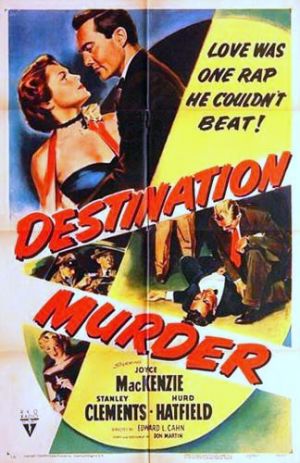
Destination Murder (1950): The Alter-Ego and the Pianola

Desination Murder (1950)Young woman helps cops find her father’s killer

A poverty row b-thriller from a competent RKO production team. A scheming blonde, a suave villain, and an amateur female sleuth are packaged into 70 minutes of satisfying entertainment, with just a hint of sexual ambiguity and a novel twist with a reversal of roles between ego and alter-ego.  Two smooth jazz interludes from Steve Gibson’s Redcaps in the Vogue night-club, and a great denoument scene at the end involving a pianola are highlights.