
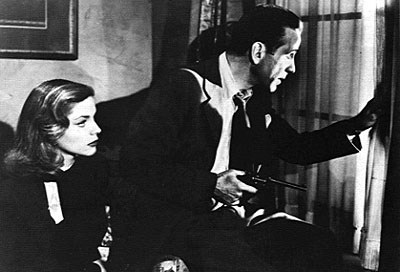
I recommend these recent reviews of films noir for their originality:
Precious Bodily Fluids Blog:
The Big Sleep
“The movie had everything going for it. But when one watches it, one finds that it is exceedingly difficult to read. The camera work is anything but polished. Cuts exist where they shouldn’t, and directional shots are at times awkward and superfluous. Hawks did not shoot the film as one expects film noir stuff to be shot. There are certainly the token shadows and curling smoke, not to mention some low shots and close-ups. But that Expressionistic element borrowed from German cinema in the previous decades is near-absent. While there are shadows, characters are not generally dwarfed by them. The contrast is rather minimal – this is less a “black-and-white” film than a “gray” film.”Chinatown
“Polanski photographed the film largely in POV shots. The number of over-the-shoulder perspectives we get (almost all over Nicholson’s shoulder) becomes nearly claustrophobic. This sort of effect connects ChinatownThe Big Sleep or Huston’s The Maltese Falcon. with the old detective noirs, such as Hawks’ The Big Sleep or Huston’s The Maltese Falcon.”Gilda
“From the film’s earliest scenes, one of the main characters is Bannin’s walking stick, which doubles as a protruding blade at Bannin’s pressing of a button. That the stick/blade is phallic goes without saying: it wields Bannin’s power, it extends, and its blade signifies castration of the other. Bannin calls it his ‘friend’, and proclaims, ‘It speaks when I wish it to speak, it is silent when I wish it to be silent.’ Johnny quickly identifies himself with the stick/blade: ‘You have no idea how faithful and obedient I can be.'”Mildred Pierce
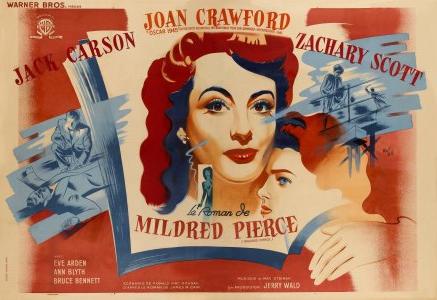
“It turns out that this film was released in 1945 just as the troops were returning home from the war. It also turns out that the film overtly attempted to reinstate masculine authority after a period of women running many of the businesses in the country.”
The Dancing Image Blog:
Force of Evil
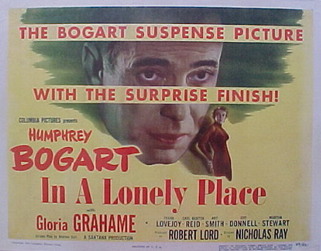
“Because at the end of the film, the greatest force of evil is not any one individual but the whole rotten system. Sure, it’s a racket; sure it’s a criminal enterprise. But writer/director Abraham Polonsky goes out of his way to establish the Combine as not so different from major banks and corporations – characters continually repeat, ‘it’s business!’ when confronted with the charge of gangsterism.”In a Lonely Place
“The movie opens with a rearview mirror reflection of Dixon Steele’s wounded eyes, held in relief against the almost abstract high beams and street lights of a Hollywood boulevard. Hollywood is that lonely place – as is any place were sensitive souls gather to use and abuse one another.”Kiss of Death
“Kiss of Death was shot entirely on location in New York. And indeed this is no idle boast; the movie is deeply enriched by the lived-in sense its, well, lived-in locations provide. The oppressive claustrophobia of an elevator as a desperate criminal tries to escape from a robbery in a busy building. The steep, narrow, and crowded architecture of Nettie’s (Coleen Gray) apartment as she welcomes Nick Bianco (Victor Mature) home from prison.”






 FilmsNoir.Net - all about film noir