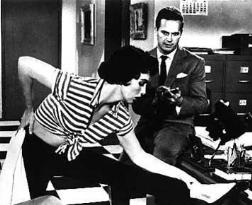
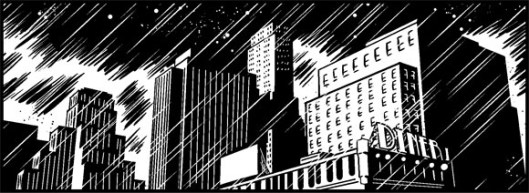
Femme Noir No. 25

noir night

Asleep beside me. Her breathing soft as moonlight. She smelled of almonds.

The celestial camera zoomed out and took in the squalid room. The neon sign outside flickered stripes across our bodies. The smoke from my cigarette coiled upwards and was lost in the gloom of the dark ceiling. She stirred and whimpered words from a lost subterranean nightmare.

I stroked her hair soft and fair. She sighed and opened black wide eyes. She smiled an angel’s smile and took my cigarette. She inhaled deeply and blew the smoke through her exquisite nostrils, licked a flake off her redolent lips, and raising herself onto her elbow, peered at me with a tender fear. Throwing her long hair back, the habitual anger resurfaced. She returned the cigarette and sat up on the side of the bed.

She got up, found her clothes, and started to dress. I feigned the usual indifference and hid my pain. She moved into and out of the light, a specter already gone. Not looking at each other, we each nursed the scars of other celestial nights of empty dreams and furtive longing. Intimate strangers. Seeking refuge in lonely dives. A shot at forgetting and a chance of bliss.

She opened the door, hesitated, almost gave me a glance, shut the door softly a reproach, and was gone.

I walked to the window and watched her walk across the wet road into a death-like fog holding her arms to her body.  She didn’t look back.

Noir City Blues

Noir City - New York - Young Man with a Horn (1950)

The dark night of forsaken city streets, vistas of  blissful angst and unholy pilgrimage.  I have been there and known their inhabitants: deadly dames, drunken losers, dangerous hoods, crooked cops, dreamers of broken dreams, and flawed heroes.

LA, Frisco, Chicago, and New York. I know these cinematic cities though I have never been.  A resident knows his locale, but the city in its ectoplasmic center is not reached corporeally, only in the phantasmagoria of a thousand and one shards of shattered night. Luminescent environs of a cosmic b-movie.  Wet asphalt, fog-laden piers, deserted streets, rusting hulks at anchor, the neon glimmer of purgatory dives, cigarettes and booze, dark tenements, the skid of car tires, and the wailing sirens of the dead.  Staccato rhythms and aching horns, crowded pavements and desperate loneliness.

One more fix, the last heist.  Treachery, misplaced loyalty, and courageous infamy. The denizens of a nether world trafficking in sordid magic and lurid hopes.

A kiss before dying, the desperate lurch before oblivion, and the erotic click-clack of stilettos on pavement. Dank stairwells and silent corridors. Closed doors and hidden secrets.  You break in and fall into a bottomless pool of black. Cut to a bare light-bulb burning on a current wired from hell.  Lying on a steel-framed bed you stare through the bars of perdition at yourself a wraith in a cracked mirror on the ceiling.

Allotment Wives (1945): The main squeeze is a dame!

Allotment Wives (1945)

A title that conjures up sordid images doesn’t disappoint.  A b-programmer from Monogram co-produced by and starring the sublime Kay Fancis as a crime-boss in one of her last roles, Allotment Wives is really a late gangster flick.   The organisers of the San Francisco’s Roxie Theatre coming noir series,  I WAKE UP DREAMING: The Haunted World of the B Film Noir,  have stretched the envelope by including this feature. Though others no doubt will pull out the tired arguments: the emasculating femme-noir threatening male dominance during the War, and the eroticisation of violence.

Allotment Wives (1945)
“Nice shooting…”

The story of a woman who uses her social status and ill-gotten wealth to front a bigamy racket where dames marry multiple GIs during WW2 to skim the allotment support paid by the Defense Dept to spouses of men on active duty, is predictable but well-made with a snappy script. Noir regular Paul Kelly as an army investigator is disappointingly wooden and his performance is underwhelming at best. Otto Kruger is fine as the lady boss’ right-hand man.  The climax is brutal with Francis plugging a dame without qualm or remorse, but justice triumphs in the end.  Francis’ flamboyant hats and her hair-do add a juicy camp quality to the goings-on.

Nightfall (1957): Final curtain call for classic noir

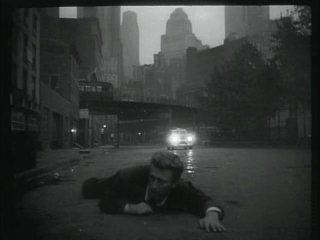
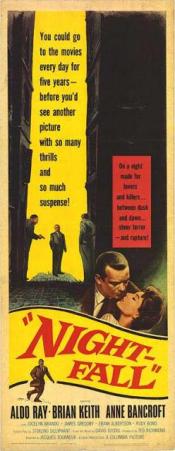
Nightfall (1957)

Jacques Tourneur’s Nightfall signals the coming end of the classic noir cycle, followed only by Murder By Contract and Touch of Evil in 1958, and Odds Against Tomorrow in 1959.

Despite Tourneur’s directorial elan, excellent noir photography from Burnett Guffey, and a script based on a David Goodis novel, the movie clearly attests to the decline of the film noir cycle. The story of the innocent man entrapped by fate and on the run from both the cops and hoods has been played out many times before, and Tourneur does not manage to invest the scenario with any real tension. Even at 78 minutes the screenplay takes too long to reach its rather pat resolution.

Nightfall (1957)

Aldo Ray and Ann Bancroft in the leads are well cast, and the development of their relationship from a pick-up at a bar in LA and its flowering in the snow-drifts of Wyoming, is handled with economy and flair. The dialog is intelligent and the inter-play between two mis-matched hoods and their prey is strikingly good. The violence whether threatened or real is particularly noir.  The two merciless hoods threaten to snap the legs of the protagonist on the boom of an oil rig, and the pitiless gunning down of a victim is still shocking to a jaded noir sensibility. But a climactic fight in the snow against an out-of-control snow plough is bereft of any true suspense, and even the final gruesome aftermath lacks real impact.

A Lighter Shade of Noir: Matinee Double-Bill

A Woman's Secret (1949) Hollywood Story (1951)

A Woman’s Secret (1949) and Hollywood story (1951), two flicks that carry a film noir classification on IMDB which I watched in the past week, I found  to be hardly noir at all.

A Woman's Secret (1949)

A Woman’s Secret, an RKO-feature, has great credentials. The movie is directed by Nicholas Ray from a screenplay from Herman J. Mankiewicz, with photography from George Diskant, and starring Maureen O’Hara, Melvyn Douglas, and Gloria Grahame.  It starts off noir with a shooting off-screen, and the use of flashback in the narrative, but plays out as sophisticated melodrama with a biting wit, and some really funny slapstick when the wife of the investigating cop does her own snooping with a handbag carrying fingerprint powder and a giant magnifying glass. The story of the conflict between a naive young singer (Grahame) and her controlling mentor (O’Hara), has shades of All About Eve but this motif is not taken too seriously.  The two female leads are charming, with Grahame displaying an engaging gift for comedy.  Melvyn Douglas is as debonair as you would expect and takes the role of narrator and referee.  Great fun.

Hollywood Story (1951)

Hollywood Story is a programmer from Universal that has a 50s television feel.  Richard Conte is a producer in LA that wants to make a movie about the murder of a big silent movie director 20 odd years before, and his delving into the past has violent consequences.  A  strictly b-effort that plays well as a whodunit with noir atmospherics, and some really funny lines.

Kiss Me Deadly’s Maxine Cooper Dead at 84

Kiss Me Deadly

Maxine Cooper, the actress who played the off-beat secretary to Ralph Meeker’s Mike Hammer in Robert Aldrich’s cult noir, Kiss Me Deadly (1955), died aged 84 on April 4.

More from the LA Times.

Femmes Noir #3: Faith Domergue

Faith Domergue

Blues in the Night (1941)
Where Danger Lives (1950)
Vendetta (1950)
Soho Incident (1956)  aka Spin a Dark Web (USA)
Man in the Shadow (1957) aka Violent Stranger (USA)

An on-going feature in no particular order…

Huzzah!! NOIR: An exciting new graphic novel project

Huzzah!! NOIR
©2009 I.N.J. Culbard. Used with Permission.

A group of nine very talented graphic artists/writers have launched an exciting new blog project titled Huzzah!! NOIR.

Each contributor in turn will be contributing a page that develops the story of a washed-up 40s boxer searching for a dame in a dark noir metropolis. Shades of Murder, My Sweet?

So far four pages are up with stunning noir graphics and a promising pulp noir story-line.

Christ in Concrete (1949): Simply a masterpiece

Christ in Concrete (1949)

The moving simplicity of the Pietro Di Donato novel, Christ in Concrete, has been brought to the screen with rare sincerity. It is two hours of genuine human drama, which makes no concession to convention.

– Variety (1949)

The camerawork by C. Pennington Richards is some of the best of the era, with the city streets, darkened hallways, and construction sites void of any softened corners guaranteed by Hollywood of the 1940s. With Dmytryk, Richards gave Christ in Concrete an astonishing look, which manages to straddle and suggest both film noir and Italian neo-realism. The deep focus crisp black-and-white photography evokes a handful of strong movies yet to be made, including On the Waterfront, Edge of the City, America, America, Sweet Smell of Success, Touch of Evil, and Pickup on South Street. Visually, Christ in Concrete looks like the most influential movie nobody ever saw… Christ in Concrete shares its rough-edged moral outrage with Visconti’s La Terra Trema but its gilded professionalism with Wilder’s Double Indemnity. It’s a knockout combination. Dmytryk found some kind of artistic voice in exile in England unlike any heard from him before or since.

– Matthew Kennedy, Bright Lights Film Journal (Nov 2003)

Based on the novel by Italo-American Pietro Di Donato, Christ in Concrete (aka Give Us This Day), a powerful leftist denunciation of capitalism from director Edward Dmytryk, had to be filmed in the UK, and was buried a few days after its US release by a reactionary backlash. Telling the story of Italian immigrant building workers and their families in Brooklyn during the Depression, the film is the closest an Anglo-American movie ever got to the aesthetic and socialist outlook of Italian neo-realism. Teeming tenements and residential streets are shot with a provocatively gritty realism and film noir atmospherics.
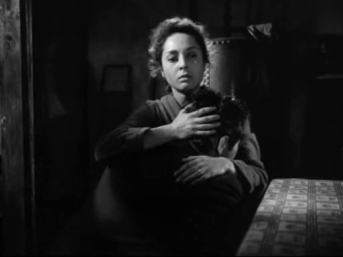
Christ in Concrete (1949)

The cast is superb with particularly powerful performances from the two leads, Sam Wanamaker and Lea Padovani, who embody the immigrant experience, which is so imbued with vitality and compassion that the film soars above any other similar work of the period. Enriched by a poetic script, the innovative cinematography of C.M. Pennington-Richards, outstanding art direction from Alex Vetchinsky, and a brilliantly evocative score by Benjamin Frankel, the movie is a revelation.

The opening scene in a deprived urban locale that follows a drunken man from the street and up the stairs of a dirty tenement building is a tour-de-force. An inspired mise-en-scene and a moving camera that follows the action from below Ozu-style, framed by the drama of the musical motifs, had me enthralled. This scene and the rest of the movie, except for panaromic shots of New York shown in the opening credits, were filmed in a studio lot in Denham, England!

Christ in Concrete (1949)

Film as art, Christ in Concrete is simply a masterpiece.

Double Jeopardy (1955): Pulp Heaven

Double Jeopardy (1955)

A 70 min b-feature  from Republic Pictures, Double Jeopardy,  is an unpretentious thriller, only tangentially noir, and  with a high sleaze factor. The good guys are wooden and boring, and the bad guys irredeemably bad. A boozy blackmailer and his cheap wife are the focus and carry the picture. Pulp heaven.

Double Jeopardy (1955)