A Shooting Star: The Noir Dialectic

Seen a shooting star tonight
And I thought of you
You were trying to break into another world
A world I never knew
I always kind of wondered
If you ever made it through
Seen a shooting star tonight
And I thought of you

Seen a shooting star tonight
And I thought of me
If I was still the same
If I ever became what you wanted me to be
Did I miss the mark or overstep the line
That only you could see?
Seen a shooting star tonight
And I thought of me

Listen to the engine, listen to the bell
As the last fire truck from hell
Goes rolling by
All good people are praying
It’s the last temptation, the last account
The last time you might hear the sermon on the mount
The last radio is playing

Seen a shooting star tonight
Slip away
Tomorrow will be
Another day
Guess it’s too late to say the things to you
That you needed to hear me say
Seen a shooting star tonight
Slip away

Bob Dylan – Shooting Star (©1989 Special Rider Music)

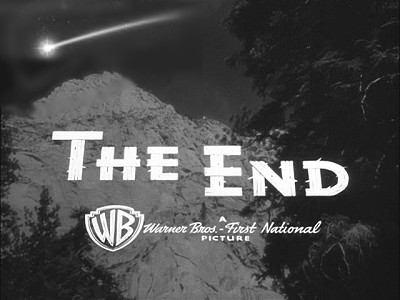
To my mind, if there is a noir dialectic it is Nietzsche vs. Redemption: the death of God vs. the rebirth of God; chaos vs. meaning.  A metaphysical tension between despair and hope. In one of the great noir novels, ‘High Sierra’ by W. R. Burnett, a shooting star is a metaphysical event.  Midway through the novel, the existential anti-hood Roy Earle,  a guy “just rushing toward death”[1], sees a shooting star one night.

They all stood up and stared. They heard people calling to each other in the little settlement beyond the court. A woman screamed shrilly. Low in the sky and moving slowly eastward, parallel with the earth, was a huge flaming ball of green and white fire…

“Look how slow it’s moving and how bright it is,” said Velma. “Do you suppose it will hit the earth?” She was standing close to Roy. He reached down and took her hand. Her fingers clung. “Oh, but it’s scary.”

“Now, don’t you worry, honey,” said Pa, his voice trembling slightly. “It will go right on past.” Then, with a laugh, he added: “I hope.”

Roy laughed, too, but he didn’t feel like laughing. His old sense of insecurity returned. This might be the end of the world. Barmy said that stars and planets sometimes smashed into each other and busted all to hell. Just a puff of smoke and you’d be gone! He held Velma’s hand tightly.

“Look,” said Pa, “she’s spluttering. Don’t I hear a noise?”

They all stood listening, straining their ears. There was a roaring hiss, then the meteor flared up and went out. They all waited for it to hit, but nothing happened. In a moment the meteor appeared again far to the east, very low on the horizon and moving much faster, vanishing finally behind a high point in the desert floor.

Velma took her hand away and laughed.

But Roy’s rush towards death is unchecked, and at the end Roy is shot dead by a cop’s bullet.

Finally he was at the summit. He sat down and put his back against a big rock. He waited for a long time with his machinegun held in front of him, but nothing happened. He relaxed and lit a cigarette.

“My God, what a place!” Roy muttered. He bent over to look, but jerked back suddenly as a wave of dizziness swept over him. A thousand feet below he had seen Sutler’s Lake, like a silver dollar embedded in green velvet. “Baby, am I up there!”

He heard a strange flapping sound and looked up. A huge bird was flying over him, headed toward the abyss—an eagle!

“Brother,” said Roy, watching the eagle’s lazy effortless flight over the terrible chasm, “I wish I had wings!”…

Time passed. The sun began to get low in the sky and the giant peaks turned golden, then red. The big eagle flew lazily back across the chasm, sailed over Roy’s head, then disappeared above him up among the rocks.

Suddenly a voice shouted: “Earle! Come down. This’s your last chance.”

“Nuts to you, copper,” said Roy, leaning forward.

There was a short silence, then far off to Roy’s right a rifle cracked.

At first he sat without moving. The gun didn’t even fall out of his hands. The rifle cracked again and the echoes rolled off sharply, bouncing from rock to rock. Roy stood up, threw the machine-gun away from him, mumbled inarticulately, then fell forward on his face…

… It was all over now. He was falling down that black abyss. Suddenly a huge green and white ball of fire swept across in front of him and a hand reached out and took his hand. But the hand was not little and soft as it had been that other time. It was lean and firm. Marie! The hand checked his fall.


[1] John T. Irwin, Unless the Threat of Death Is Behind Them: Hard-Boiled Fiction and Film Noir (©2006 The Johns Hopkins University Press)  p.116

“The Ape under the Velvet”

The small, tired eyes stared into his coldly.  “I have never seen England.”  The eyes wandered away round the table.  ” When I was last in Rome”,   he said, ” I saw a magnificent parade of the Italian army with guns and armoured cars and aeroplanes.”  He swallowed his raisins.  ” The aeroplanes were a great sight and made one think of God…  They made one think of God. That is all I know. You feel it in the stomach. A thunderstorm makes one think of God, too. But these aeroplanes were better than a storm. They shook the air like paper.”

Watching the full self-conscious lips enunciating these absurdities, Graham wondered if an English jury, trying the man for murder, would find him insane. Probably not: he killed for money; and the Law did not think that a man who killed for money was insane. And yet he was insane. His was the insanity of the sub-conscious mind running naked, of the ” throw back”, of the mind which could discover the majesty of God in thunder and lightning, the roar of bombing planes, or the firing of a five-hundred-pound shell; the awe-inspired insanity of the primaeval swamp. Killing, for this man, could be a business. Once, no doubt, he had been surprised that people should be prepared to pay so handsomely for the doing of something they could do so easily for themselves. But, of course, he would have ended by concluding, with other successful business men, that he was cleverer than his fellows. His mental approach to the business of killing would be that of the lavatory attendant to the business of attending to his lavatories or of the stockbroker towards the business of taking his commission: purely practical.

– Eric Ambler, Journey into Fear (Hodder & Stoughton Ltd., London, 1940)

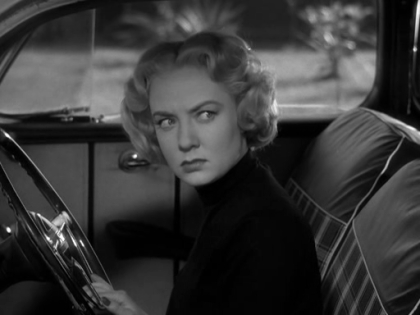
Tension (1950): A house in the suburbs? “Are you kidding?”

A reversal of sex roles so potent it has to rank as one of the best expositions in noir of the femme-noir as ball-breaker…

A neat little noir from director John Berry, who also had a hand in the script by Allen Rivkin, which was adapted from a story by John Klorer.  Cheap blonde Claire (Audrey Totter) leaves meek and earnest hubby Warren (Richard Basehart) for a Malibu-type with dough.  The boyfriend ends up on ice, with hubby framed for the murder. Sardonic hulk and investigating cop Lt. Bonnabel (Barry Sullivan) plays with Claire to fish out the killer.  There is nice support from William Conrad as Sullivan’s buddy, and Cyd Charisse as a very good girl.

You just have to relish Totter – she is the devil in no disguise.  In an early scene Claire is having a piece of strawberry pie with cream at the counter of a drug store and is eyeing an advert for a mink in a magazine – hubby the night druggist at the other end of the store is slaving over mortar & pestle to keep her in a style of life she doesn’t desire – when she is picked up.  Even a b-girl would have held out a bit – the exchange is pure sleaze:

Stunning, isn’t it?

On her.
It’d look better on you.
Think so, huh?
Yeah.
Thanks, that’s nice.
And I got something nice to talk about.
So?
Yeah. Wanna hear more?
Where you parked?
Around the corner. Gray sedan.

In Silver & Ward’s ‘Film Noir: An Encyclopedic Reference’ (1992), Claire is described as a “classic femme fatale, a woman who drives men to the brink of disaster merely on a whim”.  I dispute the contention that Claire is a femme-fatale.  Sure she is mean and manipulative, and uses sex to get what she wants – “Hey, what’s better than money?” – but she does not use men as surrogates.  She is quite capable of doing whatever needs to be done to achieve her sordid ends on her own.  This said, there is a simply brilliant scene the next morning after Claire’s escapade with the gray sedan, that portrays a reversal of sex roles so potent it has to rank as one of the best expositions in noir of the femme-noir as ball-breaker.

Hubby returns to their apartment in the morning after ending his night shift.  Anxiously hoping against hope he finds Claire asleep in the marital bed – and is fooled into thinking she has spent an innocent night at home.  His mood lifts and he makes her breakfast – the toast is burnt – and tells her he has a surprise.  The next scene cuts to the couple in their car – Warren is driving – as it pulls up to a new bungalow in a raw housing estate [my reconstruction]:

Claire (annoyed): What are you stopping here for?

Warren (happily opening the car door): Look. Isn’t that a beauty?

Claire (combing her hair and staring into the mirror of her compact): Are you kidding?

Warren (abashed but still in good humor): Gee, it would be wonderful to live out here, darling. Fresh air, room to entertain. It’s great for kids.

Claire (petulant): You wanna know something? I think it’s a miserable spot. It’s 30 minutes from nowhere.

Warren (exasperated): I thought this was what you wanted. What do you think I took the night shift for?  Saving and doing without so we’d have enough money to do this.

Claire: We still don’t have enough.

Warren: The FHA even approved the loan.

Claire: Fine. Let them live here.

Warren gets out of the car and walks toward the house singing its praises… “Darling, at least look at it”.  Meanwhile Claire shifts into the driver’s seat, she is wearing a plain dark top and flannel pants.  She starts sounding the car horn loudly, closes the driver’s door, and starts the engine: “You comin?”.

Warren turns back mortified, while Claire revs the engine like a young punk, the exhaust fumes confronting Warren as he walks behind the car before getting into the passenger’s seat.


James Gunn’s ‘Deadlier than the Male’: Psychology of the Femme-Fatale

Helen Brent had the best-looking legs at the inquest. She had a white sharkskin suit that had cost $145. She had an air of impeccable good breeding that had cost a great deal more. From the looks of things, she was no usual divorcee. Obviously, she was a woman of great wealth, of travel, of culture, of charm; she was a gorgeous blonde; she had been around. Perfectly poised, she crossed her legs with stunning and careless showmanship.

Her name was Helen Brent, she said, and she was thirty-one; her home was in San Francisco; she was in Reno to get a divorce from her husband, Mr. Charles Brent.
She had been in Reno—how long?
Six weeks; during that time she had stayed at a boarding house on the edge of town, run by a Mrs. Krantz and her daughter, Miss Rachel Krantz; Miss Rachel Krantz was in the courtroom.
On the previous Thursday, she had left the Krantzes’ and gone to the Hotel Riverside?
Yes.
She had gone back to the Krantzes’ at eleven that night to pick up a handbag?
Yes.
And about what time had she left the Krantzes’ to go to the hotel?
About five.

Deadlier than the Male is the only novel by American writer James Gunn, who wrote the book in 1943 at the age of 23.  The story was adapted by Hollywood for the 1947 film noir Born to Kill.  In his short life – he died at the age of 46 in 1966 – Gunn wrote screenplays for movies and television.  Little is known of his life, and he remains a tantalizing mystery.

The novel was chosen as the 50th book to be published by French publisher Gallimard under the Le Série Noire imprint.  In 1966, the radical French philosopher, Gilles Deleuze, in a tribute on the publishing of the 1,000th title in the series, which was started in 1945 by editor Marcel Duhamel, wrote:

The most beautiful works of La Série Noire are those in which the real finds its proper parody, such that in its turn the parody shows us directions in the real which we would not have found otherwise. These are some of the great works of parody, though in different modes: Chase’s Miss Shumway Waves a Wand; Williams’s The Diamond Bikini; or Hime’s negro novels, which always have extraordinary moments. Parody is a category that goes beyond real and imaginary. And let’s not forget #50: James Gunn’s Deadlier than the Male.

The trend in those days was American: it was said that certain novelists were writing under American pseudonyms. Deadlier than the Male is a marvelous work: the power of falsehood at its height, an old woman pursuing an assassin by smell, a murder attempt in the dunes—what a parody, you would have to read it—or reread it—to believe it. Who is James Gunn anyway? Only a single work in La Série Noire appeared under his name. So now that La Série Noire is celebrating the release of #1000, and is re-releasing many older works, and as a tribute to Marcel Duhamel, I humbly request the re-release of my personal favorite: #50.[1]

In a review in 2008 of the re-issue by Black Mask Publishing, British academic Robin Durie said of the novel:

It’s very hard to imagine the almost hallucinatory events of the novel translating to the big screen in 1947 [in Born to Kill] – although it’s just about possible to imagine John Waters or David Lynch making some headway with it. It’s also possible that Claude Chabrol might have fancied having a go at turning it into a movie, based on his admiration for the book: “It has a freely developed plot and an absolutely extraordinary tone, pushing each scene towards a violent, ironic and macabre paroxysm…an unexpected dimension, a poetic depth…  Of course, nothing like this has ever been written before. The parody is wildly inconsistent, but Deleuze is surely right when he says that, by this means, Gunn creates directions in the real which are wholly new.”  … At the same time, Chabrol is correct in his capturing of the intensity of the rhythm of Gunn’s writing. Each chapter builds – or perhaps better, meanders – towards, or into, extraordinary points of what are, in effect, bifurcations. It is as if the novel is following those bifurcating pathways described by Borges.”[2]

Deadlier than the Male is like no other noir fiction.  The weird story of a deranged con-artist who marries into a wealthy San Francisco family, while told in the third person, reveals the thoughts and motivations of the central character, an attractive 30-something divorcee, Helen Brent.   In film noir-style, the book opens in flash-back as Helen gives testimony at an inquest in Reno into a double murder.  Helen, in Reno to engineer a quick divorce, by chance stumbles on the victims of a double domestic murder.  We know the killer and that, unbeknown to Helen, he was still at the murder scene when she came across the bodies.  Gunn’s story goes on to explore how the lives of these two people become entwined, and how lies upon lies lead to the final denouement where Helen’s true self is revealed to not only the reader but to herself.  As the story plays out there is a virtual  cavalcade of odd-ball characters drawn with keen psychological insight in a series of ongoing scenarios that are woven in an almost surreal  “more or less undifferentiated present” [Durie].

These psychological insights are strongest as we follow Helen’s obsession to find out the ’truth’.  A truth which as she uncovers seeks to hide by lies and intimidation.  Her motivations are never fully fathomed but at the end we know fully what she is capable of.  Helen is sexy, smart, charming, even loving, and constantly battling her better instincts to strive for a physical security which can only be bought by money – and lots of it.  Pitted against her is a lurid drunken widow out to find the killer out of loyalty to one of the victims – her debauched friend and drinking companion who dallied with younger men.   The comic encounters of this ridiculous aging sleuth are nevertheless successful – albeit not without real danger – she just escapes death at the hands of psychopathic hood in the sands dunes of Frisco in a scene as violent and perverse as you would find in a Coen Bros. movie.

… ‘The truth is, Helen, you’re uncivilized still. You’re out of the jungle, or to be more exact, you’ve gone back to it. You have enough intelligence and enough courage to realize you don’t need other people. You’ve decided to live alone with your strength. And that’s where you fall down’…

…Helen’s mind seemed to grow endlessly inside her head. She saw herself standing alone, in an infinity of space and matter. She was quite solitary, and very strong. No one was close to her, no people. She would never be able to have anyone close to her again.

A must read.  Get the re-issued paperback here – also available is the eBook version for 99cents.

Postscript: The obscure French film Corps et biens (1986) from director Benoît Jacquot is also based on Gunn’s novel.


[1] Gilles Deleuze, The Philosophy of Crime Novels
[2] Book review by Robin Durie

The Green Cockatoo (UK 1937 65min): The Seeds of British Noir

Graham Greene, who wrote the source novel and worked on the screenplay of perhaps the greatest British noir, Brighton Rock (1947), scripted the British hard-boiled crime thriller The Green Cockatoo (aka ‘Four Dark Hours’ or ‘Race Gang’).  After the movie was screened at the 43rd New York Film Festival in September 2005, Keith Uhlich of Slant, wrote: “Director William Cameron Menzies, an award-winning production designer, grounds The Green Cockatoo in expressionist shadows that anticipate Carol Reed’s The Third Man (the ne plus ultra of Greene’s cinema output) and the writer himself is evident via the piece’s sense of a veiled, yet inescapable moral outcome with which each character must deal.” Hal Erickson in the All Movie Guide says of the film: “Filmed in 1937, the British Four Dark Hours wasn’t generally released until 1940, and then only after several minutes’ running time had been shaved off. The existing 65-minute version stars John Mills, uncharacteristically cast as a Soho song and dance man. When Mills’ racketeer brother Robert Newton is murdered, Mills takes it upon himself to track down and punish the killers. Rene Ray, the girl who was with Newton when he died, helps Mills in his vengeful task”. Bosley Crowther in the NY Times in 1947: “With all its disintegration, though, [The Green Cockatoo] is still better melodramatic fare than is usually dished out to the patient Rialto audiences… An unknown here, Rene Ray, is very attractive as a wide-eyed country girl unwittingly involved in the Soho proceedings”. Film writer for The Guardian, Andrew Pulver, wrote in 2008 that the movie “has a similar [to film noir] commitment to the boiled-down essentials of the crime genre”.  Max Green, who later lensed Night and the City (1950) for Jules Dassin, is DP and the film’s score was one of the first from Miklós Rózsa.

I found The Green Cockatoo an entertaining ‘curio’ (to paraphrase Pulver).  While there are elements that point to noir, the picture is more a melodramatic thriller.  A Soho seediness to the affair is enhanced by the very cheapness of the production.  Most of the action plays out during a London night after a young provincial ingenue arrives on a midnight train from the sticks and has a chance encounter.  The darkened sets have a definite moodiness.  A night scene introducing the Soho night-club, ‘The Green Cockatoo’, around which the action pivots,  has an accomplished mis-en-scene.  We see a couple stroll past a copper on the beat who walks up to a b-girl holding up a lamp-post in front of the club – the bobby stares the girl down and she moves on.

There is a lot of action packed into just over an hour, but the plot relies on  a touch too many contrivances and misunderstandings.  There is a nice chemistry between Mills and Ray, who is quite beguiling, with some nice patter and cute innuendo.  A number of scenes are played for laughs, which adds a pastiche quality.  Indeed, scenes at a plush hideout with a butler, played beautifully by Frank Atkinson, are laugh-out-loud funny.  This said, the pastiche factor detracts overall, and it is jarring to hear English characters using very unlikely expressions such as ‘guys’ and ‘dames’.  Though the Hollywood influence is obvious, there are no guns, only flick-knives.

Max Green’s lensing is most deserving of praise, and these shots from the picture attest to its expressionist elements:

An interesting historical artifact, and worth seeking out.  Not on DVD.

Summary Noir Reviews: Between Wall Street and a High Wall

Side Street (1950)
Young postal-worker with no prospects and a pregnant wife makes the mistake of stealing from a crooked lawyer.  A tight and savvy noir from Anthony Mann and DP Joseph Ruttenberg explores the claustrophobic canyons of New York and ends with an ironically appropriate ‘crash’ on Wall Street.  While the noir atmospherics are there, Sydney Boehm’s screenplay lacks tension, and the leads, Farley Granger and Cathy O’Donnell, fresh from Nicholas Ray’s They Live By Night (1949), fail to impress.  Bravura camera-work and editing in the climactic car chase make the ending exciting, and the signature Mann violence is particularly callous.  James Craig as a savage hood is arresting.


Mystery Street (1950)
An innocent everyman takes flight after he is implicated in the brutal murder of a b-girl.  A noirish police procedural set in Boston is ok only with disappointing work from DP John Alton.  John Sturges directed.  The inimitable Elsa Lanchester is great as a conniving landlady, and Jan Sterling is nicely camp as the b-girl, but she is knocked-off early.  Bruce Bennett as a Harvard forensic scientist is even more wooden than when he played Mildred Pierce’s boring husband!  Rocardo Montalban as the investigating cop is charming but without depth.  The denouement is flat as stale beer.

highwill1946_18h56m57s244

High Wall (1946)
A war vet with a brain tumor that causes blackouts and amnesia is charged with his wife’s murder.  A film noir where cars are integral to the story and to the noir aesthetics: fast cars screeching to nowhere, dark streets, rain on asphalt, roadblocks, escape, entrapment… ‘crashing out’.  Directer Curtis Bernhardt and his DP Paul Vogel in the many scenes with cars in this picture have fashioned indelibly mystic images of the noir car.  An inverted mis-en-scene that contrasts the order and brightness of a mental hospital with the dark and menace of city streets and apartments at night, delivers an interesting dynamic, but the grittiness factor is almost absent.  Leads Robert Taylor and Audrey Totter are not up to standard, but Herbert Marshall as the bad guy is palpably rotten.

Noir Poets: Bruce Springsteen

Atlantic City

Well, they blew up the chicken man in Philly last night
Now, they blew up his house, too
Down on the boardwalk they’re gettin’ ready for a fight
Gonna see what them racket boys can do

Now, there’s trouble bustin’ in from outta state
And the DA can’t get no relief
Gonna be a rumble out on the promenade
And the gamblin’ commissioner’s hangin’ on by the skin of his teeth

Well now, everything dies, baby, that’s a fact
But maybe everything that dies someday comes back
Put your makeup on, fix your hair up pretty
And meet me tonight in Atlantic City

Well, I got a job and tried to put my money away
But I got debts that no honest man can pay
So I drew what I had from the Central Trust
And I bought us two tickets on that coast city bus

Now, baby, everything dies, honey, that’s a fact…

Now our luck may have died and our love may be cold
But with you forever I’ll stay
Were goin’ out where the sands turnin’ to gold
Put on your stockin’s baby, `cause the night’s getting cold
And maybe everything dies, baby, that’s a fact
But maybe everything that dies someday comes back

Now, I been lookin’ for a job, but it’s hard to find
Down here it’s just winners and losers and don’t
Get caught on the wrong side of that line
Well, I’m tired of comin’ out on the losin’ end
So, honey, last night I met this guy and I’m gonna
Do a little favor for him

Well, I guess everything dies, baby, that’s a fact…

– Bruce Springsteen (1982)

The Car in Noir: High Wall (1946)

The car in the film noir is a complex symbol expressing the various kinds of escape its protagonists attempt. It is also a tool of death… But as a symbol of the modern urban landscape, the car comes to mean much more: it functions as the symbol of all that has brought America to this ambiguous state of spiritual anxiety. Taunting us as the apex of industrial achievement with its commercial appeal and status, the car in the film noir has been transformed into an object of dubious distinction, like a desperado of sorts, an accomplice. Whether noir characters use it to escape their pursuers (legal or criminal) or their past, the automobile symbolizes that dangerous flight into the unknown that contrasts with its other importance as a symbol of established success in modern American culture. Desperate people steal perfectly reputable vehicles, transforming them into getaway cars, and in the act they sully the very status of material success that these object represent… In its transformation into an escape device, the car carries out one of the narrative goals of noir cinema: to bring the illusion of freedom for its characters up to its dead end—right up to the place from which they can no longer escape, and where they usually die.

– Andrew Dickos, STREET WITH NO NAME: A History of the Classic American Film Noir (The University Press of Kentucky, 2002), pp 176-177

High Wall (MGM 1946) is a film noir where cars are integral to the story and to the noir aesthetics: fast cars screeching to nowhere, dark streets, rain on asphalt, roadblocks, escape, entrapment… ‘crashing out’. Directer Curtis Bernhardt and his DP Paul Vogel in the many scenes with cars in this picture have fashioned indelibly mystic images of the noir car, as these selected frames from the movie attest:

High Wall

High Wall

High Wall

High Wall

High Wall

High Wall


Deadline at Dawn (1946): Screwball noir

An Adrian Scott production for RKO, Deadline at Dawn (1946) is a  great ‘screwball’ noir that is a must-see.  A young Susan Hayward is as cute as a button in the lead role of a taxi-dancer who falls for a sailor mixed up in the murder of a b-girl.  The screenplay by Clifford Odets is based on a Cornell Woolrich story, and is as dark as any noir and as left as a Hollywood movie could go at the time.  At the end, a guy who has murdered a female blackmailer and general no-good dame, as the cops lead him away, laments “Imagine, at my age, to have to learn to play a harp”.  Think about it. Subversive yes! It is the only feature directed by Broadway director Harold Clurman, who was moon-lighting in Hollywood at the time, after the break-up of the Group Theater in NY.  DP Nick Musuraca’s chiaroscuro lensing completes the picture.  As Trevor Johnston says in his review for the Time out Film Guide, “it’s made with cockeyed artistry from beginning to end, and shouldn’t be missed”.

The action takes place in a single night in New York, with a signature Woolrich race against time. Much of Odets’s dialogue owes little to Woolrich and is an entertaining mash-up of clever puns that is in the tradition of the romantic screwball comedies of the period. A cavalcade of character actors portrays an ensemble of zany denizens of the New York night; taxi-dancers, b-girls, gangsters, blackmailers, besotted drunks, and cabbies.  But there is a serious underside: the greed, corruption, and passions of the noir city, where a murder seems the only way-out, and where trusting a stranger is seen as foolish even if the guy is in a jam.

There is a lot of left philosophising, as you would expect from an activist team of film-makers.  Academic’s have taken issue with this alleged hijacking of Woolrich’s story.  Mayer and McDonnell in Encyclopedia of Film Noir (2007) complain that “Unfortunately, the  film’s script tries to inject overt social meaning, and Woolrich’s clever plot is pushed aside by Odets’s pretentious dialogue”, and Robert Porfiro in Silver’s and Ward’s Film Noir: A Encyclopedic Reference (1992) concludes “Odet’s patronizing concern for the common people, and even worse, his pseudo-poetic, elliptical dialogue are out of place in the lower-class locales  of the film”.

Porfirio’s political prejudices aside, these haughty criticisms of Odet’s dialogue don’t align with my feelings. Odet’s dialogue is clever and rings true for every character.  The sailor is a small-town boy with solid values and his simple home-spun philosophy of honesty and fairness is totally believable.  Hayward’s taxi-dancer is also from a small town and the necessary cynicism she has acquired in the dark city is genuine – a matter of survival – but she retains her formative values and acts on them despite her city ways.  She is attracted to the young ‘hick’ sailor because he unlike most guys in the big city does not have an angle: what you see is what you get.  Here Odet’s focus is the fundamental noir motif of city vs. country, corruption and immorality vs. sincerity and decency.

A taxi-driver who helps the couple, Gus Hoffman, is played with assurance by Paul Lukas. Gus, an immigrant with a strong accent, is the film’s philosopher and the target of Porfiro’s attack.  He is a man who has seen injustice and suffering, and his words are world-weary and wise.  Such men exist and I have known many: working people educated in the school of life.

You make your own judgment.  This is a conversation between Gus and the Susan Hayward character, June, before they are interrupted by a cop on the beat:

Life in this crazy city unnerves me too,
but I pretend it doesn’t.
Where’s the logic to it?
Where’s the logic?

The storm clouds have passed us.
Over Jersey now.
Statistics tell us we’ll see the stars again.

Golly, the misery that walks around
in this pretty, quiet night.

June.
The logic you’re looking for…
…the logic is that there is no logic.
The horror and terror you feel, my dear,
comes from being alive.
Die and there is no trouble,
live and you struggle.
At your age, I think it’s beautiful
to struggle for the human possibilities…
…not to say I hate the sun
because it don’t light my cigarette.
You’re so young, June, you’re a baby.
Love’s waiting outside
any door you open.
Some people say,
“Love is a superstition.”
Dismiss those people,
those Miss Bartellis, from your mind.
They put poison-bottle labels
on the sweetest facts of life.
You are 23, June.
Believe in love and its possibilities
the way I do at 53.

What’s wrong here?
This man bothering you?

He’s the only man in four years
in New York who hasn’t?

Noir Poets: Ira Wolfert

All the things a man has to go through to get to live here, thought Leo, the things, the things, thousands and millions and millions of dirty things to hurt people and hurt himself.  The street seemed drowned in stone. It looked narrow and drowned, a thing emptied of life and walled with swollen, stone bones. The feeling of costly desolation was heavy in Leo. This costly desolation was splendor, but Leo did not think of it as splendid. Yet he tried to be faithful to the rich. He tried to think of the costly desolation as good for sleep. Only the rich could afford to buy quiet like this in the heart of the city, he told himself. He felt suddenly that only a man who had made himself rich could become barren enough to want and be comfortable in this desolation.

–  Ira Wolfert, ‘Tucker’s People’ (aka ‘The Underworld’), NY, 1943, p. 71

Abraham Polonsky’s and Ira Wolfert’s screenplay for Force of Evil (1948) was based on Wolfert’s novel.