Film Noir: TIME Magazine Beat the French by 15 Years!

It is not so much Mamoulian’s inventive camera angles and breakthrough use of voice-over in a Hollywood talkie, or the consummate chiaroscuro lensing by DP Lee Garmes…

Rouben Mamoulian’s classic 1931 expressionist gangster flick from 1931 City Streets was based on a treatment by Dashiell Hammett.

It is not so much Mamoulian’s inventive camera angles and breakthrough use of voice-over in a Hollywood talkie, or the consummate chiaroscuro lensing by DP Lee Garmes, or the hard-boiled patter from scenarist Oliver H.P. Garrett, that distinguish the movie as an early noir, but Hammett’s off-beat story and characterizations.

Fernando F. Croce in his expressive (undated) capsule review at cinepassion.org  nicely renders the film’s mood: “From beer to ocean, from metropolis to nature on a speeding buggy, that’s the surrealism at play here, Dashiell Hammett’s. Trucks as they roar over the camera and the tinkling of bottles at the distillery figure in the opening city symphony, promptly added is the pugnacious refrain (“No hard feelings?”) which, followed by a handshake, becomes the kiss of death. Gangland baby (Sylvia Sidney) and naïve cowpoke (Gary Cooper) at the fairgrounds, sharpshooters in love navigating through symbols (crashing waves, caged and stuffed birds, porcelain cats). Taught to keep mum, she’s caught getting rid of the gun after dad (Guy Kibbee) bumps off a fellow hoodlum (the police station reappears in Le Doulos) and ends up behind bars; inside, Sidney vows to leave the racket while outside Cooper embraces bootlegging for The Big Fellow (Paul Lukas). “The Law don’t look so good when it works both ways, uh?” Rouben Mamoulian’s take on American crime is a European one akin to Sternberg’s, tough and dreamlike: An underworld party is literally punctured with some nasty business involving a fork (a band playing “Happy Days Are Here Again” swiftly covers it up), yet the idea of an unfolding murder measured in the ash of a cigar might be out of Cocteau’s Le Sang d’un Poète. The high-angled view of the checkered-floor mansion gives it a de Hooch perspective, the low-angled view of prison walls and windows slants them toward Brutalist architecture. The heroine’s inner monologue in the cell is an elaboration of Hitchcock (Murder!), who in turn elaborated Mamoulian’s overlapping close-ups of Cooper and Sidney (dolly-in, dissolve, dolly-out) for The Wrong Man’s crucial revelation. Quite the wry gangster sonata, with a vengeful moll (Wynne Gibson) and a car chase on the edge of the abyss setting the stage for Dr. Jekyll and Mr. Hyde.”  [The  1931 version of Dr. Jekyll and Mr. Hyde was Mamoulian’s next picture.]

Both The New York Times and Variety in 1931 gave the movie a strong endorsement, but it was an unnamed staff writer in a review in the April 27, 1931 issue of  TIME Magazine that had the prescience to see the makings of a new kind of American cinema:

City Streets (Paramount). Critics may some day, examining the gangster films of 1931, find them significant as perpetuations of a culture which the more self- conscious art-expressions of the day have rejected. For here, in realistic terms, brutalized in content and set going at a breathless pace, are stories and people that are Victor Hugo’s stepchildren, many of them highly likeable and articulated with fine ingenuity. In this picture, why does Sylvia Sidney tie her arm in a black sling when her father telephones her to meet him on the corner “if she has to break her arm to get there”? She could have hidden the pistol he handed her in her handbag, but instead she hid it in the sling—for romance, for Victor Hugo, immortal originator of gangster fiction. It seems right for her to wear the sling. It seems right that her father, Guy Kibbee, should be a genial, bald-headed Irishman, fond of rococo furniture, comic strips and a pet canary called Jackie. How much more fiendish—because more human—he seems when, going out for the evening’s beer-running and murdering, he says mournfully: “Jackie ain’t sung a tune all day!”

Other good details—Wynne Gibson shooting “The Big Feller,” gang boss, in the back, throwing in the pistol and locking the door of the room in which The Big Feller is alone with Miss Sidney; the derby hat of a murdered beer-runner, with his gilt initials prominent in the crown, floating down a city river; the closing episode in which the gangsters who were going to take Gary Cooper and Sylvia Sidney for a ride are themselves taken for a ride. The story is made valid by such details and is no less properly in the Hugo tradition if several of its episodes are entirely incredible, the plot tenuous. When the action makes orderly headway it is concerned with the difficulties that oppose the happiness of Miss Sidney and Gary Cooper, who works in a shooting gallery but later becomes a beer runner. Typical shot: Guy Kibbee murdering a friend while he shakes hands with him.

The term film noir was first coined by French reviewer Nino Frank when the end of the wartime embargo brought five 1944 Hollywood films – The Woman in the Window, Laura, Phantom Lady, Double Indemnity, and Murder, My Sweet – to Paris in the same week in 1946.


Cinematic Cities: Paramount Studios, Astoria, Queens, New York City 1931

City Streets (1931)  Speakeasy delivery convoy…
Director – Rouben Mamoulian |  Cinematography – Lee Garmes


“Film noir is like a Harley-Davidson”

“film noir is like a Harley-Davidson: you know right away what it is… the object being only the synecdoche of a continent, a history and a civilization…”

“As it has come down to us through the decades, it is an object of beauty, one of the last remaining to us in this domain, situated as it is between neo-realism and the New Wave, after which rounded objects like these will no longer be made… because there is always an unknown film to be added to the list, because the stories it tells are both shocking and sentimental… film noir is like a Harley-Davidson: you know right away what it is. The object being only the synecdoche of a continent, a history and a civilization…”

– Vernet, Marc (1993). “Film Noir on the Edge of Doom”, in Copjec, Joan, ed. (1993). Shades of Noir. London and New York: Verso. ISBN 0-86091-625-1, pp. 1–31.

This edited quote is from the opening paragraph of  the cited article by French film academic Marc Vernet. The full paragraph is set out below.

Vernet here is cheekily setting up the reader.  We nod yes, and yes, as we read through this metaphysical paean to film noir, but Vernet’s purpose is to demolish this mythic edifice.  Vernet sees the conception of film noir as a deluded idée fixe conceived by the French film writers of the immediate post-WW2 from a corpus of films released in a flood of American movies screened in liberated Paris in 1946.

In essence Vernet considers film noir an invalid construct.  For Vernet, what noir aficiniados see as films noir are simply crime movies; chiaroscuro filming was evident in  Hollywood movies since 1910; and German expressionism is hardly an influence.  I can buy this up to a point.  I have always thought that Expression has only a tenuous connection with film noir, and Vernet argues the chiaroscuro angle strongly by reference to a number of pre-code Hollywood films – talkies and silents.  But his justification of the view that film noir is an idée fixe is scoped so narrowly as to negate his own argument.  He insists that the noir canon comprises only crime stories featuring a private detective and a femme-fatale, and he has nothing to say about French poetic realism.

I do though like Vernet’s explanation of why post-war French film scholars and the enfants terribles of the New Wave so loved film noir.  I don’t fully agree with how get’s there though.  He sees film noir – as he narrowly defines it –  as ‘conservative’: the hard-boiled hero is a defender of traditional values against the conglomerate; as the individual against the collective – a sort of proto-superman – like Gary Cooper’s architect in King Vidor’s expressionist bizarro noir of Ayn Rand’s unreadable novel ‘The Fountainhead’.   For me the idea that film noir is not subversive does not stand up to any fair analysis.  I have dealt with this issue at length in many articles posted at filmsnoir.net, and will leave it to the reader to explore those arguments more fully in those posts.

Getting back to why Vernet thinks the French noiristas of the 40s and 50s loved noir.  Those leftist intellectuals – the likes of Godard, Truffaut, Claire, and Rivette, according to Vernet had to sublimate their hatred of American imperialism to their love of Hollywood movies, particularly films noir and b-movies, by seeing in those pictures a critique of capitalism and its alienating institutions.  To my mind he reaches a pretty fascinating conclusion albeit for the wrong reasons.  Classic film noir is subversive and many of the classic noirs were critiques of traditional values, and were made by committed leftists and others not comfortable with the ethos of American capitalism.

Vernet, Marc (1993). "Film Noir on the Edge of Doom"


Cities Have Lost Their Poetry

Thirty years ago in my late 20s on many lonely cold winter nights I walked the desolate streets of the city fringe… down narrow sparsely-lit alleys

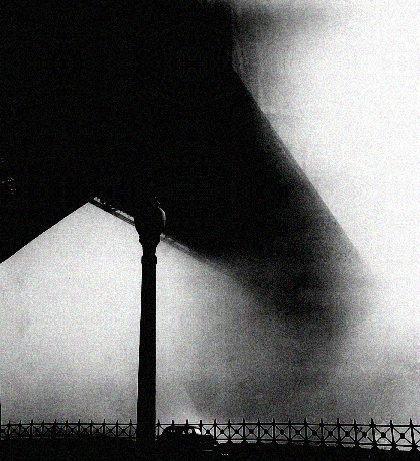
Noir City: Sydney Harbour 1950s - Original photo by Max Dupane

Thirty years ago in my late 20s on many lonely cold winter nights I walked the desolate streets of the city fringe. Down narrow sparsely-lit alleys with dark dirty store-fronts, ominous warehouses, and desperate characters.  A salty dampness and the silhouettes of sea-faring hulks on Sydney harbor drawing me into an enveloping angst.  There was mystery, an aching feeling of some unfathomable loss, of poetry.

Today those streets are bright, lined with trendy restaurants, exclusive warehouse conversions, soul-less showrooms for funky furniture, and expensive cars.  No mystery, no angst, and no poetry.


Cinematic Cities: Mexico City Noir 1949

Salón México (1949) Nylons, high heels, and dark alleys… Director – Emilio Fernández | Cinematography – Gabriel Figueroa

Salón México (1949)
Nylons, high heels, and dark alleys…
Director – Emilio Fernández  |  Cinematography – Gabriel Figueroa


Get Angry: “I was fed up I guess”

Most film noir protagonists are driven by anger. Anger grown of frustration and resentment at a society that excludes them from comfort and a decent life…

Caged (1950)

Most film noir protagonists are driven by anger. Anger grown of frustration and resentment at a society that excludes them from comfort and a decent life. Some are simply lazy and greedy and see crime as a fast lane to riches, many are driven by poverty and degradation to crime, also as a kind of revenge against ‘those’ who have taken everything and left nothing, and all share the widely held delusion that money buys happiness.

In the female prison noir, Caged (1950), a powerful critique of a society that breeds such anger, a young woman is jailed after she is an unwitting accomplice in a gas-station robbery with her husband, who is killed during the heist. The sheltered girl on admittance to a women’s prison discovers she is pregnant, but her condition does not protect her from the humiliation and brutalisation of prison life. Melodramatic but with a strong social conscience that targets corrupt authorities, the movie is downbeat and pessimistic. By the end of the film, the girl is hard-bitten beyond her years and ready to hit the streets as a prostitute, after her recruitment by a glamorous older inmate, who manages to run her racket from inside the prison. The prison warden tries hard to help such girls but money is in short supply and the politicians aren’t interested. The girl’s decision to go bad is triggered by the resentment that erupts when from her cell she is confronted with the site of a gaggle of socialites dressed to the nines in a philanthropic tour of the prison. We appreciate her anger and resentment as an understandable response to her treatment by ‘the system’.

Hollywood doesn’t make movies likes that anymore thanks to the HUAC purges of the 1950s and the comfortable cowardice of contemporary film-makers.

I get angry at injustice and inequality, very angry. What intrigues me is why Americans don’t get angry at the injustice and inequality in their midst. For the record I am not American nor do I live in America, and for many Americans that disqualifies me from having a view, but I don’t care. If you personally have a problem with this, write to your member of Congress.

A sobering article was published today by my local newspaper.

  • A taxation system emaciated by political opportunism has left the US with tax rates so low as to undermine the work of government, strangling revenue and magnifying inequality. Each year, the IRS constructs figures for the top 400 income earners in the country. In 2008, when the great recession was biting hardest, the top 400 earned on average $US270.5 million each – 20 times what they made in 1955 (which was $US13.3 million, in 2008 dollars). The mind-blowing reality beyond that growth is that the 400 highest-earning Americans in 1955, after exploiting all possible deductions, paid 51.2 per cent of their total earnings in federal income tax. Fifty years later, in 2008, the top 400 paid just 18.1 per cent in tax. So pronounced is the disparity that the top 1 per cent of American taxpayers now takes almost a quarter of all income – double their share of 25 years ago. And they control about 40 per cent of America’s wealth, compared to 33 per cent then.
  • In the days of the postwar president Dwight Eisenhower, America’s top income tax bracket hovered around 90 per cent. It was eased to 70 per cent in the mid-1960s and remained there until the advent of ”Reaganomics” when the top marginal tax rate was slashed to 50 per cent, then to 28 per cent. Reagan’s successors – George Bush snr and Bill Clinton – pushed the rates back up, citing fiscal necessity, but George W. Bush cut again, lowering the top marginal rate to 35 per cent, while reducing the tax on capital gains to 15 per cent for assets held for more than a year, accelerating the accumulation of wealth at the summit, because the rich, increasingly, were deriving their income from capital gains – by trading shares, bonds and other assets.

Get angry America!

The appalling legacy of greed…

Film Noir: Cinema as Mourning

Office memorandum, Walter Neff to Barton Keyes, Claims Manager. Los Angeles, July 16th, 1938. Dear Keyes: I suppose you’ll call this a confession when you hear it. I don’t like the word confession…

Double Indemnity (1944)

Office memorandum, Walter Neff to Barton Keyes, Claims Manager. Los Angeles, July 16th, 1938. Dear Keyes: I suppose you’ll call this a confession when you hear it. I don’t like the word confession…  When it came to picking the killer, you picked the wrong guy, if you know what I mean. Want to know who killed Dietrichson? Hold tight to that cheap cigar of yours, Keyes. I killed Dietrichson. Me, Walter Neff, insurance agent, 35 years old, unmarried, no visible scars – until a little while ago, that is. Yes, I killed him. I killed him for money – and a woman – and I didn’t get the money and I didn’t get the woman. Pretty, isn’t it?

I am currently reading a book on French cinema by American academic T. Jefferson Kline titled Unravelling French Cinema (John Wiley & Sons 2010).  As the title indicates, Kline by examining French films from the early 1930s to the present day explores the nature of French cinema.  His guiding thesis is that French films are more concerned with the nature of cinema than with narrative for its own sake.  It is a complex analysis and the author’s scholarly approach makes the book daunting reading.

Kline initiates an intriguing discussion of cinema as a process of mourning, which goes not only to the examination of certain films but to the very nature of cinema.   He focuses on art-house films and strangely mentions French poetic realism only as an aside.  The great poetic realist films of the 1930s are not discussed, nor the French noirs of the 1940s and 1950s.  The fatalism of these films to me seems germane to any discussion of cinema as mourning, and to an understanding of film noir.

Let us take these word’s from Kline’s book:  “We can think of many films that move us precisely because the main character must die, and so we mourn… we must realize that cinema in its most essential form is an image of something that is no longer there.  Like a cherished photograph, we can look at it over and over again, but we can never make its subjects return to the physical form they enjoyed when the film was made.” (p. 334)

This is the very nature of the fatalism inherent in poetic realism and in film noir: a doomed protagonist battling the fates.   The very use of flashback in many noirs reinforces this fatalism – the fate of the protagonist is known from the outset.  Billy Wilder’s Double Indemnity (1944) and Robert Siodmak’s The Killers (1946) are the definitive flashback noirs.

Something to think about.


The Killers (1946)

Still Cause for Alarm

Noir lifts the veil of normality to reveal the chaos below

Noir is subversive.  Noir lifts the veil of normality to reveal the chaos below. The underbelly of reality.  The insanity of sanity.  The furtive destructiveness of obsession. The truth behind the lies.  The disaster of success.  The ‘ghost in the machine’.

Many of the artists of the classic noir cycle, from the writers of the hard-boiled fiction of the 20s, 30s, and 40s to those involved in the making of the films noir of the 40s and 50s, were ‘subversives’.  Artists whose art was a politic statement, a social critique, a thesis on the nature of freedom and social responsibility.

Novelists like Dashiell Hammett, Raymond Chandler, Ira Wolfert, Graham Greene, and Eric Ambler.  Screenwriters like Dalton Trumbo, John Paxton, A. I. Bezzeridis, and Carl Foreman. Film-makers and actors like Abraham Polonsky, Jules Dassin, Orson Welles, Edward Dmytryk, Adrian Scott, Joan Scott, John Garfield, and Marsha Hunt.

A number of these artists were vilified and their careers destroyed during the ‘red menace’ years of HUAC and the blacklist.  What was ignored then and largely forgotten now is that these men and women were united and largely animated by a common cause: anti-fascism.  These liberals and leftists were warning of the dangers of fascism well before the outbreak of WW2, when many of the rightists that later prosecuted the anti-communist hysteria of the immediate cold-war period were apologists of fascism.

Eric Ambler was a thriller writer whose best work was written during the late 30s and early 40s.  His novels Journey into Fear (1943) and The Mask of Dimitrios (1944) were made into films noir during the war.  In 1938 Ambler published ‘Cause for Alarm’ – not related to any movie with the same title – a story about a British munitions engineer, Marlow, haplessly caught up in espionage in Fascist Italy.  The protagonist is aided in his escape from fascist death squads by a mysterious American, Zaleshoff, who may be a Soviet spy but is definitely a socialist.  Caught in a snow storm just before crossing into Yugoslavia to freedom, the pair is given shelter for the night by an artist and her elderly father.  It transpires that the father is a mathematician, a Professor Beronelli, whose career was destroyed after he refused to pledge a loyalty oath to fascism.  The trauma has plunged the man into insanity.  The two fugitives discover this after a reviewing the professor’s notes on a perpetual motion machine, and after they realize the daughter is helping them even though she is aware of their fugitive  status.  After the old man goes to bed, Zaleshoff says to Marlow:

‘Sure! That’s right. What a tragedy! We’re horrified. Hell! Beronelli went crazy because he had to, because it hurt him too much to stay sane in a crazy world. He had to find a way of escape, to make his own world, a world in which he counted, a world in which a man could work according to his rights and know that there was nobody to stop him. His mind created the lie for him and now he’s happy. He’s escaped from everybody’s insanity into his own private one. But you and me, Marlow, we’re still in with the other nuts. The only difference between our obsessions and Beronelli’s is that we share ours with the other citizens of Europe. We’re still listening sympathetically to guys telling us that you can only secure peace and justice with war and injustice, that the patch of earth on which one nation lives is mystically superior to the patch their neighbours live on, that a man who uses a different set of noises to praise God is your natural born enemy. We escape into lies. We don’t even bother to make them good lies. If you say a thing often enough, if you like to believe it, it must be true. That’s the way it works. No need for thinking. Let’s follow our bellies. Down with intelligence. You can’t change human nature, buddy. Bunk! Human nature is part of the social system it works in. Change your system and you change your man. When honesty really is good business, you’ll be honest. When rooting for the next guy means that you’re rooting for yourself too, the brotherhood of man becomes a fact. But you and I don’t think that, do we, Marlow? We still have our pipe dreams. You’re British. You believe in England, in muddling through, in business, and in the dole to keep quiet the starving suckers who have no business to mind. If you were an American you’d believe in America and making good, in breadlines and in baton charges. Beronelli’s crazy. Poor devil. A shocking tragedy. He believes that the laws of thermodynamics are all wrong. Crazy? Sure he is. But we’re crazier. We believe that the laws of the jungle are allright!’

Fate: “a belly-laugh on Olympus”

The gods, like most other practical jokers, have a habit of repeating themselves too often

The gods, like most other practical jokers, have a habit of repeating themselves too often. Man has, so to speak, learned to expect the pail of water on his head. He may try to sidestep, but when, as always, he gets wet, he is more concerned about his new hat than the ironies of fate. He has lost the faculty of wonder.

The tortured shriek of high tragedy has degenerated into a petulant grunt. But there is still one minor booby-trap in the repertoire which, I suspect, never fails to provoke a belly-laugh on Olympus. I, at any rate, succumb to it with regularity. The kernel of the jest is an illusion; the illusion that the simple emotional sterility, the partial mental paralysis that comes with the light of the morning, is really sanity.

– Eric Ambler, ‘Cause For Alarm’, London, 1938. Ambler, an English writer, wrote the source novels for the films noir Journey Into Fear (1943) and The Mask of  Dimitrios (1944).

Plato and Noir: “Incoherence partly resolved”

“The effect of this dialogue… is not to offer the reader a system, a structure of propositions, but to disturb and upset him in a certain way, to leave him in a kind of radical distress.”

[Properties ascribed by James Boyd White to Plato’s Crito]:  “The effect of this dialogue… is not to offer the reader a system, a structure of propositions, but to disturb and upset him in a certain way, to leave him in a kind of radical distress.”  According to White, Plato’s literary technique reflects his philosophical stance: “This text offers us the experience of incoherence partly resolved, then, but resolved only by seeing that in our own desires for certainty in argument, for authority in the laws—or in reason, or in persuasion—are self-misleading; that we can not rest upon schemes or formulae, either in life or in reading, but must accept the responsibility of living, which is ultimately one of establishing a narrative, a character, a set of relations with others, which have the kinds of coherence and meaning it is given us to have, replete with tension and uncertainty.”

– White, James Boyd. 1994. Acts of Hope: Creating Authority in Literature, Law, and Politics. Chicago: University of Chicago Press. p.40 quoted by Aronoff, Myron J. 2001. The Spy Novels of John le Carré: Balancing Ethics and Politics. New York: Palgrave. p.17