Blog Feed

Detnovel.com on the Origins of Film Noir

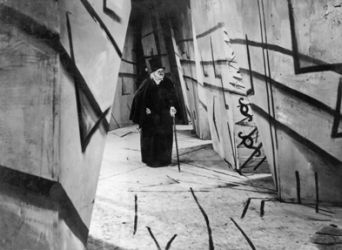
dr caligari
The Cabinet of Dr. Caligari (1920)

Many thanks to the ubiqutious Dark City Dame for bringing a compelling resource to my attention.

Dr William Marling, Professor of English at Case Western Reserve University in Cleveland, has on the detnovel.com film noir portal gathered an impressive collection of his essays on noir and its origins in German expressionism and hard-boiled fiction of the 20s and 30s.

In his introductory essay he reminded me that German expressionism as manifested in films like The Cabinet of Dr Caligari was not only about chiaroscuro lighting, but also that (my emphasis):

Expressionist movie-makers liked to employ extreme camera angles, tight close-ups, very slow dissolves, fast cutting and fast motion – anything that emphasized subjectivity.

German Expressionism: New DVD Collection

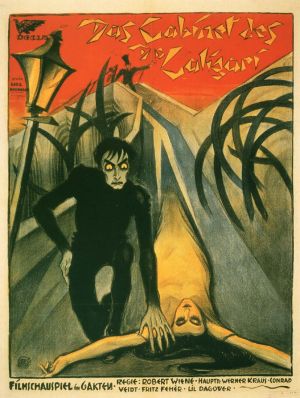
Cabinet of Dr. Caligari

Kino has released a 4-DVD box set titled German Expressionism Collection, which includes four silent classics from the period of German expressionism, which some film scholars consider is the genesis of the dark shadowy look of film noir.

The four titles are:

The Cabinet of Dr. Caligari (1920) Directed by Robert Wiene
Warning Shadows (1923) Directed by Arthur Robison
The Hands of Orlac (1924) Directed by Robert Wiene
Secrets of a Soul (1926) Directed by G.W. Pabst

The Hands of OrlacSecrets of the Soul

The release is reviewed here by Justin DeFreitas of The Berkely Daily Planet

A Touch of Evil (1958): “the rich baroque and the decadent gothic”

Touch of Evil (1958)

The Parallax View: Smart Words About Cinema blog has today published a brilliant review of Orson Welles’ Touch of Evil (1958): Touch of Evil: Crossing the Line by Robert C. Cumbow.  This essay is the best on this problematic film that I have read.

I was particularly struck by Cumbow’s analysis of the famous opening take:

“In establishing this matrix of border crossings, Touch of Evil’s celebrated opening shot… [in order]  …To see why the opening shot is cinematically, stylistically, and thematically necessary, we need only consider how the opening sequence would seem if the opening were not a single take, but a series of briefer shots edited together.  The sequence’s – and the film’s – whole concept of time and space would be irretrievably damaged.  For if there were cuts between the time a shadowy figure puts the bomb into the car and the time it explodes, we would not know how long the bomb had been ticking, or how long it took the car to get from that parking garage to the border.  Nor would we know how far it was from one place to another.  And an understanding of the geography of that border town is as crucial to Touch of Evil as is its treatment of the time frame within which the events occur.”

Concidentally, this morning I started re-reading V.F. Perkins’ book, Film as Film: Understanding and Judging Movies (Penguin, London, 1972), and on reading Cumbow’s essay later in the day, I immediately recalled this telling passage from the book where Perkins discusses the long take in the context of Andre Bazin’s critique of montage as the basis of film theory: “Directors like jean Renoir, Orson Welles, and William Wyler had to a large extent renounced editing effects in order to explore the dramatic possibilities of an uninterrupted continuity in pace and time.“.

The tension of the long fluid opening shot in Touch of Evil would perhaps also have been lost if the shot was broken-up by editing.

Blood on the Moon (1948): Quintessential Noir Western

Blood on the Men (1948)

A drifter becomes embroiled in a violent dispute between an Arizona cattle rancher and local homesteaders. (1948 RKO. Directed by Robert Wise 88 mins)

Cinematography by Nicholas Musuraca
Screenplay by Lillie Hayward and Luke Short (adaptation of his novel “Gunman’s Chance”)
Film Editing by Samuel E. Beetley
Art Direction by Albert S. D’Agostino and Walter E. Keller
Original Music by Roy Webb
Starring Robert Mitchum, Barbara Bel Geddes, and Robert Preston
Filmed on location in Arizona and the RKO Ranch California
Robert Wise also directed: The Set-Up (1949) and Odds Against Tomorrow (1959)

“A bevy of late ’40s RKO talent, including ace cameraman Nick Musuraca, combine to make an intriguing noir Western. A complex tale of duplicity and split loyalties is played out against a noir backdrop of low-ceilinged bars and rain-soaked windswept darkness. Mitchum delivers his customarily immaculate, stoned performance as a reluctant hired gun duped into heading a trumped-up homesteaders’ revolt, and Bel Geddes plays the spunky cowgirl who engages him in erotic gun-play.” – By NA for the Time Out Film Guide

Blood on the Moon: what a great title for a noir western from a dream RKO film noir team!  Steven H. Scheuer in his Movies on TV guide rates this movie as only 2½ out of 4 stars, but his terse write-off, to my mind perversely establishes its noir credentials: “Murky, violent, post-war western”.

The film weaves a classic noir scenario into a western with all the motifs of the genre: the mysterious drifter with divided loyalties, the virginal rancher’s daughter in britches, the conniving proto-gangster, the crooked Indian-Reservation agent, hired-guns, shout-outs, bar-room brawls, and the Arizona backdrop, while organically integrating the noir elements of the redeemed noir protagonist, doom-laden atmospherics, outbursts of  violence, and vengeance into the story.

Mitchum as the drifter is classic Mitchum, and Barbara Bel Geddes truly engaging as the rancher’s younger daughter, with Robert Preston delivering a competent bad-guy, who in a neat twist is the homme-fatale to the rancher’s older daughter.  The wonderful Walter Brennan is great as an old homesteader, who as an active protagonist personifies the moral underpinnings of the story and its resolution.

But the movie belongs to director Wise and cinematographer Musuruca.  From the opening frame of the drifter’s silhouette riding over  a mountain pass in driving rain in the day’s gloaming, you know you are in noir territory.  The night-for-night scenes use available light and sharp contrasts to develop the dark themes of violence and betrayal, with interior scenes using key lighting and disturbing angular shots to establish risk and menace. The daylight scenes are filmed in classic western-style with deep focus and from higher angles. There is a brilliantly filmed cattle stampede at night in the middle of the film, that has to be text-book.  The score from Roy Webb adapts seamlessly from the dramatic to elegiac scenes of the lone horseman on the plain.


Val Lewton Screenplay Collection

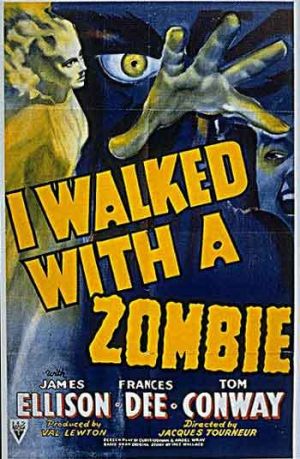
I Walked With a Zombie (1942)

When researching my previous post on The Seventh Victim (1943), I came across the site The Val Lewton Screenplay Collection, which has many of the scripts produced by Lewton and other interesting Lewton resources.

A reminder too that on Amazon you can get the Val Lewton Horror Collection DVD Box Set with nine movies: Cat People, The Curse of the Cat People, I Walked with a Zombie, The Body Snatcher, Isle of the Dead, Bedlam, The Leopard Man, The Ghost Ship, The Seventh Victim, and Shadows in the Dark for only  US$37.49 new and from US$29.99 used.

The Seventh Victim (1943): “And all my pleasures are like yesterdays”

The Seventh Victim (1943)

A young woman travels to New York to find her older sister after she stops paying her tuition fees, and discovers a satanic cult is threatening her sister’s life.
(1943 RKO. A Val Lewton production directed by Mark Robson 71 mins)

Cinematography by Nicholas Musuraca
Story and Screenplay by DeWitt Bodeen and Charles O’Neal
Art Direction by Albert S. D’Agostino and Walter E. Keller
Original Music by Roy Webb

After Cat People (1942), I Walked With a Zombie (1943), and Leopard Man (1943), the head of the low-budget horror production unit at RKO, Val Lewton, could not afford the services of Jacques Tourneur, who had been promoted by RKO to a-production, and he gave Mark Robson, who had edited those earlier movies, hist first directing job with The Seventh Victim, a simply stunning film that out-classes Lewton’s earlier productions.

I cannot express the power of this movie better than Chris Auty from London’s Time Out Film Guide:

What other movie opens with Satanism in Greenwich Village, twists into urban paranoia, and climaxes with a suicide? Val Lewton, Russian emigré workaholic, fantasist, was one of the mavericks of Forties’ Hollywood, a man who produced (never directed) a group of intelligent and offbeat chillers for next-to-nothing at RKO. All bear his personal stamp: dime-store cinema transformed by ‘literary’ scripts, ingenious design, shadowy visuals, brooding melancholy, and a tight rein over the direction. The Seventh Victim is his masterpiece, a brooding melodrama built around a group of Satanists. The bizarre plot involves an orphan (Hunter) searching for her death-crazy sister (Brooks), but also carries a strong lesbian theme, and survives some uneven cameos; the whole thing is held together by a remarkably effective mix of menace and metaphysics – half noir, half Gothic.

The opening frame of the film, a close-up of a stained-glass window in a gothic school building, establishes the mood of foreboding:

The Seventh Victim (1943)

Knowledge of three further lines in Donne’s sonnet enrich our experience of this film:

I run to death, and death meets me as fast,
And all my pleasures are like yesterday;
I dare not move my dim eyes any way,
Despair behind, and death before doth cast
Such terror, and my feebled flesh doth waste

“Despair behind, and death before doth cast”: the specter of existential terror haunts this film, where it is the angst of an empty existence that terrorises – not the super-natural. The noir motif of inescapable doom is developed as strongly if not more so than any other Hollywood film of the period.

Jacqueline Gould, a stunning dark beauty is not comfortable with existence: “I’ve always wanted to die – always.” Life nauseates her and in her desperation joins a Satanic cult, and when she re-cants and seeks to abandon the group, she is marked for death.  But she wants death on her terms, not theirs. She is the classic existential protagonist:

I can’t say I feel relieved or satisfied; just the opposite, I am crushed. Only my goal is reached: I know what I wanted to know; I have understood all that has happened to me… The Nausea has not left me and I don’t believe it will leave me so soon; but I no longer have to bear it, it is no longer an illness or a passing fit: it is I. – Jean Paul Sartre, Nausea (1938).

After a brilliantly filmed chase through dark city streets, Jacqueline escapes an assassin from the cult, and  reaches the tenement building where she is staying with her sister. She trudges wearily up to to the fist landing, then meets Mimi, an ill young woman, who lives in an apartment next to an empty apartment that Jacqueline has rented but never lived in, in which resides a terrible secret. The scene is strongly evoked by the very literate script:

NIGHT

Jacqueline, still running, comes into the scene and goes up the steps. She opens the front door and lets herself in.

INT. UPPER STAIRS – HALLWAY – NIGHT

The gas light has been turned down so that there is only a tiny flame to illuminate the hall. The draft in the hallway stirs this little flame and the shadows move with it. Jacqueline comes up the stairs. Now that she can be seen more closely, it can be seen also that she is exhausted, her eyes wild, her hair in disorder. She almost staggers as she reaches the landing and goes slowly supporting herself on the banisters, toward Mary’s door. Her way brings her past Room #7, the room with the noose. For a moment she stands weakly staring at the door, then goes on. She has reached Mary’s room, has crossed the narrow hallway and her hand is almost on the knob when Mimi’s door opens and Mimi, white night-gowned, comes out into the eerie gas light. Jacqueline looks at her face which is distorted and horrible in the moving shadows and flickering light. She stifles a scream. The other girl is also frightened. The two stand staring at each other for a moment.

JACQUELINE: (weakly) Who are you?

MIMI: I’m Mimi — I’m dying.

JACQUELINE: No!

MIMI: Yes. It’s been quiet, oh ever so quiet. I hardly move, yet it keeps coming all the time – closer and closer. I rest and rest and yet I am dying.

JACQUELINE: And you don’t want to die. I’ve always wanted to die – always.

MIMI: I’m afraid.

Jacqueline shakes her head.

MIMI (CONT’D): I’m tired of being afraid – of waiting.

JACQUELINE: Why wait?

MIMI: (with sudden determination) I’m not going to wait. I’m going out – laugh, dance – do all the things I used to do.

JACQUELINE: And then?

MIMI: I don’t know.

JACQUELINE: (very softly end almost with envy) You will die.

But Mimi has already turned back into her room. Jacqueline stands watching until the light snaps on in Mimi’s room and then the door closing, plunges the hall into weird half light again. In this semi-darkness, she turns away from Mary’s door and walks down the hall toward room #7. She opens the door and goes in.

This slide-show attests to the cinematic mastery of a film that displays the brilliant gestalt achieved by a team of talented film-makers:

This slideshow requires JavaScript.

Gambling House (1950): Obscure Gem

Gambling House (1951)

After small-time hood, Mike Fury (aka Furioni) beats a rap for a murder committed by a crooked casino-boss, he has to collect from the capo who welshes on the deal, and fight deportation as an undesirable alien. (1950 RKO. Directed by Ted Tetzlaff 80 mins)

Apart from leads Victor Mature and Wiliam Bendix, the only other strong film noir connection for Gambling House, is Roy Webb’s soundtrack. With a plot broadly similar to Mature’s earlier Kiss of Death (1947), this is a tight thriller-melodrama with nicely-integrated social and romance angles. Mature is charming as the reforming hood, Bendix dependable as the casino-operater, and Terry Moore truly engaging as the love interest.

The cinematography and art direction have a gritty noir look with deep-focus New York location shooting. The direction is tight with not a false step for the full 80 minutes.

The cast is entirely convincing, and the post-war migration and citizenship themes are handled simply at a personal level with a moving sincerity, and without grand-standing.

An engaging picture which has an immediacy that belies its age.

Gambling House (1950)

The Noir Night

film noir

Have you ever lain awake at night and wondered why you like films noir?

In my case I have come to the realisation that is the look of noir that has me hooked. No matter how good a film noir, I feel let down if it doesn’t look noir: the mystery and angst of dark city streets are buried deep within me.

When I was a kid in the early 60s in Sydney, I slept in a room above my parent’s store along a main drag, and if I couldn’t sleep I stared mesmerised at the shafts of light from car headlights flashing across my darkened ceiling, lost in the anguished mysteries that invade your psyche late at night.

My old man had a beat-up pickup truck for the store, which was also the family car. A sister of my mother lived way across the other side of the city, and after visiting her we returned home late at night driving through the glitz of Broadway and Kings Cross, and then on to the darker streets of the inner suburbs, with me sitting out in the truck’s tray and my parents and younger brother in the cab. The moody city streets were mine and each corner and door-way had an immediate mystery to ponder…

Otto Preminger: A Slap Too Many

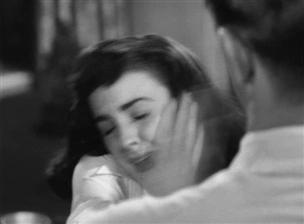
Angel Face (1952)

Early in the film Angel Face (1952), Robert Mitchum slaps Jean Simmons in the face:

When [autocratic director Otto] Preminger called for retake after retake, Mitchum, worried about his costar’s face, finally hit the director across the face and then asked him if he would like another slap.
– Mayer and Mc Donnell, Encyclopedia of Film Noir (2007)

Noteworthy Reviews

The Big Sleep

I recommend these recent reviews of films noir for their originality:

Precious Bodily Fluids Blog:

The Big Sleep
“The movie had everything going for it. But when one watches it, one finds that it is exceedingly difficult to read. The camera work is anything but polished. Cuts exist where they shouldn’t, and directional shots are at times awkward and superfluous. Hawks did not shoot the film as one expects film noir stuff to be shot. There are certainly the token shadows and curling smoke, not to mention some low shots and close-ups. But that Expressionistic element borrowed from German cinema in the previous decades is near-absent. While there are shadows, characters are not generally dwarfed by them. The contrast is rather minimal – this is less a “black-and-white” film than a “gray” film.”

Chinatown
“Polanski photographed the film largely in POV shots. The number of over-the-shoulder perspectives we get (almost all over Nicholson’s shoulder) becomes nearly claustrophobic. This sort of effect connects ChinatownThe Big Sleep or Huston’s The Maltese Falcon. with the old detective noirs, such as Hawks’ The Big Sleep or Huston’s The Maltese Falcon.”

Gilda
“From the film’s earliest scenes, one of the main characters is Bannin’s walking stick, which doubles as a protruding blade at Bannin’s pressing of a button. That the stick/blade is phallic goes without saying: it wields Bannin’s power, it extends, and its blade signifies castration of the other. Bannin calls it his ‘friend’, and proclaims, ‘It speaks when I wish it to speak, it is silent when I wish it to be silent.’ Johnny quickly identifies himself with the stick/blade: ‘You have no idea how faithful and obedient I can be.'”

Mildred Pierce
“It turns out that this film was released in 1945 just as the troops were returning home from the war. It also turns out that the film overtly attempted to reinstate masculine authority after a period of women running many of the businesses in the country.”

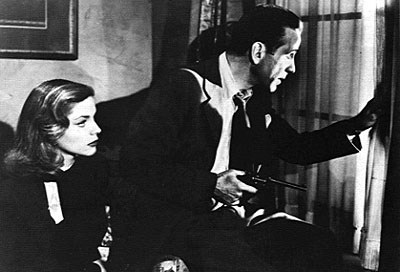
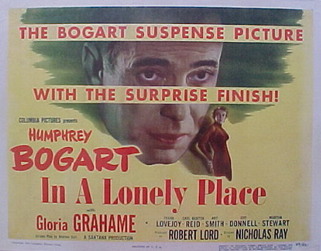
In A Lonely Place

The Dancing Image Blog:

Force of Evil
“Because at the end of the film, the greatest force of evil is not any one individual but the whole rotten system. Sure, it’s a racket; sure it’s a criminal enterprise. But writer/director Abraham Polonsky goes out of his way to establish the Combine as not so different from major banks and corporations – characters continually repeat, ‘it’s business!’ when confronted with the charge of gangsterism.”

In a Lonely Place
“The movie opens with a rearview mirror reflection of Dixon Steele’s wounded eyes, held in relief against the almost abstract high beams and street lights of a Hollywood boulevard. Hollywood is that lonely place – as is any place were sensitive souls gather to use and abuse one another.”

Kiss of Death
“Kiss of Death was shot entirely on location in New York. And indeed this is no idle boast; the movie is deeply enriched by the lived-in sense its, well, lived-in locations provide. The oppressive claustrophobia of an elevator as a desperate criminal tries to escape from a robbery in a busy building. The steep, narrow, and crowded architecture of Nettie’s (Coleen Gray) apartment as she welcomes Nick Bianco (Victor Mature) home from prison.”