Summary Noir Reviews: when Pushover comes to Whirlpool

Tomorrow Is Another Day

Tomorrow Is Another Day (1951) A rare Warner-b. Felix Feist ( The Man Who Cheated Himself and The Devil Thumbs a Ride) helms a redemption noir with true pathos. The redemption is played out in a farm-worker’s camp with shades of The Grapes of Wrath. The two leads, Ruth Roman and Steve Cochran, are great and deliver with real grit and integrity.

The Glass Key (1942) A very flat adaptation of Hammett’s novel starring Alan Ladd and Veronica Lake. But William Bendix is a knockout as a queer sadistic hood in the darkest scene, which succeeds because it is faithful to the novel. The scene opens in a basement dive with a soulful black singer Lillian Randolph (uncredited) on a piano performing a bluesy number, and climaxes in a seedy private room with a drunken Bendix strangling his hoodlum boss, while Ladd looks on holding a “roscoe”.

Pushover (1954) is a wide-screen noir as hip as an LA martini, where an LA cop redefines Double Indemnity, with bravura direction by unknown stringer Richard Quine. Fred MacMurray and Kim Novak in her first role are awesome! Darkly forlorn like an empty city street at the witching hour.

Lured (1947) is an entertaining camp thriller set in London. Douglas Sirk (!) directs a virtual cavalcade of talent, George Sanders as a good guy, a luscious Lucille Ball as the serio-comic heroine, Cedric Hardwicke as the bad guy who writes Baudelaire-like poetry, Charles Coburn as a wily police inspector, with an over-the-top cameo from Boris Karloff as an off-the-wall washed-up fashion designer!

Fallen Angel (1945) is as tight and elegant noir as you would want. Otto Preminger steers a solid cast through an ethical labyrinth: Dana Andrews in perhaps his best role as a grifter on the skids, Linda Darnell is a femme-savant whose sexual chemistry sends the male protagonists’ libidos haywire, Broderick Crawford is a deadly cop, and Alice Faye is the salvation angel.

LA Confidential (1997) is a visually stunning thriller: great direction, production design, score, camera-work, and editing. Strong performances all-round. But it has no real soul and lacks a true noir sensibility. The screenplay is hopelessly contrived, and the ending is pat. Mickey Spillane on steroids.

The Blue Gardenia (1953) is a minor Fritz Lang melodrama which has some noir elements. Anne Baxter shines as a young woman who thinks she has killed a guy, but Lang was not really interested, and Richard Conte as a cynical reporter delivers yet another weak performance. The saccharine ending disappoints. Nick Musucura’s contribution as DP is sadly undistiguished, though some moody scenes impress.

You Only Live Once (1937) also from Fritz Lang is a fascinating movie. Henry Fonda and the luminous Sylvia Sidney as star-crossed lovers become desperadoes on the run, and the stunning ending presages Gun Crazy’s fog-bound denouement by a full decade. As a relentless fatalistic melodrama moodily shot by virtuoso DP Leon Shamroy, it is a real contender as the first poetic realist film – beating the French by a full year. Consider this, Carne’s Port of Shadows was released in 1938, and Pépé le Moko debuted in France on 28 January 1937, while You Only Live Once opened in the US only a day later on 29 January 1937! The amour fou of Lang’s feature I think bumps the less romantic Pepe Le Moko.

Witness to Murder (1954) directed by Roy Rowland and lensed by John Alton is a minor but involving thriller with a noir angle. Barbara Stanwyck as the witness and a deliciously sinister George Sanders as the murderer hold it all together. Alton’s contribution is subdued, but the opening scenes around an LA apartment building on a breezy summer night are nicely atmospheric.

Laura (1944) is elegant noir melodrama. Gene Tierney is an exquisite iridescent angel and Dana Andrews a stolid cop who nails the killer after falling for a dead dame. Clifton Webb as the homme-fatale is his annoying best.

Citizen Kane (1941) Its sheer audacity always amazes. Though the scenario is beginning to feel dated with the episodic nature of the narrative less than satisfying.

Kiss the Blood Off My Hands (1948) is an atmospheric noir set in London directed by Norman Foster and lensed by Russell Metty with a great Miklos Rózsa score. Burt Lancaster and Joan Fontaine shine as two loners. The trauma of the returning WW2 vet is given an original treatment and Foster’s direction is polished. Norman Foster started out in the 30’s directing Charlie Chan and Mr Moto features, and does not have a high profile. He got directing credit for the Welles’ scripted Journey Into Fear (1943) starring Joseph Cotton, but the cognoscenti claim that Welles is the real helmsman. Foster also directed the sharp b-noir Woman on the Run (1950), and he deserves high praise for Kiss the Blood Off My Hands, which ranks with the best of Siodmak and Tourneur.

Black Angel (1946) is a visually elegant psycho-noir from a Cornell Woolrich story. Dan Duryea and June Vincent investigating the murder of a female blackmailer are impressive, with good support from a suave Peter Lorre as a ‘good’ bad guy. An hypnotic dream climax is the highlight – with kudos to director Roy Neill (his last movie) and DP Paul Ivano.

Whirlpool (1949) is directed by Otto Preminger, and stars Gene Tierney, Richard Conte, and José Ferrer in another psycho-noir. Lensed by Arthur Miller with a wonderfully dramatic score from David Raksin. Preminger turns a preposterous frame-up by hypnosis premise into a polished melodrama. Tierney is vivacious but does little more than the role of a dupe demands. Conte is incredibly wooden and a real disappointment, while Ferrer steals the picture as a suave homme-fatale, who has real wit and cunning. Broderick Crawford is good as a skeptical scruffy cop. Preminger uses mise-en-scene deftly to expose the truth below the surface. In an early scene, we have Tierney in close-up while Ferrer delivers lines of seductive poison, and as he approaches Tierney with his promises of sincerity his shadow fall across her face…

The Killer That Stalked New York (1950)

The Killer That Stalked New York (1950)

The Killer That Stalked New York (1950) is a b-noir from a director who made only three movies in the early 50s, Earl McEvoy. The movie was lensed by Joe Biroc and stars the under-rated Evelyn Keyes, who passed away last year, and appeared to advantage in Joseph Losey’s The Prowler (1951) and Robert Rossen’s Johnny O’Clock (1947). Keyes plays an accomplice to a hood, who after a job in Cuba, returns to NYC with smallpox, in a dramatisation of the New York smallpox scare of 1946. Keyes is brilliant as ‘the killer’ and dominates the film, which in the light of the current swine flu scare, is a well-crafted docu-drama which deftly weaves the drama of the woman’s noir story and how a city of over 8 million people has to mobilise to deal with such a threat, with vignettes on how the illness is transmitted, and a continuing story arc of the fate of the killer’s first ‘victim’, a young working-class girl.

An interesting segue is how these old Hollywood b-pictures weaved wonderful vignettes and comic moments into the story. Two such scenes stand out in this movie. A milkman is infected and there is a scene in the sick man’s bedroom when the inoculation team visits. The poor guy’s persona is eloquently evoked by his wife’s harping but deeply loving commentary on her husband – before she realises the gravity of his illness. The other scene cuts to a Brooklyn street with kids playing on the road in front of a bar. The kids scramble as a police car pulls up. They gather on the footpath to check it out. As a burly detective steps out of the car, one kid pipes up and asks for the low-down “Hey Bub…”. The cop replies “Beat it kid.” The bar is closed so the cops after getting the form from the kids, drive off, and the kids jump back on the road shooting air tommy guns after the car.

Blues in the Night (1941): Noir Counterpoint

Blues in the Night (1941)

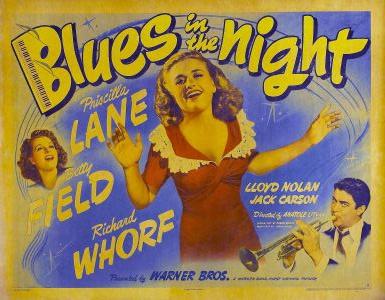
Blues in the Night (Warner Bros 1941) is a fascinating musical noir melodrama about a budding white jazz band scripted by Robert Rossen, directed by Anatole Litvak, and atmospherically lensed by Ernest Haller, with a b-cast, including a very young Elia Kazan, as a dizzy jazz clarinetist. These impeccable leftist credentials are reflected in the plot and the resolution which talk to personal integrity and the values of solidarity and loyalty. Amazingly for the period an establishing scene in a police lock-up respectfully credits the music’s black roots. Tied up in all this is a noir arc with a hood played by Lloyd Nolan and a killer performance by Betty Field (an actress who sadly went nowhere) as a cheap femme-fatale.  The socially aware feel-good ending is tempered by the noir-like denouement for the hoods and the femme-noir.

This movie is a serious contender as a seminal film noir,  remembering The Maltese Falcon was made in the same year, Stranger On the Third Floor only a year earlier in 1940, and Double Indemnity a full three years later in 1944.

Sexual Imagery in Film Noir: Tread Softly Stranger (1958)

Dian Dors - Tread Softly Stranger (1958)

Tread Softly Stranger (1958) is a top-class British noir set in a steel town in the North of England, starring Diana Dors, as a sultry femme-noir.  Two brothers are desperate for money after one has been stealing from his employer, a steel mill, to finance his infatuation with Dors.  She suggests a heist to cover the fraud and it of course goes badly wrong.  The second brother also falls for the woman, and this scene where physical violence becomes sexual attraction is deftly handled by director Gordon Parry with potent imagery that flows with the narrative as the scene shifts to the next day at the steel works…

The First Rule of Film Noir: “A Dame With a Past and a Hero With No Future”

Out of the Past

Check out this recent primer from BBC4:  The Rules of Film Noir.  Odd that it makes no mention of British Noir. I was also disappointed that little attribution was given to the film-makers with most of the attention on the stars.  The talking heads also spoke in generalities.  The best sequence is where a British cinematographer takes you through a series of tracking shots from The Sweet Smell of Success with Burt Lancaster and Tony Curtis in conversation as they walk-stop-walk on a Manhattan street. Pure artistry. But zero credit to the brilliant work of DP James Wong Howe!

New Horizon – Part 1

New Horizon

Freedom was fresh and bracing. The sky was blue. Not a cloud. The morning sun had not yet tempered the coolness of the night before. A new horizon.

My reverie was shattered by the sound of a car horn. There she was, the driver, ringlets of gold, and a cigarette held tightly by thin crimson lips. Her hands held the steering wheel and her eyes squinted as she peered at me through the smoke of the cigarette. She wasn’t smiling. Just peering with impatient eyes. They were black – the eyes. Limpid pools of dark angst and abandon. She knew the power of those eyes and held her stare. I dropped my gaze, picked up the almost empty valise – prison issue just like the sack of a suit I had been jumbled with – and shuffled towards the car, a blue Studebaker purring in anticipation of the expert caresses that would guide us out of here.

She leaned across the front seat to open the passenger door revealing two firm breasts held by a bodice of black lace. Her perfume was expensive. “You’re late”, I said. “Had to check the hotel room was ok”, she lied. She always lied. Lies for her were like breathing. The car pulled out onto the road, and was soon gliding at 60 over the blacktop. I looked out the window. New wheat and old houses. The same houses. The more things change the more the stay the same, my father used to say. “You haven’t changed”, I said, leering at her legs. The form of her perfect body was tightly held in a clinging dress which rode down her thighs to reveal more than was seemly. “It’s only been two years.” “Yeah. Two years. Felt more like twenty. And no visits from you, babe.” She shifted her arse in the seat and threw her cigarette out the car window. “I had to lay low. You know how it is.” “Sure”, I said with less than the required conviction, “a two your stretch isn’t much, but only if you’re not taking a rap. Where’s Johnny?” She turned and looked at me warily, “Waiting at the Club”. “Humph.”

We rode the highway in silence now. After two years, nothing more to say. Only the ache that wanted her as badly as ever. She avoided my gaze.

Femme Noir No. 25

noir night

Asleep beside me. Her breathing soft as moonlight. She smelled of almonds.

The celestial camera zoomed out and took in the squalid room. The neon sign outside flickered stripes across our bodies. The smoke from my cigarette coiled upwards and was lost in the gloom of the dark ceiling. She stirred and whimpered words from a lost subterranean nightmare.

I stroked her hair soft and fair. She sighed and opened black wide eyes. She smiled an angel’s smile and took my cigarette. She inhaled deeply and blew the smoke through her exquisite nostrils, licked a flake off her redolent lips, and raising herself onto her elbow, peered at me with a tender fear. Throwing her long hair back, the habitual anger resurfaced. She returned the cigarette and sat up on the side of the bed.

She got up, found her clothes, and started to dress. I feigned the usual indifference and hid my pain. She moved into and out of the light, a specter already gone. Not looking at each other, we each nursed the scars of other celestial nights of empty dreams and furtive longing. Intimate strangers. Seeking refuge in lonely dives. A shot at forgetting and a chance of bliss.

She opened the door, hesitated, almost gave me a glance, shut the door softly a reproach, and was gone.

I walked to the window and watched her walk across the wet road into a death-like fog holding her arms to her body.  She didn’t look back.

Noir City Blues

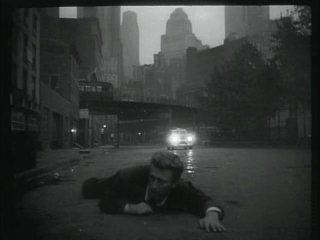
Noir City - New York - Young Man with a Horn (1950)

The dark night of forsaken city streets, vistas of  blissful angst and unholy pilgrimage.  I have been there and known their inhabitants: deadly dames, drunken losers, dangerous hoods, crooked cops, dreamers of broken dreams, and flawed heroes.

LA, Frisco, Chicago, and New York. I know these cinematic cities though I have never been.  A resident knows his locale, but the city in its ectoplasmic center is not reached corporeally, only in the phantasmagoria of a thousand and one shards of shattered night. Luminescent environs of a cosmic b-movie.  Wet asphalt, fog-laden piers, deserted streets, rusting hulks at anchor, the neon glimmer of purgatory dives, cigarettes and booze, dark tenements, the skid of car tires, and the wailing sirens of the dead.  Staccato rhythms and aching horns, crowded pavements and desperate loneliness.

One more fix, the last heist.  Treachery, misplaced loyalty, and courageous infamy. The denizens of a nether world trafficking in sordid magic and lurid hopes.

A kiss before dying, the desperate lurch before oblivion, and the erotic click-clack of stilettos on pavement. Dank stairwells and silent corridors. Closed doors and hidden secrets.  You break in and fall into a bottomless pool of black. Cut to a bare light-bulb burning on a current wired from hell.  Lying on a steel-framed bed you stare through the bars of perdition at yourself a wraith in a cracked mirror on the ceiling.