Recess Noir

thechase1946

FilmsNoir.Net will be in recess for a couple of weeks.  Meantime here is a list of camp b-noirs to watch while I am away:

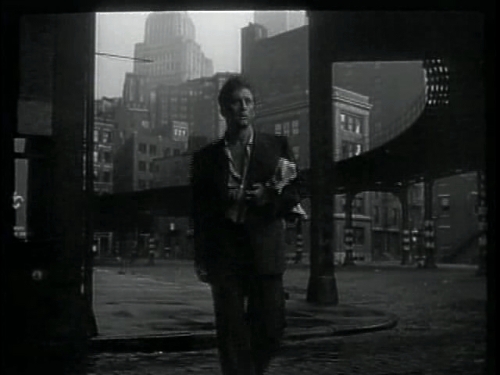
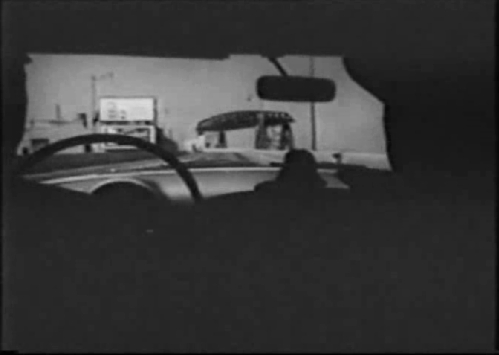
The Chase (1946) Insane hoods pursue shell-shocked vet. Totally surreal obscure noir melodrama (?) like no other movie you have ever seen.

I Love Trouble (1948) Hot-jive noir. Laughs and smooth-as-nylons repartee, while guys get slapped hard, drugged, and slugged from behind.

I Married a Communist (1949) Commies as hoods. Never flags. Erotic fission and violent noir pyrotechnics make for enthralling & wild ride.

Shock (1946) Perverse b-noir. Murder witness goes catatonic. Her shrink is the killer. A dark Lynn Bari smolders. Enticingly preposterous!

Strange Illusion (1945) Bizarre Hamlet remake. Edgar Ulmer turns PRC b into camp expressionist noir of foul villains with a knockout finale.

The Unsuspected (1947) Camp noir! Curtiz directs, Woody Bredell lenses, Waxman scores, Claude Rains over-acts, and Audrey Totter is a hoot!

Woman on the Run (1950) Intelligent b-thriller set on the streets, tenements, dives, and wharves of Frisco, with a roller-coaster climax.

The dreams are theirs

Man With a Horn (1950)

The dreams are theirs. Those with the easy laughter and healthy complexions. They are comfortable in their  designer skins. Making the ‘hard’ decisions for us. You have your anger. You hold it tight lest they take that too.  Easy to nurture and never absent, it goes where you go – “uptown, downtown, all around”. You know anger, you know pain, like Jack knew time. Dead now, his sodden soul awash in the lees of a bottle of rye glistening in the gutter, the peeling label his epitaph. The night is cool and the streets of perdition are sweetly rank with rotting garbage and dead hopes.  You grew up in these streets by the light of day, and the street-lamp.  Streets alive with palpable energy and unbounded love.  The old man with his beer on the stoop on a balmy summer night.  Your mother old before her time holding your angelic little sister by the hand recalling faded dreams of a new start and a better life.  The cacophony of kids playing mad games on the pavement and the idle gossip of adults that had you enthralled.  Day by day it all slipped away into that dark place where time and happiness go, along with your dreams. Gone forever.

Cinematic Cities: Brooklyn

Glengarry Glen Ross (1992)

Glengarry Glen Ross (1992)
Director  James Foley | DP  Juan Ruiz Anchia

Entrapment, futility, and malevolent fate in the dog day night of urban dreams. Savage sharks in suits, borderline psychotics selling real-estate, and weary losers.

Cinematic Cities: Manhattan

Force of Evil (1948)

Force of Evil (1948)
Director  Abraham Polonsky | DP  George Barnes

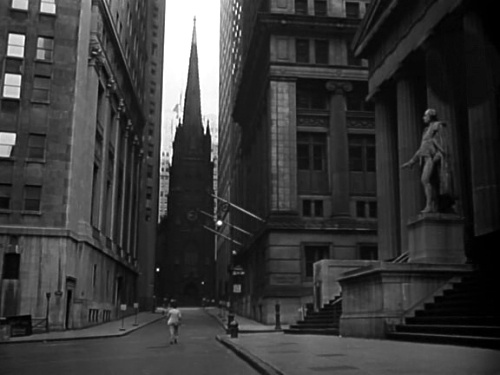
This is Wall Street… and today was important because tomorrow – July Fourth – I intended to make my first million dollars.  An exciting day in any man’s life. Temporarily, the enterprise was slightly illegal.  You see I was the lawyer for the numbers racket.

Cinematic Cities: Noir London

Night and the City (1950)

Night And the City (1950) Director  Jules Dassin | DP Mutts Greenbaum

Thwarted ambition and tawdry betrayal in a dark existential journey of the human soul played out in the dives and night-clubs of post-war London fashioned as the quintessential noir city.  Full Review

Cinematic Cities: Buenos Aires Beat

Of Missing Persons (1956)

Of Missing Persons (Sección desaparecidos (1956) France/Argentina)
Director  Pierre Chenal  | DP   Américo Hoss

Lurid adaptation of  1950 pulp novel by David Goodis.  The violent death of a wealthy un-hinged woman implicates her husband,  who is in hiding after faking his own suicide so that he can be with his exotic-dancer girl-friend.  Appalling yet mesmerizing melodrama. The dancer is one hot babe.

Summary Noir Reviews: Highway Crack-Up at Moontide

Apology For Murder

Apology for Murder (1945) Entertaining PRC rip-off of Double Indemnity. Hugh Beaumont plays the sap to Anne Savage’s femme-fatale. Savage dominates in a camp turn that has you wanting more.

Crack-Up (1946)

Crack-Up (1946) A rollicking b-thriller. Pat O’Brien and Claire Trevor hunt down art forgery racket.  Some noir overtones and moody photography with the clever use of flashback.

Endless Desire (Hateshinaki yokubo 1958 Japan)

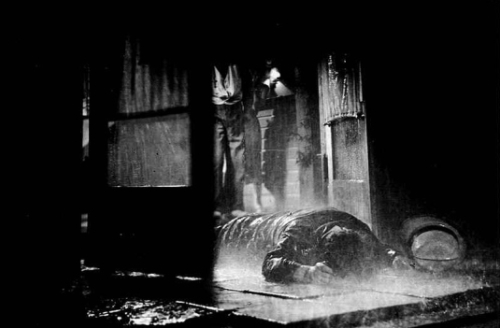
Endless Desire (Hateshinaki yokubo 1958 Japan) A darkly sardonic tale of greed punished by relentless fate. Bravura direction and cinematography, with a hip 50s jazz score. The movie opens with credits passing over a locomotive thundering along the rails – an opening very reminiscent of  Fritz Lang’s Human Desire.  A group of hoods and a wily femme-fatale tunnel for hidden loot with attendant double-crosses and a final triple-cross. A comic side-plot of a young couple’s courtship is nicely intertwined and the femme-fatale seduction of the callow youth is played for laughs. A brilliant climax in teeming rain at night in deserted city streets and the final denouement on an abandoned bridge thrill.

He Walked By Night

He Walked By Night (1948) A psychopathic killer is stalked by cops. An amazing chase climax in underground drains is the highlight. DP John Alton’s visual poetry offsets zero characterisation.

Highway 301 (1950)

Highway 301 (1950) A taut crime-doesn’t pay b with Steve Cochran dominating as a savage hood. Cochran’s cold-blooded point-blank murder of a former girl friend is chilling,  and his pursuit of the hapless wife of a dead gang-member is remorseless and unrelenting. The violent dispatch of these women is down-right disturbing.  Memorable drawn-out tour-de-force climax on dark city streets.

I Walk Alone

I Walk Alone (1948) A great noir sleeper from director Byron Haskin. Crooked nightclub-impresario Kirk Douglas has framed boot-legging partner Burt Lancaster, who went down for a 14 year stretch. Lancaster returns looking for his cut, and falls for chanteuse Lizabeth Scott, the two-timing Douglas’ girl on-the-side.  Wendell Corey is the fall guy. Lancaster oozes integrity, Scott decency, and Douglas villainy. Corey the crooked accountant is more resonant as the primal noir protagonist.

I Was a Communist for the FBI

I Was a Communist for the FBI (1951) Slick reds-under-the-bed homage to HUAC. FBI plant Frank Lovejoy saves pinko dame in great noir rail-yard shoot-out.

Moontide

Moontide (1944) Savvy pairing of Jean Gabin and Ida Lupino in a moody noir melodrama by the sea aching with love, humor, fog, and angst.  A nice reversal of noir motifs: a guy with a past, a dame with no future, and an homme-fatale. Gabin in his first Hollywood picture oozes Gallic charm. Lupino you have to fall in love with. Cameron Mitchell is great as the  low- life homme-fatale, with Claude Rains out-of-place as an enigmatic intellectual-cum-nightwatchman. Camp elements like Mitchell flicking Raines’ naked butt with a towel  in a communal shower (behind a low wall of course); Gabin a $2 a day fish bait-seller dressed for his aboard-barge wedding in the most elegant suit this side of Paris; and Raines advising Lupino on her wedding night on the erotic obligations of a wife.  Wonderful expressionist revenge climax on a dark pier at night.  Archie Mayo directed with cinematography from Charles Clarke and Lucien Ballard (uncredited).  Originally a Fritz Lang vehicle he was replaced by Mayo two weeks into shooting.  How much the finished film owes to Lang is an intriguing mystery.

My Name Is Julia Ross

My Name Is Julia Ross (1945) Gothic noir is Joseph H. Lewis’ first notable film. Nina Foch is convincing as abducted young woman whose sanity is under assault. Richly atmospheric but marred by hurried ending after 60 minutes.

The Bribe (1949): Too late the fireworks

The Bribe (1949)

“Price and Laughton make a formidable pair of heavies in this otherwise feeble thriller shot on a cheaply rigged-up corner of the MGM backlot. Taylor isn’t up to moral dilemma as a US government agent sent to crack illicit aircraft engine trading in the Caribbean, yet tempted by a lucrative cash offer and the irresistible charm of café chanteuse Gardner.”
– Time Out Film Guide

You would think a movie boasting the talent invested here by MGM just couldn’t miss. But it does. The Bribe which flopped at the box-office never gets off the ground until the end with some pyrotechnical wizardry.  We have an a-list production team in Director Robert Z. Leonard and DP Joseph Ruttenberg,  supplied with a ripping story, a good script, an exotic latin locale, and a score from Miklós Rózsa.  Robert Taylor is a jaded chain-smoking war vet turned undercover-cop, Ava Gardner the angelic wife  of a lush moonlights as a sultry cabaret singer, Charles Laughton is a scruffy low-life with bad feet, and Vincent Price is the suave villain.

It starts off noir with Taylor’s cop sweating out a tropical storm in his hotel-room with a dame on his mind – you know because there is his voice-over.  He can’t trust the woman but wants her bad.  To keep her he has to go over to the other side, and a bribe offered by Laughton as Price’s voluble emissary is an added incentive to go over.  We then segue into a long flashback to establish what he is doing in a hotel on an island off  the coast of South America.  Taylor is wooden and a drag on the story which moves too slowly and with little tension. Gardner is eminently watchable and convincing.  Her single cabaret outfit is sensuous and quite revealing, but she is no Gilda.  Laughton and Price give their roles a sardonic edge, with Laughton nicely hamming it up as a sloven conniver. When the flashback is over towards the end we hit noir territory again.

What saves the film from obscurity is the literally explosive climax, an imaginatively choreographed and technically daring shootout at night.  This tour-de-force noir denouement is a blast!

Cinematic Cities: The Shanghai Night

The Goddess (1934)

The Goddess (Shen nu – China 1934)
Director Yonggang Wu | DP Hong Weilie

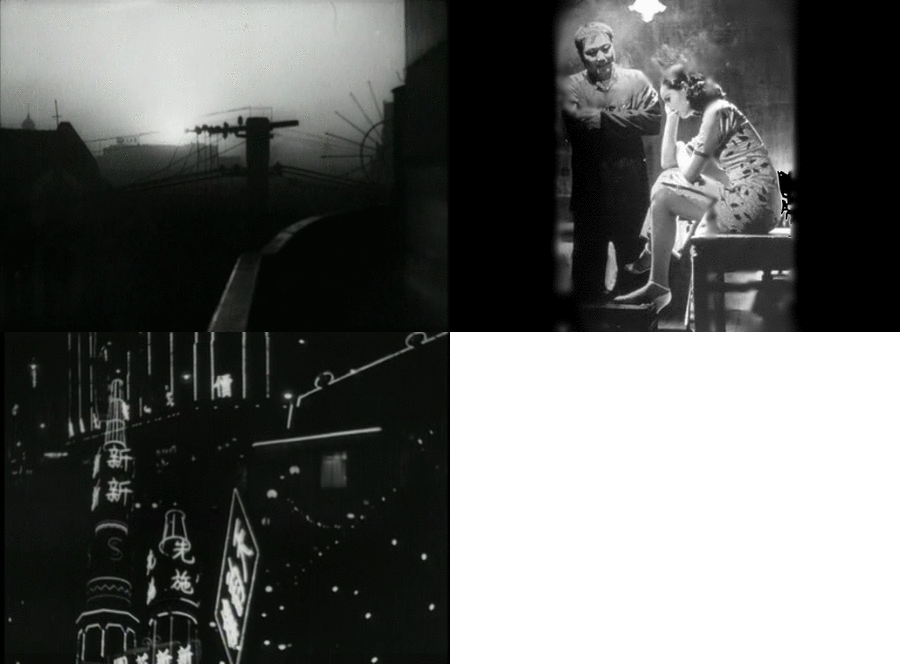
One of the masterpieces of the silent cinema starring the legendary Chinese actress Ruan Lingyu,  is a fatalistic story of entrapment and futility, which presages French poetic realism. The film is a profound and mesmerising critique of greed and bourgeois hypocrisy, set against the tender counterpoint of the bond between mother and child.  The streets of Shanghai are a glittering purgatory. The fallen woman walks the dark streets of oppression and shame. Trapped and struggling, loving and kind, a prostitute and an angel, she soars with wings of  joy for a brief instant above the sordid infamy of vanity, exploitation, and deprivation. A woman’s anguished bid for freedom is a revolutionary act.  The whore and the mother the existential  heroine made flesh.

Cinematic Cities: Okinawa Noir

Stray Dog - Kurosawa - 1949

Stray Dog (aka Nora inu) 1949
Director Akira Kurosawa | DP Asakazu Nakai

Akira Kurosawa’s 10th film directly inspired by Jules Dassin’s The Naked City (1948), explores the nether world of post-WW2 Japan in a story that parallels the American noir theme of the returning soldier’s re-integration into civilian society. The different responses of two men to a chance event underlie the story of pursuit tempered by empathy, and the realisation that the pursuer could as easily have been the pursued. Full Review.