
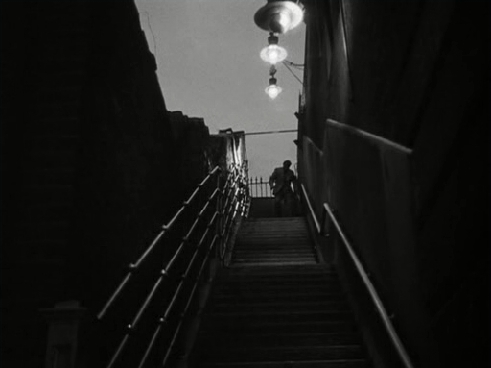
Night And the City (1950) Director Jules Dassin | DP Mutts Greenbaum
Thwarted ambition and tawdry betrayal in a dark existential journey of the human soul played out in the dives and night-clubs of post-war London fashioned as the quintessential noir city. Full Review
 FilmsNoir.Net - all about film noir
Ah Tony, you know how to really make a man ‘cinematically excited.’ This of course is one of my favorite noirs of all-time, and I actually saw it during festivals in Jersey City, New Jersey and in Manhattan just months apart. I have come to understand and appreciate this film, and certainly the shot you showcase here captures that dizzying climax, where the doomed man cannot escape his fate. Few noirs feature a setting as prohibitively gloomy and hopeless as what NIGHt does here with the London locales.
LikeLike
http://www.wsws.org/articles/2008/apr2008/dass-a03.shtml
THE PARALYSIS OF AN ENTIRE CREATIVE IMPULSE MCCARTHYISM AND THE 50’s. Note the question posed at the end of this quote!!I never have tired of watching Rififi and the films of François Truffaut, .Many resemblances to the films of coming of age produced by the artistic genius of Louis Malle.
I have read the article on Dassin in the full review and it is packed with information about Rififi and Dassin’s part in it. Note the quote below:
His next project turned out to be Rififi, a crime thriller filmed in Paris. Dassin adapted it from a book that he hadn’t much liked. He wrote a screenplay with a collaborator in seven days. One of its most famous sequences is a 33-minute scene without music or dialogue, the scene of the crime itself. The scene is much praised for its unremitting tension, but Dassin points out that one of the chief reasons for the lack of dialogue was his unfamiliarity with the French language and his desire to produce as short a script as possible.
“Critics are divided over the work. François Truffaut apparently considered it one of the greatest crime dramas ever made, at least at the time. Sarris regarded it as overrated, and Jean-Luc Godard, then a critic, commented superciliously in 1959: “Jules Dassin wasn’t at all bad when he was shooting semi-documentary style among Italian fruit-workers of San Francisco, in the old wooden subway of New York, on the dreamy docks of that charming city which, as Sacha Guitry said, the English insist on calling London. But one day, alas, our Jules began to take himself seriously and came to France with a martyr’s passport. At the time, Rififi fooled some people. Today, it can’t hold a candle to [Jacques Becker’s 1954] Touchez pas au Grisbi, which paved the way for it, let alone [Jean-Pierre Melville’s 1956] Bob le Flambeur, which it paved the way for.”
> Be that as it may, Rififi is a competently and intelligently made and acted film, with Dassin playing one of the criminals. Berg notes, “While writing the screenplay, his [Dassin’s] experiences of the hard times he and many of his colleagues were living through had a profound influence on the script. ‘I was thinking when I was writing about my character’s death,’ he says. ‘There’s a close shot of me saying, “You’ve got to shoot me,” and I was thinking so much of the guys who were blacklisted. [In the scene] they want [Dassin’s character] to give names to the gangster that’s going to kill me and I was thinking, No, you don’t give names. I was thinking of all my friends who during the McCarthy era betrayed other friends.
“Dassin became romantically and artistically involved with Greek actor Melina Mercouri in the mid-1950s. Some of their films together are forgettable, or worse (He Who Must Die [based on a Nikos Kazantzakis novel], The Law, Phaedra). Never on Sunday (1960), with Mercouri as a lighthearted prostitute, is something of a fantasy and a trifle, but it helped open the American cinema up to a more realistic, or at least less prudish, attitude toward sexual matters. It’s not coincidental that the cheerful work came out at the same time as the end of the blacklist. Topkapi (1964), another heist film (with Mercouri and Peter Ustinov), but this time in a comic vein, is also a slight work, but it too helped loosen up American audiences and introduced them to a more knowing, cynical European attitude toward cops and robbers.
“Dassin’s life was bound up with critical events in the 20th century. He became a victim, along with many other talented figures, of the anti-communist frenzy of the 1950s, a frenzy that crippled artistic and intellectual life in the US for decades. The film industry still suffers from the purge of left-wing and critical spirits.
What kind of work he and others of his generation might have produced under more favorable circumstances is obviously an unanswerable question. No one seems to have doubted his sincerity or honesty.
Bertrand Tavernier, French filmmaker and film writer, observed: “McCarthyism, in reducing to silence a whole generation of young filmmakers (Dassin, Losey, Berry, Rossen, Polonsky, Enfield), important screenwriters (Trumbo, Wilson, Maltz, Buchman, Ring Lardner Jr., Hugo Butler), paralyzed an entire creative impulse.”
LikeLike