Richard Schickel on Film Noir

Film Noir

TIME magazine film critic, Richard Schickel, has written an article on film noir for the Wilson Quartely, which has been published on-line: Rerunning Film Noir. Generally an excellent historical overview, with some interesting movies discussed, but in some aspects unsatisfying:

Noir, despite its Frenchified name, is a truly American form, as Alain Silver and Elizabeth Ward observe in Film Noir: An Encyclopedic Reference to the American Style (1979). Yes, many of its leading directors (Fritz Lang, Billy Wilder, Jacques Tourneur, André de Toth) were born in Europe and well versed in expressionism. But their ­source—­often directly, always at least ­indirectly—­was the American crime fiction of Dashiell Hammett, Raymond Chandler, James M. Cain, W. R. Burnett, and others. Almost all noir actors and many of the directors’ significant collaborators (cameramen, editors, etc.) were American born and certainly American ­trained.

This dismissal of the influence of the European directors is defensive, and does not help readers to understand the real influence of these expatriate directors. Schiekel seems to deride the autuer influence of artists like Wilder, Siodmak, Lang, Tourneur, and others. Existentialism is not even mentioned: the noir anti-hero is more of an outsider than an urban refugee. And of course the French recognised and named the genre, and provided an analytical framework.

In A Lonely Place (1950): A Psychic Prison

In A Lonely Place (1950)

After my post of Aug 4, In A Lonely Place (1950): The “Creative” Outsider, I watched In a Lonely Place again last night, and found more to say about this intriguing movie. James Naremore in his book, More than Night: Film Noir in Its Contexts(Berkely, 1998), quotes two post-war French auteur theorists on director, Nicholas Ray:

François Truffaut wrote that the essential theme of Ray’s films was “moral solitude,” and Jacques Rivette argued that Ray was concerned with “the interior demon of violence, which seems linked to man and his solitude.” (p. 26)

These themes are clearly evident in In a Lonely Place, where a creative outsider is imprisoned by his interior demons. The mood of the film is alienating too, with the protagonist kept at an emotional distance from the audience. The Bogart character is not only lonely, torn, and alienated, but amoral in his self-obsession. He leaves the hat-check girl to find her own cab alone late at night on the streets of LA, and so is partly responsible for what happens to her. When he learns of her murder the next morning, he cannot connect emotionally with the event – even when he is shown graphics photos of the crime scene – and he has no real remorse. As an afterthought he callously orders some flower to be sent to the girl’s home, but can’t be bothered to find out the address himself.

Nicholas Ray uses powerful imagery to visualise this alienation. Dixon Steeles’ apartment is on a lower level to his lover’s. He must walk up to see her and when he leaves for the last time, he must walk out and down a stairway. The strongest imagery is in the design of Steele’s apartment where prison-like bars are virtually everywhere – even in the patterns of curtains:

In A Lonely Place (1950) In A Lonely Place (1950) In A Lonely Place (1950)

And in almost all interior scenes having the view from windows obscured by the lateral bars of closed venetian blinds reinforces the mood of alienation.

In A Lonely Place (1950)

The Cabinet of Dr. Caligari (1919): German Expressionism and Film Noir

The Cabinet of Dr Caligari (1919) The Cabinet of Dr Caligari (1919)

Matt Holmes has posted an interesting article on the Obsessed With Film blog: The Cabinet of Dr. Caligari: Suffering creates art?, where he explores the historical context of the film, and the influence of adversity on creativity. He also says that German expressionism is a major influence on the film noir genre:

Like the great speech from Orson Welles in The Third Man, who said that times of war and suffering bring out the most creative and artistic periods in history, Caligari is a testament to the human spirit and a way of how expression through film was a way of venting your social state.

The Cabinet of Dr. Caligari was the precursor to the great Universal horror movies of the 30’s and influenced the whole genre of film noir. You can see elements of German Expressionism in every single one of Tim Burton’s movies, must explicitly in the character of Edward Scissorhands (a double for Cesare), The Penguin (a double for Caligari) and the whole of Sleepy Hollow, The Nightmare Before Christmas and Ed Wood (the painted sets).

In A Lonely Place (1950): The “Creative” Outsider

In A Lonely Place (1950)

Steve-O of Noir of The Week blog has posted a good article on In A Lonely Place, from Barry Gifford’s book, Out of the Past: Adventures in Film Noir. Don‘t read the article if you haven’t seen the film, as it contains spoilers.

I always go to my falling-apart paperback copy of Steve Scheuer’s Movies On TV and Video 1993-94 for a razor-sharp plot summary: Gripping story of a Hollywood writer who is under suspicion of murder and his strange romance with his female alibi.

This picture is an atypical noir, where the psyche of a “creative” outsider is explored. Its stars an aging Humphrey Bogart, and Gloria Grahame: both are great in these against-type roles. I prefer it to Sunset Blvd.

This is a movie in which the title has a real deep meaning. In a lonely place: those of you who have suffered from or been close to someone who has suffered major depression, will also find this story a painfully accurate portrayal of how a depressed person battles with his demons. Many creative artists are linked with depression or bipolar disorder, where anger is at a trigger point. Director Nicholas Ray, deftly explores the effects of frustration and anxiety on the creative psyche within the grid-lines of the noir genre.

Pristine Film Noir Trailers

I have prepared a compilation of high quality film noir trailers available on-line at TCM:

Ace in the Hole
Act Of Violence
Angels With Dirty Faces
Asphalt Jungle, The
Big Steal, The
Chinatown
Clash by Night
Criss Cross
Crossfire
Dark Passage
Detective Story
Dial M For Murder
Double Indemnity
Gaslight
Gilda
High Sierra
His Kind Of Woman
I am a Fugitive From a Chain Gang
Johnny Angel
Johnny Eager
Key Largo
Lady Without Passport, A
Macao
Maltese Falcon, The
Mildred Pierce
Ministry Of Fear
Mystery Street
Narrow Margin, The
Night of the Iguana, The
Nora Prentiss
Notorious
On Dangerous Ground
Petrified Forest, The
Postman Always Rings Twice, The (1946)
Private Detective (1939)
Public Enemy, The
Point Blank
Racket, The
Scarface
Scene of the Crime
Second Chance
The Seventh Victim
Shadow Of Doubt
Shadow On The Wall
Side Street
Split Second
Stranger, The
Strip, The
Sunset Blvd
Suspicion
Tension
Thin Man, The
Touch of Evil
Two Mrs. Carrolls, The
Vertigo
Where Danger Lives
Whiplash
White Heat
Woman On Pier 13, The
Wrong Man, The

Pithy Definition of Film Noir

Night in the City…

Geoff Pevere has today coined a nice expression of the film noir genre in his Toronto Star review of the just released Film Noir Classic Collection, Vol. 4 DVD set (see my post of yesterday):

… a genre defined by shadows, of harsh, sharp contrasts of light and dark: at any moment, those clouds of fate could pass right over your head.

Ingmar Bergman

Ingmar Bergman

A few of the obits on the passing of the great European director, Ingmar Bergman, refer to the influence of film noir on his ouvre. Personally, I don’t see it, unless perhaps you refer to the significant influence of 40’s Hollywood on all film-makers of his generation. His films were mostly dark intellectual ruminations on life and death, and appealed only to narrow audiences. Film noir is a genre that talks to everyman. The interesting thing for me is the realisation that he was at his peak when aged in his 40s and 50s. In today’s ageist realm, most of us in that age groove are considered history. The Financial Times obit on Bergman is recommended.

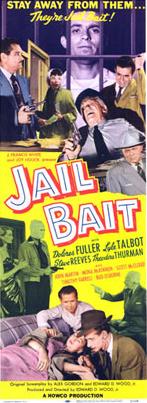
Jail Bait (1954): Schlock Noir on RetroTV.com

Jail Bait (1954)

Have some fun and enjoy this public domain copy on RetroTV.com of the 50’s schlock noir Jail Bait from the legendary Ed Wood.

Rated 2.2/10.0 on IMDB (so bad it’s good):

“She’s A Good Girl… To Leave Alone!”

Vic Brady draws young Don Gregor into a life of crime. He then blackmails Gregor’s plastic surgeon father…

‘Jail Bait’, directed by the legendary Ed Wood, is an enjoyably bad attempt at Film Noir on a shoestring budget. The cast includes Lyle Talbot, Dolores Fuller and Timothy Farrell from Wood’s classic ‘Glen Or Glenda’, as well as a very early appearance by Steve Reeves. Talbot once again plays a kindly cop, but this time Farrell is on the other side of the law, the nasty Vic Brady. Brady has corrupted Fuller’s brother Don (Clancy Malone) the middle class son of a world renowned plastic surgeon Dr. Boris Gregor (Herbert Rawlinson). We first see Don being bailed out by his sister Marilyn (Dolores Fuller) after being caught carrying an unlicensed firearm. Despite his sister’s concern and a stern lecture from Ins. Johns (Talbot), he continues to associate with small time crook Vic Brady. A robbery gone wrong results in the death of a Night Watchman. Don’s conscience gets the better of him and he intends to give himself up, but Brady has other ideas… ideas which involve Dr. Gregor’s skills as a plastic surgeon. The combination of Wood’s trademark lousy dialogue and the stilted performances of the actors (especially Malone and Fuller) with Farrell’s hammy Vic Brady and the nutty denouement make ‘Jail Bait’ a lot of fun to watch.

If you install UnPlug for Firefox you can download the movie. And don’t forget the pop-corn…

Crime Scenes: Movie Poster Art of the Film Noir

7027

I just came across this book of film noir posters from the classic period of film noir: Crime Scenes: Movie Poster Art of the Film Noir : The Classic Period : 1941-1959 by Lawrence Bassoff (Paperback).

Available from Amazon from US$20.

Blade Runner (1982): The Final Cut

Blade Runner (1982)

On December 18, Warner will release a definitive version of director Ridley Scott’s cult classic Blade Runner: The Final Cut, a fusion of film noir and science fiction The DVD set will also feature four other versions of the movie. The film will be available in both HD formats and in three different DVD editions, with the final cut also receiving select theatrical releases in New York, Los Angeles and the Venice Film Festival.  More from Variety.

Update 31 July 2007: Hollywood.com Interview with Ridley Scott on his memories of making Blade Runner.