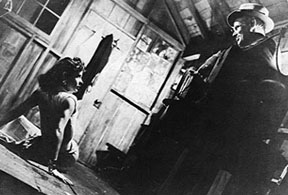
Blast Of Silence (1961): Hidden Noir

Blast Of Silence (1961): Hidden Noir

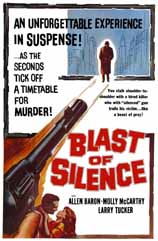
Criterion Confessions blog has an interesting review of a recent DVD release of Blast of Silence, a little known low-budget independent production from Allen Baron made in 1961:

There are films with more polish than Blast of Silence, but that’s okay. In some ways, the unsanded corners of this film put the boot into old film noir and how the bad guys were prettied up. Inside Frank Bono’s head, we hear about hate and pain and the things a man can’t escape, film noir concepts that weren’t always given those blunt terms. Shot as it was, Allen Baron’s movie brings the struggle to life, illustrating the need to get ahead and to get the filthy jobs done. The fact that Baron and Merrill and the rest got theirs done, putting together a one-two punch of a film, is illustration enough of what that means.

The Dark Self: The Origins of Film Noir

Nighthawks: Edward Hopper

Lloydville of mardecortesbaja.com has responded to my post yesterday, Light in the Shadows: Noir and Redemption:

Hibbs writes: “In its assumption that a double” — that is a “dark self” — “lurks just beneath the surface of the most ordinary individuals, noir punctures naive, conventional assumptions about human behavior.” This I think is exactly right, and I can’t understand your position that the emergence of a film tradition with this underlying theme precisely in the wake of the global catastrophe of WWII and in the shadow of nuclear annihilation had nothing to do with those phenomena. To me, the connection is self-evident, and if it’s a cliche, it’s a cliche because it’s true.

While I believe the origins of film noir lie elsewhere, this is not to say that the experience of WWII did not influence or inform the themes and development of the noir cycle in the post-war period. But the shadow of nuclear annihilation was cast only by the US until the classic noir cycle was already mature, so I don’t see this as particularly relevant.

The origins of film noir and why it flowered where and when it did are complex, and we can’t be definitive, but it is fairly evident that noir emerged before the US entered the War, and had it’s origins principally in the new wave of emigre European directors and cinematographers, who fashioned a new kind of cinema from the gangster flick of the 30’s and the pre-War hard-boiled novels of Hammett, Chandler, Cain, and Woolrich. We can also clearly see the influence of German expressionism, the burgeoning knowledge of psychology and its motifs, and precursors in the French poetic realist films of the 30’s.

Noir was not only about the other, the “dark self”, but the alienation in the modern American city manifested in psychosis, criminality, and paranoia. It was also born of an existential despair which had more to do with the desperate loneliness of urban life in the aftermath of the Depression. Cornell Woolrich, for example, was a lonely and repressed individual, who spent his life in hotel rooms, and Edwards Hopper’s study of the long lonely night in Nighthawks was painted in 1942.

Film noir was a manifestation of the fear, despair and loneliness at the core of American life apparent well before the first shot was fired in WWII.

Philip Slater prefaced his study of American culture, The Pursuit of Loneliness (1970), with these words from Paul Simon:

‘Kathy, I’m lost,’ I said,
Though I knew she was sleeping.
‘I’m empty and aching and
I don’t know why.’
Counting the cars
On the New Jersey Turnpike.
They’ve all come
To look for America.

Light in the Shadows: Noir and Redemption

Arts Of Darkness

Regular readers of FilmsNoir.Net will know of my focus on the redemptive element of film noir, and my recent concern with the nihilism in most contemporary post-noir Hollywood films.

In my recent post In the Valley of Elah (2007): Responsibility and Chaos I talk about my conception of the noir sensibility, which “must have a redemptive focus for me to value a film, whether redemption is achieved or not. This is what the great films noir have in common: a profoundly and deeply human response to the chaos and random contingency at the edge of existence”, and in the post Post-Noir: The New Hollow Men, I express the view that “too many film pundits today are happy to spout the received wisdom that film noir was a response to some pervasive (but in reality non-existent) post-WW2 trauma-cum-malaise, and then uncritically enlist this (thoroughly) conventional wisdom as some contrived justification for the plunge of contemporary American cinema into an abyss of banal fascist violence: most recently American Gangster, Death Proof, Gone Baby Gone, Before the Devil Knows You’re Dead, and No Country for Old Men“.

This is by way of introduction to a most unlikely new book on film noir: Arts of Darkness: American Noir and the Quest for Redemption by Thomas S. Hibbs, a Baylor University professor of ethics and culture and film critic for the conservative National Review Online.

I have not read the book, and I certainly don’t share the politics of the author, his reading of history, or his religious affiliations, but from what I have read about the work, it offers a novel perspective on film noir, which resonates with ideas I have previously put forward about redemption versus nihilism, though my conception of redemption has a humanist if not spiritual stamp.

In a post today on the book, Light In the Shadows, Chuck Colson from Breakpoint, a US Christian community concerned with prisoner outreach, outlines Hibbs’ thesis:

Hibbs borrows Pascal’s concept of a “hidden God” to help show the motive that drives many of the characters in film noir. Films like Double Indemnity and Maltese Falcon, Hibbs explains, show a reaction against the kind of shallow, facile optimism born out of the Enlightenment period—a mentality that taught that all things were possible through rational thinking and scientific observation. Film noir, by contrast, is all about the restraints on humans in a sinful world. It tells us that we cannot just do anything we feel like doing with impunity.

As Hibbs writes, “In its assumption that a double”—that is, “a dark self”—“lurks just beneath the surface of the most ordinary individuals, noir punctures naïve, conventional assumptions about human behavior. But the dark side is [not] liberating. . . . The characters who try to exercise a Nietzschean ‘will to power,’ to exist beyond good and evil, destroy themselves instead of triumphing.”

Before proceeding further, I must repudiate the dismissal of the Enlightenment: this is just plain wrong. No-one can accuse the father of the Enlightenment, Voltaire, of “facile optimism”. Having said this, Hibbs’ has something very interesting to say.

An excerpt from a review in National Review February 25 2008:

Hibbs writes that, although noir seems bleak and cynical on the surface, the meaning behind the phenomenon is a good deal more complex and significantly more positive: What is significant about these films is not just that they present a dark and dismal world but that they display their main characters as on a quest for love, truth, justice, and even redemption. What interests Hibbs is the convergence of noir with the religious quest : Noir arises from the same impulses that prompted Pascal to write of the hiddenness of God, and of the faithful believer who seeks with groans.

Hibbs sees noir as engaging and critiquing the two major philosophical dangers of modernity: nihilism and Gnosticism. He writes: Enlightenment theorists promise liberation from various types of external authority: familial, religious, and political. But an unintended consequence of the implementation of Enlightenment theories is the elimination of freedom. The film noir vividly expresses this truth, as the protagonists find themselves ever more deeply enmeshed in the complex, bureaucratized, soulless modern cities and webs of uncaring institutions that are the consequence of the Enlightenment passion for controlling the world through science. In portraying the tragic limitations of the Enlightenment project, Hibbs argues, noir shows liberal modernity as a potential source of nihilism, a human existence devoid of any ultimate purpose or fundamental meaning, where the great tasks of inquiry and the animating quests that inspired humanity in previous ages cease to register in the human soul, a place where the very notion of a soul is suspect.

Richard Widmark: The Outsider

Pickup On South Street

Others have posted obits and bios, and today’s New York Times obit by Douglas Martin is well worth reading. I will focus on one aspect of Richard Widmark’s craft.

My screen memories of Mr Widmark are bound up with his Westerns on B&W television during adolescence. His tough enigmatic persona in those movies resonated deeply, more than his film noir roles.

But there is a common theme: the outsider. The great westerns and noirs are essentially stories of a loner on the “outside”: whether as violent psychopath or flawed hero. Widmark inhabited such roles so well because he was an outsider himself, and this comes out clearly in the NY Times piece.

He was originally turned down for his breakthrough role in Kiss Of Death (1947) by the director, who told him that he was too “clean cut and intellectual” for the part. Throughout his life he protected his privacy and shunned the celebrity lifestyle.

I think his role in Samuel Fuller’s Pickup On South Street (1953) is his most nuanced noir performance: he profoundly portrays the psyche and persona of a petty criminal not only outside the law but outside even the criminal milieu – he lives an almost an ascetic existence in a shack on the city’s waterfront. When his “island” is threatened by a woman’s attachment he reacts with instinctual violence before she eventually draws him out.

The conversion scene in a boat moored near the shack is a no-man’s land where the b-girl and the pick-pocket traverse the narrow emotional and social confines of their existence. While we must acknowledge Fuller’s creative genius here, Widmark’s performance is pivotal.

Stranger on The Third Floor (1940): The Noir Dream-Scape

Stranger on the Third Floor (1940)The wrong guy is convicted of a murder…

Generally viewed as the first film noir, Stranger on the Third Floor, an RKO b-movie of only 64 minutes is a landmark film in a number of respects. The influence of a new generation of European expatriates and of German expressionism in the genesis of film noir is clearly evident. The screenplay is by Austro-Hungarian, Frank Partos, the director is Latvian émigré Boris Ingster, and photography is by the cult noir cinematographer, Italian-born Nicholas Musuraca.

With b-actors as leads, John McGuire as the reporter Mike Ward, and Margaret Tallichet, as his girl-friend Jane, the movie is propelled by the intelligence of the script, the strength of the direction and cinematography, and excellent turns by Peter Lorre as the Stranger and Elisha Cook Jr. as the taxi-driver accused of murder.

Between the cheesy opening and closing scenes is a tight claustrophobic thriller, where fear and paranoia is deftly portrayed both in reality and oneiristically. The nightmare sequence in this picture has to be the best dream-scape ever produced by Hollywood.

Here we have the strongest evidence supporting the thesis set out in the seminal book on film noir, A Panorama of American Film Noir, published in France in 1955, by authors Borde and Chaumeton, that films noir appeared with the emergence of a wider awareness of psychoanalysis and its motifs in America in the early 1940’s. Their analyses of their canon of the first big three post-war noirs, are centred on the films’ dream-like qualities and the emergence of protagonists with pronounced psychoses: The Big Sleep (1945), Gilda (1946), and The Lady From Shanghai (1947).

Ironically, Stranger on the Third Floor is not even mentioned by Borde and Chaumeton.

In this proto-noir, we see explored the role of the subconscious, where reporter Mike, whose testimony sways the jury, starts to question the guilt of the condemned taxi-driver, after his girl-friend Jane tells him she has a feeling that the jury has condemned an innocent man. This doubt then feeds into Mike’s paranoia about the mysterious stranger he encounters in his boarding house, and a guilt-fuelled nightmare about the fate of an obnoxious neighbor where his own sanity is put on trial.

Ingster and Musucara, and associate art director, Albert D’Agostini, as in all the great b-noirs, use set-bound budget constraints as brilliant artifice. The Caligari-like sets and the necessary noir lighting make the dream sequence profoundly surreal and compelling. The climax towards the end of the film on a tenement street set late at night builds and sustains the fear and tension in a way that even in a big-budget movie would be hard to emulate.

This picture is a revelation and is testimony to the greatness of the b-movies of the classic noir cycle. The following slideshow of frames from the movie are compelling artefacts of themselves.

This slideshow requires JavaScript.

The Maltese Falcon (1941): Love in Noir

The Maltese Falcon (1941)

The Maltese Falcon: others may argue about its place in the film noir canon, but none can question its greatness.

Sam Spade is fully the creation of Dashiell Hammett and his book informs the film totally. What John Huston and his ensemble cast did was to make the story forever theirs. Having seen the movie, one cannot imagine any of the characters as other than the players that portray them. This picture is a defining moment in film history. The Maltese Falcon takes us beyond what is on the screen into a nether world of desparate love, existential angst, mystery, and the pain of irredeemable loss.

Spade is the quintessential noir protagonist: a loner on the edge of polite society, sorely tempted to transgress but declines and is neither saved nor redeemed.

Brigid will never make up the years she will lose in prison, and Sam will never recover from the necessary betrayal of their love. For Sam and Brigid are truly lovers. Sam was not seduced. Brigid is not a femme-fatale: she manipulates Sam, but never seeks to have him act as her surrogate. Together they discover the desperate emptiness of their lives. She true to her nature can’t comprehend how he can send her down if he loves her. He can’t fathom her lying while knowing she loves him.

The famous ad-lib by Bogart on the leaden black bird at the end says it all … the stuff that dreams are made of.

In the Valley of Elah (2007): Responsibility and Chaos

What is Film Noir? There as many answers as there are noir movies.

I consider a film for posting to FilmsNoir.Net only some time after a recent viewing. I want the film to return to my memory on its own terms, and when this happens, it is more often than not, a response to what I describe as the picture’s noir sensibility. This sensibility must have a redemptive focus for me to value a film, whether redemption is achieved or not. This is what the great films noir have in common: a profoundly and deeply human response to the chaos and random contingency at the edge of existence.

It is with this in mind that I am posting on the recent release: In The Valley of Elah (2007). On the surface it is a police procedural framed against US soldiers returning from the Iraq war. On a deeper level it is an exploration of contingencies and responsibility.

Three crimes: the heinous unnecessary invasion of Iraq, the brutal killing of a child by a US humvee on the streets of Baghdad, and the gruesome murder of a returning soldier on the outskirts of an American army town, bring chaos to the life of a father, who no longer understands his son or his country and its institutions. Everything including the American flag is upside-down.

This film is the true heritage of film noir, not banal and unredeemably violent films such as No Country For Old Men.

In The Valley of Elah (2007)

The Air I Breathe (2007): Noir Liberation

The Air I Breathe (2007)

James Ellory, in the documentary film, Film Noir: Bringing Darkness to Light (2006) says of film noir of the classic period: [film noir] exposited one great theme, and that great theme is “your fucked”.

Jieho Lee’s The Air I Breathe (2007), is a very unusual Hollywood movie that goes beyond genre and episodically explores dark and mystical motifs: memory, love, violence, criminality, ambition, alienation, urban ennui and existential angst, causality, serendipity, and even the butterfly effect cum six degrees of separation. The episodes are based on an ancient Chinese proverb that breaks life down into four elements:

happiness: clerk (Forest Whitaker) bets his life on a horse race
pleasure: criminal enforcer (Brendan Fraser) sees the future
sorrow: pop star (Sarah Michelle Gellar) is caught in the ultra-violent web of crime boss “Fingers” (Andy Garcia)
love: a doctor (Kevin Bacon) must save the life of his lost love (Julie Delpy).

The film opens with happiness. A timid clerk in an office job who has always done the right thing is lonely and unhappy, desperately sees money as a way out to happiness (sound familiar?). After waking that morning from a nightmare to see a butterfly fly into his bedroom, he surreptitiously overhears office colleagues who are betting on a fixed horse race, with “Butterfly” to win. He places a $50,000 off-course bet and (yeah) the horse takes a dive and he does his dough. He is now in hock to Fingers, and has two weeks to make good his bet, before he starts losing his fingers. Fingers’ stand-over man gives him a gun on a “home visit” as some kind of solution.

The Air I Breathe (2007)

The clerk’s voice-over in the next scene begins: “Sometimes being totally fucked can be a liberating experience…” and then he lays out his plan for a bank heist, which has nowhere to go but wrong, and he dies in a hail of police bullets on the roof of an office building, but not before he throws the bag with the bank money over the side of the building, laughing deeply and profoundly in a dervish-er whirl of liberation…

There is an interesting related post by Lloydville on his mardecortesbaja.com blog: The Message Of Film Noir.

Union Station (1950): On Ice in the Train Shed

Union Station (1950)

Police manhunt for a kidnapped blind girl

Union Station (1950) directed byRudolph Mate is a period crime action movie set in Chicago that marks the transition from the classic period of film noir to the 50’s police procedural. While the picture is weakened by a conventional plot and a fairly laconic performance from William Holden as the railway cop, the location shooting (actually on the streets of LA) has a “naked city” feel and the action played out in Union Station is made interesting by certain noirish episodes.

A truly bungled surveillance op on an elevated railway line climaxes in a cattle stockyard where a chase and shootout leaves one of the hoods trampled to death after a stampede set-off by the gun-fire.

Union Station (1950) Union Station (1950)

A second hood spills the beans to the cops after he is taken down to the train shed to be worked-over and threatened with decapitation by steam train.

Union Station (1950) Union Station (1950)

The final chase and shootout in the labyrinthine power plant and service tunnels under Union Station is a classic, with superior direction and camera work.

Union Station (1950) Union Station (1950)

But the really impressive scene is when the cops arrive late at night on a deserted street outside a suspected hideout in a sleazy boarding house. It flows elegantly and has a strongly surreal quality without musical scoring.

Union Station (1950) Union Station (1950)Union Station (1950) Union Station (1950)

[piclens-lite-link]

The Prowler (1951): The Dark Side of the American Dream

The Prowler (1951)

Homme-fatale, Van Heflin, seduces lonely housewife, Evelyn Keyes, and murders her husband for the woman and the inheritance. The dirty underbelly of the American dream exposed to scourging desert winds.

The screenplay of Joseph Losey’s The Prowler (1951 – Horizon Pictures), was written by blacklisted screenwriter Dalton Trumbo, who also wrote another film noir script, Gun Crazy (1950). The Prowler is a sordid tale of passion, entrapment, and betrayal. Suburbia cast as a dark nightmare, where the predator comes disguised as protector. Bravura performances from the two leads carry a flawed script forward to a classic denouement at the base of a tailings dump on the dusty outskirts of a ghost-town.  Losey’s direction is unforgiving. Each squalid act of the protagonist is forecast in tight claustrophobic framing that is almost suffocating. Finally justice propels the action out into the desert.

The Prowler (1951) The Prowler (1951)

The Prowler (1951) The Prowler (1951)

The Prowler (1951) The Prowler (1951)