Cinematic Cities: Paris Noir 2

Voici le temps des assassins... (1956)

Voici le temps des assassins… ( Deadlier Than the Male  – France 1956)
Director  Julien Duvivier   |   DP  Armand Thirard

Very young and twisted femme-fatale Danièle Delorme guided by her off-the-wall user mother very nearly destroys Jean Gabin as besotted Paris restauranter of a certain age. The denouement while not graphic is a bitch…

Christ in Concrete: Not on Wall Street

Christ in Concrete by Pietro Di Donato

There is a certain irony in this excerpt from the novel by Italo-American Pietro Di Donato, Christ in Concrete (1939), a story of Italian immigrant building workers and their families in Brooklyn during the Depression. In 1949 a film adaptation of  the novel by director Edward Dmytryk, featured teeming tenements and residential streets shot with a provocatively gritty realism and film noir atmospherics. A powerful leftist denunciation of capitalism, the picture had to be filmed in the UK, and was buried a few days after its US release by a reactionary backlash. The film is the closest an Anglo-American movie ever got to the aesthetic and socialist outlook of Italian neo-realism. My review of the movie last Easter is here.

Hôtel du Nord (France 1938): Arletty as femme noir

Hotel du Nord (1938)

Marcel Carne’s Hotel Du Nord is seen as part of a trilogy that encompasses two other of his films from the 1930s: Le quai des brumes (Port of Shadows 1938) and Le jour se lève (Daybreak  1939).  These films represent what has been termed ‘poetic realism’, a gritty fatalistic French cycle of films seen as a precursor of the classic film noir cycle, with a male protagonist failing dismally to escape a dark past with a doomed romantic entanglement.  Unlike the other two movies, Hotel du Nord is not based on a script from Carne’s famed collaborator, Jacques Prévert, but by scenarist Jean Aurenche, which some critics see as a weakness. The film has on the surface a lighter touch, and much of the dialog crackles with simple humanity,  jokes and good-natured innuendo.  But there are deeper layers of meaning, and these come from the screenplay.

The scenario revolves around the daily dramas of a not-so-grande hotel in downtown Paris. Amongst others, of principal interest for me are the indomitable Arletty as a b-girl shacked up with a hood, played by Louis Jouvet with world-weary elegance, who is in hiding after ratting on an accomplice.  The story revolves around a botched suicide pact between a pair of young lovers, and the dénouement is driven by the arrival of Jouvet’s framed accomplice out for revenge.  The whole affair plays out in front of the real Hotel du Nord and in a magnificent studio lot, complete with a canal, bridges, trams, village shops, and the Hotel,  conceived by art director, Alexandre Trauner, who also worked on Carne’s masterpiece, Les enfant du Paradis (1945).  Maurice Jaubert’s deeply romantic and evocative score completes the scene.

Hotel du Nord (1938)

Aurenche’s script and Carne’s mis-en-scene develop a duality: the generosity and humanity of daily life versus the dark flip-side of angst, cowardice, and cruelty. Goodness nurtures healing and reconciliation, while falsity and lies breed suffering and terrible revenge.  When the hood Jouvet declares his love for a young woman and failed-suicide, Renée, he proposes as ‘Robert’, the man he was before he became a criminal and who then took on another bi-polar identity to hide from his pursuer –  love demands purity of intent and the grace he desperately seeks to recover –  fate however, has other ideas.  Jouvert as the squealer  ‘Paulo’ was a shy bumbling petty-crook scared of blood, and now in hiding as ‘Monsieur Edmond’ he is a severe dandy who kills chickens for local housewives by strangling them with his bare hands.  Arletty’s whore Raymonde is engaging, tolerant, and sharp, with a seeming heart of gold. But her final revenge as spurned lover is a dark act of treachery.

Raymonde survives without regrets between the sheets of a more compliant lover, Robert’s ultimate self-abnegation is absurd rather than tragic, and the final reconciliation of the young lovers in the closing scene is more fantasy than real.  As dark as any noir.

The Face Behind the Mask (1941): Iconic proto-noir

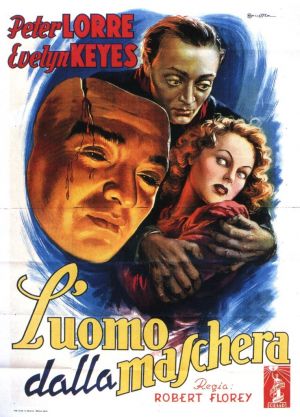
The Face Behind the Mask (1941)

The Face Behind the Mask (RKO 1940 69 mins) has a strong claim to being the first true noir of the classic cycle.  Until recently I like many others gave this accolade to another b-movie from a year earlier: Stranger on the Third Floor (Columbia 1940 64 mins).  It is interesting that both films  star Peter Lorre.

Stranger on the Third Floor was a landmark film in a number of respects. The influence of a new generation of European expatriates and of German expressionism in the genesis of film noir is clearly evident. The screenplay is by Austro-Hungarian, Frank Partos, the director is Latvian émigré Boris Ingster, and photography is by the cult noir cinematographer, Italian-born Nicholas Musuraca. Between the cheesy opening and closing scenes is a tight claustrophobic thriller, where fear and paranoia is deftly portrayed both in reality and oneiristically. The nightmare sequence in this picture has to be perhaps the best dream-scape ever produced by Hollywood. We have here strong evidence supporting the view that noirs appeared with the emergence of a wider awareness of psychoanalysis and its motifs in America in the early 1940’s. In this proto-noir the role of the subconscious is explored.  A newspaper reporter, whose court testimony has condemned a taxi-driver for murder, begins to doubt the guilt of the condemned man. This anxiety feeds into paranoia about a mysterious stranger he encounters in his boarding house, triggering a guilt-fuelled nightmare about the fate of an obnoxious neighbor where his own sanity is put on trial. Ingster and Musucara, and associate art director, Albert D’Agostini, as in all the great b-noirs, use set-bound budget constraints as brilliant artifice. The Caligari-like sets and the necessary noir lighting make the dream sequence profoundly surreal and compelling. But there is not the despairing bleakness of  The Face Behind the Mask.

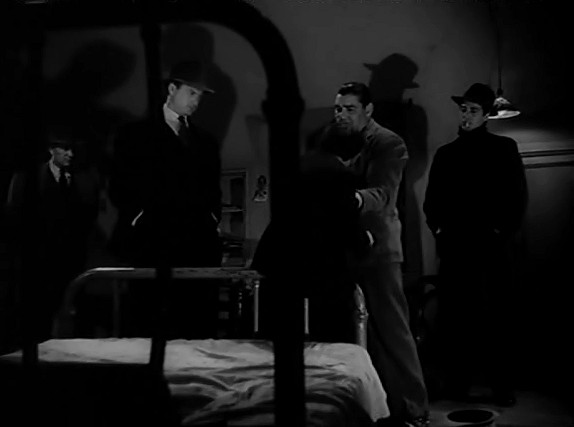
The Face Behind the Mask (1941)

The Face Behind the Mask was made by b-director, Robert Florey, and lensed by the under-appreciated Franz Planer. There is a true gestalt operating here, the work of this team here is much more than you would expect from journeyman Florey.  The script (from a story by Arthur Levinson) is by Paul Jarrico, who was later blacklisted in the wake of  the HUAC witch-hunt.   What distinguishes  this picture is the pervasive mood of  life ransomed to chaotic fate, and the dire consequences of  social exclusion and injustice.  The Face Behind the Mask is an iconic proto-noir which presages the motifs of a score of later noirs.  There is no redemption or hope.  A bleak ending where Lorre’s  protagonist must wreak his own terrible vengeance on his persecutors and fate itself  heralds the coming of classic noir.

Some may say the story is pure melodrama and contrived, and this is hard to refute, but the film goes far beyond these limitations to reach a sort of pulp integrity. A young man from Europe lands in New York full of dreams and boisterous love for his new homeland. A tragedy destroys those dreams.  An uncaring society built on inequality and with no safety net steers him ineluctably to a life of crime as the boss of a heist gang.  He gets a chance at redemption, but his sins have to be paid for.

Lorre is powerful as a man who must battle his own decency to overcome malevolent fate.  He is ably supported by b-stalwart George E. Stone, as his buddy-in-crime, with a wonderful performance from a 24-yo Evelyn Keyes as a young blind woman: her portrayal is the closest to angelic I have ever seen on film.  The economy and tautness of Florey’s direction is inspired.  You never actually see a robbery.  The progress of Lorre’s career as hoodlum is shown in a deft montage of dramatic newspaper headlines and scenes of cops berated for their failure to bring the gang to justice – imposed by the economics of the b picture yes – but still impressive.  When the tragic denouement begins to unravel, Florey and Planer give us innovative low-angle Dutch framing shots to telegraph the disturbances to come.  The American dream becomes a nightmare for a man who must steal to pay for a doctor to visit his sick friend.  Plus ca change plus la meme chose.

This  gutsy-b with ‘body and soul’ is a must see.

Film Noir: Forthcoming Books

Cover for 'The Film Noir Encyclopedia'

The Film Noir Encyclopedia (new editon)
Alain Silver; Elizabeth Ward; James Ursini; Robert Porfirio
Release Date: May 13th, 2010  Pre-Order

Film Noir, American Workers, and Postwar Hollywood (Working in the Americas)
Prof. Dennis Broe
Release Date: April 1st, 2010  Pre-Order

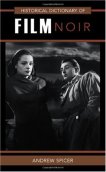
Cover for 'Historical Dictionary of Film Noir'
Historical Dictionary of Film Noir
Andrew Spicer
Release Date: April 15th, 2010  Pre-Order

Film Noir and the Portrait

Laura (1944)
Laura (1944)

I recently started reading a ‘heavy’ tome by feminist academic Susan Felleman, Art in the Cinematic Imagination (University of Texas Press, 2006), and found her discussion of the portrait as a central motif  in certain films noir worth sharing.

The portraits, too inert and non narrative to realistically inspire such identification within a realist scenario, threaten the viewer with awareness of the magic of the mimetic and narrative devices employed by the film itself to engage him or her. This is very much a danger in a number of movies in which the portrait assumes a more explicit role and is incorporated into narratives whose realism is strained by, if not abandoned to, psychological or supernatural treatment of mortal desire. In Otto Preminger’s Laura and Fritz Lang’s The Woman in the Window, both from 1944, the male protagonists fall in love with portraits of beautiful women. In Laura, it is ambiguous, at first, when Detective McPherson (Dana Andrews) falls asleep beneath the portrait of Laura (Gene Tierney)—his desire for which has been established—and then awakens to the ‘‘real’’ Laura, presumed dead, whether or not he is dreaming. This ambiguity is a function, as [scholar] Reynold Humphries has indicated, of the uncanny: ‘‘The irruption of Laura the woman into the privileged space of Laura the portrait is not just a question of a return from the dead but rather of a return of the repressed.’’   Humphries aptly relates this to the even more explicit scenario of The Woman in the Window, in which the entire narrative, stemming from Professor Wanley’s fascination with the portrait, is revealed—only finally—as a dream: a dream in which mortal terror and death are conceived as the inevitable outcome of his desire.

Film noir’s peculiar amalgam of sexual angst,morbidity, and the portrait may well find its apogee in another Fritz Lang film, Scarlet Street (1945), in the painfully ironic scene in which the defeated and dispossessed portraitist (Edward G.Robinson) witnesses the sale of what might be called his ‘‘self-portrait as femme fatale,’’ that is, the portrait Chris painted of Kitty ( Joan Bennett) that was exhibited as her self-portrait. The cadaverous image of the woman who stole his meager self-respect, along with the authorship of the painting, and whom he murdered in a fit of sexual jealousy, is borne, funereally, out of the gallery and past the painter, as he shuffles past in a schizophrenic oblivion. The pathological possibilities of mimesis and its subject-object confusions reach so fevered a pitch in Scarlet Street that it’s hard to imagine a sicker scenario…” (pp 17-18).

On reading this passage, the thought came to me, and I don’t claim that I am the first to have had this ‘revelation’,  that in Laura, Detective McPherson doesn’t actually wake-up to be greeted by the living Laura but dreams what he subconsciously desires – that Laura is not dead but alive.   To this ambiguity challenged by necromancy, add Felleman’s bizarre description of  “[his ]self-portrait as femme fatale”!

New on DVD: Bad Girls of Film Noir

Bad Girls Vol 1Bad Girls Vol 2

Sony has released a new twin DVD-set of 8 b-girl movies from the Columbia vaults titled Bad Girls of Film Noir.  Mostly pot-boilers, but Night Editor is a must-have cult noir.

Volume 1

Evelyne Keys
The Killer That Stalked New York (1950) directed by Earl McEnvoy

Lizabeth Scott
Two of A Kind (1951) directed by Henry Levin
Bad for Each Other (1953) directed by Irvin Rapper

Gloria Grahame
The Glass Wall (1953) directed by Maxwell Shane

Volume 2

Cleo Moore
Night Editor (1946) directed by Henry Levin
One Girl’s Confession (1953) directed by Hugo Haas
Over-Exposed (1956) directed by Lewis Seiler

Ida Lupino/Cleo Moore/JanSterling/Audrey Totter
Women’s Prison (1956) directed by Lewis Seiler

Re-Focusing Film Noir

The Big Sleep

After some recent reading on film noir, I am re-focusing my approach to film noir, and this re-appraisal will influence my coming film noir reviews.

If we go back to the hard-boiled detective novels of Dashiell Hammett and Raymond Chandler, we find protagonists who are essentially outsiders with personas concerned not with redemption but with maintaining a stasis that is outside the mainstream in an existential sense.  Sam Spade and Philip Marlowe are not concerned with money or status, conventional relationships, or necessarily following the letter of the law.  These guys are loners. Independent men above banal striving and ambition, but loyal to a code that not only guides but defines them.  While the PI works at the perimeter of convention, his realm goes beyond the dark sordid recesses of criminality to the rotten core of polite society.  Death-in-life is their métier, and integrity their salvation.  But this integrity and independence casts them adrift. They are of society but not anchored in it. Their alienation is knowing and desperate:  capitulation is existential death.  These guys are subversives as film noir is subversive:  a losing battle against chaos. Nietzche was wrong: superman is a ‘loser’. The loser is outside society, his alienation is a positive reverse-psychosis, he maintains his sanity in a crazy urban nightmare only by his detachment, yet he despairs of it.  Ambivalence and entrapment the cost.

L.A. 1939: Ask the dust

MaxYavno-Underneath-Third-Avenue-El-1938
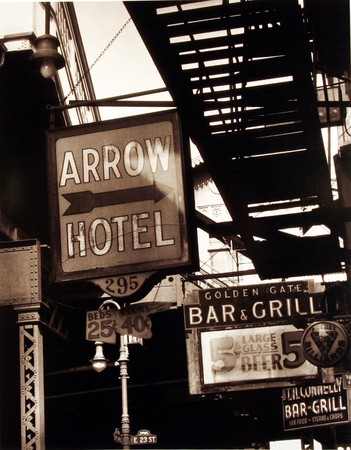
Max Yavno (Los Angeles: Underneath Third Avenue El –  1938)

I am currently reading a very interesting book, Unless the Threat of Death Is Behind Them: Hard-Boiled Fiction and Film Noir (2006 The Johns Hopkins University Press) by John T. Irwin, which studies five novels and the films based on them – The Maltese Falcon, The Big Sleep, Double Indemnity, High Sierra, and Night Has a Thousand Eyes.  Irwin’s thesis seems to be that noir is concerned with death metaphysically as life-in-being and death also in an existential sense bred of social alienation.  The following excerpts for me express the kind of prose Irwin is concerned with, and are passages from my own reading that have particularly struck me as being relevant.

“I went up to my room, up the dusty stairs of Bunker Hill, past the soot-covered frame buildings along that dark street, sand and oil and grease choking the futile palm trees standing like dying prisoners, chained to a little plot of ground with black pavement hiding their feet. Dust and old buildings and old people sitting at windows, old people tottering out of doors, old people moving painfully along the dark street. The old folk from Indiana and Iowa and Illinois, from Boston and Kansas City and Des Moines, they sold their homes and their stores, and they came here by train and by automobile to the land of sunshine, to die in the sun, with just enough money to live until the sun killed them, tore themselves out by the roots in their last days, deserted the smug prosperity of Kansas City and Chicago and Peoria to find a place in the sun. And when they got here they found that other and greater thieves had already taken possession, that even the sun belonged to the others; Smith and Jones and Parker, druggist, banker, baker, dust of Chicago and Cincinnati and Cleveland on their shoes, doomed to die in the sun, a few dollars in the bank, enough to subscribe to the Los Angeles Times, enough to keep alive the illusion that this was paradise, that their little papier-mache homes were castles. The uprooted ones, the empty sad folks, the old and the young folks, the folks from back home. These were my countrymen, these were the new Californians. With their bright polo shirts and sunglasses, they were in paradise, they belonged. But down on Main Street, down on Towne and San Pedro, and for a mile on lower Fifth Street were the tens of thousands of others; they couldn’t afford sunglasses or a four-bit polo shirt and they hid in the alleys by day and slunk off to flop houses by night. A cop won’t pick you up for vagrancy in Los Angeles if you wear a fancy polo shirt and a pair of sunglasses. But if there is dust on your shoes and that sweater you wear is thick like the sweaters they wear in the snow countries, he’ll grab you. So get yourselves a polo shirt boys, and a pair of sunglasses, and white shoes, if you can. Be collegiate. It’ll get you anyway. After a while, after big doses of the Times and the Examiner, you too will whoop it up for the sunny south. You’ll eat hamburgers year after year and live in dusty, vermin-infested apartments and hotels, but every morning you’ll see the mighty sun, the eternal blue of the sky, and the streets will be full of sleek women you never will possess, and the hot semi-tropical nights will reek of romance, you’ll never have, but you’ll still be in paradise, boys, in the land of sunshine.”

– John Fante, Ask the Dust (1939)

“No feelings at all was exactly right. I was as hollow and empty as the spaces between the stars. . . . Out there in the night of a thousand crimes people were dying, being maimed, cut by flying glass, crushed against steering wheels or under heavy tires. People were being beaten, robbed, strangled, raped, and murdered. People were hungry, sick; bored, desperate with loneliness or remorse or fear, angry, cruel, feverish, shaken by sobs. A city no worse than others, a city rich and vigorous and full of pride, a city lost and beaten and full of emptiness. It all depends on where you sit and what your own private score is. I didn’t have one. I didn’t care.”

– Raymond Chandler, The Big Sleep (1939)

Noir Digest: Noir City 2010

Noir City 2010

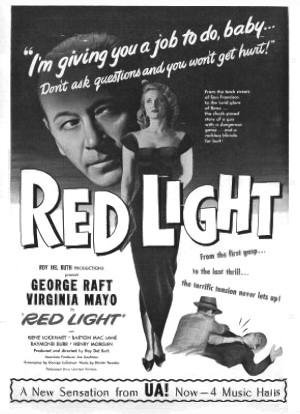
Red Light (1949)

San Francisco’s NOIR CITY 8 film noir series returns to San Francisco’s Castro Theatre January 22-31 2010. The full program is here.

Movies not on DVD on the program:

FLY BY NIGHT (1942) Dir. Robert Siodmak
DEPORTED (1950) Dir. Robert Siodmak
CRY DANGER (1951) Dir. Robert Parrish, newly restored
THE MOB (1951) Dir. Robert Parish
THE GANGSTER (1947) Dir. Gordon Wiles
HE RAN ALL THE WAY (1951) Dir. John Berry
ONE GIRLS’ CONFESSION (1953) Dir. Hugo Haas
WOMEN’S PRISON (1955) Lewis Seiler
RED LIGHT (1949) Dir. Roy Del Ruth
WALK A CROOKED MILE (1948) Dir. Gordon Douglas
SLATTERY’S HURRICANE (1949) Dir. Andr? de Toth
INSIDE JOB (1946) Dir. Jean Yarbrough
HUMAN DESIRE (1954) Dir. Fritz Lang
ESCAPE IN THE FOG (1945) Dir. Budd Boetticher
  • FLY BY NIGHT (1942) Dir. Robert Siodmak
  • DEPORTED (1950) Dir. Robert Siodmak
  • CRY DANGER (1951) Dir. Robert Parrish, newly restored
  • THE MOB (1951) Dir. Robert Parish
  • THE GANGSTER (1947) Dir. Gordon Wiles
  • HE RAN ALL THE WAY (1951) Dir. John Berry
  • ONE GIRLS’ CONFESSION (1953) Dir. Hugo Haas
  • WOMEN’S PRISON (1955) Lewis Seiler
  • RED LIGHT (1949) Dir. Roy Del Ruth
  • WALK A CROOKED MILE (1948) Dir. Gordon Douglas
  • SLATTERY’S HURRICANE (1949) Dir. Andr? de Toth
  • INSIDE JOB (1946) Dir. Jean Yarbrough
  • HUMAN DESIRE (1954) Dir. Fritz Lang
  • ESCAPE IN THE FOG (1945) Dir. Budd Boetticher

Columbia Noir DVD Set

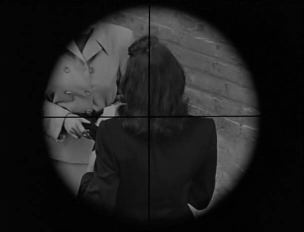
The Sniper

Columbia Pictures Film Noir Classics, Vol. 1 a new noir collectors DVD set has just been released. The films in the set:

  • The Big Heat
  • 5 Against the House
  • The Lineup
  • Murder by Contract
  • The Sniper

The special features include commentaries by Michael Man, Martin Scorsese, Christopher Nolan, Eddie Muller, and James Ellroy.