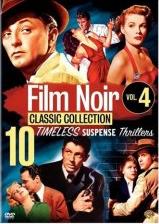
New DVD Set: Film Noir Classic Collection Vol. 4

Films Noir Collection DVD

On July 31, Warner Home Video, will release Film Noir Classic Collection, Vol. 4, which contains a bumper 10 remastered movies on five double DVDs from the classic film noir period of the 40s and 50s:

Act of Violence / Mystery Street
Crime Wave / Decoy
Illegal / The Big Steal
They Live By Night / Side Street
Where Danger Lives / Tension

Each DVD in the set can be purchased separately.

The DVD release has reviewed by Glenn Erickson of DVDTalk.Com, with a focus on They Live By Night and Side Street.

Update 7 Aug 2007: Decoy has been has been reviewed on Noir Of the Week.
Update 8 Aug 2007: All movies on the DVD are reviewed in filmjournal.net by clydefro.
Update 9 Aug 2007: All movies on the DVD are reviewed by Adnan Tezer at dvd.monstersandcritics.com.
Update 13 Aug 2007: All movies on the DVD are reviewed by dvdverdict.com.
Update 14 Aug 2007: All movies on the DVD are reviewed by The Shelf DVD Reviews.
Update 21 Aug 2007: All movies on the DVD are reviewed by Film Forno.
Update 9 Sep 2007: An interesting review of the DVD and film noir generally by Cullen Gallagher of The Brooklyn Rail.

These movies are a feast for noir fans with many of the top-level directors and stars of the period featured:
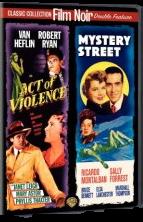
Act Of Violence / Mystery Street

Act of Violence (1948)
Cast:
Van Heflin, Robert Ryan, Janet Leigh, Mary Astor, Phyllis Thaxter
Director: Fred Zinnemann
War veteran Frank Enley seems to be a happily married small-town citizen until he realises Joe Parkson is in town. It seems Parkson is out for revenge because of something that happened in a German POW camp, and when a frightened Enley suddenly leaves for a convention in L.A., Parkson is close behind.

Mystery Street (1950)
Cast:
Ricardo Montalban, Sally Forrest, Bruce Bennett, Elsa Lanchester, Marshall Thompson
Director: John Sturges
Vivian, a B-girl working at “The Grass Skirt,” is being brushed off by her rich, married boyfriend. To confront him, she hijacks drunken customer Henry Shanway and his car from Boston to Cape Cod, where she strands Henry…and is never seen again. Months later, a skeleton is found (sans clothes or clues) on a lonely Cape Cod beach. Using the macabre expertise of Harvard forensic specialist Dr. McAdoo, Lt. Pete Morales must work back from bones to the victim’s identity, history, and killer. Will he succeed in time to save an innocent suspect?
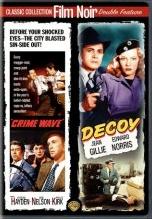
Crime Wave / Decoy

Crime Wave (1954)
Cast:
Sterling Hayden, Gene Nelson, Phyllis Kirk, Ted de Corsia, Charles Bronson
Director: André De Toth
Three San Quentin escapees kill a cop in a gas-station holdup. Wounded, Morgan flees through black-shadowed streets to the handiest refuge: with former cellmate Steve Lacey, who’s paroled, with a new life and lovely wife, and can’t afford to be caught associating with old cronies. But homicide detective Sims wants to use Steve to help him catch Penny and Hastings, who in turn extort his help in a bank job. Is there no way out for Steve?

Decoy (1946)
Cast: Jean Gillie, Edward Norris, Robert Armstrong, Herbert Rudley, Sheldon Leonard
Director: Jack Bernhard
Gangster Frank Olins (Robert Armstrong) is to die in the gas chamber much to the dismay of his girlfriend Margot Shelby (Jean Gillie) as he is carrying the secret of the location of $400,000 with him. Margot seduces gangster Jim Vincent (Edward Norris) to get him to engineer the removal of Olins’ body from the prison immediately after he dies in the gas chamber. She takes prison doctor Craig (Herbert Rudley) away from his nurse/girl friend (Marjorie Woodworth) and gets him to administer an antidote for cyanide gas poisoning. During the removal of Olins’ body, the hearse driver is killed by Tommy (Phil Van Zandt). The revived Olins gives Margot half of a map showing the money location and Vincent, in a fit of jealousy, kills Olins and takes the other half. Because the doctor’s plates on his car will get them through the police roadblocks, Vincent and Margot take him with them on the money hunt.
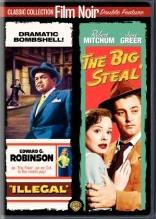
Illegal / The Big Steal

Illegal (1955)
Cast: Edward G. Robinson, Nina Foch, Hugh Marlowe, Robert Ellenstein, DeForest Kelley
Director: Lewis Allen
Ambitious D.A. Victor Scott zealously prosecutes Ed Clary for a woman’s murder. But as Clary walks “the last mile” to the electric chair, Scott receives evidence that exonerates the condemned man. Realizing that he’s made a terrible mistake he tries to stop the execution but is too late. Humbled by his grievous misjudgement, Scott resigns as a prosecutor. Entering private practice, he employs the same cunning that made his reputation and draws the attention of mob kingpin, Frank Garland. The mobster succeeds in bribing Scott into representing one of his stooges on a murder rap and Scott, in a grand display of courtroom theatrics, wins the case. But soon Scott finds himself embroiled in dirty mob politics. The situation becomes intolerable when his former protégé in the D.A.’s office is charged with a murder that seems to implicate her as an informant to the Garland mob. Can Victor defend the woman he secretly loves and also keep his life?

The Big Steal (1949)
Cast:
Robert Mitchum, Jane Greer, William Bendix, Patrick Knowles, Ramon Novarro
Director: Don Siegel
Jane and Duke (alias Capt. Blake) accidentally meet in Vera Cruz while chasing flim-flam man Fiske. Soon the local Inspector General (El Gato) is involved. Fiske races across Mexico, pursued by Jane and Duke, trailed by the real Capt. Blake. The crafty Inspector General is waiting for them in Tihuacan but they all give him the slip, just in time for the climactic finale. Very tight script and pacing.
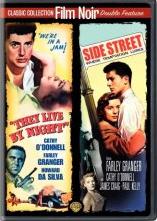
They Live By Night / Side Street

They Live by Night (1948
Cast:
Farley Granger, Cathy O’Donnell, Howard Da Silva, Jay C. Flippen, Helen Craig
Director: Nicholas Ray
In the ’30s, three prisoners flee from a state prison farm in Mississippi. Among them is 23-yo Bowie, who spent the last seven years in prison and now hopes to be able to prove his innocence or retire to a home in the mountains and live in peace together with his new love, Kitty. But his criminal companions persuade him to participate in several heists, and soon the police believe him to be their leader and go after “Bowie the Kid” harder than ever.

Side Street (1950)
Cast:
Farley Granger, Cathy O’Donnell, James Craig, Paul Kelly, Jean Hagen
Director: Anthony Mann
Joe Norson, a poor letter carrier with a sweet, pregnant wife, yields to momentary temptation and steals $30,000 belonging to a pair of ruthless blackmailers who won’t stop at murder. After a few days of soul-searching, Joe offers to return the money, only to find that the “friend” he left it with has absconded. Now every move Joe makes plunges him deeper into trouble, as he’s pursued and pursuing through the shadowy, sinister side of New York.
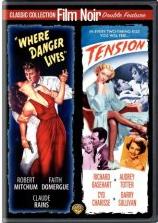
Where Danger Lives / Tension

Where Danger Lives (1950)
Cast: Robert Mitchum, Faith Domergue, Claude Rains, Maureen O’Sullivan, Charles Kemper
Director: John Farrow
One night at the hospital, young doctor Jeff Cameron meets Margo, who’s brought in after a suicide attempt. He quickly falls for her and they become romantically involved, but it turns out that Margo is married. At a confrontation, Margo’s husband accidentally gets killed and Jeff and Margo flee. Heading for Mexico, they try to outrun the law.

Tension (1950)
Cast: Richard Basehart, Audrey Totter, Cyd Charisse, Barry Sullivan, Lloyd Gough
Director: John Berry
A mousy drugstore manager turns killer after his conniving wife leaves him for another man. He devises a complex plan, which involves assuming a new identity, to make it look like someone else murdered her new boyfriend. Things take an unexpected turn when someone else commits the murder first and he becomes the prime suspect.
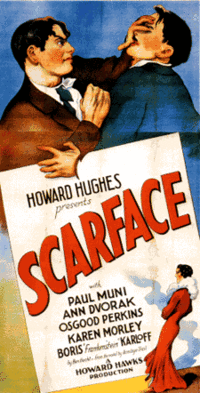
New DVD: Scarface (1932)

Scarface 1932

Scarface (1932) directed by Howard Hawks and starring Paul Muni, the proto-ganster flick, has just been released on DVD from a pristine transfer. Buy the DVD

The New York Times review yesterday by David Kehr:

this is the greatest of the early-30s gangster films. Paul Muni, in what would remain his most uninhibited performance, is the simian title character, a thinly disguised Al Capone who machine-guns his way to the top of the Chicago rackets. (In a darkly playful touch, each of his assassinations is marked, somewhere in the frame, by an X.) Universal has made a new transfer of this essential title, making it available for the first time on DVD apart from its perverse inclusion as an extra in the deluxe edition of Brian De Palma’s dimly satirical, ultraviolent 1983 remake with Al Pacino.

Hawks’ film begins as an uncomfortably exhilarating comedy about the joys of unchecked desire, and ends as an expressionistic horror movie with howls of madness and intimations of incest. This disc includes a censor-pleasing alternate ending in which Muni’s Tony Camonte is caught, convicted and hanged, instead of going down, still a compelling force of nature, in the heat of battle.

Scarface 1932

New DVD: Ace In The Hole (1951)

Ace In The Hole (1951)

A new Criterion DVD of the classic film noir, Ace in the Hole (1951), directed by Billy Wilder and starring Kirk Douglas, is now out and has been reviewed by Lou Lumenick in the New York Post:

“It’s dark for 2007, let alone for 1951,” says Spike Lee, who admits to stealing the flick’s famous last shot – stricken star Kirk Douglas falling, his eye within inches of the camera – for “Malcolm X.” More

Spike Lee is featured in one of the many special features on the DVD, which include a 1980 feature-length documentary on Wilder and vintage interviews with Wilder and Kirk Douglas.

Update 20 July 2007: Two more reviews of this DVD release have appeared:

Wilder’s Bleak Commentary Comes Up Ace by Chris Garcia on Austin360.com –

Some call it satire. If so, it’s satire of the bleakest stripe. It is certainly “newspaper noir,” a sub-genre marked by tough, ink-stained downers like “Sweet Smell of Success” and “Underworld Story” that expose the power of the press when it’s gone sour and scheming.

Noir’s window into American society is filthy but clear. “Ace in the Hole” presents more than a view through it. It offers a timely reflection, pushing the movie past a crack thriller and grim character study to something elegiac and urgent.

Presence of Malice by Jack Shafer on SLATE –

“Ace in the Hole” disturbs journalists because they recognize too much of themselves and their colleagues in the film’s loathsome protagonist, Charles Tatum (Kirk Douglas). Like most classic film noir tough guys, Tatum is running from a sordid past. He’s stranded in Albuquerque with no money and a car with bad tires and a burned bearing, so he ambles into the Sun-Bulletin office and pitches the straight-laced editor for a job…

New DVD – James Ellroy: American Dog

LA Confidential

DVD Savant, Glenn Erickson, reviews this new DVD on noir novelist, James Ellroy, who penned LA Confidential:

Arte’s DVD of James Ellroy: “American Dog” is an excellent presentation of a show with a beautiful look; the views of Los Angeles are a slick tour of a noir city. The audio is good and the music editorial excellent, with those classical pieces weaving in and out of Ellroy’s edgy speeches. An extras menu leads to several interesting sidebar videos. Two dinner conversations with Ellroy and his friends (Rick Jackson, Bruce Wagner, Dana Delaney, Joe and Matthew Carnahan, Michelle Grace) at the Pacific Dining Car are followed by a 2005 reading of American Tabloid at the Hammer Museum by Ellroy, Bruce Wagner and Dana Delany. Ellroy is presented with the ‘Jack Webb Award’ by the LAPD, an honor that must have been a prelude to the film’s interview with the oddly worshipful Chief Bratton. Galleries of vintage L.A. postcards, and gruesome crime scene photos finish the presentation. More

New Edition of Film Noir eBook

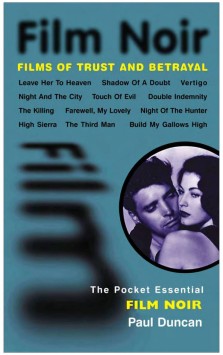
For US$9.99 you can download the 2nd edition the Film Noir eBook by Paul Duncan from eBooks.com. An excerpt:

The usual relationship in a Film Noir is that the male character (private eye, cop, journalist, government agent, war veteran, criminal, lowlife) has a choice between two women: the beautiful and the dutiful.The dutiful woman is pretty, reliable, always there for him, in love with him, responsible “all the things any real man would dream about. The beautiful woman is the femme fatale, who is gorgeous, unreliable, never there for him, not in love with him, irresponsible “all the things a man needs to get him excited about a woman. The Film Noir follows our hero as he makes his choice, or his choice is made for him. The reason the femme fatale meets the male character is because she has already made her choice. She is usually involved with an older, very powerful man (gangster, politician, millionaire), and she is looking to make some money from the relationship. She needs a smart man (who is also dumber than her) to go get that money, and take the fall if things go wrong. Enter the male character. The story follows the romantic/erotic foreplay of their relationship. The male character is often physically and mentally abused in this meeting and separating of bodies. Sometimes, he ends up doing very bad things. What is most surprising about Film Noir, and the reason I suspect it has become so difficult to categorise and pigeonhole, is that the focus of the films can be from the point of view of any of the characters caught in this relationship. For example, we can follow the femme fatal’s story or, as is more often the case, the dutiful woman’s. (The timid, unknowing woman who learns about the dark side of life harks back to the Gothic novel of the nineteenth century, which is where Noir Fiction came from.) This is because all the characters are equally interesting “they are all either obsessed with something they desire (money, power, sex), or compelled to do what they do because of their nature, or the physical or social environment they live in. The Film Noir follows a number of discernible frameworks within which the characters clash and collide. To show the workings of the police and government agencies, we had the Documentary Noir. Many filmmakers worked with army documentary units during World War Two, and discovered the freedom of movement the new, lightweight cameras afforded them. Audiences back home also got used to seeing them, so they found it easier to accept the rough style when it was presented to them as a feature film.The Docu Noir invariably had an authoritative voice telling us the facts (time, place, purpose) of the case, and we followed the investigation through to the end.The first one was The House on 92nd Street (1945) directed by Henry Hathaway, who did several in this style. Others of note include Call Northside 777 (1948), The Naked City (1948) (which spawned a TV series), Joseph H Lewis’ The Undercover Man (1949) and The Enforcer (1951). In the 50s, this style was subverted and reinvented by Alfred Hitchcock in his magnificent The Wrong Man (1956). In this film, instead of glorifying the law, we see a man and his family becoming victims of the police procedure – in the end his wife has a mental breakdown.

AFI Again Ignores Film Noir Heritage

For what it’s worth, a new AFI list of the Top 100 Movies of All Time has been published, with only nine movies with noir credentials making the list:

3 Casablanca (-1)
9 Vertigo (+52)
16 Sunset Blvd. (-4)
21 Chinatown (-2)
29 Double Indemnity (+9)
31 The Maltese Falcon (-8)
48 Rear Window (-6)
55 North By Northwest (-15)
97 Blade Runner ( -)

I would contend that only four of these movies: Subnset Blvd, Chinatown, Double Indemnity, and The Maltese Falcon are true noirs. So only three out of a 100 is bad. Even if one is not an afficianodo of film noir, I cannot comprehend how Orson Welles’ The Third Man, is not on the list.

These 22 noirs were listed in the ballot of 400 films sent to voters, but did not make the final cut:

The Big Sleep
Gilda
Gun Crazy
I Am A Fugitive From A Chain Gang
LA Confidential
Laura
Little Caesar
The Lost Weekend
Memento
Mildred Pierce
The Night Of The Hunter
Out Of the Past
The Postman Always Rings Twice
Rear Window
Scarface
Strangers On A Train
The Sweet Smell Of Success
The Thin Man
The Third Man
Touch Of Evil
White Heat

New Raymond Chandler Noir

Sin City (2005) director, Frank Miller will direct a new feature film noir for Universal. The movie will be an adaptation of the Raymond Chandler novella, Trouble is My Business, which has not been previously produced for the screen, and will star Sin City lead, Clive Owen.

Universal and production partner, Strike Entertainment, obtained the rights for the story from UK-based Chorion. The studios hope this film will kick off a series of PI Philip Marlowe flicks.

Films Noir based on Chandler novels:

The Big Sleep (1946)
Lady in the Lake (1946)
Strangers on a Train (1951)
The Long Goodbye (1973)

Posteritati Film Noir Posters

I just discovered this wonderful NY movie poster house.

Their collection of original noir posters is truly magnificent, and includes many foreign posters. Prices are very reasonable. Check out these samples:

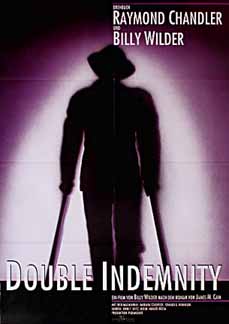
Double IndemnityDial M for Murder

Sunset Blvd.

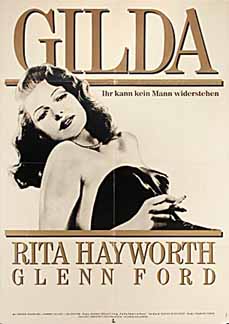
Gilda Woman in the Window

Undercurrent (1946): A Katharine Hepburn Film Noir?

Undercurrent

From a review by Jamie S. Rich of DVD Talkof the just released Katharine Hepburn 100th Anniversary Collection DVD Box Set (Warner Bros. US$59.95)

Undercurrent has started to pick up a bit of a reputation as a film noir. I first heard of the film last year when it played as part of a noir festival at the Northwest Film Center. I’m not really sure it qualifies, however, unless we can establish a subgenre of women’s noir. The plot has more in common with Victorian melodramas like Wuthering Heights and the work of Daphne Du Maurier (and her frequent adapter Alfred Hitchcock) than it does the moody expressionism of Fritz Lang or Jules Dassin. Genre hair-splitting aside, however, I found Undercurrent to be absolutely riveting. [Director Vincent] Minnelli creates a palpable sense of foreboding that lingers over the picture, ratcheting up the suspense each time Anne finds something new to cause her to doubt her husband’s story only to be placated by his wily explanations. You just know that eventually one of these things is going to be too large for him to erase, and then Anne is going to be in real trouble.”

Robert Mitchum has a supporting role.

Crime and the American Genre Film

Gun Crazy Still

A wide-ranging discussion between Chris Fujiwara and Mark Roberts: It Takes a Thief to Catch a Thief : Crime and the American Genre Film