Odd Man Out (1947): Dark Yet Glistening

In 1949 British director Carol Reed and Australian born cinematographer Robert Krasker made The Third Man. One of the great films of the 1940s and a signal film noir. Two years earlier the pair worked together on Odd Man Out.  While Odd Man Out is less widely known, the film is of sufficient stature to rank as an essential film noir.

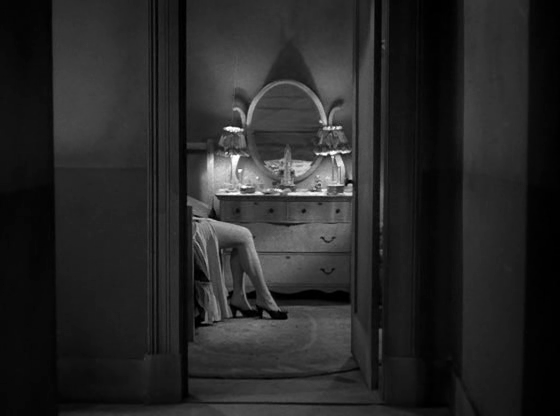
In Odd Man Out Reed and Krasker reveal the nocturnal soul of the regional city of Belfast, a port and industrial town in Northern Ireland, as they did to greater acclaim the more urbane environs of post-war Vienna in The Third Man. A dark fatalism imbues both films, which are concerned with a police hunt for a criminal. Each protagonist is drawn with a certain ambivalence, and both men are loved by a woman who sees past their crimes. These scenarios have an engaging cavalcade of characters as in a true human comedy, yet it is the antagonism of love and friendship on the one hand, and the imperatives of conscience on the other, that matter. In The Third Man, the dilemma is whether loyalty out of passion is stronger and more genuine than the loyalty of friendship, where the object of affection is without scruples and commits despicable acts.  Harry Lime is an engaging rogue but his crimes are immoral and motivated by greed. Odd Man Out however presents us with a protagonist whose morality is more problematic.

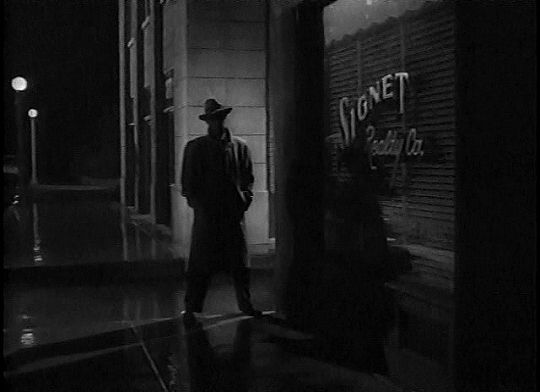
In the opening scenes of Odd Man Out the leader of an IRA cell played by James Mason is shot and wounded during a heist to raise cash, and in the struggle to escape, he shoots and kills a cashier.  The rest of the story follows his desperate attempts to reach a safe house where the young woman who loves him is waiting. He engages in not only this physical struggle but also with an agonising remorse at having taken a life. Here the film meanders a bit while a clutch of humanity is caught up in the pursuit.  Betrayal, avarice, and spirituality are all given a place, but it is altogether too much like preaching, and some odd humour jars even though it is a barbed portrayal of greed and artistic pretensions.  The poetry here is in the dark yet glistening visuals as we follow Mason on his path through the city at night and in the rain.

The inevitable dénouement has a tragic pathos that echoes not so much film noir but more the fatalism of French poetic realism.  If we are charitable the ending is a homage to Julien Duvivier’s Pépé le Moko (1937), and if we are not so inclined it harkens unmistakably to the motifs and mise-en-scène of that film.

Mason beautifully inhabits his role in a strong physical sense where his words are few and often soliloquies.  As the girl who loves him, Kathleen Ryan is a commanding presence – her quiet stoicism masks a deep passion and devotion. A woman straight from a novel by Simone de Beauvoir. Her actions sharply mark her as an existential hero, so much so that the closing scenes achieve a different resonance than in Pépé le Moko.

One of the great films noir and, to quote Peter Bradshaw from the UK Guardian, “an eccentric masterpiece”.
The Thief (1952): Silence is golden

The Thief (1952)

The independently made cold-war thriller The Thief covers familiar terrain in a novel way. Sight and sound are heightened by a central conceit that I won’t reveal. Composer Herschel Burke Gilbert’s dramatic and insistent score – which garnered an Oscar nomination – is more than up to a big task.

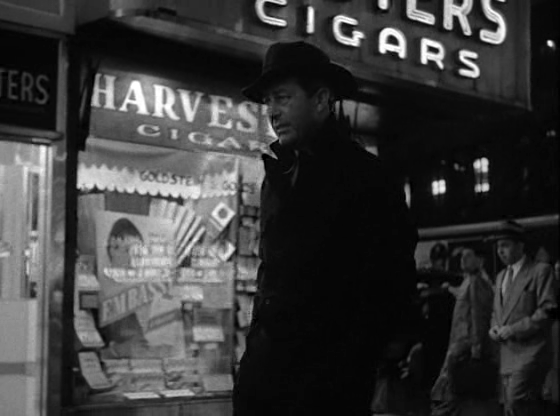
A nuclear scientist in Washington is leaking secrets to the enemy. When the story opens he is clearly having second thoughts. Whether his entrapment is motivated by money or ideology is not central to the film’s concerns, which early on focuses on the mechanics of the treachery. After a mishap blows the breach wide-open the hapless spy is on the run. Here the film goes out on the streets of  Washington and – in the final scenes – New York City.

A middle-aged greying Ray Milland delivers in a demanding role where demeanour must convey the mood. He is as strong as in The Lost Weekend (1945) and then some. Milland’s performance, and the brilliant noir photography of Sam Leavitt and taut direction of Clarence Greene (who had a hand in the script and produced) elevate the film despite a threadbare plot to a certain greatness. The tension is held throughout and your adrenalin levels are continually pushed to the max. The redemptive resolution is weak but countered by the sheer visual poetry of the closing scenes.

The Thief (1952)

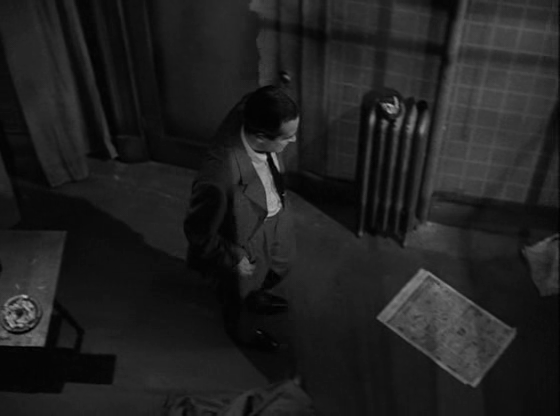
The film noir motif  of entrapment is the dramatic core and delivers one of the movie’s strongest scenes. Milland is holed-up in a decrepit NY tenement with the FBI closing-in while he waits for the next signal from his handlers of his escape plan.  The camera looks down from the ceiling of the tenement room at Milland pacing frantically from wall to wall like a rat in a trap. The only window faces a brick wall. This solitary desolation harkens back to earlier in the story when Milland is shown walking the prison-like corridors of  his place of work.

This is a film noir so sex lays its claim to attention. Milland’s scientist is a loner who has lived and worked in isolation, and his sexual repression is revealed through a tease that is both brutal and unnerving. As he desperately waits for a telephone call in the corridor of the tenement ever on the edge of hysteria, he encounters the occupant of the room opposite, a young woman that makes “alligators look tame”.  Then TV actress Rita Gam plays this girl with consummate sleaze, delivering perhaps the hottest come-on of the classic noir cycle.

A must-see study of entrapment on steroids.

The Thief (1952)

The Burglar (1957): The last b-movie?

The Burglar (1957)

One of the few films where David Goodis adapted his own novel for the screen, The Burglar is a brooding story where decency is a ‘dark passage’ to destruction.

A flashback provides the back story of an abandoned boy brought up by a kindly thief who adopts him, and apprentices him to the ‘trade’.  The adoptive father is killed in an abortive heist when the boy’s first mistake on the job triggers an alarm. The dead man has previously extracted from the boy the promise that if something happens to the father, he will look after his young daughter. The story pivots on this obligation and the complications that ensue when the burglar the boy has grown up to be steals a valuable necklace – aided by the girl and a motley crew of accomplices.

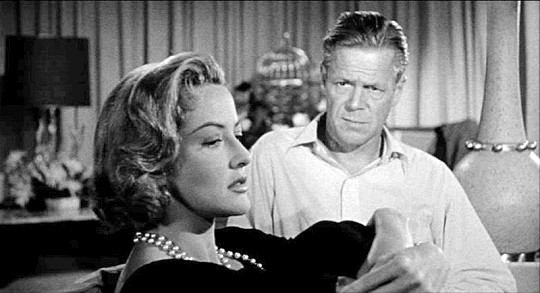
Dan Duryea is the thief and Jayne Mansfield is the child-woman under his wing, who is otherwise employed in the kitchen or casing heists. Duryea delivers in a role where what is not expressed is where the action is. The limitations of Mansfield in an early role render her believable as a simple girl struggling to make sense of the life she has fallen into, and her ambivalent relationship with Duryea, who is tormented by his warring paternal obligations and the underlying attraction they have for each other.  In the noir universe such dilemmas are always resolved at a cost.

A crooked cop is involved in that denouement, which is telegraphed after an interlude where Duryea hooks up with a women in a bar, played at first as a tough dame but then with real pathos by Martha Vickers.  There is a rare for noir tenderness in the scenes that follow when these two damaged souls open up to each other. This night of refuge is followed by a brutal betrayal the next day, and here a jarring plot hole almost pushes the scenario off-course, but it quickly swerves back onto the road to nowhere.

The film’s budget was only US$90,000 and perhaps was one of the last b-movies delivered of the signature gritty realism of Columbia Pictures.  But the picture has a patina that belies it’s budget, with truly accomplished cinematography from DP Don Malkames, and taut editing and elegant direction from first-time director Paul Wendkos. All carrying a stunning wide-screen realist austerity from a deep focus on-the-streets ambience.

A worthy valedictory to the b-movie.


The Big Bluff (1955): The bitter flavour of festering reality

The Big Bluff (1955)

The lurid original posters for The Big Bluff are those rare cinematic documents, where the movie promoted is actually sleazier than the posters would have you believe.

A suave grifter latches on to a dying woman with dough, only he is impatient to see her gone.  His evil machinations are his undoing.  The sheer perversity of the scenario and its relentless immorality leave you stunned.  Don’t go figuring this is a cinematic experience. It has the bitter flavour of festering reality, and is played out in a fetid LA where evil ambition and a conniving race to the bottom suck you down into a putrid swamp.  The homme-fatale is tripped-up in a quintessential noir dénouement, twisted and out of left field.

A b-movie par-excellence that is so compelling it feels much longer than the economical 70 minutes it takes to go from melodrama to perdition.

Director W. Lee Wilder, Billy Wilder’s estranged brother, and DP Gordon Avil, keep the action up, with some crazy antics like what-the-heck low angle and point-of-view shots that keep you unsettled in flash noir style, not to mention some tawdry kissing that literally mists up the screen.

Check out the cheap cabaret act featuring a floozy so vulgar you are in no doubt of where you are headed.


The Story of Temple Drake (1933): The good bad-girl

storyoftempledrake-hopkins

Pre-code Hollywood was frank about sex, and women were more than appendages to male heroics.  Though the male gaze ensured these dames were hot and not just adventurous.

While the Paramount adaptation of William Faulkner’s trash novel ‘Sanctuary’ took a while to get made, when it hit the screen the studio didn’t cut corners nor dolly things up. The Story of Temple Drake is all of 71 minutes and not surprisingly coherent story-telling is a casualty, yet the lurid plot is handled with a compelling economy and frankness, strongly abetted by the suitably dark lensing of Karl Struss, whose expressionist lighting of horrendous close-ups insinuates a decadent menace into the melodrama.

Temple Drake is a cheap little rich-girl from the South, who likes slumming with drunken lechers driving fast cars. One night she comes a cropper when her latest partner in sleaze crashes his roadster. After seeking help at a decrepit mansion they are abducted by a sinister gang of bootleggers.  The drunken beau is dumped, the girl raped, and then shanghaied to a bordello.  Is she a willing accomplice to her degradation? The scenario is ambivalent and you have to live with your doubts.

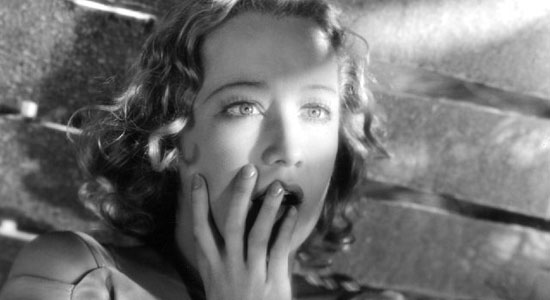
Wide-eyed and gorgeous, a not so young Miriam Hopkins brings a simmering sexuality to her portrayal of a woman whose lurid appetites are kept in check by a veneer of respectability – and a genuine awareness of her tendency to self-destruct.  For all her baseness, she has a moral centre that only needs to be coerced into action. Trouble is on both occasions she aids her own demise. First by killing, and then into making an admission of guilt that has severe consequences.

While Temple Drake is no femme-fatale and her actions are reactive, she cannily prefigures those hard dames that were let loose less than a decade later.

This notorious pre-coder is essential viewing.


The Big Knife (1955): Bore me deadly

The Big Knife (1955)

The Big Knife is labelled a film noir by some.  I don’t see it myself. Rather an overwrought pot-boiler.

A  melodrama about Hollywood that out-melodramas Hollywood.  Cloister an ensemble of A-list actors in a Hollywood bungalow with maverick-director Robert Aldrich, all singing from an operatic song-sheet courtesy of a play from Clifford Odets, with some snappy camera moves, amidst the hot-house boundaries of a posh living room, and the histrionics hit the roof.

Jack Palance a contract actor for an exploitative b-studio was once a young man with ideals.  He is now a middle-aged drunkard and Lothario who still loves his estranged wife – an aging Ida Lupino who at all times seems rather lost and discomfited.  She will only come back if he junks his career by refusing to sign a new contract pushed on to him by literally insane studio boss Rod Steiger.  Wendell Corey a modern-day Iago is spin-artist to Steiger, and a man happy to contrive a murder to keep the lid on a damaging back-story.

Filmed with a flatness and harsh lighting that washes out any nuance or ambivalence, the players are left to strut their stuff with exaggerated gestures and contrived rhetoric.  The picture may just as well have played as a radio soap.  It is hard to conceive that the same director had just completed the great Kiss Me Deadly. One of the rare occasions I can agree with the NY Times’ Bosley Crowther, who on the film’s release saw “a group of sordid people jawing at one another violently”.


Jigsaw (1949): “like the last act of Hamlet”

Jigsaw (1949)

Jigsaw is a rollicking thriller so camp you forgive the preposterous plot and thank the heavens for bringing it your way. A weirder movie you could not imagine. Franchot Tone is a NY special prosecutor pursuing a murky underground hate group with tentacles in the highest echelons of the city’s elite government and business circles. Tone’s delicious turn has shades of his acerbically ironic portrayal of a PI in the excellent I Love Trouble from the year before.

But the dames steal the picture. Winifred Lenihan, an actress who only ever appeared in this movie and another obscure picture from 1931, is a delight as a middle-aged socialite with a hidden agenda, while another stringer Jean Wallace (Kiss Me Deadly) has you enthralled as a sexy – and intelligent – blonde cabaret singer with sinister connections.

Jigsaw in more ways than one. The only movie made by production company Tower Pictures Inc., this b-picture was made by a bunch of journeymen, who through the quirky finger of fate came together to pack into 77 minutes an entertainment set in a Manhattan so darkly baroque, it seems almost self-consciously noir. From the opening panoramic shots of an isolated city street to the seamless and exciting climax in a darkened art gallery at night, impenetrable shadows haunt the streetscape of a city almost subterranean in its ambience. Add out-of-left field tracking shots that harken to the craft of Max Ophuls, director Fletcher Markle, who co-wrote the screenplay, and his DP Don Malkames, fashion a mise-en-scene of real panache. The script is both corny and intelligent, with a disarming amorality. A crusading journalist killed by the bad-guys is still warm when Tone makes a move on the widow who is also more hot than cold.

To add to the puzzle, you have a bunch of A-listers in uncredited bit parts. Names like Marlene Dietrich, Henry Fonda, John Garfield, Marsha Hunt, Burgess Meredith, and Everett Sloane.

It takes a while to get moving, but once it kicks in, look out. A must-see.

Highway 301 (1950): “a straight exercise in low sadism”

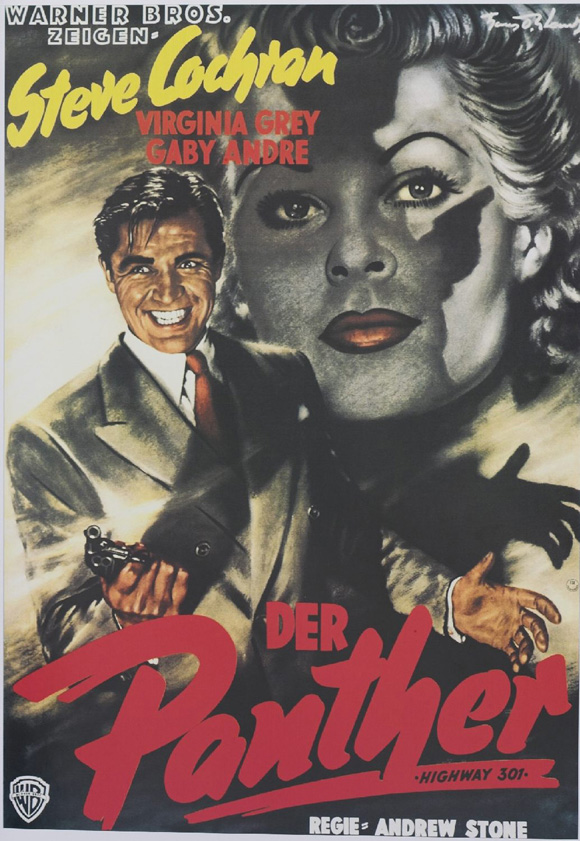
The demonic protaganist features in this German poster for Highway 301
The demonic protagonist features in this German poster for Highway 301

In 1950 New York Times film critic Bosley Crowther was “disturbed” and “depressed” by Highway 301, a dark gangster flick from Warner Bros.  He was emphatic in his dismissal: “the whole thing, concocted and directed by Andrew Stone, is a straight exercise in low sadism”.  Glen Erikson in his review of the DVD, described the relentlessly violent trajectory thus: “Imagine White Heat shorn of its rich characterizations and reduced to little more than its basic violent content: no complexity, just action and suspense scenes”.

Get it? A police procedural stripped back to its unardorned essence: violent hoods on the rampage. In deep focus and on the streets of  L.A.

In the way of the burgeoning police procedurals of the 1950’s, the movie is prefaced by homilies from not one but three State governors, each attesting to the veracity of the story and the lessons it holds for those contemplating similar escapades. The Tri-State Gang led by a remorseless “pretty boy” killer played menacingly by Steve Cochran, are heist specialists who find time to have settled relationships with women. One is even married to a totally amoral yet passive woman – unnervingly portrayed by Virginia Grey. A dame not offended by her better-half’s style of life, and who finds solace on those long  lonely nights with a portable radio that goes with her everywhere. Cochran early on dispatches his talkative erstwhile girlfriend by shooting her in the back.  He then latches on to the French Canadian girlfriend of another member of the gang, after he checks out when a heist goes wrong. Trouble is “Frenchy” finds out too late the trap she has fallen into. There is real terror here, and most strongly delivered in an extended sequence where Cochran pursues the girl on dark city streets after she tries to cut loose. The gang is eventually picked-off  by the law in increasingly bloody encounters.

Don’t look for ambivalence or redemption. This is a brutal modern take on the police procedural: uncanny in that the picture sets off rather than ends the late cycle segue on film noir.

La Bionda (The Blonde – Italy 1992)

An amnesiac femme-fatale the titular blonde is fate’s doleful instrument in this little known neo-noir from Italian writer/director Sergio Rubini.  Dark destiny takes an innocent young man with a limp and throws him onto a nocturnal autostrada littered with blood and a burst suitcase full of cash, with a woman running screaming into the night.  A tragedy of gothic proportions played first as an unlikely love story takes you inexorably where so many noirs have taken us before.  A blameless life and an accepting obscurity are not enough to protect the mild protagonist from a wild furiously indifferent universe.

Who are we? Are we the sum of our experiences? Or a persona that can be discarded through accident or design but never entirely or without consequences? Natasha Kinski is the blonde, suffering from amnesia after she runs into the path of a car and is knocked over. The driver (played by Rubini) a young man from the rural South struggling to keep afloat in a Milan of dark elegance. A city where deep shadows seep from the classroom where he hunches over a desk learning the skills of a watchmaker, and out into the streets. La bionda needs help and crashes in his apartment. She gives him focus and a strange purpose through a hesitant yet compelling obligation.   For a few short days they float in a maelstrom of doubt tempered by a softening dependency and growing intimacy. She searching for who she is, and he glimpsing what he could be.  But reality intervenes, she remembers, and he is abandoned. He searches for her, finds her, but she is not the girl she was for those few short days. She is hard-bitten enough to know that he can’t be a part of that dark and sordid existence.  He, oblivious, naively pursues a chimera of his own making, drawn on into a catastrophe with a brutally visceral and operatic climax.

Director Rubini is not passive. He takes his camera and literally spins it around scenes and events. Colors have a brightness and profundity that fuel both the emotional intensity of the protagonists, and telegraph the dangers that will entrap all the players in the end.  Kinski when she returns to her erstwhile existence is embodied in red – lips, dress, and her car. Dark and vengeful destiny pursues her in black, and the hapless anti-hero stumbles along in white – ignoring Fate’s little hurdles that more than once give him a chance to escape.

Patience with an early slow pace more concerned with characterisation than narrative drive is amply rewarded in a dénouement of almost unbearable hysteria.


Naked Alibi (1954): “bizarre images, strange juxtapositions, and erotic plays”

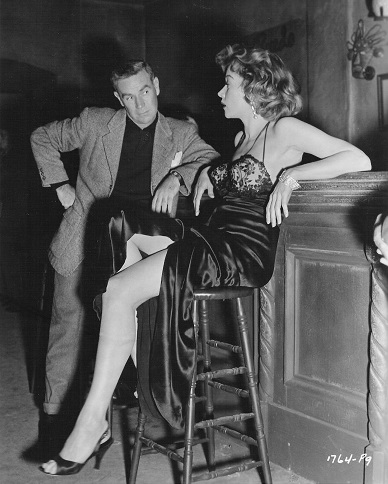
Director Jerry Hopper with Gloria Grahame on the set of Naked Alibi

James Naremore in his introduction to the English translation of the seminal book on film noir by Raymond Borde and Etienne Chaumeton, ‘A Panorama of American Film Noir, 1941-1953’, surveys the contribution of the Surrealist critique of cinema, and posits that “at certain moments, even in ordinary genre film or grade-B productions, [cinema] could involuntarily throw off bizarre images, strange juxtapositions, erotic plays of light and shadow on human bodies, thus providing an opportunity for the audience to break free of repressive plot conventions and indulge in private fantasies.”

More fully Naremore says:

The best account of the Surrealist fascination with cinema as a whole can be found in Paul Hammond’s witty, perceptive introduction to ‘The Shadow and Its Shadow: Surrealist Writings on the Cinema’… Hammond, who is also the translator of this edition of Panorama, reminds us that during the years immediately after the First World War, the original Surrealists used movies as an instrument for the overthrow of bourgeois taste and the desublimation of everyday life. Engaging In what Hammond describes as “an extremely Romantic project” and an “inspired salvage operation,” [André] Breton and his associates would randomly pop in and out of fleapit theaters for brief periods of time, sampling the imagery and writing lyrical essays about their experiences. Like everyone in the historical avant-garde, they were captivated by modernity, but they particularly relished the cinema because it was so productive of the “marvelous” and so like a waking dream. Willfully disrupting narrative continuities, they savored the cinematic mise-en-scene, which functioned as a springboard for their poetic imagination; and out of the practice they developed what Louis Aragon called a “synthetic” criticism designed to emphasize the latent, often libidinal implications of individual shots or short scenes. Even when cinema became too expensive for Breton’s style of serial viewing, it remained the fetishistic medium par excellence. At certain moments, even in ordinary genre films or grade-B productions, it could involuntarily throw off bizarre images, strange juxtapositions, and erotic plays of light and shadow on human bodies, thus providing an opportunity for the audience to break free of repressive plot conventions and indulge in private fantasies.

Naked Alibi an unpretentious b-movie from late in the classic noir cycle has just such a surreal quality. Whether from the cheapness of the production, the bizarre plot, or the literal darkness of much of the film, the picture is not so much a banal pastiche of noir motifs and set pieces, but an oneiric hallucination where characters from other films noir assemble onto a movie lot by some perverse twist of fate, and play out an adventure that makes as much sense as Luis Bunuel’s L’Age d’Or.

Made by a bunch of stringers – bar the great Russell Metty who lensed – the movie holds a strange fascination. Shot in the flat TV-style that emerged in the 50s there is little to recommend the picture as a cinematic effort – though Metty and director Jerry Hopper do hit some scenes out of the park, thanks to a peppering of classic film noir lighting and framing, and a theatrical final shootout across rooftops.

Stars Sterling Hayden and Gloria Grahame each wander in from some other set, Hayden perhaps taking a breather from Crime Wave and Grahame on the loose from Human Desire. Hayden is a cop who is fired after he pursues a model-citizen played by Gene Barry for the killing of the three cops – Barry has an angelic wife and a baby in a crib. The big surprise is Barry, who later made it big on TV as Bat Masterson. As the villain leading a truly bizarre Jeckyll & Hyde existence as a small-town baker – in one scene he is shown in his store icing a cake! – who falls foul of the law after he is picked up as drunk and disorderly, he leaves Hayden and Grahame behind in a wake of attitude and booze. But the motive for the killings is so flimsy you can’t understand why Hayden doesn’t give it up, tailing the suspect until Barry can’t take it any more and leaves town to “calm his nerves”. Apparently the baker takes regular business trips on his own, so the wife and kid are left behind. The plot is moot on why a baker would need to make business trips. Anyway.

Hayden pursues Barry down to a Mexican border town where Barry is revealed as a chronic drunk and mean racketeer, after Grahame is shown flashing a lot of flesh as a chanteuse in a cheap dive. It turns out Barry is Grahame’s long-lost boyfriend. Barry’s reunion with Grahame is particularly sordid and sexually charged. A classic triangle ensues. One thing leads to another, and Hayden gets his man on ice and Grahame checks out in Hayden’s arms after stopping two bullets from Barry’s gun in a low-rent reprise from Fritz Lang’s The Big Heat from the year before.

Take with a lot of booze.