Quicksand (1950)

Watch , Quicksand, a minor 50’s noir on-line free at RetroTV.  Stars some big names: Mickey Rooney, Jeanne Cagney, Barbara Bates, and Peter Lorre.

This is the story of a nice guy who borrows $20 from a cash register to keep a date… with a cop… and a killer!” After borrowing $20 from his employer’s cash register, an auto mechanic is plunged into a series of increasingly disastrous circumstances which rapidly spiral out of his control.

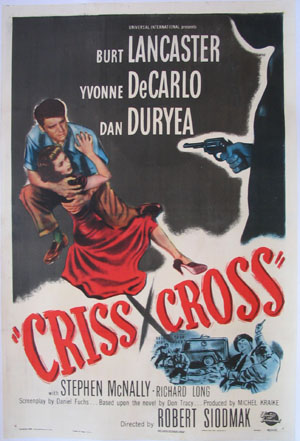
Criss-Cross (1949)


I watched the Robert Siodmak noir, Criss Cross, last night again after many years: while not a great film, certainly a worthy effort.

The exotic Rumba dance sequence at the beginning of the movie is really fun, and signals that it is the director’s skill that saves this film from mediocrity.

As far as noirs go, Criss-Cross is is atypical. It is more a cautionary tale of besotted love. There is a fatalistic element, but the male lead, Steve Thompson, played with just the right degree of bewilderment by Burt Lancaster, is not so much dealt a raw deal by fate but by his own naivety. The femme, Anna, the Yvonne de Carlo role, is not really a fatale, but the obscure object of desire – the Bunuel pun is intentional – that is Steve’s undoing. Dan Duryea, as always, delivers a solid performance as the bad guy, and veteran character actor, Percy Hilton, is engaging as the wily but sincere bartender.

But it is the cinematic composition by Siodmak and cameraman, and fellow German, Franz Planer, that remains in the memory.

The aerial opening credits where the camera swoops down into the dance-club parking lot onto a passing car, which in its wake exposes the doomed lovers to the spotlight.

The narrow bar to which Steve inexorably returns to find Anna, and the dark and sordid back-alley, where Steve washes off a drunken stupor.

The no-turning back one-way ramp out of the armored car HO.
Criss-Cross (1949)Criss-Cross (1949)Criss-Cross (1949)

The hawk’s-eye panning shot as Steve drives the armored car between the giant silos of an industrial plant, which by pinning the car to a must-follow root presages the claustrophobic ambush ahead.

Criss-Cross (1949) Criss-Cross (1949)

New Noir DVD Reviews

Two new film noir reviews based on new DVD releases have just been published:

Nightmare Alley

Nightmare Alley (1947) by Tom Huddleston of NotComing.com:

Nightmare Alley is an obscure post-war thriller, a noirish tale of circus fakes and con men every bit as crafty and exploitative as the characters it depicts, and just as much fun. Full Review

The Wrong Man (1956) by Dan Schneider of Blog Critics:

Perhaps [Alfred Hitchcok’s] most successful such ‘oddball’ film was 1956’s black and white social realism film The Wrong Man, starring Henry Fonda. It was manifestly influenced by the spate of European films that indulged in the Neo-Realistic style of such masters as Vittorio De Sica, Federico Fellini, and Roberto Rossellini. It was also based upon a real life case of mistaken identity in 1953 which nearly put an innocent man in prison. Full Review

The Wrong Man

Out Of The Past (1947) – Tourneur’s Mise En Scene Revisited

Near the end of Jacques Tourneur’s classic noir, Out of the Past (1947), there is a scene that must be one of the greatest compositions in American cinema:

Out Of The Past

The lighting, and the placement of the central elements, from the sofa on which Robert Mitchum rests his hand to the archway that frames Jane Greer, is brilliant. The femme fatale, Kathie Moffat, is framed in the dark background, while Jeff Bailey is highlighted in the foreground. The elemental contrast between good and evil is perfectly balanced, with the natural perspective of the lens emphasising the distance between the two protagonists. The window lattice shadow falling across the floor in the background behind Kathie enforces the perspective established by the lighting and placement of the actors. To complete the tension Kathie is clothed in saintly garb and presents a demure demeanour.

Dashiell Hammett: The Red Gumshoe

In the paranoid 1950’s, Dashiell Hammett was jailed under sinister manipulation of The Smith Act. Popular radio serials based on Hammett’s books, including The Maltese Falcon, were immediately cancelled, and his books withdrawn from publication in the US.

When he was released from prison the IRS, attached his income and the copyright on his books and stories for payment of back taxes and penalties. He was broke and unpublishable.

Hammett died in 1961. Two years later friend, fellow writer and progressive, Lillian Hellman, bought back the copyrights to his works at an IRS auction for US$5,000.

In 1998, the Editorial Board of The Modern Library named The Maltese Falcon as one of the 100 best novels in English of the 20th century.

In 2005, the US Senate approved a resolution commemorating the 75th anniversary of The Maltese Falcon and recognising it as a great American crime novel.

Film Noir Interviews: Billy Wilder and Samuel Fuller

The Images Journal web site features interviews with these stellar noir directors:

Billy Wilder – A really fun interview from July 1975.

Sunset Blvd.
SunsetBlvd. (1950)

Wilder On Double Indemnity (1944):

Well, he was just kind of a middle-class insurance guy who works an angle. If he is that tough, then there is nothing left for Stanwyck to work on. He has to be seduced and sucked in on that thing. He is the average man who suddenly becomes a murderer. That’s the dark aspect of the middle-class, how ordinary guys can come to commit murder.

Wilder’s noirs:

Double Indemnity (1944)
The Lost Weekend (1945)
Sunset Blvd. (1950)
Ace in the Hole (1951)

Samuel Fuller – 1972 to 1976 composite of several interviews.

Pickup On South Street
Pickup on South Street (1953)

Fuller on his noir movies:

When I was making these damned pictures, I never knew about film noir… To me it’s the emotion, the lies, the double-cross… that defines what kind of drama it is.

Fuller’s noirs:

Pickup on South Street (1953)
House of Bamboo (1955)
The Crimson Kimono (1959)
Underworld USA (1961)
Shock Corridor (1963)
The Naked Kiss (1964)

The Narrow Margin (1952): Opening Credits

The Narrow Margin (1952)
It is a shame the brilliant shot used for the opening credits of The Narrow Margin (1952), by great noir director, Richard Fleischer, is obscured by the credits. In a single elegantly paced panning shot, cinematographer, George E. Diskant, establishes the noir atmosphere of the movie.

Fleischer’s major noirs:

Bodyguard (1948)
Follow Me Quietly (1949)
Trapped (1949)
The Clay Pigeon (1949)
Armored Car Robbery (1950)
The Narrow Margin (1952)

Diskant’s noir credits include:

Kansas City Confidential (1952)
On Dangerous Ground (1952)
The Racket (1951)
They Live by Night (1948)
Riffraff (1947)

The Narrow Margin (1952)

AFI Again Ignores Film Noir Heritage

For what it’s worth, a new AFI list of the Top 100 Movies of All Time has been published, with only nine movies with noir credentials making the list:

3 Casablanca (-1)
9 Vertigo (+52)
16 Sunset Blvd. (-4)
21 Chinatown (-2)
29 Double Indemnity (+9)
31 The Maltese Falcon (-8)
48 Rear Window (-6)
55 North By Northwest (-15)
97 Blade Runner ( -)

I would contend that only four of these movies: Subnset Blvd, Chinatown, Double Indemnity, and The Maltese Falcon are true noirs. So only three out of a 100 is bad. Even if one is not an afficianodo of film noir, I cannot comprehend how Orson Welles’ The Third Man, is not on the list.

These 22 noirs were listed in the ballot of 400 films sent to voters, but did not make the final cut:

The Big Sleep
Gilda
Gun Crazy
I Am A Fugitive From A Chain Gang
LA Confidential
Laura
Little Caesar
The Lost Weekend
Memento
Mildred Pierce
The Night Of The Hunter
Out Of the Past
The Postman Always Rings Twice
Rear Window
Scarface
Strangers On A Train
The Sweet Smell Of Success
The Thin Man
The Third Man
Touch Of Evil
White Heat

New Raymond Chandler Noir

Sin City (2005) director, Frank Miller will direct a new feature film noir for Universal. The movie will be an adaptation of the Raymond Chandler novella, Trouble is My Business, which has not been previously produced for the screen, and will star Sin City lead, Clive Owen.

Universal and production partner, Strike Entertainment, obtained the rights for the story from UK-based Chorion. The studios hope this film will kick off a series of PI Philip Marlowe flicks.

Films Noir based on Chandler novels:

The Big Sleep (1946)
Lady in the Lake (1946)
Strangers on a Train (1951)
The Long Goodbye (1973)

The Big Heat (1953): Film Noir As Social Criticism

I am prompted to make this post after reading this week’s post from Lloydville from mardecortesbaja.com: The Genealogy Of Noir.

In the broadest perspective, film noir belongs in the long tradition of American Gothic fiction, that dark vision crystallized in the tales of Hawthorne and Poe. A kind of counterbalance or reaction to American optimism, this tradition can have an almost savage quality, as though the decision to explore the shadowy realms of the American psyche has led to a determination to follow that path to its uttermost end, to the absolute limits of nightmare… In the true noir, we can identify totally with the protagonist — not least in his fated doom, or provisional salvation, in a world that has gone terribly wrong, for reasons that aren’t clear and that it probably wouldn’t help much to understand.

This is a good analysis far as it goes. But what about the European experience, and the influence of directors such as Lang and Tourneur?

Existentialism is European in origin and owes little to the US war experience, which for US civilians contrary to the European experience of the war, was essentially a vicarious trauma.

For example, Lloydville, in a previous post sees Fritz Lang’s, The Big Heat (1953), as a reflection of a collective paranoia rooted in post WW2 angst, but which again is a European phenomenon, not a North American experience. The Big Heat to me is more a socio-political critique of 50’s America. The protagonists dare to question injustice and corruption, which is a palpable reality not a delusion: the mobsters kill Bannion’s wife and threaten his child, with the police and politicians actively complicit. Justice is won only at a terrible cost and with no assistance from the ruling order. There are no femme fatales in this movie, only strong women, who do the dirty work required to bring a male-owned system of oppression and corruption to account.
