8th Annual Palm Springs Film Noir Festival: Rare Screenings

The 8th Annual Palm Springs Film Noir Festival over May 29 – June 1, 2008 features a number of rare and obscure titles only available on the big screen. The festival will screen 12 features at Camelot Theatre, 2300 Baristo Road, Palm Springs Ca. – Telephone (760) 325-6565.

The program is a veritable feast of intriguing movies that have not been available for many years – two are so obscure I couldn’t find a poster:
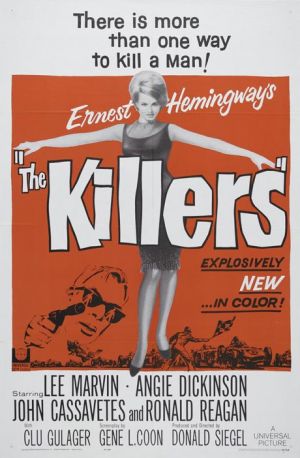
The Killers 1964

Thursday May 29 7:30 pm – OPENING NIGHT
Special Guest: Angie Dickinson
The Killers (1964) 95m.
DIR: Don Siegel
Lee Marvin, Angie Dickinson, John Cassavetes, Clu Galager, Ronald Reagan

Remake of the Siodmak noir based on the Hemmingway short story.
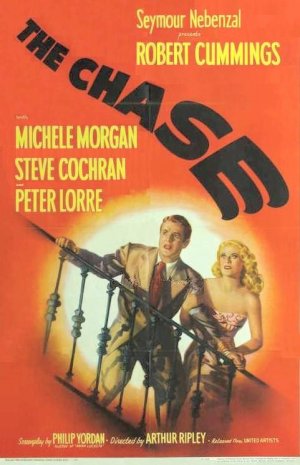
The Chase

Friday May 30 10:00 am
The Chase (1946) 86m.
DIR: Arthur Ripley
Robert Cummings, Steve Cochran, Peter Lorre, Michele Morgan

A down-and-out roustabout (Cummings) is hired by a vicious gangster (Cochran) and quickly gets down-and-dirty with his lovely wife (Morgan). Restored 16mm print.
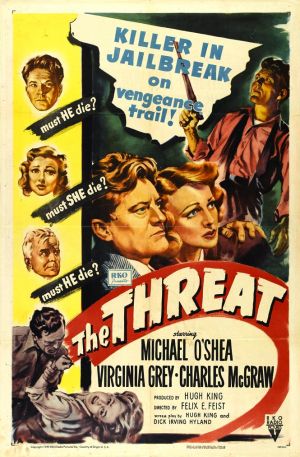
The Threat

Friday May 30 1:00 pm
The Threat (1949) 66m.
DIR: Felix Feist
Charles McGraw, Michael O’Shea, virginia Grey, Julie Bishop

Ruthless killer escapes prison, kidnapping the cop and D.A. who helped jail him while leading a wild escape into the California high desert. The action moves at a breakneck pace; a veritable highlight reel of malicious mayhem courtesy of ultimate noir baddie, CharlesMcGraw.

Friday May 30 4:00 pm
Special Guest: Margia Dean
Treasure of Monte Cristo (1949) 79m.
DIR: William Berke
Glenn Langan, Adele Jergens, Steve Brodie, Margia Dean

A freighter officer, (Langan) a descendant of the Count of Monte Cristo, is framed for murder and tries to puzzle it out. Shot on location in San Francisco and starring the husband and wife team of Langan and Jergens.

Lady in The Lake

Friday May 30 7:30 pm
Special Guest Jayne Meadows
Lady in the Lake (1947) 105m.
DIR: Robert Montgomery
Robert Montgomery, Lloyd Nolan, Audrey Totter, Jayne Meadows

Robert Montgomery offers a terse rendition of Philip Marlowe from an unusual first-person camera perspective via Steve Fisher’s screen adaptation of Chandler’s novel of the same title.

Saturday May 31 10:00 am
Smooth as Silk (1946) 64m.
DIR: Charles Barton
Kent Taylor, Virginia Grey, Jane Adams, MIlburn Stone

Respected attorney (Taylor) concocts a plot of vengeance after learning his sweetheart has jilted him for a wealthy producer.
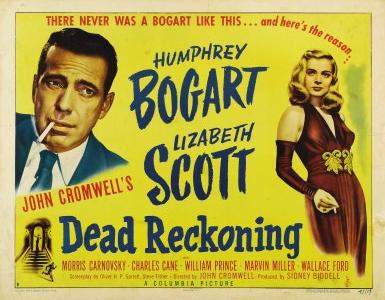
Dead Reckoning

Saturday May 31 1:00 pm
Dead Reckoning (1947) 100m.
DIR: John Cromwell
Humphrey Bogart, Lizabeth Scott, Morris Carnovsky, William Prince

Bogart is a mustered out vet who heads down south searching for a buddy who took a powder on the Medal of Honor. He runs into big trouble with femme fatale Scott and gangster Carnovsky.
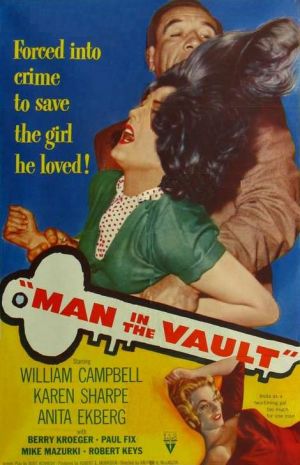
Man in The Vault

Saturday May 31 4:00 pm
Special Guest Karen Sharpe Kramer
Man in the Vault (1956)
DIR: Andrew V. McLaglen
William Campbell, Karen Sharpe, Anita Ekberg, Barry Kroeger

An innocent locksmith (Campbell) is seduced into participating in a robbery by femme fatale (Sharpe) to his eternal regret.
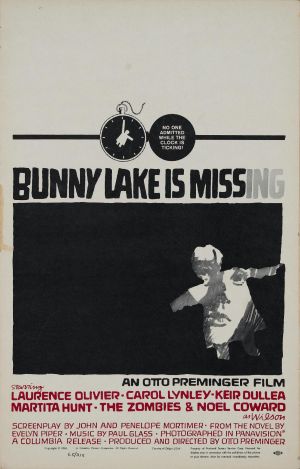
Bunny Lake is Missing

Saturday May 31 7:30 pm
Special Guest Carol Lynley
Bunny Lake is Missing (1965) 107m.
DIR: Otto Preminger
Laurence Olivier, Carol Lynley, Keir Dullea, Noel Coward

Lynley and her brother report the apparent disappearance of her daughter from a British preschool. The only problem is Police Supt. Olivier can find no evidence that the girl existed.
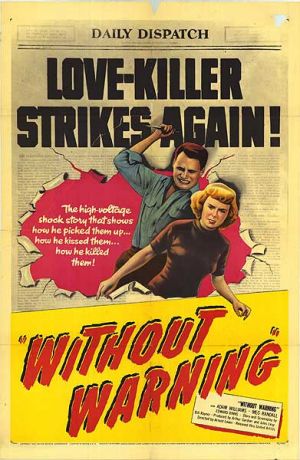
Without Warning

Sunday June 1 10:00 am
Without Warning (1952) 77m.
DIR: Arnold Laven PRODUCERS: Arthur Gardner and Jules Levy

Professional gardener Carl Martin (Adam Williams) ably portrays a vicious psychopath with a thing for young blondes… and garden shears. One of the first Hollywood send-ups of the redoubtable serial killer, superbly crafted and almost never shown theatrically.
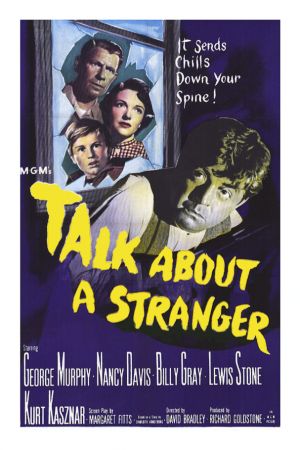
Talk About a Stranger

Sunday June 1 1:00 pm
Special Guest Billy Gray
Talk about a Stranger (1952) 65m.
DIR: David Bradley
George Murphy, Nancy Davis, Billy Gray, Lewis Stone, Kurt Kasznar

A compelling tale about a young boy, convinced his new neighbor poisoned his dog, which launches a quest for justice that careens out of control. Camera work by John Alton.

Night Editor

Sunday June 1 4:00 pm
Night Editor (1946) 66m.
DIR: Henry Levin
William Gargan, Janis Carter, Jeff Donnell, Coulter Irwin

Police detective (Gargan) can’t report a murder he witnessed because it would involve exposing an adulterous affair he was having with a socialite (Carter) with an overactive libido.
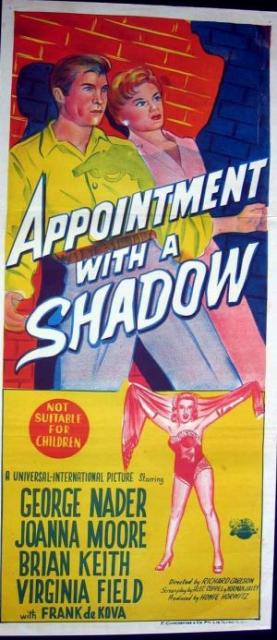
Appointment With a Shadow

Sunday June 1 7:30 pm
Appointment with a Shadow (1958) 73m.
George Nader, Joanna Moore, Brian Keith, Frank DeKova

While trying to score the lowdown on a big story, an alcoholic reporter becomes the target of a diabolical murder plot.

Get full program details from the Palm Springs Festival Film Noir site.

View the full size posters by clicking here: [piclens-lite-link]

Split Second (1953): No cops required

Split Second 1953Escaped con holds a motley crew hostage in a Nevada ghost town on the eve of an atomic bomb test

First time director Dick Powell delivers a powerful crime melodrama from RKO, ably assisted by veteran noir cameraman Nicholas Musuraca. A solid ensemble cast is led by Stephen McNally as Sam Hurley, a fugitive on the run.

McNally dominates this movie as the brutal but complex killer: the noir motifs of the damaged war veteran and nuclear paranoia are deftly interwoven in an intelligent script from William Bowers and Irving Wallace from a story by Wallace and Chester Erskine.

Not a cop is to be seen and cruel destiny deals with the protagonists in an explosive finale. In one scene, Hurley tells his hostages that he doesn’t like heroes, and this movie doesn’t have any. Retribution is in the hands of fate and the weather.

A must see cult classic. Watch the trailer at TCM.

Split Second 1953

Dalton Trumbo: Blast from the Past

A documentary, Trumbo (2007),  on HUAC-blacklisted screenwiter, Dalton Trumbo, who penned the noirs, The Prowler (1951) and The Brothers Rico (1957), opens in NY and LA on June 27. Scripted by Trumbo’s son, and based on letters from his father, this movie is said to be a highly emotive account of the years Trumbo spent in exile:

A number of celebrities take turns narrating from the script, including [Nathan] Lane, Paul Giamatti, Brian Dennehy, Donald Sutherland and others. As a visual accompaniment, the film intercuts home movie footage from the Trumbos’ lives, incisive interview material with Trumbo, his family, friends and collaborators; and haunting glimpses of the HUAC trial hearings with the Hollywood Ten, led by Senator Joseph McCarthy; as well as extracts from The Sandpiper, Johnny Got His Gun, Spartacus and other productions authored by Trumbo. Peter Askin, who helmed the stage play, directs.

– Nathan Southern, All Movie Guide

Update 27 June 2008: In today’s NY Times Stephen Holder reviews Trumbo in an interesting article that looks basck at the dark days of the HUAC in the early 50’s:

Trumbo emerges as a fervently resolute, highly literate man of principle who, along with the other members of the Hollywood Ten, cited the First Amendment, protecting free speech, and not the Fifth, protecting self-incrimination, as his defense…If only the movers and shakers of Hollywood…  had stood together like the slaves in “Spartacus” and all claimed to have been Communists, the blacklist might have been averted. But they didn’t. Fear can make people instant cowards and informers. Resisting it may be the ultimate test of character. Today few would dispute Trumbo’s assessment of that very dark period: “The blacklist was a time of evil, and no one who survived it on either side came through untouched by evil.”

Offscreen Com: Noir Essays

Man With a Trumpet

The film site Offscreen.com has published an interesting collection of articles on film noir:

The Long Goodbye (1973): Redefining Philip Marlowe

The Long Goodbye (1973)

The House of Mirth and Movies blog has posted an excellent review of Robert Altman’s The Long Goodbye (1973). An extract from The Long Goodbye: Recreating Noir:

The Long Goodbye maintains the thematic associations of noir, while altering the physical environment. The location remains much the same, as the conventional noir, as the film is set in Los Angeles, and the urban setting plays heavily into creating mood and atmosphere. The most apparent change is no doubt the shift from black and white to colour. The added choice to expose the undeveloped film negative to additional pure light in post production, until the colours were softened and the darks faded, further differentiate the look with the genre’s original stylistic trademark. Instead of the high contrast, low key lighting that characterizes film noir, the film is almost washed away. This technique works at creating a similar atmosphere as the traditional noir model despite being so different. Life and existence lack all vibrancy, and the uniform shade of grey that seems to pervade every scene emphasizes the moral ambiguity of all those who inhabit the city. There is little difference between black and white, so everyone is living in a perpetually grey and faded environment, living between the traditional models of good and evil instead of clearly on one side or the other…

This blog also has an interesting post on The Big Sleep (1946): Thinking about The Big Sleep and Howard Hawks.

Armored Car Robbery (1950): Solid B-Noir

Armored Car Robbery 1950Director, Richard Fleischer, teams with B-movie stalwart, Charles McGraw, in a tight 67 minutes of classic b-noir mayhem. A daring heist goes wrong and the criminal mastermind tries to shoot his way out, with a final take-out on an airport runway. A police procedural firmly grounded in the steets of LA with dark noir atmospherics. Recommended.

Fliescher and McGraw teamed again in The Narrow Margin (1952).

The Fight Movie and Film Noir

The Set-Up 1949

The Set-Up (1949)

Film-maker David Mamet, in an interesting piece in today’s New York Times on his new film, Redbelt, about a movie fight director, has written eloquently on the fight movie and film noir:

Fight films are sad. There is nobility in effort, in discipline and, if not in suffering, in trying to live through suffering and endeavour to find its meaning… the fight film is a celebration of submission, which is to say, of loss. As such, it finds itself on the outskirts of my beloved genre of film noir. The punch-line of drama is “Isn’t life like that. …” But its elder brother, tragedy, is the struggle of good against evil, of man against the gods. In tragedy, good, and the gods, are proclaimed winners; in film noir, which is tragedy manqué, the gods still win, but good’s triumph gets an asterisk… The true story of any true fight must be sad. As Wellington said, “Nothing except a battle lost can be half so melancholy as a battle won.”

Mamet explores this thesis that “All fighters are sad” by analysing the scenes featuring real-life fighters playing fighters in Jules Dassin’s Night And the City (1950) and Stanley Kubrick’s The Killing (1956), and goes on to explore it more deeply in Kurosawa’s The Seven Samurai (1954).

Surprisingly, Mamet does not mention two other films noir: Robert Rossen’s Body and Soul (1947), or Robert Wise’s The Set-Up (1949). The wrestlers in Night and the City and The Killing are not central characters, while in Body And Soul and The Set-Up, a boxer is the central character, and the tragedies played-out in these two movies more strongly evoke the existential angst of the ‘fight’. Indeed, The Set-Up as a real-time evocation of one fight, brilliantly confronts Mamet’s theme of the melancholy duality of winning and losing. Robert Ryan, also once a real-life boxer, as the aging fighter, “Stoker” Thompson, refuses to throw the fight and by winning loses when the heavies, who paid his trainer for the fall, cripple him in a dark back-alley outside the stadium.

Crime Wave (1954): On The Streets of LA

Crime Wave 1954

An ex-con trying to stay clean is sucked into a bank heist when a former cell-mate turns-up at his apartment after a late night gas-station smash and grab goes wrong and a cop is killed.

Andre de Toth’s Crime Wave (1954) gives star billing to Sterling Hayden as the LAPD homicide detective hunting down the killers, but all major players in this police procedural have equal presence. From the gas-station attendant to the crooked vet who patches up wounded hoods on the run, and the aging parole officer woken in the night by a call from one of his ‘boys’, each character is deeply drawn.

A very tight story of 74 minutes played out on the streets of LA, has a feel so authentic, you think it happened yesterday and for real. The noir theme of an inescapable past propels the drama at a personal level in the claustrophobic constraints of an apartment, while out on the streets and in police headquarters the camera observes the manhunt with detachment and precision.

A masterwork.

Crime Wave 1954  Crime Wave 1954

Crime Wave 1954   Crime Wave 1954

Review of Fritz Lang’s M

M 1931

US novelist David Schleicher, has posted a very worthy review of Fritz Lang’s M (1931) on his blog.

Murder, My Sweet (1944): A face like a Sunday school picnic

Murder My Sweet (1944)It was a nice little front yard.
Cozy, okay for the average family…
only you’d need a compass
to go to the mailbox.

The house was all right, too,
but it wasn’t as big as Buckingham Palace.

I had to wait
while she sold me to the old folks.
It was like waiting to buy a crypt
in a mausoleum.

Watching Murder, My Sweet (aka Farewell My Lovely – 1944) , is the most fun you will ever have with a film noir. Raymond Chandler’s hard-boiled prose crackles in this screen adaption by John Paxton, with moody noir direction by Edward Dmytryk.

Inhabiting a plot about a rich dame’s stolen jade necklace almost as convoluted as The Big Sleep (1946), the cast is superb. Dick Powell has a comic edge that brings a lightness to the shenanigans, and is a superb foil to the camp turn by Claire Trevor as the putative femme-fatale. Anne Shirley is as cute a 40’s starlet as ever graced the screen. The bad guys are bigger than life and truly entertaining, and rub each other out without ceremony or prevarication. It looks like a film noir, but the bad guys and gals are truly bad, and the good guy and gal are incorruptible.

Look out for the innovative “purple haze” sequence, after PI Marlowe is drugged by a crooked quack.

Murder My Sweet (1944)