The Locket (1946): Freudian Melodrama

The Locket (1946)

A young woman who is a kleptomaniac and a pathological
liar wreaks havoc in the lives of three men
(1946 RKO. Direction by John Brahm 85 mins)

Cinematography by Nicholas Musuraca
Screenplay by Norma Barzman (uncredited) and Sheridan Gibney
Original Music by Roy Webb
Art Direction by Albert S. D’Agostino and Alfred Herman

Starring:
Laraine Day – Nancy Monks Blair Patton
Brian Aherne – Dr. Harry Blair
Robert Mitchum – Norman Clyde
Gene Raymond – John Willis

“Never has the device of the flashback been taken so far.  Narratives are jumbled up, parentheses opened, exploits slot one inside the other like those Chinese toys sold in bazaars, and the figure of the heroine gradually comes into focus: beneath her somewhat obscure charm there lurks a dangerous and perverse mythomaniac”
– Borde & Chaumeton,  A Panorama of American Film Noir 1941-1953 (1955)

“The Locket is a radically ambivalent film… [it’s] oscillation between condemnation and sympathy for its central protagonist, draws attention to the processes of narration and to the attempt of male narrators to control the ‘problem’ of femininity.”
– Andrew Spicer, Film Noir (2002)

The Locket is a bizarre melodrama that marks one the first films noir to use Freudian concepts to explore criminal psychology.  Though the film is studio bound, the film-makers have used this constraint to advantage. Under the assured direction of John Brahm [who also directed The Brasher Doubloon (1947), Hangover Square (1945), and The Lodger (1944)], cinematographer Musuruca, and art directors Albert S. D’Agostino and Alfred Herman, place the story firmly in a suffocatingly surreal mise-en-scene.  The atmosphere is decidedly gloomy – even baroque – with many dramatic scenes so darkly lit that there is aura of grim foreboding that goes far beyond the immediate action.

The Locket (1946)

Larain Day, a little known b-actress, is entirely convincing as Nancy, the woman who weaves an elaborate charade only a disturbed mind could navigate, handling the melodramatic climax with considerable style.

The first thing that takes your breath away is what Borde & Chaumeton describe as a “technical shot in the dark”:  the audacious use of flashback. There are two male narrators and finally Nancy herself, who each in turn construct a flashback within a flashback within a flashback. The final flashback takes Nany back to her childhood where her widowed mother works as a servant in the mansion of a haughty rich woman.  The scenario in this flashback intelligently establishes the root cause of Nancy’s psychosis, while her treatment as a child of ‘the help’ initiates in the viewer sympathy for the character as a child, and an ambivalent empathy for the troubled woman she becomes.

A music box and its tune is a strong motif in the film, and in the climactic ending, this musical motif triggers a psychotic episode that is both cathartic and catastrophic. These scenes depicting Nancy’s disintegrating mental and physical state are inventively portrayed by innovative camera-work and by Roy Webb’s musical acumen.

The theme of entrapment is multi-layered.  While Nancy is a prisoner of her compulsion and childhood trauma, each of the men who love her is equally attracted and repelled by the enigma that lies beneath her longed for persona. One of the men, an artist played by Robert Mitchum, expresses this exasperation in a portrait of Nancy in which her eyes are incomplete.

The Locket (1946)

A must-see noir.

Nightmare Alley (1947): Geeks and Freaks

Nightmare Alley (1947)

In Nightmare Alley (1947), based on the dark novel by William Lindsay Gresham, you enter a bizarre oneiric universe of thwarted ambition and inescapable degradation.

A world of geeks and freaks, where a predatory femme-fatale uses greed not sex to trap her prey, where the hallucinations at the bottom of an empty gin bottle transport you to hell, where illusion and reality fuse into a phantasmagoria of tarot cards and hangmen, and where both tabernacles and carnival tents mock faith and trade on gullibility.  Life is a squalid con where you can trust no one, the only solace is in booze, and redemption is as a carnival geek fed on live chickens.

Director Edmund Goulding and cinematographer Lee Garmes fashion a monstrous world of dark nights and sordid shadows.  Death and opportunism are pulled out of an illusionist’s trunk, and a fog of angst shrouds all in its wake. There are no actors here: only visages and apparitions that inhabit a shadow play where Jungian archetypes invade your subconscious.

Never was a film noir more aptly titled – the nightmare at the end of the dark alley of the soul.

Nightmare Alley (1947)

Jonathan Auerbach: Noir Citizenship and Anthony Mann’s Border Incident

Border Incident (1949)

Jonathan Auerbach is professor of English at the University of Maryland, and is currently writing a book titled ‘Dark Borders: The Un-Americaness of Film Noir’.

Professor Auerbach, in a recent issue of the scholarly Cinema Journal (47, No. 4, Summer 2008) in an article titled Noir Citizenship: Anthony Mann’s Border Incident, posits an ambitious thesis about national borders and the borders of film genres, as set out in the article’s abstract:

Looking closely at how images subvert words in Anthony Mann’s generic hybrid Border Incident (1949), this article develops the concept of noir citizenship, exploring how Mexican migrant workers smuggled into the United States experience dislocation and disenfranchisement in ways that help us appreciate film noir’s relation to questions of national belonging.

The article offers a rich analysis of Anthony Mann’s Border Incident (1949), and develops a fascinating study of the sometimes antagonistic dynamic between the police procedural plot imperatives of the screenplay, and the subversive visual imagery fashioned by cinematographer John Alton.  It is essential reading for anyone interested in film noir.

Professor Auerbach’s conclusions are compelling, but to my mind can be taken further.  In his final paragraph he says:

Throughout, I have been using the word ‘noir’ as a noun and adjective in ways that inevitably suggest that the term has some substantive, intrinsic meaning, just as I have similarly referred to ‘America’ and ‘Mexico’ as fixed entities. But, as… other scholars have insisted, ‘film noir’ as coined by the French soon after World War II had absolutely no institutional bearing on American studio production and marketing during the 1940s (unlike Westerns or musicals), and took on critical significance in the United States only as a generic category well after the fact. In this regard, it makes more sense to think of film noir less as a bounded genre that a ‘meta-genre’—a threshold concept, or better yet, a concept or mode that tests the very permeability and limits of borders… In the case of Border Incident—especially due to Alton’s cinematography—what cannot be named in terms of generic narrative is the elemental muck and chaos that underlies civilization (contra the Western), the lack of any moral compensation for injustice (contra the social problem film), and, most profoundly, the exercise of law based on nothing but the sovereign nation’s capacity to invoke at will a state of exception or emergency (contra the police procedural). These truths do not themselves constitute the content of Border Incident, and cannot be contained by the generic label ‘film noir’.  But in so powerfully probing boundaries, they do compel us to consider how genres are made and remade, and nations as well.

The scene in Border Incident where the undercover agent Jack, is murdered by the furrowing blades of a tractor is one of the most horrific in film noir, and Professor Auerbach rightly observes that the agent “gets ground into American soil by the monstrous machinery of US agribusiness… [this is] a purely noir moment of recognition that reveals the terrifying underbelly of the American farm industry itself in its dependence on and ruthless exploitation of Mexican labor”.

But Professor Auerbach skirts the irony of the history of wider US involvement in Central and South America, where the integrity of national borders has been ignored and the poor exploited in the service of US strategic and corporate interests.

A Film Canon Blog: Original Noir Reviews

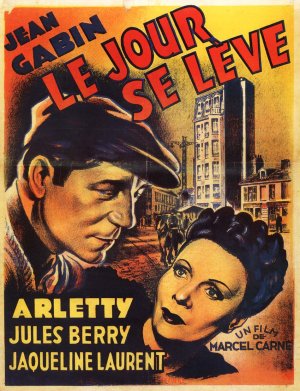
Le Jour Se Leve

I have come across a blog, A Film Canon, by a Mr Billy Stevenson, where you will find very original capsule reviews of many classic movies, including quite a number of films of interest to readers of FilmsNoir.Net:

Is The Green Cockatoo (UK 1937) the first film noir?

The Green Cockatoo (1937)

I came across this article in The Guardian (UK) today by film writer, Andrew Pulver:
Is Graham Greene the father of film noir?.

Graham Greene wrote an original script for a British crime thriller called The Green Cockatoo (aka Four Dark Hours or Race Gang), released in 1937, which is hardly-ever screened and is available only from the British National Film Archive. Pulver requested a screening and in his article he reports that the movie “has a similar [to film noir] commitment to the boiled-down essentials of the crime genre” . He also discusses these Greene noirs: The Third Man, Ministry of Fear, Brighton Rock, The Fallen Idol, and This Gun For Hire.  Coincidentally, Allan Fish of Wonders in the Dark posted an excellent review of Brighton Rock yesterday.

I have not seen The Green Cockatoo, so I must rely on the writing of others. I have not seen The Green Cockatoo, so I must rely on the writing of others. The Green Cockatoo since reviewed on December 3, 2010.

The Green Cockatoo was screened at the 43rd New York Film Festival in September 2005 and was reviewed by Keith Uhlich of Slant, and his closing remarks seem to establish its noir credentials: “Director William Cameron Menzies, an award-winning production designer, grounds The Green Cockatoo in expressionist shadows that anticipate Carol Reed’s The Third Man (the ne plus ultra of Greene’s cinema output) and the writer himself is evident via the piece’s sense of a veiled, yet inescapable moral outcome with which each character must deal.”

Hal Erickson in the All Movie Guide says of the film: “Filmed in 1937, the British Four Dark Hours wasn’t generally released until 1940, and then only after several minutes’ running time had been shaved off. The existing 65-minute version stars John Mills, uncharacteristically cast as a Soho song and dance man. When Mills’ racketeer brother Robert Newton is murdered, Mills takes it upon himself to track down and punish the killers. Rene Ray, the girl who was with Newton when he died, helps Mills in his vengeful task.”

Bosley Crowther in the NY Times: “With all its disintegration, though, it is still better melodramatic fare than is usually dished out to the patient Rialto audiences… An unknown here, Rene Ray, is very attractive as a wide-eyed country girl unwittingly involved in the Soho proceedings.”

James Naremore’s in his book on film noir, More Than Night (UCLA, 1998), in a chapter titled ‘Modernism and Blood Melodrama’, explores the noir sensibility and the English literary critique of modernity found in the writings of Eliot, Joseph Conrad, and of course, Grahame Greene, in the first half of the last century. Naremore discusses Greene’s 1939 novel Brighton Rock and the 1947 film adaptation in considerable detail. This quote from Naremore when analysing the influence of French poetic realism on Greene, is relevant:

Greene recognized that film was a mass medium, and he believed that highly charged poetic imagery should rise out of popular narrative. He insisted that ‘if you excite your audience first, you can put over what you will of horror, suffering, truth’. The logical formula for such effects, he observed, was ‘blood melodrama’. The problem in England was that ‘there never has been a school of popular English blood. We have been damned from the start by middle-class virtues, by gentlemen cracksmen and stolen plans and Mr. Wu’s’. The solution was ‘to go further back than this, dive below the polite level, to something nearer to common life’. If the British could only develop ‘the scream of cars in flight, all the old excitements at their simplest and most sure-fire, then we can begin—secretly, with low cunning—to develop our poetic drama… Our characters can develop from the level of The Spanish Tragedy toward a subtler, more thoughtful level’.

Naremore does not mention The Green Cockatoo, and I wonder if he knew of the movie when he wrote the book. It is worth noting that the film’s score was one of the first from Miklós Rózsa.

Detective Story (1951): “I built my whole life on hating my father”

Detective Story (1951)

William Wyler’s Detective Story (1951)  is an intensely rendered account of a few hours in a New York police-station.  Kirk Douglas as an inflexible embittered detective, dominates with a bravura performance, and is ably supported by an ensemble supporting cast.   Director Wyler uses the constrained space and hot humid weather to build a sense of anxiety and frustration. Even the two scenes outside the station are tightly framed: inside a taxi and in the back of a black mariah.  In this fashion Wyler turns the staginess of the screenplay, based on a Sidney Kingsley play, to advantage, and by using low angle and mid-level closely framed shots with a mis-en-scene accentuating the closeness of people and objects, he heightens the drama while sustaining visual interest.  There is no musical score but unless brought to your attention you would never notice.

The script deftly weaves the detective’s wife and their marriage with the principal story arc, and the melodramatic scenes with his wife at the station played out in confined back-rooms ratchet up the drama to histrionic levels.  The other naked city stories are elegantly woven into the tableau to reveal different aspects of the detective’s personality. Many critics have complained that the plausibility of the plot is weakened by there being no deep explanation for the Douglas character’s tortured and fanatical hatred of all transgressors, and his easily-triggered violence, apart from his own testimony that he hated his father, who was a hood and drove his mother insane. But to my mind, from weakness comes strength.  In real life, we rarely have either the luxury, skill, or inclination to go beyond  immediate actions and their consequences, and the nature of the story makes it entirely plausible that the other protagonists and the audience must deal directly and urgently with this troubled in-your-face cop.

Detective Story (1951)

The resolution is strong and very down-beat, and this deepens the poignancy of the final aerial shot of a young couple having been released from purgatory, bolting out of the station and running for dear life. A solid noir drama.

The 2003 DVD print is crisp and clean, and the audio crystal clear.

Secret Beyond the Door (1948)

Secret Beyond The Door (1948)

Direction by Fritz Lang
Screenplay by Silvia Richards
Cinematrography Stanley Cortez
Original Music by Miklós Rózsa
Starring Joan Bennett (Celia Lamphere) and Michael Redgrave (Mark Lamphere)
Diana Productions 99 mins

The opening scenes of Secret Beyond the Door, a creepy melodrama from Fritz Lang, introduce the protagonists as they are to wed, with the bride’s poetic voice-over narration letting us know it is a flashback. The camera of cinematographer, Stanley Cortez, elegantly explores the Gothic interior of the church in perfect harmony with the ethereal narration.  Lang’s mise-en-scene places the mysterious groom, Mark, played by Michael Redgrave, in a space alone in deep shadow as he waits for the bride.

Sadly, the rest of the film is not a patch on these first few minutes.

A variation of the Bluebeard fable, the story has a Freudian theme where a dark traumatic childhood event is the root of a deadly psychosis.  The resolution is a little too pat, and undermines the fairly intriguing drama that has gone before. But the screenplay is strong with intelligent use of Freudian tropes to explicate the motivations of the disturbed husband.

The attempt to deal with the psychological aspects and the moody atmosphere of entrapment establish the picture’s credentials as a film noir.

A minor effort which bombed at the box office.

Secret Beyond The Door (1948)

Sunset Boulevard (1950): “I’m ready for my closeup”

Sunset Blvd (1950)

Director: Billy Wilder
Screenplay: Charles Brackett, Billy Wilder and D.M. Marshman Jr
Cinematography: John F. Seitz
Editing: Arthur Schmidt
Art Direction: Hans Dreier and John Meehan
Music: Franz Waxman
Cast: William Holden (Joe Gillis), Gloria Swanson (Norma Desmond),
Erich von Stroheim (Max von Mayerling), Nancy Olson (Betty Schaefer)
Paramount 1950 (110 min)

“Wilder grasped that Hollywood itself could be a scene of Gothic isolation and solipsistic emotion. He showed the grandeur that could emerge from the parasitical relations between actors and writers, performers and directors, stars and star-gazers – cannibals all. Like most noir films, with their dark motives and circular structures, Sunset Boulevard makes corruption and betrayal seem inescapable. Yet Wilder pays tribute to what can emerge from this hothouse world, just as he does honor to the film formulas he lightly parodies. As Hollywood keeps reinventing itself, as Wilder’s own films become relics of a distant age, his barbed tribute stings and sings with even more authority.”
– Morris Dickstein, The A List (Da Capo Press).

“… a tale of humiliation, exploitation, and dashed dreams… The performances are suitably sordid, the direction precise, the camerawork appropriately noir, and the memorably sour script sounds bitter-sweet echoes of the Golden Age of Tinseltown… It’s all deliriously dark and nightmarish, its only shortcoming being its cynical lack of faith in humanity: only von Stroheim, superb as Swanson’s devotedly watchful butler Max, manages to make us feel the tragedy on view.” – Time Out

Sunset Blvd (1950)

Sunset Boulevard is a masterpiece. Billy Wilder’s assured direction and the elegant and fluid camera of veteran cinematographer John F. Seitz enthrall from the first frame to the last.  A literate script, great performances from the lead actors, an expressionistic score from Franz Waxman, and the bravado art direction of Hans Dreier and John Meehan define a deeply focused journey into dissolution and madness. There is also a wit and wry humor that lightens the mood before the noir universe begins to exact its vengeance on the poor souls who stumble in their struggle to simply live and love.

Sunset Blvd (1950)

The last major Hollywood film shot on a nitrate negative, the restored DVD version of 2002 reproduces the “lustrous black and white images” cinema audiences experienced on the film’s release nearly 60 years, and gives the drama an immediacy that belies the many years that have passed.

Sunset Blvd (1950)

Applauded as the quintessential movie about Hollywood, for the writer the theme of the film is deeper and more universal.  Aging silent actress Norma Desmond, who hasn’t worked for 20 years, lives out the autumn of her life in a decaying 1920s palace on Sunset Blvd. with her intensely loyal factotum, Max, in gothic delusional grandeur, dreaming of the day she returns to the studio where Cecil B. DeMille will direct her abominable screenplay of Salome, in which of course she will play the lead.  Into this scenario stumbles a younger man, Joe Gillis, a screenwriter on the skids and on the lam from his creditors. She wants her script edited and he is desperate for money and lodgings – a bargain is made in perdition.

He becomes her kept lover and she falls madly in love with him. He tries to rebel, she slashes her wrists, and he runs back to the mansion-cum-prison where only the front cell-like gate has a lock.  His thwarted ambition, lassitude, weakness, and a kind of reciprocated love for the aging siren, hold him to her, until he starts sneaking out at night to work on a script with Betty, a young studio reader, who falls in love with him. Norma finds out, and one whispered surreptitious phone call has thunderous consequences for all.

In the quote at the head of this review, the Time Out writer says the movie’s “only shortcoming… [is] its cynical lack of faith in humanity: only von Stroheim, superb as Swanson’s devotedly watchful butler Max, manages to make us feel the tragedy on view.”  I can’t agree with this assessment.  Gloria Swanson, William Holden, and Erich von Stroheim inhabit their roles with an intense humanity, and Nancy Olson as Betty is totally engaging as a young woman with heart and a vivacious intelligence.  Norma’s femininity and vulnerability are on display in every scene. Her tragedy is that of the successful woman whose career is side-lined into a banal existence of domestic isolation: her angst is palpable and exquisite.  Max, the loyal friend, ex-husband, and faithful retainer, idolises Norma, and his noble intentions in perpetuating Norma’s delusions tragically precipitate her destruction.  Joe is desperate when he enters his Faustian-pact with Norma, and his actions are all too human. His first attempt at freedom is thwarted by his ‘love’ for Norma, and his capitulation is not totally abject. His second and final renunciation is as noble and self-less as it is tragic.

Wilder has fashioned a deeply sympathetic story of four fundamentally decent people, each tortured in their own way, and each sadly complicit in the inevitable doom that will engulf them.

The Postman Always Rings Twice (1946)

The Postman Alays Rings Twice (1946)

Sex and death. Greed and selfishness. Crime and punishment. The film adaptation of James M. Cain’s novel, The Postman Always Rings Twice, is a dark allegory of amorality and its consequences.  As a relentless cosmic avenger, fate ensures that the adulterous lovers who murder the woman’s husband, suffer definite and final retribution for their sins.

Lana Turner and John Garfield are great in the lead roles. Turner’s platinum beauty, and the smouldering animal sexuality of both Turner and Garfield dominate the mise-en-scene.

The Postman Always Rings Twice (1946) The Postman Always Rings Twice (1946)

A theme of entrapment is played out in a roadside diner.  Cora the beautiful and ambitious young wife is caged in a barren loveless marriage to a much older man, while Frank the drifter who works for them is ensnared in a demonic love for Cora.  This scenario and the doomed fate of the protagonists is established deftly in the first few scenes with the help of an otherwise prosaic ‘Man Wanted’ sign. Director Tay Garnett and cinematographer Sidney Wagner use close-framed shots to express the suffocation of the two lovers, and panoramic elevated ocean beach scenes at dusk to portray the blooming of love and as the backdrop to idyllic respites from their doomed trajectory towards destruction. Their final visit to the beach has a dark foreboding.

The Postman Always Rings Twice (1946)

As Mark T. Conrad wrote of the movie: “It has the feeling of disorientation, pessimism, and the rejection of traditional ideas about morality, what’s right and what’s wrong.” And there is no pity or remorse. A classic film noir.

The Sniper (1952): Off Target

The Sniper (1952)

A sharp-shooting psychopath who hates woman goes on a killing
spree in San Francisco and is pursued by the police.

Director Edward Dmytryk started work on The Sniper just after he finished serving a 12 month jail sentence for refusing to co-operate with the infamous HUAC. Upon his release Dmytryk recanted and squealed to the HUAC naming names. Producer Stanley Kramer then offered him this Columbia production. Ironically, the veteran right-wing actor and HUAC collaborator, Adolphe Menjou, was signed to play an un-sartorial cop sans moustache.  The NY-based Daily Worker was not impressed: “Movie director Edward Dmytryk, ex-member of the Hollywood Ten who turned informer for the FBI, is now palsy-walsy with his erstwhile foe – the rabid witch-hunter and haberdasher’s gentleman – Adolphe Menjou. Now Dmytryk and Menjou are together again – this time as friends. Menjou has a leading role in The Sniper, which Dmytryk, gone over to warmongering and restored to favor of the Big Money, is now directing for Stanley Kramer productions.”.

A solid b-production, The Sniper is a taut thriller, which does not quite come off as a film noir, although there are strong moments in this gritty story of a young loner battling a deep and violent pathological hatred of young woman. Shot on location on the streets of San Francisco, angle shots and off-kilter staging sustain the visual interest throughout, with those scenes in the seconds before the sniper shoots three of his victims being particularly suspenseful.

The Sniper (1952)

The acting is rather stolid and this weakens the drama. While the script attempts to explain the sniper’s pathology and sermonises on how the law should handle such offenders, there is little real depth to the portrayal. Filler scenes used to establish his immediate motivation are too obviously contrived, with the younger women he encounters socially being unnecessarily mean-spirited. But in a sequence in an amusement park, the pathology and the anger of the sniper are deftly explored without artifice and with chilling accuracy.

The police investigation has just too many convenient coincidences, and the meetings with the cops and the good burghers of ‘Frisco demanding action on the pursuit are too stagey by half. A fair b-thriller of considerable historical interest.

The Sniper (1952)