The Maltese Falcon: The beginning of noir

The Maltese Falcon (1941)

John Huston’s 1941 screenplay was the first serious attempt to bring the hard-boiled nature of Hammett’s fiction to the screen. The 1931 version may have more closely followed the story of the novel, but it did not carry the hard-boiled spirit of Spade to the screen, and the 1936 version, Satan Met a Lay, with Bette Davis played the story as broad comedy.

David Spicer wrote in his book Film Noir (2002) that Huston’s film “was much closer than previous versions to the cynical tone of Hammett’s hard-boiled novel, retaining as much of Hammett’s dialogue as possible”.  William Luhr, in his book on the 1941 version says that: “Spade does not happily juggle a plethora of women but is bitterly involved with only two… For him, sexuality is not carefree but dangerous and guilt-ridden. The mystery and the evil world it reveals dominate the mood of the movie, and this sinister atmosphere does not entirely disappear at the end. Such an atmosphere presages film noir.”

The Spade of Hammett’s novel is deeply cynical, and at the end of the novel, but not in Huston’s film, he is ready to resume his affair with Archer’s wife. Mayer and McDonnell in The Encyclopedia of Film Noir (2007), say this about the final scenes in Huston’s screenplay: “Huston replaces Hammett’s cynicism with a more romantic gesture from Spade as he tells Brigid, ‘Maybe I do [love you]‘. While Ricardo Cortez’s Spade in 1931 is more or less resigned to handing Wonderly over to the police, Huston extends this sequence by accentuating the psychological disturbance within the detective. His torment is palpable, especially when he shouts into her face that ‘I won’t [fall for you] because all of me wants to, regardless of the consequences’. While this is not an existential moment, as some claim, it does represent a significant moment in the development of film noir. Unlike the novel, where survival is all that matters to the detective, Spade’s torment in the 1941 film nearly destroys him.”

Summary Noir Reviews: when Pushover comes to Whirlpool

Tomorrow Is Another Day

Tomorrow Is Another Day (1951) A rare Warner-b. Felix Feist ( The Man Who Cheated Himself and The Devil Thumbs a Ride) helms a redemption noir with true pathos. The redemption is played out in a farm-worker’s camp with shades of The Grapes of Wrath. The two leads, Ruth Roman and Steve Cochran, are great and deliver with real grit and integrity.

The Glass Key (1942) A very flat adaptation of Hammett’s novel starring Alan Ladd and Veronica Lake. But William Bendix is a knockout as a queer sadistic hood in the darkest scene, which succeeds because it is faithful to the novel. The scene opens in a basement dive with a soulful black singer Lillian Randolph (uncredited) on a piano performing a bluesy number, and climaxes in a seedy private room with a drunken Bendix strangling his hoodlum boss, while Ladd looks on holding a “roscoe”.

Pushover (1954) is a wide-screen noir as hip as an LA martini, where an LA cop redefines Double Indemnity, with bravura direction by unknown stringer Richard Quine. Fred MacMurray and Kim Novak in her first role are awesome! Darkly forlorn like an empty city street at the witching hour.

Lured (1947) is an entertaining camp thriller set in London. Douglas Sirk (!) directs a virtual cavalcade of talent, George Sanders as a good guy, a luscious Lucille Ball as the serio-comic heroine, Cedric Hardwicke as the bad guy who writes Baudelaire-like poetry, Charles Coburn as a wily police inspector, with an over-the-top cameo from Boris Karloff as an off-the-wall washed-up fashion designer!

Fallen Angel (1945) is as tight and elegant noir as you would want. Otto Preminger steers a solid cast through an ethical labyrinth: Dana Andrews in perhaps his best role as a grifter on the skids, Linda Darnell is a femme-savant whose sexual chemistry sends the male protagonists’ libidos haywire, Broderick Crawford is a deadly cop, and Alice Faye is the salvation angel.

LA Confidential (1997) is a visually stunning thriller: great direction, production design, score, camera-work, and editing. Strong performances all-round. But it has no real soul and lacks a true noir sensibility. The screenplay is hopelessly contrived, and the ending is pat. Mickey Spillane on steroids.

The Blue Gardenia (1953) is a minor Fritz Lang melodrama which has some noir elements. Anne Baxter shines as a young woman who thinks she has killed a guy, but Lang was not really interested, and Richard Conte as a cynical reporter delivers yet another weak performance. The saccharine ending disappoints. Nick Musucura’s contribution as DP is sadly undistiguished, though some moody scenes impress.

You Only Live Once (1937) also from Fritz Lang is a fascinating movie. Henry Fonda and the luminous Sylvia Sidney as star-crossed lovers become desperadoes on the run, and the stunning ending presages Gun Crazy’s fog-bound denouement by a full decade. As a relentless fatalistic melodrama moodily shot by virtuoso DP Leon Shamroy, it is a real contender as the first poetic realist film – beating the French by a full year. Consider this, Carne’s Port of Shadows was released in 1938, and Pépé le Moko debuted in France on 28 January 1937, while You Only Live Once opened in the US only a day later on 29 January 1937! The amour fou of Lang’s feature I think bumps the less romantic Pepe Le Moko.

Witness to Murder (1954) directed by Roy Rowland and lensed by John Alton is a minor but involving thriller with a noir angle. Barbara Stanwyck as the witness and a deliciously sinister George Sanders as the murderer hold it all together. Alton’s contribution is subdued, but the opening scenes around an LA apartment building on a breezy summer night are nicely atmospheric.

Laura (1944) is elegant noir melodrama. Gene Tierney is an exquisite iridescent angel and Dana Andrews a stolid cop who nails the killer after falling for a dead dame. Clifton Webb as the homme-fatale is his annoying best.

Citizen Kane (1941) Its sheer audacity always amazes. Though the scenario is beginning to feel dated with the episodic nature of the narrative less than satisfying.

Kiss the Blood Off My Hands (1948) is an atmospheric noir set in London directed by Norman Foster and lensed by Russell Metty with a great Miklos Rózsa score. Burt Lancaster and Joan Fontaine shine as two loners. The trauma of the returning WW2 vet is given an original treatment and Foster’s direction is polished. Norman Foster started out in the 30’s directing Charlie Chan and Mr Moto features, and does not have a high profile. He got directing credit for the Welles’ scripted Journey Into Fear (1943) starring Joseph Cotton, but the cognoscenti claim that Welles is the real helmsman. Foster also directed the sharp b-noir Woman on the Run (1950), and he deserves high praise for Kiss the Blood Off My Hands, which ranks with the best of Siodmak and Tourneur.

Black Angel (1946) is a visually elegant psycho-noir from a Cornell Woolrich story. Dan Duryea and June Vincent investigating the murder of a female blackmailer are impressive, with good support from a suave Peter Lorre as a ‘good’ bad guy. An hypnotic dream climax is the highlight – with kudos to director Roy Neill (his last movie) and DP Paul Ivano.

Whirlpool (1949) is directed by Otto Preminger, and stars Gene Tierney, Richard Conte, and José Ferrer in another psycho-noir. Lensed by Arthur Miller with a wonderfully dramatic score from David Raksin. Preminger turns a preposterous frame-up by hypnosis premise into a polished melodrama. Tierney is vivacious but does little more than the role of a dupe demands. Conte is incredibly wooden and a real disappointment, while Ferrer steals the picture as a suave homme-fatale, who has real wit and cunning. Broderick Crawford is good as a skeptical scruffy cop. Preminger uses mise-en-scene deftly to expose the truth below the surface. In an early scene, we have Tierney in close-up while Ferrer delivers lines of seductive poison, and as he approaches Tierney with his promises of sincerity his shadow fall across her face…

The Killer That Stalked New York (1950)

The Killer That Stalked New York (1950)

The Killer That Stalked New York (1950) is a b-noir from a director who made only three movies in the early 50s, Earl McEvoy. The movie was lensed by Joe Biroc and stars the under-rated Evelyn Keyes, who passed away last year, and appeared to advantage in Joseph Losey’s The Prowler (1951) and Robert Rossen’s Johnny O’Clock (1947). Keyes plays an accomplice to a hood, who after a job in Cuba, returns to NYC with smallpox, in a dramatisation of the New York smallpox scare of 1946. Keyes is brilliant as ‘the killer’ and dominates the film, which in the light of the current swine flu scare, is a well-crafted docu-drama which deftly weaves the drama of the woman’s noir story and how a city of over 8 million people has to mobilise to deal with such a threat, with vignettes on how the illness is transmitted, and a continuing story arc of the fate of the killer’s first ‘victim’, a young working-class girl.

An interesting segue is how these old Hollywood b-pictures weaved wonderful vignettes and comic moments into the story. Two such scenes stand out in this movie. A milkman is infected and there is a scene in the sick man’s bedroom when the inoculation team visits. The poor guy’s persona is eloquently evoked by his wife’s harping but deeply loving commentary on her husband – before she realises the gravity of his illness. The other scene cuts to a Brooklyn street with kids playing on the road in front of a bar. The kids scramble as a police car pulls up. They gather on the footpath to check it out. As a burly detective steps out of the car, one kid pipes up and asks for the low-down “Hey Bub…”. The cop replies “Beat it kid.” The bar is closed so the cops after getting the form from the kids, drive off, and the kids jump back on the road shooting air tommy guns after the car.

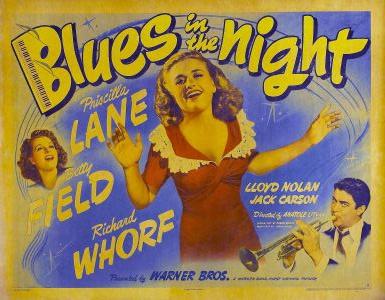
Blues in the Night (1941): Noir Counterpoint

Blues in the Night (1941)

Blues in the Night (Warner Bros 1941) is a fascinating musical noir melodrama about a budding white jazz band scripted by Robert Rossen, directed by Anatole Litvak, and atmospherically lensed by Ernest Haller, with a b-cast, including a very young Elia Kazan, as a dizzy jazz clarinetist. These impeccable leftist credentials are reflected in the plot and the resolution which talk to personal integrity and the values of solidarity and loyalty. Amazingly for the period an establishing scene in a police lock-up respectfully credits the music’s black roots. Tied up in all this is a noir arc with a hood played by Lloyd Nolan and a killer performance by Betty Field (an actress who sadly went nowhere) as a cheap femme-fatale.  The socially aware feel-good ending is tempered by the noir-like denouement for the hoods and the femme-noir.

This movie is a serious contender as a seminal film noir,  remembering The Maltese Falcon was made in the same year, Stranger On the Third Floor only a year earlier in 1940, and Double Indemnity a full three years later in 1944.

Allotment Wives (1945): The main squeeze is a dame!

Allotment Wives (1945)

A title that conjures up sordid images doesn’t disappoint.  A b-programmer from Monogram co-produced by and starring the sublime Kay Fancis as a crime-boss in one of her last roles, Allotment Wives is really a late gangster flick.   The organisers of the San Francisco’s Roxie Theatre coming noir series,  I WAKE UP DREAMING: The Haunted World of the B Film Noir,  have stretched the envelope by including this feature. Though others no doubt will pull out the tired arguments: the emasculating femme-noir threatening male dominance during the War, and the eroticisation of violence.

Allotment Wives (1945)
“Nice shooting…”

The story of a woman who uses her social status and ill-gotten wealth to front a bigamy racket where dames marry multiple GIs during WW2 to skim the allotment support paid by the Defense Dept to spouses of men on active duty, is predictable but well-made with a snappy script. Noir regular Paul Kelly as an army investigator is disappointingly wooden and his performance is underwhelming at best. Otto Kruger is fine as the lady boss’ right-hand man.  The climax is brutal with Francis plugging a dame without qualm or remorse, but justice triumphs in the end.  Francis’ flamboyant hats and her hair-do add a juicy camp quality to the goings-on.

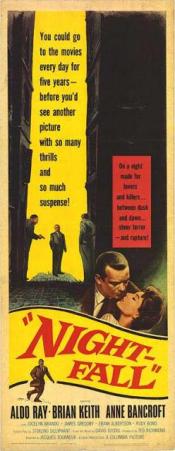
Nightfall (1957): Final curtain call for classic noir

Nightfall (1957)

Jacques Tourneur’s Nightfall signals the coming end of the classic noir cycle, followed only by Murder By Contract and Touch of Evil in 1958, and Odds Against Tomorrow in 1959.

Despite Tourneur’s directorial elan, excellent noir photography from Burnett Guffey, and a script based on a David Goodis novel, the movie clearly attests to the decline of the film noir cycle. The story of the innocent man entrapped by fate and on the run from both the cops and hoods has been played out many times before, and Tourneur does not manage to invest the scenario with any real tension. Even at 78 minutes the screenplay takes too long to reach its rather pat resolution.

Nightfall (1957)

Aldo Ray and Ann Bancroft in the leads are well cast, and the development of their relationship from a pick-up at a bar in LA and its flowering in the snow-drifts of Wyoming, is handled with economy and flair. The dialog is intelligent and the inter-play between two mis-matched hoods and their prey is strikingly good. The violence whether threatened or real is particularly noir.  The two merciless hoods threaten to snap the legs of the protagonist on the boom of an oil rig, and the pitiless gunning down of a victim is still shocking to a jaded noir sensibility. But a climactic fight in the snow against an out-of-control snow plough is bereft of any true suspense, and even the final gruesome aftermath lacks real impact.

A Lighter Shade of Noir: Matinee Double-Bill

A Woman's Secret (1949) Hollywood Story (1951)

A Woman’s Secret (1949) and Hollywood story (1951), two flicks that carry a film noir classification on IMDB which I watched in the past week, I found  to be hardly noir at all.

A Woman's Secret (1949)

A Woman’s Secret, an RKO-feature, has great credentials. The movie is directed by Nicholas Ray from a screenplay from Herman J. Mankiewicz, with photography from George Diskant, and starring Maureen O’Hara, Melvyn Douglas, and Gloria Grahame.  It starts off noir with a shooting off-screen, and the use of flashback in the narrative, but plays out as sophisticated melodrama with a biting wit, and some really funny slapstick when the wife of the investigating cop does her own snooping with a handbag carrying fingerprint powder and a giant magnifying glass. The story of the conflict between a naive young singer (Grahame) and her controlling mentor (O’Hara), has shades of All About Eve but this motif is not taken too seriously.  The two female leads are charming, with Grahame displaying an engaging gift for comedy.  Melvyn Douglas is as debonair as you would expect and takes the role of narrator and referee.  Great fun.

Hollywood Story (1951)

Hollywood Story is a programmer from Universal that has a 50s television feel.  Richard Conte is a producer in LA that wants to make a movie about the murder of a big silent movie director 20 odd years before, and his delving into the past has violent consequences.  A  strictly b-effort that plays well as a whodunit with noir atmospherics, and some really funny lines.

Christ in Concrete (1949): Simply a masterpiece

Christ in Concrete (1949)

The moving simplicity of the Pietro Di Donato novel, Christ in Concrete, has been brought to the screen with rare sincerity. It is two hours of genuine human drama, which makes no concession to convention.

– Variety (1949)

The camerawork by C. Pennington Richards is some of the best of the era, with the city streets, darkened hallways, and construction sites void of any softened corners guaranteed by Hollywood of the 1940s. With Dmytryk, Richards gave Christ in Concrete an astonishing look, which manages to straddle and suggest both film noir and Italian neo-realism. The deep focus crisp black-and-white photography evokes a handful of strong movies yet to be made, including On the Waterfront, Edge of the City, America, America, Sweet Smell of Success, Touch of Evil, and Pickup on South Street. Visually, Christ in Concrete looks like the most influential movie nobody ever saw… Christ in Concrete shares its rough-edged moral outrage with Visconti’s La Terra Trema but its gilded professionalism with Wilder’s Double Indemnity. It’s a knockout combination. Dmytryk found some kind of artistic voice in exile in England unlike any heard from him before or since.

– Matthew Kennedy, Bright Lights Film Journal (Nov 2003)

Based on the novel by Italo-American Pietro Di Donato, Christ in Concrete (aka Give Us This Day), a powerful leftist denunciation of capitalism from director Edward Dmytryk, had to be filmed in the UK, and was buried a few days after its US release by a reactionary backlash. Telling the story of Italian immigrant building workers and their families in Brooklyn during the Depression, the film is the closest an Anglo-American movie ever got to the aesthetic and socialist outlook of Italian neo-realism. Teeming tenements and residential streets are shot with a provocatively gritty realism and film noir atmospherics.

Christ in Concrete (1949)

The cast is superb with particularly powerful performances from the two leads, Sam Wanamaker and Lea Padovani, who embody the immigrant experience, which is so imbued with vitality and compassion that the film soars above any other similar work of the period. Enriched by a poetic script, the innovative cinematography of C.M. Pennington-Richards, outstanding art direction from Alex Vetchinsky, and a brilliantly evocative score by Benjamin Frankel, the movie is a revelation.

The opening scene in a deprived urban locale that follows a drunken man from the street and up the stairs of a dirty tenement building is a tour-de-force. An inspired mise-en-scene and a moving camera that follows the action from below Ozu-style, framed by the drama of the musical motifs, had me enthralled. This scene and the rest of the movie, except for panaromic shots of New York shown in the opening credits, were filmed in a studio lot in Denham, England!

Christ in Concrete (1949)

Film as art, Christ in Concrete is simply a masterpiece.

Double Jeopardy (1955): Pulp Heaven

Double Jeopardy (1955)

A 70 min b-feature  from Republic Pictures, Double Jeopardy,  is an unpretentious thriller, only tangentially noir, and  with a high sleaze factor. The good guys are wooden and boring, and the bad guys irredeemably bad. A boozy blackmailer and his cheap wife are the focus and carry the picture. Pulp heaven.

Double Jeopardy (1955)