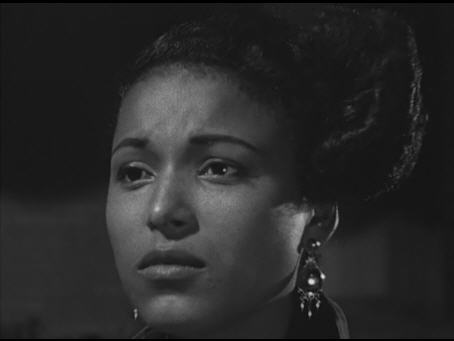
Une Si Jolie Petite Plage (France 1949): Iron in the soul

Une Si Jolie Petite Plage (Such a Pretty Little Beach France 1949)

Une Si Jolie Petite Plage (Such a Pretty Little Beach France 1949) (91 mins)
Released as Riptide in USA in 1951

Screenplay by Jacques Sigurd
Directed by Yves Allegret
Cinematography by Henri Alekan
Original Music by Maurice Thiriet

Produced by Emile Darbon

Pierre . . . . . Gerard Philipe
Marthe . . . . . Madeleine Robinson
Landlady . . . . . Jane Marken
Mrs. Cullier . . . . . Mona Dol
Fred . . . . . Jean Servais
Commercial Traveler . . . . . Julian Carette
Garage Owner . . . . . Andre Valmy
Orphan Boy . . . . . Gabriel Gobin

Jacques Sigurd, one of the last to come to “scenario and dialogue,” teamed up with Yves Allégret. Together, they bequeathed the French cinema some of its blackest masterpieces: Dêdée D’Anvers, Manèges, Une Si Jolie Petite Plage, Les Miracles N’Ont Lieu Qu’une Fois, La Jeune Folle.

– Francois Truffaut

Une Si Jolie Petite Plage (Such a Pretty Little Beach France 1949)

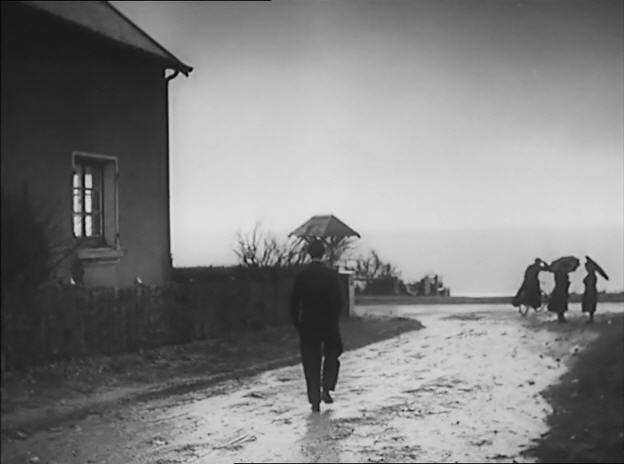
A country priest on some banal errand cycles past a man walking in the rain to his doom, and then waves to a pair of village matrons, as relevant and as useful to the other rain-soaked pedestrian as the umbrellas held by the two women.

Savage irony, withering subversion, and desolation mark the rain-sodden angst of a young man’s end.

What is respectable is rotten, beauty masks filth; the melancholy song of a plaintive chanteuse from a record is a conspiracy of decadence and low greed. Eve is a woman of a certain age in mourning with a hunger for youthful sex and a penchant for cheap sentimentality. Lucifer is a lyricist and stool-pigeon in a grubby search for the jewels of a dead woman. Respectability is a travelling salesman who buys postcards of cemetery monuments for his son’s collection.

Une Si Jolie Petite Plage (Such a Pretty Little Beach France 1949)

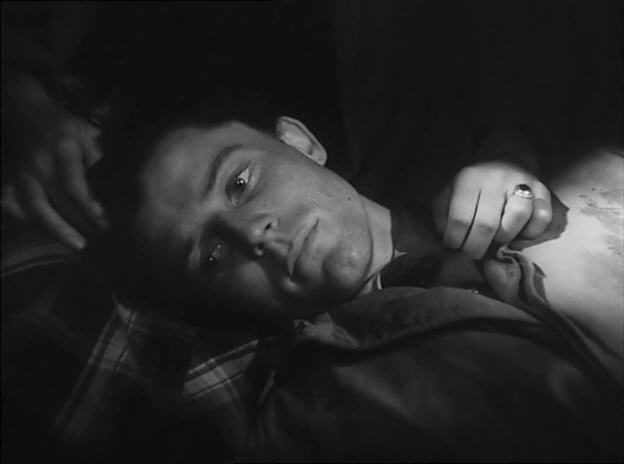
Truth and beauty are not poetry, but the simple and unaffected concern of one troubled soul for another. A woman caressing the brow of a condemned man in a desolate shack on the beach of perdition.  The eve of the last day, two men work on a car, a murderer helping a mechanic, both strangers yet angelic comrades.

Solidarity meeting fate head-on.  A last desperate attempt by the killer to redeem the child he was before and still is – lost in the sordid machinations and cruel exploitation of bourgeois hypocrisy.

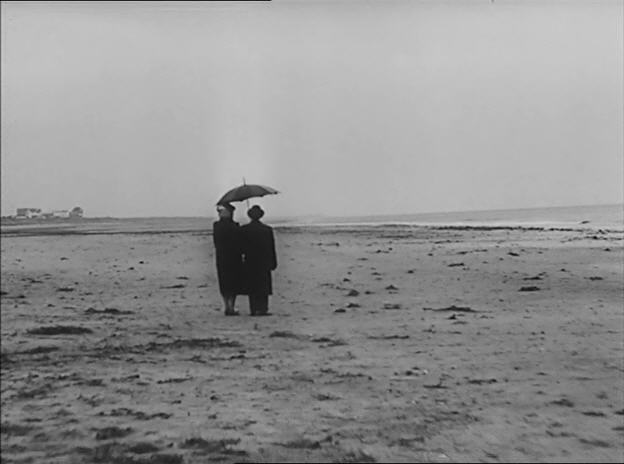
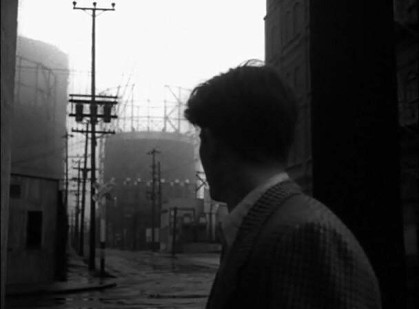
The apotheosis of poetic realism and film noir, not on the dark streets of Los Angeles, but in a decrepit consumptive ville on the French coast. This is the true trajectory of noir released from the shackles of the studio enterprise: treacherous mud and dull clouds leading to a desolate beach of lost youth. Death the only escape – sur une si jolie petite plage.

Une Si Jolie Petite Plage (Such a Pretty Little Beach France 1949)

Summary Noir Reviews: Drunken Angel on River Street Rocks

99 River Street (1953)

99 River Street (1953) Essential Phil Karlson b. Pulp poetry from DP Franz Planer. Matches the best of Anthony Mann and Sam Fuller. Evelyn Keys is hot! A cab-driver fights a murder wrap after his cheating wife leaves him for a ruthless hood.  Keys steals this picture as a budding actress who helps the cab-driver in a night of noir entrapment.  Her ‘seduction’ scene with the hood is the stuff of dreams – leaving Ella Raines in her jazz scene in Phantom Lady (1944) in the mud.  Chiaroscuro lensing of Franz Planer is a revelation.

Brighton Rock (1947)

Brighton Rock (1947 UK) Greatest British noir is dark and chilling. A cinematic tour-de-force: from the direction and cinematography to top cast and editing. As brutal as any noir any time any country.  A cheap young psychopath playing the hoodlum boss leaves a bloody trail as he tries to cover up his murder of a ‘rat’.  Adapted by Grahame Greene from his pre-WW2 novel and brought to the screen by the talented Boulting brothers, the story has a venomous counter-point  involving a gullible young waitress who ‘knows too much’.  The picture has to contain one of the most chilling lines in all of noir when a nun  speaks of  “the appalling strangeness of the mercy of God”.

Drunken Angel (1948)

Drunken Angel (aka Yoidore tenshi) (1948 Japan) “Too many useless sacrifices” A great Kurosawa noir.  A loser doctor with soul takes on the fetid moral swamp of Yakuza degradation. The Japanese master in one of his early films has created a classic noir.  He fully comprehends the meaning of noir: from his story and a total control of his mis-en-scene he fashions a tragedy from the back alleys and stinking open sewers of urban degradation. An alcoholic slum doctor tries desperately and in all the wrong ways to cure a young consumptive Yakuza hood.  Kurosawa makes bravura use of ambient music to juxtapose and telegraph the meaning of the drama as it unfolds: from a jazz band playing St. James Infirmary Blues, to a  loudspeaker atop the “Happy” Supermarket blaring the Cuckoo Waltz in an endless loop…

Of Missing Persons (1956)

Of Missing Persons (aka Section des disparus)(1956 Argentina) Lurid adaptation of 1950 pulp novel by David Goodis. Appalling yet mesmerizingly torrid latin melodrama. Playboy husband opportunistically fakes his death to flee the clutches of his neurotic wife and fall into the ample bosom of his dancer girlfriend.

Phenix City Story (1955)

The Phenix City Story (1955) Expose confidential based on true story. Unrelenting and chilling portrayal of decent people fighting crime. One of the better 50s ‘confidentials’ based on fact. A good b-cast exudes realism in on-the-streets confrontations filmed as newsreels.  The killing of a black child is particularly brutal, and a sympathetic portrayal of blacks is noteworthy.

Scandal Sheet (1952)

Scandal Sheet (1952) Lacklustre realisation of Sam Fuller’s expose novel on yellow journalism. Broderick Crawford is strong as the bad guy, but the rest of  the cast is adequate 0nly. No tension or surprises from by-the-numbers direction.

The Second Woman (1950)

The Second Woman (1950) From producer Harry M. Popkin (DOA and Impact) A neat b-noir lensed by Hal Mohr has you guessing with a nice twist. Interesting psycho-drama starring Robert Young as a disturbed architect (or is he?) with a love angle, but the pace is a little slow and the drama labored.

The Sleeping City (1950)

The Sleeping City (1950) Sleep inducer about drug racket in NY hospital. Could have been interesting if made by talented film-makers. NY cop goes undercover as an intern in a large city hospital to investigate a murder. Richard Conte’s mind is elsewhere…

The Sound of Fury (1950)

The Sound of Fury (1950) Great noir from Cy Endfield outdoes Lang’s Fury and brilliantly prefigures Wilder’s Ace in the Hole. Climactic mob scenes mesmerise. Frank Lovejoy plays himself – an everyman down on his luck who takes to crime after hooking up with homme-fatale Lloyd Bridges, who then frames him for murder. Crazy scene of a lynch mob trying to storm a jail full of rioting in-mates is a must-see tour-de-force.

They Drive By Night (1938)

They Drive by Night (1938 UK) On-the-run ex-con tries to beat a murder rap on dark London streets and long-haul lorries. Abrupt ending though. Quaint English who-dun-it with noir atmospherics and a  loopy camp villain. Not to be confused with the US-made Bogart vehicle.

The Unsuspected (1947)

The Unsuspected (1947) Camp noir! Curtiz directs, Woody Bredell lenses, Waxman scores, Claude Rains over-acts, and Audrey Totter is a hoot! Radio-host of a radio true murders program investigate his own crime!  Predictable but fun. Checkout the vinyl…

Voici le temps des assassins... (1956)

Voici le temps des assassin (1956 France) A young twisted femme-fatale and  her off-the-wall mere try to destroy aged Paris restaurateur. Climax a bitch. Jean Gabin is a master-chef and and all-round good guy, seduced by the daughter of his ex-wife. This dame is a text-book psychopath. Lies and more lies and layer upon layer of  cruel  manipulation.  A dark hysteria pervades and look out for the young woman whipped by the dominatrix mother-in-law swathed in mourning!

The Web (1947)

The Web (1947) Entertaining thriller with dumb lawyer framed for murder. Snappy patter from solid leads, but about as noir as an albino cat. Hapless lawyer moonlights as bodyguard for a corporate type, and gets into trouble. An ensemble cast serve up a fizzy martini: Ella Raines, Edmond O’Brien, William Bendix, and Vincent Price.  Guess who plays who!

Where  the Sidewalk Ends (1950)

Where the Sidewalk Ends (1950) Preminger’s elegant direction and La Shelles’ crisp noir lensing are aloof.  Dan Andrews in the lead is wooden. Andrews is a cop on a short fuse, who accidentally kills a suspect, and covers it up, then falls for the daughter of the cab-drover charged with the killing. Over-rated and it has all been said before.  Gene Tierney as always is engaging as the love interest.

Woman on the Beach (1947)

The Woman On the Beach (1947) Intriguing cerebral noir melodrama from Jean Renoir… what’s left of it after hacking by RKO suits. A moody ‘art-house’ noir where a love triangle suffused with suppressed rage, anger, and eroticism is played out in an isolated beach-side setting. Top cast make it interesting: Joan Bennett, Robert Ryan, and Charles Bickford.

World for Ransom (1954)

World For Ransom (1954) Dan Duryea a good guy! Robert Aldrich takes a boys own script and fashions a noir take on love, loyalty and illusion. Set in Singapore with a shootout finale in the jungles of Malaya.  Story while solid does not support the heavy psychological sub-text.


Call Northside 777 (1948): “It’s a good world outside”

Call Northside 777 (1948)

1948 was a signal year in the film noir cycle, which saw the move towards on-the-streets filming and a shifting focus on police operations, heralding the police procedurals that became dominant in the 1950s.

Jules Dassin’s The Naked City for Mark Hellinger carries the banner for this nascence of a cinema-verite style of filming. Dassin’s picture is set in New York and tells the story of a murder investigation by homicide cops with a gritty realism. But thematically, there is little to distinguish The Naked City as a film noir. It is the city of New York and its people that hold your attention, and the several bit-portrayals of people going about their lives are truly engaging. The final scene where a street-sweeper in profile scoops up yesterday’s papers from the gutter and moves on into the New York night gives an arresting hard-bitten closure.

In the same year Fox released Call Northside 777, a ‘newspaper’ noir set in Chicago directed by Henry Hathaway (The House on 92nd Street (1945), The Dark Corner (1946), Kiss of Death (1947), and Niagara (1953)). The film is an adaptation based on true events in Chicago during prohibition and recounts a newspaper reporter’s 1944 investigation into the conviction in 1932 of two young polish immigrants for the killing a policeman. A solid script by Jerome Cady and Jay Dratler, and the exceptional cinematography of DP Joseph MacDonald (Shock (1946), The Dark Corner (1946), The Street with No Name (1948), Panic in the Streets (1950), Niagara (1953), Pickup on South Street (1953), and House of Bamboo (1955)), mark this picture has having at least equal standing with The Naked City. The streets of Chicago are explored as never before.

A top-line male cast attracted an a-budget: James Stewart plays the reporter, Richard Conte is one of the convicted, and Lee J. Cobb is Stewart’s editor. Stewart is cast against type, and it doesn’t quite work. He is not hard-boiled. Rather he is too sober, happily married and middle-class, and while his reluctance to pursue the story of a ‘cop-killer’ marks out a certain prejudice, his persona jars. Conte has a relatively small role as the convict but is convincing, and Cobb is in his element.

But these guys are out-classed by the dames in this picture. They are all bit-players that shine in their characterizations. Helen Walker (Nightmare Alley (1947), Impact (1949), The Big Combo (1955)) is charming and intelligent as Stewart’s knowing wife. Betty Garde (Cry of the City (1948) and Caged (1950)) is convincing as an aging hard-bitten low-life whose hostile testimony convicted Conte. Kashia Orzazewski (Thieves’ Highway (1949), I Was a Communist for the FBI (1951), and Deadline – U.S.A. (1952)) as Conte’s mother is a revelation – she IS the guy’s mother– scrubbing floors and saving nickels & dimes for 11 years to save $5,000 to offer as a reward for whoever can get her son released. Joanne De Bergh (in the first of only two film apperances) as Conte’s ex-wife steals the scene where she is interviewed by a cynical and aggressive Stewart. Her unflinching integrity shines from her unwavering eyes – she has total control of the situation – in the living room of her home where she has built a new life for herself and Conte’s son.

Call Northside 777 (1948)

The picture is compelling even though the pace is slow and melodrama is kept at bay. The dramatic development of the reporter from a reluctant investigator to an impassioned crusader for justice impels the first half, and the second half is carried forward by the need to get credible evidence before a deadline agreed with the authorities. Stewart at one point castigates the blindfolded statue of justice for having a two-edged sword: the enforcement edge is sharp, but the other edge that deals with over-turning injustice is blunt. There is a duality too in the portrayal of the newspaper business in the movie, where the pursuit of sensational headlines and circulation compromises the search for truth. Early in the film, after Conte has read Stewart’s early tabloid stories, one of which splashes a photo of his wife and son on the front page, he tells Stewart to drop the story:

I sent for you
to tell you that…
I don’t want you
to write anymore…
about me or my family.

I’ve read what you’ve written.
I’ve seen the pictures
of my mother…
my wife and my boy.

We’ve poured our hearts
out to you…

(Well, you wanted help, didn’t ya?

That’s the only way you can get people
interested in the case

Nobody’s gonna read a little two-line ad
like your mother ran in the paper.

A half a million people
have been followin’ this story.

Now somebody might know
the killers and get in touch with us.)

I don’t want that kind of help.
I’ll stay here a thousand years.

But you must not
write anymore…
about my wife
and my mother and my boy.
My mother is doing this for me,
not to sell your papers.

(Oh, now, wait a minute. Wiecek.)

I made my wife divorce me…
so my boy has a new name.

Now you put his picture in the paper,
spoiled everything for him.

(I don’t know.
I thought I was doin’ a good job.)

No! This is writing
without heart…
without truth.

Before, I thought maybe
some crook lawyer…
would try to get the dollars
from my mother.

But this, I never figured.

Yes, I say it.
I’ll stay here. I’ll stay here
a thousand years.

But never write anymore
about my family.

Leave them alone.

Leave alone my wife and my boy.

Call Northside 777 (1948)

Like in The Naked City, the use of new technology in police operations is significant, but here it is used to gather evidence to quash a conviction. Conte undergoes a lie-detector test, and a good amount of screen-time is spent on a useful description of how the machine works. The evidence that exonerates Conte relies on blowing up a newspaper photo to reveal the date it was taken, and the transmission of the blow-up is over telephone lines using the then ‘wire photo system’. Also, unlike in The Naked City, the cops are portrayed as obstructionist and not above illegally withholding public records in an attempt to stymie Stewart’s efforts on behalf of a ‘cop-killer’.

Call Northside 777, like The Naked City, has noir elements but is thematically less concerned than traditional noir with the fate of the criminal protagonist. Conte is free at the end, but he has lost 11 years of his life, his former wife and his son are no longer his, and his future is uncertain. While there is a definite irony in the last words spoken in the film (apart from those of the narrator) when Conte says, “It’s a good world… outside. Yes it’s a good world outside.”, these words are spoken without irony – but not without a trace of regret.


Call Northside 777 (1948)

Cinematic Cities: New Jersey Shore

The Big Night (1951)

The Big Night (1951)
Director Joseph Losey | DP Hal Mohr

Joseph Losey’s last American movie is a powerful and affecting drama of a boy crossing into manhood one dark noir night.

The Art of the B: Riff-Raff (1947)

Riff Raff (1947)

Riff-Raff (1947) is a routine RKO comedy-adventure movie that has a certain flair with snappy dialog and an engaging cast. It would be  a stretch to call it a noir, but the opening sequence is so visually noir and accomplished that it should not be missed.  The movie opens at an isolated air-strip late at night in pouring run, as a plane waits for a passenger who finally arrives late.  This sequence running for 5 minutes  is totally without dialog, and brilliantly establishes a mood of dark mystery.

The kudos must go to DP George Diskant  (A Woman’s Secret (1949), They Live by Night (1949), Port of New York (1949), The Racket (1951), The Narrow Margin (1952), On Dangerous Ground (1952), and Kansas City Confidential (1952)) and first-time director Ted Tetzlaff  (The Window (1949), Johnny Allegro (1949), and Gambling House (1950)), who formerly had a long career as a cinematographer starting in the silent era.

Race and Film Noir: Black and Noir

Mauri Lynn in The Big Night (1951)

If during the 1940s and 1950s Hollywood was not actively racist, it still largely ignored race. Some academics have gone so far as saying that film noir was essentially a manifestation of a transference of a fear of blackness, the other, to a noir nether world of ambivalence and sublimation. But my view is to the contrary. If you look at noir movies over the classic period from the early 40s to the late 50s, a significant number of progressive writers and directors made noirs that deal sympathetically with race as important elements of the story. This is more than can be said of the body of Hollywood output for the period.

Here I would like to cover some of these noirs from 1941 through to 1956. The Harry Belafonte produced Odds Against Tomorrow (1959) is not included in this discussion, as we are dealing here with white Hollywood’s portrayal of blacks.

Blues in the Night (1941) An unusual melodrama cum musical with a leftist heart and a killer performance by Betty Field as cheap femme-fatale. Blues in the Night is a fascinating musical noir melodrama about a budding white jazz band scripted by Robert Rossen, directed by Anatole Litvak, and atmospherically lensed by Ernest Haller, with a b-cast, including a very young Elia Kazan, as a dizzy jazz clarinetist. These impeccable leftist credentials are reflected in the plot and the resolution which talk to personal integrity and the values of solidarity and loyalty. Amazingly for the period an establishing scene in a police lock-up respectfully credits the music’s black roots. A black prisoner is given a lot of screen-time as he sings a blues number and the white cast listen awe-struck.

Body and Soul (1947) This masterwork from Robert Rossen is a melodramatic expose of the fight game and a savage indictment of money capitalism. The powerful screenplay by Abraham Polonsky is brought to the screen with an authority and beauty that is still breathtaking. From the editing to the photography and direction, the film is a work of art. The black actor Canada Lee has a substantial role as a damaged ex-boxer, whose tragic death following a brutal betrayal by a crooked white promoter is one of the film’s central elements and perhaps the most affecting scene in the film.

The Reckless Moment (1949) Max Ophuls takes a blackmail story and infuses it with a complexity and subtlety rarely matched in film noir. Ophuls’ last Hollywood picture is a great film. It is a brilliant example of the dynamics of the auteur working inside the studio system. Ophuls’ long and fluid takes and subtle mise-en-scene infuse the movie with a rare subtlety. Joan Bennett as the threatened middle-class housewife, Lucia Parker, and James Mason as the Irish blackmailer Donnelly, are both impeccable, but it is Joan Bennett as the wife and mother plunged into a noir world of criminality that carries the drama forward. She struggles to defend an idyllic domesticity against a rising tide of darkness that would engulf her family. Lucia’s black maid, Sybil, plays a central role in the film. The Canadian film critic Robin Wood has written: “Sybil, and the splendid actress [Frances E. Williams] who plays her, deserve comment… The film’s presentation of her represents a drastic break with the conventional demeaning stereotype of the devoted black maidservant. Sybil’s hovering presence is a recurring leitmotif throughout the film, Ophuls taking every opportunity to show her watching and listening in the background of scenes in which (because of her social position) she is denied active participation. The empathy she manifests for Lucia is altogether different from the servile devotion to family of the stereotype she superficially resembles but from which she so drastically departs: it is essentially the concern of a woman who is fully aware of her oppression for another who is equally oppressed but unable to recognize the fact… In certain ways she resembles John (Art Smith), the mute servant of Letter From an Unknown Woman, the point being that their very exclusion from participation in the affairs of their employers (John by his handicap, Sybil by her colour) gives them a distance that makes possible a heightened awareness.”

Juano Hernandez  - Young Man With a Horn
Juano Hernandez in Young Man With a Horn (1950)

Young Man with a Horn (1950) A fine melodrama with true pathos, great jazz, and an intelligent screenplay by HUAC blacklistee Carl Foreman. Young Man with a Horn is loosely based on the biography of jazz trumpeter Bix Beiderdecke: the story of how a lonely white kid in LA learns the trumpet from a black musician, who becomes his close friend and mentor. His shift to New York in pursuit of a career is the stuff of melodrama; young guy makes good, marries the wrong woman and abandons his friends, and after tragedy finds a kind of redemption. There is great jazz played by Hoagey Charmichael and Harry James, nice songs from a young Doris Day, solid acting from Kirk Douglas in the lead, Lauren Bacall as the wife, Juano Hernandez as the black trumpeter, and Charmichael as Douglas’ piano-playing buddy. The strength of the film is in the script by Carl Foreman (who during filming of his script for High Noon in 1951 appeared at HUAC and was later blacklisted by Hollywood studio bosses). Redemption for the young man with the horn comes from a realisation – triggered by the tragic death of his black mentor – that a great artist’s obsession with his craft is not the only requirement for artistic fulfillment – it cannot come from a sterile wedding of player and instrument but ultimately from a deeper maturity which comes from embracing human relationships and commitment – a responsibility to and for others. The mentor’s death and its immediate precedent lend a true pathos to the melodrama, and the prominence given to the black father-figure in a film of this era is a revelation.

The Set-Up (1949 ) Robert Ryan is great as washed-up boxer in Robert Wise’ sharp expose of the fight game packed into a lean 72 minutes. From RKO and filmed at night on a studio lot, this movie is brooding and intense, with Robert Ryan, as the aging boxer, “Stoker” Thompson, in perhaps his best role. The boxers’ dressing room, where Stoker’s essentially decent persona is established from his interactions with the other boxers, is beautifully evoked. Each person in that room is deeply and sympathetically drawn, and these scenes are enthralling. To the movie makers’ credit, remember this is 1949, there is a black boxer, who responds to Stoker’s friendliness, with a heart-felt wish of good luck, after winning his own fight.

The Big Night (1951) Joseph Losey’s last American movie is a powerful and affecting drama of a white boy crossing into manhood one big noir night. During the young man’s dark journey, he confront his own racism, when he encounters a young black woman after being moved by her beauty and soulful singing in a night-club. A close-up of the singer renders her pain as important as the central protagonist’s bewilderment and regret.

The Well (1951) This movie deals explosively with race and mob hysteria. Up there with Fritz Lang’s Fury (1936) and Cy Endfield’s The Sound of Fury (1950). The seeming tolerance of small town is shattered when a white mining engineer is accused of abducting a 5-yo black girl. The girl’s family is given equal billing in this adventerous picture, which received AANs for the screenplay and editing. The reconciliation at the end is idealistic but fragile.

The Killing (1956) Kubrick’s heist movie has a bloody savage climax. ‘Individuality is a monster, and it must be strangled in its cradle… ‘ In a pivotal scene a black parking attendant confronts the reality of prejudice when push comes to shove.

POSTSCRIPT:
To these films should be added No Way Out (1950) and The Breaking Point (1950). In No Way Out a young black intern’s struggle against the prejudice of a deranged criminal confronts the issue of race head-on. A white woman is redeemed by her decent self opening to the other: black people who show her a path to a life of decency free of prejudice and self-loathing. In The Breaking Point the death of a black man is for society of little consequence, his despairing boy ignored and left to discover the fate of his father alone – completely alone – a closing scene that is the most subversive and poignant in all of film noir.

New DVD Set: Film Noir Collector’s Edition

Questar Entertainment on May18 will release a 6-DVD Box set of 7 classic films noir. Questar has kindly sent me a complimentary promotional copy.

The nicely boxed set presents each DVD in it’s own case with high quality stills and artwork, and the DVD menu has a cool animated noir motif and voice-over. While the titles are in the public domain and the image quality is variable, all but two of the transfers are of higher quality than files currently available on the Internet. Sound quality on all transfers is very good with no hiss.

The Movies

Disc 1:

DOA

DOA ( 1950) ‘I want to report a murder…mine.’ Edmond O’Brien stars as an accountant whose number is up when he is poisoned, and spends his last desperate hours trying to find out who ‘killed’ him and why.

A taut thriller with a bravura performance from Edmond O’Brien as Frank Bigelow. From the Cardinal Pictures factory and directed by Rudolph Maté, this movie packs so much in 83 minutes. It starts off slow, but once the action shifts from a sleepy rural burg to San Francisco and LA, the pace is frenetic. The streets of these cities are filmed in deep focus, and there is a sense of immediacy in every scene.

The image quality is good, but I have seen a better transfer on late-night TV.

Disc 2:

Detour

Detour (1945) ‘What did you do with the body?‘ A hitchhiker gets into the wrong car and picks up the wrong woman. Roger Ebert: ‘No one who has seen it has easily forgotten it’.

Edgar G. Ulmer’s cult poverty-row noir .  Filmed on a shoe-string, this story of a guy so dumb he blames fate for the consequences of his own foolishness, is pure pulp noir, with a career-best from Anne Savage, as the street-wise conniving dame, who incredulously falls for the sap.

This is the best transfer of Detour I have seen.

Disc 3:

The Stranger (1946) Orson Welles stars in this tense thriller as a small-town professor who will stop at nothing to conceal his Nazi past, with Edward G. Robinson as the Nazi hunter out to expose him.

A strong thriller with Orson Welles directing and playing the lead in a screenplay by Victor Trivas. Edward G Robinson is solid – as always – as the investigator, with the beautiful Loretta Young perfect as the innocent and loyal wife. Welles’ deft direction and the camera-work of Russell Metty transform an over-the-top thriller into a moody and intelligent noir, where Jungian concepts of the unconscious are woven with a taut psychological study of the deranged mind of a desperate man.

Image quality is good.

Disc 4:

Scarlet Street (1945) stars Edward G. Robinson as a henpecked husband who falls under the spell of a scheming femme-fatale.

This classic film noir from Fritz Lang, shattered the closed romantic realism of Hollywood. It is unremitting in its pessimism. A dark mood and pervading doom are devastating in their intensity.

The Strange Love of Martha Ivers (1946 ) Stars Barbara Stanwyck and Van Heflin. A dark tale of small town secrets, obsession, and murder.

A very dark noir rife with fascinating psychological puzzles.

The image quality for these two transfers is poor to fair.  For Scarlet Street (1945) the KINO digitally restored DVD can’t be beat.  I have seen a better transfer of The Strange Love of Martha Ivers on television.

Disc 5:

Killer Bait (aka Too Late for Tears) (1949) stars Lizabeth Scott as a woman who will do anything to keep $60,000 that falls into her lap.

From the opening scene of the silhouette of a car speeding up a winding road on a hill outside LA one dark night, you know you are in noir territory. Soon a preposterous chance event launches a wild descent into dark avarice and eroticised violence as perverse and relentless as fate itself.

Image quality is Ok.

Suddenly (1954) stars Frank Sinatra in his most controversial role as a psycho who holds a family hostage while plotting to assassinate the president.

A fast-paced b-thriller with a viciously violent protagonist.

Image quality is Ok.

Disc 6:

Extras:

  • Featurette: What is Film Noir?
  • Featurette: Femme Fatale – The Noir Dame
  • Film Noir poster gallery
  • 38 Film Noir trailers

The two short featurettes are good intros but fairly unsophisticated. What makes them very entertaining is the skillful editing of themed montages of film clips.  There were a few posters I hadn’t seen before in the Poster Gallery.  The trailers included a few sleepers I was not aware of, with the image quality variable.

The Verdict

The high quality of  the packaging make the set compelling, and the better image quality of five of the seven movies over downloads is a definite plus, but the recommended retail price of  US$49.99 is on the high side.  It gets down to how much you value the convenience of easily loading a DVD into your DVD-player and watching the movies on a large screen television.  Amazon is taking orders for the special price of US$44.99.  At this price, with each movie costing you only US$6.42, the set is Ok value.  All  the pictures, bar Suddenly, are essential noirs, and for many chronic noiristas,  a good quality transfer of  Detour would be worth a lot more.

John Alton: Cinematic Poet

John Alton was one of the great noir cinematographers.  Alton’s visual poetry in a stunning chase climax in underground city drains in this edited final sequence from the pulp-b He Walked by Night (1948) attest to his greatness.

A select film noir filmography for Alton as DP:

T-Men (1947)
Bury Me Dead (1947 )
Raw Deal (1948)
Canon City (1948)
The Amazing Mr. X (1948)
He Walked by Night (1948)
Hollow Triumph (1948)
Reign of Terror (1949)
Border Incident (1949)
Mystery Street (1950)
The People Against O’Hara (1951)
Talk About a Stranger (1952)
Count the Hours (1953)
I, the Jury (1953)
Witness to Murder (1954)
The Steel Cage (1954)
The Big Combo (1955)
Slightly Scarlet (1956)
Elmer Gantry (1960)

Christ in Concrete: Not on Wall Street

Christ in Concrete by Pietro Di Donato

There is a certain irony in this excerpt from the novel by Italo-American Pietro Di Donato, Christ in Concrete (1939), a story of Italian immigrant building workers and their families in Brooklyn during the Depression. In 1949 a film adaptation of  the novel by director Edward Dmytryk, featured teeming tenements and residential streets shot with a provocatively gritty realism and film noir atmospherics. A powerful leftist denunciation of capitalism, the picture had to be filmed in the UK, and was buried a few days after its US release by a reactionary backlash. The film is the closest an Anglo-American movie ever got to the aesthetic and socialist outlook of Italian neo-realism. My review of the movie last Easter is here.

Hôtel du Nord (France 1938): Arletty as femme noir

Hotel du Nord (1938)

Marcel Carne’s Hotel Du Nord is seen as part of a trilogy that encompasses two other of his films from the 1930s: Le quai des brumes (Port of Shadows 1938) and Le jour se lève (Daybreak  1939).  These films represent what has been termed ‘poetic realism’, a gritty fatalistic French cycle of films seen as a precursor of the classic film noir cycle, with a male protagonist failing dismally to escape a dark past with a doomed romantic entanglement.  Unlike the other two movies, Hotel du Nord is not based on a script from Carne’s famed collaborator, Jacques Prévert, but by scenarist Jean Aurenche, which some critics see as a weakness. The film has on the surface a lighter touch, and much of the dialog crackles with simple humanity,  jokes and good-natured innuendo.  But there are deeper layers of meaning, and these come from the screenplay.

The scenario revolves around the daily dramas of a not-so-grande hotel in downtown Paris. Amongst others, of principal interest for me are the indomitable Arletty as a b-girl shacked up with a hood, played by Louis Jouvet with world-weary elegance, who is in hiding after ratting on an accomplice.  The story revolves around a botched suicide pact between a pair of young lovers, and the dénouement is driven by the arrival of Jouvet’s framed accomplice out for revenge.  The whole affair plays out in front of the real Hotel du Nord and in a magnificent studio lot, complete with a canal, bridges, trams, village shops, and the Hotel,  conceived by art director, Alexandre Trauner, who also worked on Carne’s masterpiece, Les enfant du Paradis (1945).  Maurice Jaubert’s deeply romantic and evocative score completes the scene.

Hotel du Nord (1938)

Aurenche’s script and Carne’s mis-en-scene develop a duality: the generosity and humanity of daily life versus the dark flip-side of angst, cowardice, and cruelty. Goodness nurtures healing and reconciliation, while falsity and lies breed suffering and terrible revenge.  When the hood Jouvet declares his love for a young woman and failed-suicide, Renée, he proposes as ‘Robert’, the man he was before he became a criminal and who then took on another bi-polar identity to hide from his pursuer –  love demands purity of intent and the grace he desperately seeks to recover –  fate however, has other ideas.  Jouvert as the squealer  ‘Paulo’ was a shy bumbling petty-crook scared of blood, and now in hiding as ‘Monsieur Edmond’ he is a severe dandy who kills chickens for local housewives by strangling them with his bare hands.  Arletty’s whore Raymonde is engaging, tolerant, and sharp, with a seeming heart of gold. But her final revenge as spurned lover is a dark act of treachery.

Raymonde survives without regrets between the sheets of a more compliant lover, Robert’s ultimate self-abnegation is absurd rather than tragic, and the final reconciliation of the young lovers in the closing scene is more fantasy than real.  As dark as any noir.