Panic In The Streets (1950) Free On-Line

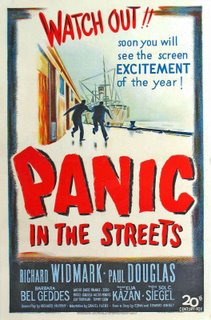
Panic In The Streets (1950)

A public domain copy of this classic noir from Elia Kazan is available from the Internet Archive. The blurb on the site is worth quoting in full:

One night in the New Orleans slums, vicious hoodlum Blackie (Jack Palance) and his friends kill an illegal immigrant who won too much in a card game. Next morning, Dr. Clint Reed (Richard Widmark-this time not seen pushing little old ladies in wheelchairs down the stairs) of the Public Health Service confirms the dead man had pneumonic plague. To prevent a catastrophic epidemic, Clint must find and inoculate the killers and their associates, with the reluctant aid of police captain Tom Warren (Paul Douglas), despite official skepticism, and in total secrecy, lest panic empty the city. Can a doctor turn detective? He has 48 hours to try. Spellbinding

The Maltese Falcon (1941): Love in Noir

The Maltese Falcon (1941)

The Maltese Falcon: others may argue about its place in the film noir canon, but none can question its greatness.

Sam Spade is fully the creation of Dashiell Hammett and his book informs the film totally. What John Huston and his ensemble cast did was to make the story forever theirs. Having seen the movie, one cannot imagine any of the characters as other than the players that portray them. This picture is a defining moment in film history. The Maltese Falcon takes us beyond what is on the screen into a nether world of desparate love, existential angst, mystery, and the pain of irredeemable loss.

Spade is the quintessential noir protagonist: a loner on the edge of polite society, sorely tempted to transgress but declines and is neither saved nor redeemed.

Brigid will never make up the years she will lose in prison, and Sam will never recover from the necessary betrayal of their love. For Sam and Brigid are truly lovers. Sam was not seduced. Brigid is not a femme-fatale: she manipulates Sam, but never seeks to have him act as her surrogate. Together they discover the desperate emptiness of their lives. She true to her nature can’t comprehend how he can send her down if he loves her. He can’t fathom her lying while knowing she loves him.

The famous ad-lib by Bogart on the leaden black bird at the end says it all … the stuff that dreams are made of.

Sam Spade Radio Capers

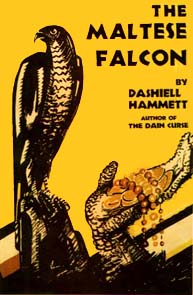
The Maltese Falcon - Book Cover

In the 40s and 50s, The Adventures of Sam Spade, was a popular US radio show based on stories written by Dashiell Hammett, featuring Howard Duff in the lead. But the story Blue Moon features the the chemistry of Bogie and Bacall!

The Free Information Society has five of the original broadcasts available for free download:

  • Blue Moon: with Humphrey Bogart and Lauren Bacall.
  • Missing Newshank Caper
  • Over My Dead Body Caper
  • Stopped Watch Caper
  • Terrified Turkey Caper

The Thrilling Detective site has more information on the shows on it’s excellent Sam Spade page.

The Glass Key: Mercury Radio Production (1939)

Orson Welles

Thanks to a pointer to the Mercury Theater on the Air site from Lloydville of mardecortesbaja.com.

Amongst many broadcasts from this famous Orson Welles radio-play project, is a 1939 radio adaptation of Dashiell Hammett’s novel, The Glass Key, which was adapted for the screen in 1935 and again in 1942.

You can download an MP3 of the original broadcast from the Mercury Theater on the Air site.

In the Valley of Elah (2007): Responsibility and Chaos

What is Film Noir? There as many answers as there are noir movies.

I consider a film for posting to FilmsNoir.Net only some time after a recent viewing. I want the film to return to my memory on its own terms, and when this happens, it is more often than not, a response to what I describe as the picture’s noir sensibility. This sensibility must have a redemptive focus for me to value a film, whether redemption is achieved or not. This is what the great films noir have in common: a profoundly and deeply human response to the chaos and random contingency at the edge of existence.

It is with this in mind that I am posting on the recent release: In The Valley of Elah (2007). On the surface it is a police procedural framed against US soldiers returning from the Iraq war. On a deeper level it is an exploration of contingencies and responsibility.

Three crimes: the heinous unnecessary invasion of Iraq, the brutal killing of a child by a US humvee on the streets of Baghdad, and the gruesome murder of a returning soldier on the outskirts of an American army town, bring chaos to the life of a father, who no longer understands his son or his country and its institutions. Everything including the American flag is upside-down.

This film is the true heritage of film noir, not banal and unredeemably violent films such as No Country For Old Men.

In The Valley of Elah (2007)

The Air I Breathe (2007): Noir Liberation

The Air I Breathe (2007)

James Ellory, in the documentary film, Film Noir: Bringing Darkness to Light (2006) says of film noir of the classic period: [film noir] exposited one great theme, and that great theme is “your fucked”.

Jieho Lee’s The Air I Breathe (2007), is a very unusual Hollywood movie that goes beyond genre and episodically explores dark and mystical motifs: memory, love, violence, criminality, ambition, alienation, urban ennui and existential angst, causality, serendipity, and even the butterfly effect cum six degrees of separation. The episodes are based on an ancient Chinese proverb that breaks life down into four elements:

happiness: clerk (Forest Whitaker) bets his life on a horse race
pleasure: criminal enforcer (Brendan Fraser) sees the future
sorrow: pop star (Sarah Michelle Gellar) is caught in the ultra-violent web of crime boss “Fingers” (Andy Garcia)
love: a doctor (Kevin Bacon) must save the life of his lost love (Julie Delpy).

The film opens with happiness. A timid clerk in an office job who has always done the right thing is lonely and unhappy, desperately sees money as a way out to happiness (sound familiar?). After waking that morning from a nightmare to see a butterfly fly into his bedroom, he surreptitiously overhears office colleagues who are betting on a fixed horse race, with “Butterfly” to win. He places a $50,000 off-course bet and (yeah) the horse takes a dive and he does his dough. He is now in hock to Fingers, and has two weeks to make good his bet, before he starts losing his fingers. Fingers’ stand-over man gives him a gun on a “home visit” as some kind of solution.

The Air I Breathe (2007)

The clerk’s voice-over in the next scene begins: “Sometimes being totally fucked can be a liberating experience…” and then he lays out his plan for a bank heist, which has nowhere to go but wrong, and he dies in a hail of police bullets on the roof of an office building, but not before he throws the bag with the bank money over the side of the building, laughing deeply and profoundly in a dervish-er whirl of liberation…

There is an interesting related post by Lloydville on his mardecortesbaja.com blog: The Message Of Film Noir.

Union Station (1950): On Ice in the Train Shed

Union Station (1950)

Police manhunt for a kidnapped blind girl

Union Station (1950) directed byRudolph Mate is a period crime action movie set in Chicago that marks the transition from the classic period of film noir to the 50’s police procedural. While the picture is weakened by a conventional plot and a fairly laconic performance from William Holden as the railway cop, the location shooting (actually on the streets of LA) has a “naked city” feel and the action played out in Union Station is made interesting by certain noirish episodes.

A truly bungled surveillance op on an elevated railway line climaxes in a cattle stockyard where a chase and shootout leaves one of the hoods trampled to death after a stampede set-off by the gun-fire.

Union Station (1950) Union Station (1950)

A second hood spills the beans to the cops after he is taken down to the train shed to be worked-over and threatened with decapitation by steam train.

Union Station (1950) Union Station (1950)

The final chase and shootout in the labyrinthine power plant and service tunnels under Union Station is a classic, with superior direction and camera work.

Union Station (1950) Union Station (1950)

But the really impressive scene is when the cops arrive late at night on a deserted street outside a suspected hideout in a sleazy boarding house. It flows elegantly and has a strongly surreal quality without musical scoring.

Union Station (1950) Union Station (1950)Union Station (1950) Union Station (1950)

[piclens-lite-link]

The Prowler (1951): The Dark Side of the American Dream

The Prowler (1951)

Homme-fatale, Van Heflin, seduces lonely housewife, Evelyn Keyes, and murders her husband for the woman and the inheritance. The dirty underbelly of the American dream exposed to scourging desert winds.

The screenplay of Joseph Losey’s The Prowler (1951 – Horizon Pictures), was written by blacklisted screenwriter Dalton Trumbo, who also wrote another film noir script, Gun Crazy (1950). The Prowler is a sordid tale of passion, entrapment, and betrayal. Suburbia cast as a dark nightmare, where the predator comes disguised as protector. Bravura performances from the two leads carry a flawed script forward to a classic denouement at the base of a tailings dump on the dusty outskirts of a ghost-town.  Losey’s direction is unforgiving. Each squalid act of the protagonist is forecast in tight claustrophobic framing that is almost suffocating. Finally justice propels the action out into the desert.

The Prowler (1951) The Prowler (1951)

The Prowler (1951) The Prowler (1951)

The Prowler (1951) The Prowler (1951)

Noir Motifs and the Allure of Noir: The Lure of Certain Doom

Where Danger Lives

Jim Ridley of the Nashville Scene has written an excellent article, The Naked City, on the film noir genre and its allure, while reporting on the upcoming Nashville Film Noir Festival:

… real-life ruin with plausibly grubby motives… all angular shadows and slashing black-and-white… [protagonists] either slaves to temptation and lust, or tarnished knights honor-bound to clean up their mess. Hard-edged in style, hard-headed in content and [with] their resolute lack of sentiment, these movies were existentialist to the core. You made a bad choice, and you lived—or more often, died—by the consequences.
[Dark Soul] …sums up the allure of noir: the chance to experience, vicariously, how it would feel to act on the impulses we’ve been wisely conditioned to ignore.

Clash By Night (1952): Love… because we’re bored

Clash By Night (1952)
Cheating wife faces the music…

Clash by Night (1952) from Fritz Lang transcends film noir in a neo-realist melodrama that turns the film noir motif upside down and inside out. Sexual abandon and existential entitlement are put on trial and found empty.

Lang and veteran noir photographer, Nicholas Musuraca, team with Paul Douglas, and noir regulars, Barbara Stanwyck and Robert Ryan, in a deep story grounded in simple lives and normal passions, from a screenplay by Alfred Hayes and David Dortot, based on a play by Clifford Odets. A very young Marilyn Monroe is also well-cast.

The realist feel is established in the long opening sequence which simply and eloquently documents the start of the working day in the fishing community of Monterey, but only after the impending drama is telegraphed in the opening scene with waves crashing on coastal rocks at night accompanied by a portentous and strongly emotive score from Roy Webb.

On one level, the picture is pure melodrama: sexual frustration, infidelity, deception, selfishness, and betrayal. On a deeper level it is about the possibility of redemption and the power of forgiveness. A female protagonist confronts the disastrous consequences of the false choices she has made. A tour-de-force performance from Barbara Stanwyck, who in her role as Mae, delivers a profound critique:

Earl Pfieffer (Robert Ryan)
Mae Doyle (Barbara Stanwyck)

Earl: You feel guilty? That’s the way they want you to feel.

Mae: They?

Earl: The world! All the people who haven’t got guts enough to do what they want to do…

Mae: All my life I’ve walked away from things.

Earl: And what’s stopping you now? Responsibility? … I told you somebody’s throat has to be cut!

Mae:
But it’s never our’s, is it Earl? It’s always someone else’s – why?

Earl: Because they’re soft.

Mae: And we’re tough, we’re hard? And if someone suffers because of us, that’s just too bad? That’s the way life is? Huh. How many times have I told myself that. Nothing counted but me. My disappointments, my unhappiness… I thought I was being honest. I thought I wasn’t lying, but I was. I said to the world, this is what I am, take me or leave me, so that it was always on my terms that they had to accept me. But it was a trick. Can’t you see Earl? It was a trick to avoid the responsibility of belonging to someone else.

Earl: What are you giving me? An hour ago you were in love.

Mae: I don’t know what the word means anymore. Not the way we use it.

Earl: You knew yesterday…

Mae: Love because we’re lonely, love because were frightened, love because we’re bored.

Clash By Night (1952): Love… because we’re bored